Cold call connect rates: The benchmark data for 2026
By Jamila Parker · · 10 min read

Cold call benchmarks vary by list quality, geography and definition. Here is a careful 2026 view of answer, connect and success rates.
Key takeaways
- Cold call connect rates 2026 should be compared only when teams use the same definition for answered calls, intended-person connects, conversations and successful outcomes.
- Verified contact data, direct-dial accuracy, caller-ID reputation, market, seniority and calling time can change cold call answer rates more than raw dialing volume.
- A useful cold calling benchmark separates answer rate from connect rate and success rate instead of treating all three as the same KPI.
- Build an internal benchmark from several weeks of consistent sales call data, then compare performance by list source, persona, geography, campaign and rep.
- Use cold call connect rate benchmarks diagnostically: low answers suggest a reachability problem, while healthy connects with weak meetings usually point to targeting or conversation quality.
Cold call connect rates 2026 are useful only when the underlying definitions are clear. One sales team may call every answered phone a connect, while another counts a connect only when the intended prospect answers. A third team may report success rate as meetings booked rather than conversations started. Those differences can make two benchmark reports look contradictory even when both are technically correct.
For sales leaders, the practical question is not whether there is one universal cold calling benchmark. It is whether your team can measure the full path from dial to answer, from answer to intended-person connect, from connect to meaningful conversation, and from conversation to a positive sales outcome. That funnel makes cold call performance easier to diagnose and gives 2026 benchmark data a useful context.
The current benchmark signals in this draft show why precision matters. Cognism's 2026 State of Outbound reports a 13.3% answered rate for SDR cold calls using verified contact data and 14.4% for AEs calling warm contacts. Its State of Cold Calling report cites an industry cold-call success rate of 2.7% and Cognism's own success rate of 11.3%. Because these figures use different populations and definitions, they should be treated as directional evidence rather than universal targets.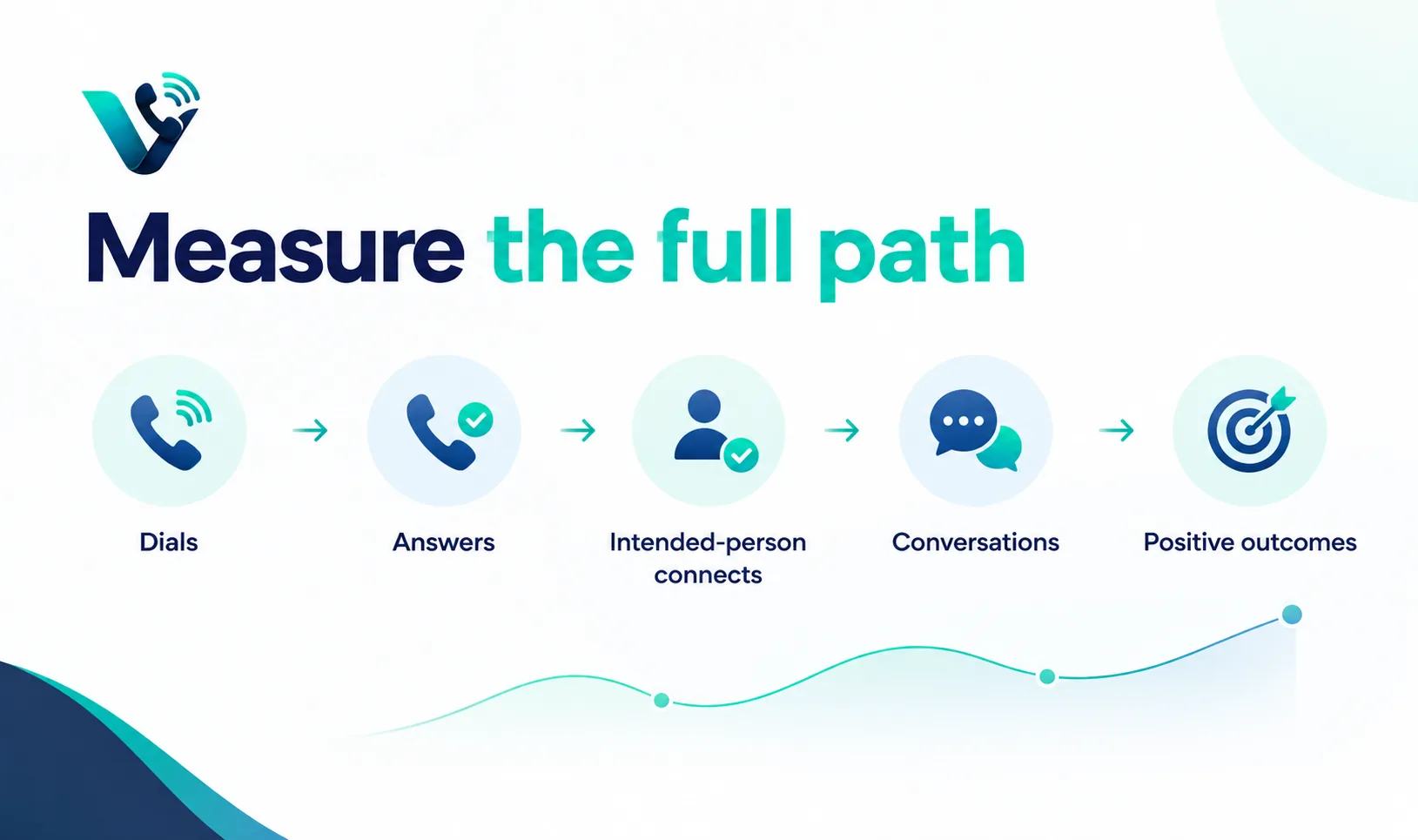
Start with definitions
The phrase cold call connect rate sounds simple, but sales teams often calculate it differently. Before comparing cold call connect rates 2026, write down exactly what your CRM or dialer counts in the numerator and denominator. If the definition changes between teams, campaigns or reports, the benchmark becomes unreliable.
A clean measurement model separates at least four stages. Answer rate measures calls picked up by any human or endpoint according to your chosen rule. Intended-person connect rate measures calls where the rep reaches the target contact. Meaningful conversation rate measures connects that progress beyond a brief rejection or wrong-person exchange. Success rate measures the sales outcome your team actually cares about, such as a meeting, qualified opportunity or agreed next step.
For example, if 1,000 dials produce 130 answered calls, 85 intended-person connects, 40 meaningful conversations and 8 booked meetings, each stage tells a different story. Collapsing all of that into one percentage hides where performance is being lost.
Use the same definitions in dashboards, manager reviews and benchmark comparisons. That small discipline makes cold call statistics much more useful because the team is no longer comparing unlike metrics under the same label.
2026 benchmark signals
The 2026 cold calling benchmarks in this draft provide useful reference points, but they should be read carefully. Cognism's State of Outbound reports a 13.3% answered rate for SDR cold calls using verified contact data, compared with 14.4% for AEs calling warm contacts. Its State of Cold Calling report cites an industry cold-call success rate of 2.7% and Cognism's own success rate of 11.3%.
Those numbers are not directly interchangeable. Answered rate describes reachability, while success rate describes a later business outcome. Warm contacts are also not the same population as cold prospects. A higher or lower number can reflect list quality, relationship strength, market conditions or methodology rather than rep skill alone.
The safest way to use cold call connect rates 2026 is as a range of signals. If your answer rate is dramatically lower than a comparable benchmark, investigate the data and calling setup. If your answer rate is healthy but your meeting rate is weak, the problem probably sits later in the funnel.
Avoid turning published benchmark data into a quota. A benchmark can tell you where to investigate; it cannot tell you what every rep in every industry should achieve.
Why your connect rate can differ
Cold call connect rates vary because reachability is influenced by the data, the market and the calling environment before the rep even says hello. List quality is usually one of the biggest variables. Verified direct dials, current job titles and accurate company information reduce attempts wasted on invalid or irrelevant records.
Seniority also matters. Executives, managers and individual contributors may have very different call-screening behaviour. Industry and geography can change the likelihood that a prospect answers an unknown business number. Local calling norms, mobile usage and working hours all affect cold call answer rates.
Caller-ID reputation can create another hidden constraint. If a business number is repeatedly marked as spam or appears unfamiliar to the market being called, answer rates can decline even when the contact list is accurate. Monitor patterns by outbound number rather than assuming every drop in connect rate comes from the lead list.
Calling time should be analysed by segment rather than by one universal "best time." A timing window that works for small-business owners may perform poorly for enterprise buyers. Compare answer rate and intended-person connect rate by hour and day, then look for repeatable patterns within your own audience.
Brand recognition and prior touchpoints also influence performance. A prospect who has seen an email, event invitation or product content may answer a call differently from someone encountering the company for the first time. Keep cold and warm datasets separate when building benchmarks.
How to calculate cold call connect rates
Use simple formulas and keep them consistent. Answer rate can be calculated as answered calls divided by total valid dials. Intended-person connect rate can be calculated as target contacts reached divided by total valid dials. Conversation rate can be calculated as meaningful conversations divided by intended-person connects. Success rate can be calculated as the chosen positive outcome divided by the stage your team considers appropriate.
The denominator matters. If you include invalid numbers, duplicate attempts or technical failures in total dials, the apparent connect rate will fall. If you remove too many failed attempts, the rate can look artificially strong. Decide what counts as a valid dial and document the rule.
For manager reporting, show counts beside percentages. A 20% connect rate based on 20 calls is not as stable as a 12% connect rate based on 2,000 calls. Volume gives the percentage context and helps prevent overreaction to small samples.
When comparing reps, make sure they are calling similar lists. A rep assigned warm accounts should not be ranked directly against a rep working a completely cold, low-recognition segment without adjusting for the different opportunity set.
Build your own benchmark
Your own data is usually more actionable than an external cold calling benchmark. Track the same funnel for several weeks: Valid dials, unique prospects attempted, answered calls, intended-person connects, meaningful conversations, positive dispositions, meetings booked and opportunities created.
Break the results down by list source, persona, seniority, industry, geography, campaign, rep and time of day. Blended cold call connect rates can hide a weak list or a strong niche. Segmentation shows where the team is actually gaining or losing reach.
Use a rolling period long enough to smooth out random variation. A single day can be distorted by holidays, events, outages or a small sample. A multi-week baseline makes changes in cold call answer rate easier to trust.
Record major operational changes beside the data. If you switch data providers, introduce a new outbound number, change the target market or alter the calling schedule, mark the date. Otherwise a genuine process change may be mistaken for normal fluctuation.
Once the baseline is stable, set improvement targets at the stage with the clearest opportunity. A team with weak reachability should work on contact data and caller identity before trying to optimise meeting conversion. A team with strong connects but few positive outcomes should focus on targeting, opening and conversation quality.
Use benchmarks diagnostically
The biggest value of cold call connect rate benchmarks is diagnosis. Each stage of the funnel points toward a different class of problem, which means managers can avoid prescribing more activity when the real issue sits elsewhere.
A weak answer rate can indicate poor contact data, low direct-dial coverage, bad calling windows or caller-ID reputation. A healthy answer rate with a weak intended-person connect rate can point to shared numbers, reception barriers or incorrect contact records. Strong connects with weak meaningful conversations can indicate targeting or opening problems.
If conversations are healthy but meetings remain low, review qualification, value proposition, objection handling and next-step clarity. If meetings are booked but few are held, the issue has moved beyond cold call connect rates into confirmation, qualification or scheduling discipline.
This funnel prevents a common management mistake: Asking reps to make more calls when the existing calls are failing for a reason volume cannot fix. More dials amplify a weak list just as easily as they amplify a strong one.
Use external 2026 cold call benchmarks to identify unusual performance, then use your own funnel data to decide what to change.
2026 takeaway
The practical 2026 takeaway is precision over blind volume. Recent benchmark signals in this draft support the idea that verified contact data and better-targeted phone workflows can reduce wasted attempts, but they do not guarantee a specific cold call connect rate for every team.
For sales managers, the strongest benchmark is a well-defined internal funnel. Know your answer rate, intended-person connect rate, conversation rate, positive-disposition rate, meeting rate and opportunity rate. Compare those metrics by segment and watch how they change when you improve data, timing or messaging.
For reps, the lesson is similar. A day with fewer dials can still be more productive if the contact data is stronger and more conversations reach the right buyers. Activity matters, but useful contact is what creates the opportunity to sell.
Cold call connect rates 2026 should therefore be treated as a diagnostic benchmark, not a universal scorecard. Use published data for context, use your own sales data for decisions, and keep the definitions stable enough that month-to-month improvement actually means something.
Common mistakes when comparing cold call benchmarks
- Comparing answer rate with success rate. These metrics sit at different stages of the funnel and should never be treated as interchangeable.
- Using a benchmark from a different audience. Warm-account calling, inbound follow-up and fully cold prospecting can produce very different results.
- Ignoring list quality. A poor contact database can make a strong rep look weak because the rep spends more time reaching invalid or irrelevant numbers.
- Ranking reps without segment context. Different territories, industries and seniority levels can create different baseline connect rates.
- Reacting to tiny samples. A few calls can move the percentage dramatically, so benchmark decisions should use enough volume to be stable.
- Optimising only for answer rate. A higher answer rate is valuable only if it leads to more useful conversations and sales outcomes.
- Changing definitions mid-period. If the CRM starts counting voicemail systems or gatekeepers differently, historical comparisons need to be recalculated or clearly separated.
Try this on your own numbers
Local numbers in 118 countries, AI call notes and one shared inbox. Live the same day, no contract.
How to connect this topic to Votelly
For Votelly, this topic fits naturally within sales calling analytics and outbound workflow design. The educational message is that a business calling platform provides the call activity layer, while the sales process defines which cold call metrics matter and how outcomes are recorded. The primary brand destination in this draft remains www.votelly.com.
Keep detailed product claims tied to confirmed live Votelly capabilities. The article can still explain a strong measurement model without promising a specific dashboard: Capture call attempts consistently, distinguish answers from intended-person connects, record outcomes, and compare cold call connect rates by campaign and segment.
This article can also link naturally to Votelly content on power dialers, sales call activity metrics, call disposition codes and call recording for coaching. Together, those topics cover the path from making the call to measuring reach, recording the outcome and improving the conversation.
Frequently asked questions
- What is cold call connect rates 2026?
- Cold call connect rates 2026 refers to current benchmark data and measurement methods for how often outbound cold calls are answered or reach the intended prospect. The exact percentage depends heavily on the definition, target market and data quality.
- How should a small team start with cold call connect rates 2026?
- Start by defining answer rate, intended-person connect rate, meaningful conversation rate and success rate separately. Track those stages for several weeks before comparing your numbers with an external 2026 cold calling benchmark.
- What should be measured?
- Track valid dials, unique prospects, answered calls, intended-person connects, meaningful conversations, positive dispositions, meetings booked and opportunities created. Break the data down by list source, persona, geography, campaign and calling time.
- How often should the setup be reviewed?
- Review cold call connect rates weekly for operational issues and monthly for trends. Rebuild the benchmark whenever the team materially changes its data source, market, dialing method or definition of a connect.
- Can automation replace human ownership?
- Automation can capture call activity and calculate rates, but managers still need to define the metrics correctly, investigate unusual changes and decide whether the problem is data, timing, targeting or conversation quality.
- How can Votelly fit into the workflow?
- Votelly can be positioned as part of the business-calling layer used to generate and manage outbound call activity where the live product supports the required workflow. Keep detailed feature claims tied to verified Votelly capabilities.