SIP Trunking Explained, and When You Should Skip It
By Jamila Parker · · 6 min read

SIP trunking connects a phone system to carrier voice service over IP. It can modernise an existing PBX, but cloud phone services may be simpler when you do not need to preserve that infrastructure.
Key takeaways
- A SIP trunk replaces or complements traditional carrier trunks by carrying voice signalling/media over IP.
- SIP trunking is useful when you want to keep a PBX but modernise PSTN connectivity or consolidate carriers.
- An SBC often sits at the boundary for security, interoperability and routing.
- Skip SIP trunking if maintaining the PBX creates more cost and complexity than moving users to a cloud phone service.
What is SIP trunking?
SIP trunking is a way to connect a business phone system to a telecom provider using IP networking instead of traditional fixed circuits such as PRI. SIP - Session Initiation Protocol - handles signalling that establishes, changes and ends communications sessions. The voice media itself is commonly carried with RTP.
Think of the trunk as the connection between your PBX and the outside telephone world. With an on-premise or hosted PBX, the SIP provider supplies public-number connectivity and routes calls to and from the PSTN. Unlike a physical trunk with a fixed bundle of channels, modern SIP services can offer more flexible capacity and geographic reach.
A typical SIP trunk architecture
A common design is: IP phones or softphones connect to the PBX; the PBX sends SIP signalling toward a session border controller; the SBC protects and normalises the boundary; the SIP trunk provider carries calls to the PSTN. Some deployments combine the SBC and PBX functions, and cloud SBC services also exist.
The SBC can handle tasks such as topology hiding, encryption, codec/interoperability issues, policy, NAT traversal and routing. It should not be treated as an optional mystery box: configuration quality affects security and call reliability.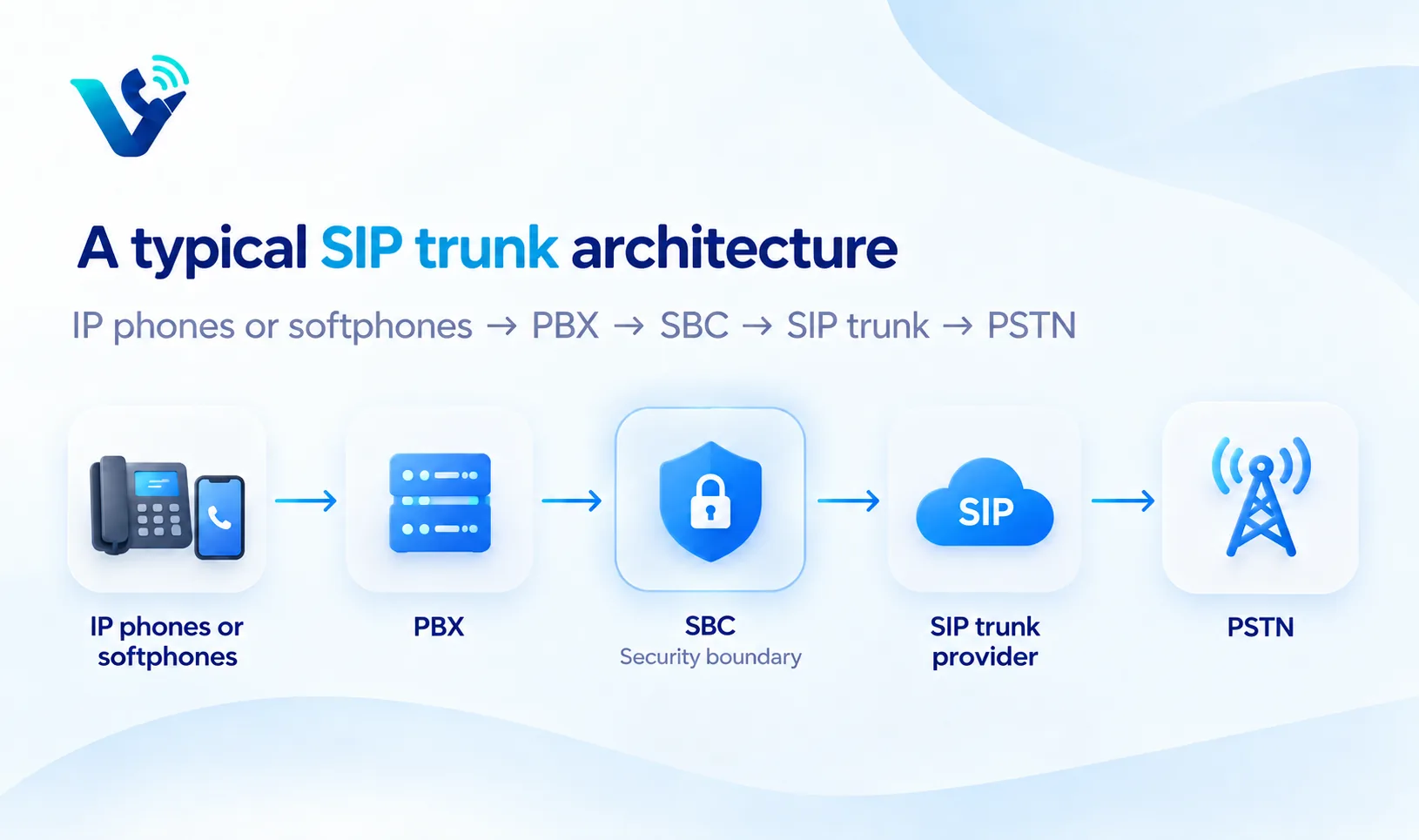
Where SIP trunking saves money or complexity
SIP trunking can be attractive when a company has a PBX that still works well and wants to retire legacy PRI circuits, centralise trunks across sites, add numbers in new markets or gain more elastic calling capacity. It can also support hybrid migrations where the organisation keeps some existing telephony while moving other users to cloud services.
Usage-based pricing can be granular. For example, Twilio’s US Elastic SIP Trunking page currently lists local origination at $0.0034 per minute and termination starting at $0.0011, with phone numbers and optional services priced separately. A traditional carrier quote may use different bundles, channels or commitments.
When you should skip SIP trunking
Skip it when the only reason to keep the PBX is inertia. If the PBX requires scarce expertise, hardware support, remote-access workarounds and a separate collaboration stack, adding a modern SIP trunk improves the carrier edge but does not remove the old operational burden. A cloud phone platform may eliminate more infrastructure and provide desktop/mobile clients, routing and analytics as a service.
Also skip a do-it-yourself trunk if nobody owns telecom security, fraud prevention and SBC operations. A managed service or complete cloud phone product may be safer for a small IT team.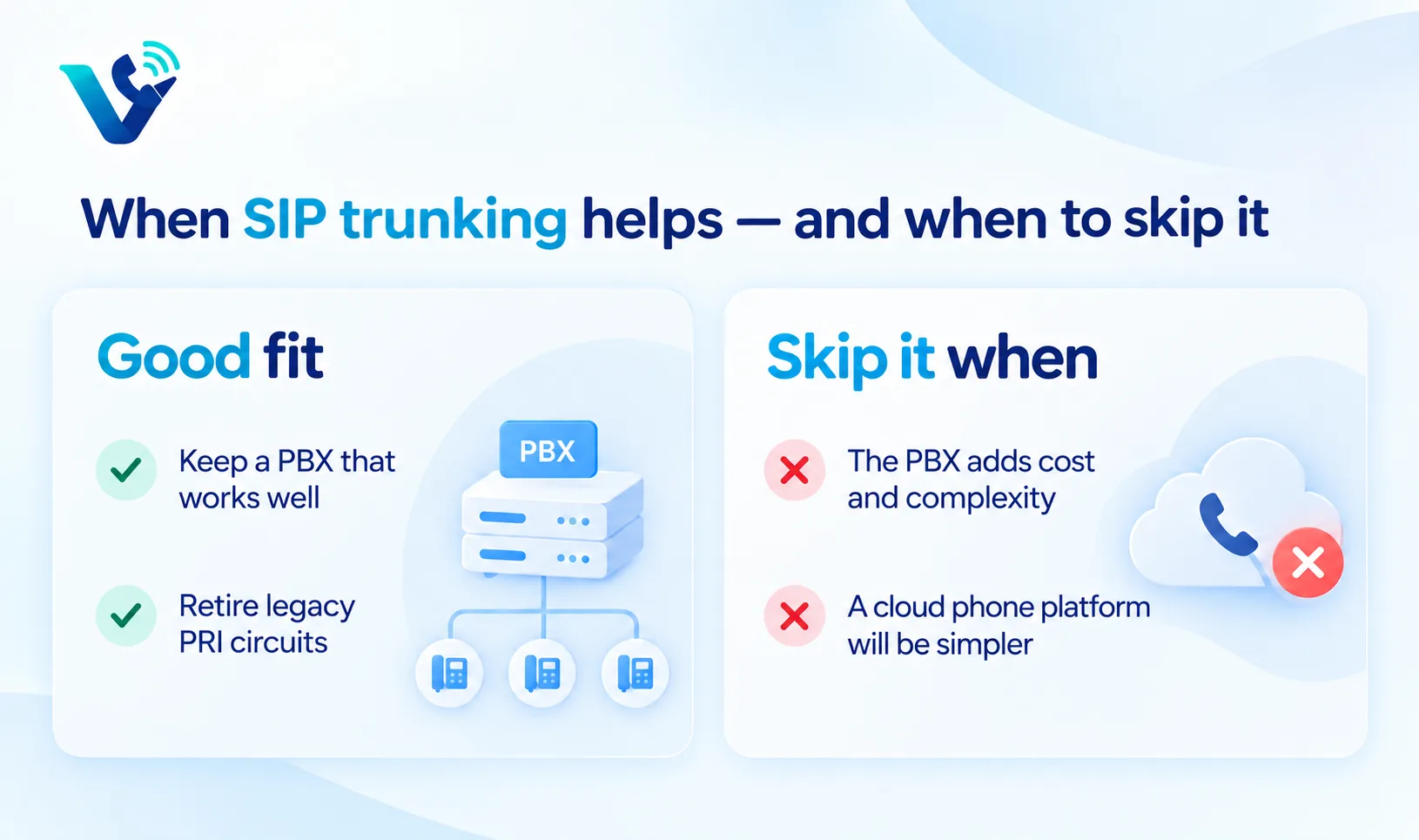
Capacity, codecs and quality still matter
A SIP trunk travels over IP, so network design matters. Concurrent calls consume bandwidth and can be affected by packet loss, latency and jitter. Codecs change the bandwidth per call; G.711 provides high-quality audio at a higher bit rate than compressed codecs. Firewalls and NAT must handle media correctly, and quality-of-service policies can protect voice on busy private networks.
Do a concurrency estimate from busy-hour call data rather than buying capacity from total employee count. Then include failover paths so one internet link or carrier route does not become a single point of failure.
SIP trunk migration checklist
- Inventory DIDs, toll-free numbers, fax/analogue devices and emergency locations.
- Confirm codec, encryption, DTMF and caller-ID requirements.
- Size concurrent sessions from real busy-hour traffic.
- Choose and harden the SBC or managed edge.
- Test inbound/outbound, transfer, hold, voicemail, fax and emergency calling.
- Port numbers in controlled batches and keep rollback routing available.
What this means when choosing a business phone provider
Translate the technical concept into an operational requirement. Ask the provider to show the setting or workflow in a live tenant, explain which plan includes it, and identify any country, number, device or network limitations. The same technical term can hide very different implementations. A simple queue, for example, may be enough for a five-person team while a contact centre needs skills, priority, callbacks, supervisor controls and detailed reporting. Document the outcome you need before comparing terminology, then test it with a real call rather than accepting a diagram as proof.
Common implementation mistakes
Most failures happen around the edges: number porting is scheduled before routing is tested; remote users are not told how emergency location works; Wi-Fi is assumed to be fine because ordinary web browsing works; recording is enabled without a retention or consent policy; or an integration is purchased without checking what fields it actually writes back. Treat the phone system as an end-to-end service that includes carrier, network, devices, users, identity, data and support. A short pre-launch checklist and named owner for each area prevents far more problems than adding another advanced feature.
A simple validation checklist
Test inbound and outbound calls on desktop and mobile, hold and transfer, voicemail, caller ID, business hours, no-answer behaviour and at least one failure path. If the design uses queues or IVR, call every branch of the flow. If it uses an API or CRM, verify both successful write-back and what happens when the destination is unavailable. Review call-quality data during the pilot and ask users about audio, delay and ease of use. Finally, confirm support escalation and a rollback route before moving a high-value published number.
Try this on your own numbers
Local numbers in 118 countries, AI call notes and one shared inbox. Live the same day, no contract.
Security, privacy and policy checks
Confirm how the service encrypts signalling and media, how administrators control access, and how recordings, transcripts and messages are retained. If SSO or automated user provisioning matters, test the exact identity workflow rather than assuming an enterprise logo means it is included in your tier. Review recording-consent obligations and data-location requirements with the people responsible for privacy and compliance. Also ask how fraud, compromised credentials and unusual international calling are detected. Security features are most useful when administrators can understand and operate them without specialist intervention.
Support and day-two administration
The system still needs to be easy after the implementation team leaves. Have your own administrator add and remove a user, change a number, edit a holiday schedule, update routing, find a recording, export a call report and troubleshoot a poor-quality call. Then review support hours, severity definitions, escalation channels and any extra cost for faster response. For a business phone system, day-two administration and support are part of the product: a small monthly saving can disappear quickly if every routine change becomes a ticket or a consultant task.
Frequently asked questions
- What does SIP trunking replace?
- It commonly replaces or supplements traditional PSTN trunks such as PRI by connecting a PBX to a carrier over IP.
- Is SIP trunking the same as VoIP?
- No. SIP is a signalling protocol used by many VoIP systems. VoIP is the broader concept of carrying voice over IP networks.
- Do I need an SBC for SIP trunking?
- Many business deployments use an SBC for security, interoperability, NAT traversal and routing. Exact requirements depend on the PBX and provider.
- How many SIP channels do I need?
- Estimate maximum concurrent calls during busy periods, then add appropriate headroom and failover rather than buying one channel per employee.
- Is SIP trunking cheaper than cloud VoIP?
- It can be for organisations that keep an efficient PBX, but compare PBX maintenance, SBCs, IT labour and client software as well as carrier rates.
- When should I move straight to cloud phone?
- When preserving the PBX has little strategic value and a managed cloud platform can replace both call control and user applications more simply.