Twilio vs a Ready-Made Phone System: Build or Buy?
By Jamila Parker · · 6 min read

Twilio gives developers granular telephony building blocks; a ready-made phone system gives teams a finished workflow. Compare cost, control, engineering effort and time to value.
Key takeaways
- Twilio Programmable Voice and Elastic SIP Trunking are usage-based building blocks, not a finished business phone workspace.
- US Elastic SIP Trunking lists origination from $0.0034/min and termination from $0.0011/min, with numbers priced separately.
- Build when telephony is product differentiation; buy when the main goal is to equip staff with calling quickly.
- Engineering, monitoring, compliance, support and carrier edge cases are part of the build cost even when per-minute rates look tiny.
Build versus buy in one sentence
Twilio vs a ready-made phone system. Use Twilio when you need to design the calling experience itself. Buy a ready-made cloud phone system when you need employees to make and receive business calls with routing, history, administration and integrations already assembled.
Twilio exposes programmable voice, phone numbers and SIP connectivity as components. That is powerful because developers can decide exactly what happens when a call arrives, which data is fetched, what audio plays and where the call routes. A finished phone system makes those same decisions configurable through an admin interface. You trade code-level control for speed and a supported operating model.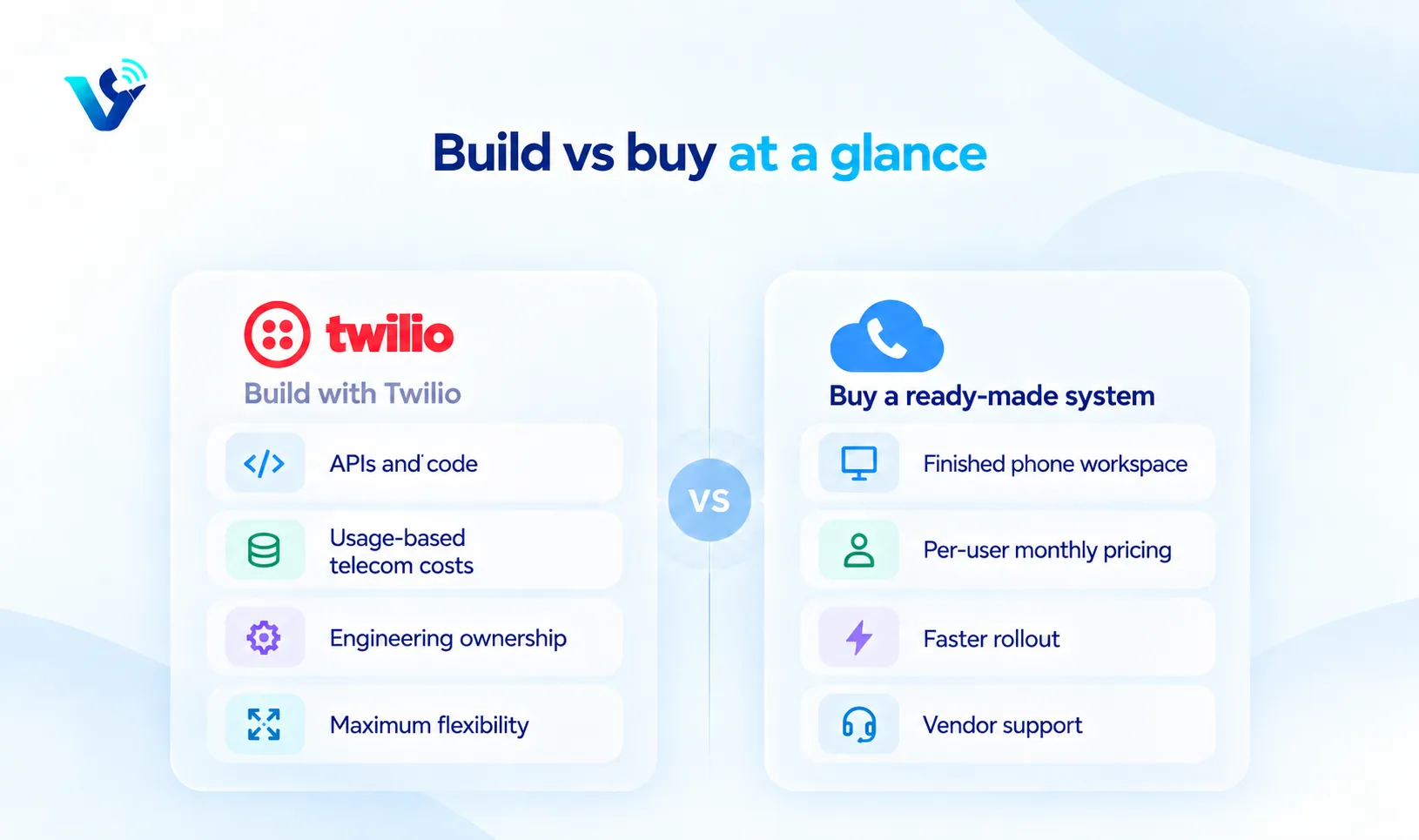
How the cost model differs
Cost area |
Twilio / build |
Ready-made phone system |
|
Licensing |
Often usage-based APIs rather than user seats |
Usually per-user/per-month |
|
Voice usage |
Per-minute and route-specific |
May include domestic minutes or bundles |
|
Numbers |
Monthly number rental |
Often one number included, extras charged |
|
Engineering |
Design, code, QA, on-call ownership |
Configuration and integrations |
|
Operations |
You own logs, monitoring, failure handling |
Vendor provides admin/support layer |
|
Special workflows |
Almost unlimited flexibility |
Limited to product/API capabilities |
Twilio pricing can look dramatically cheaper - until you add the product
In the United States, Twilio Elastic SIP Trunking currently lists termination starting at $0.0011 per minute and local origination at $0.0034, while a local number is $1.15 per month. Programmable Voice has its own per-minute rates and optional features. At scale, those unit rates can be attractive.
But a business phone system is more than a carrier minute. You need user identity, call controls, queues, voicemail, business hours, recordings, permissions, search, mobile and desktop clients, number administration, reporting, integrations, audit trails, monitoring and support. If developers build those pieces, their salary and opportunity cost belong in the comparison.
When building with Twilio is the right call
Build when the telephone interaction is part of your product or competitive advantage. Examples include marketplaces that mask caller identities, healthcare workflows that connect calls to appointment logic, logistics systems that trigger calls from live events, AI voice applications, or highly customised routing driven by proprietary data. In those cases, forcing the workflow into a generic phone UI can be more expensive than building.
Twilio is also a strong infrastructure layer for companies that already have telecom engineering and want to own the customer experience. Its APIs and Elastic SIP Trunking let you mix carrier connectivity with application logic rather than adopting an entire employee phone suite.
When buying wins
Buy when the goal is operational: give ten, fifty or five hundred employees a working phone number, transfer calls, run an IVR, track missed calls, record where permitted and integrate with common business tools. A ready-made platform can be live in days because it already includes clients, user management, reporting and support.
Buying also reduces the “unknown unknowns” of telephony. Number porting, fraud controls, emergency calling, audio edge cases, retry behaviour and carrier differences appear only after a system is used in the real world. A product vendor has usually absorbed much of that complexity into the service.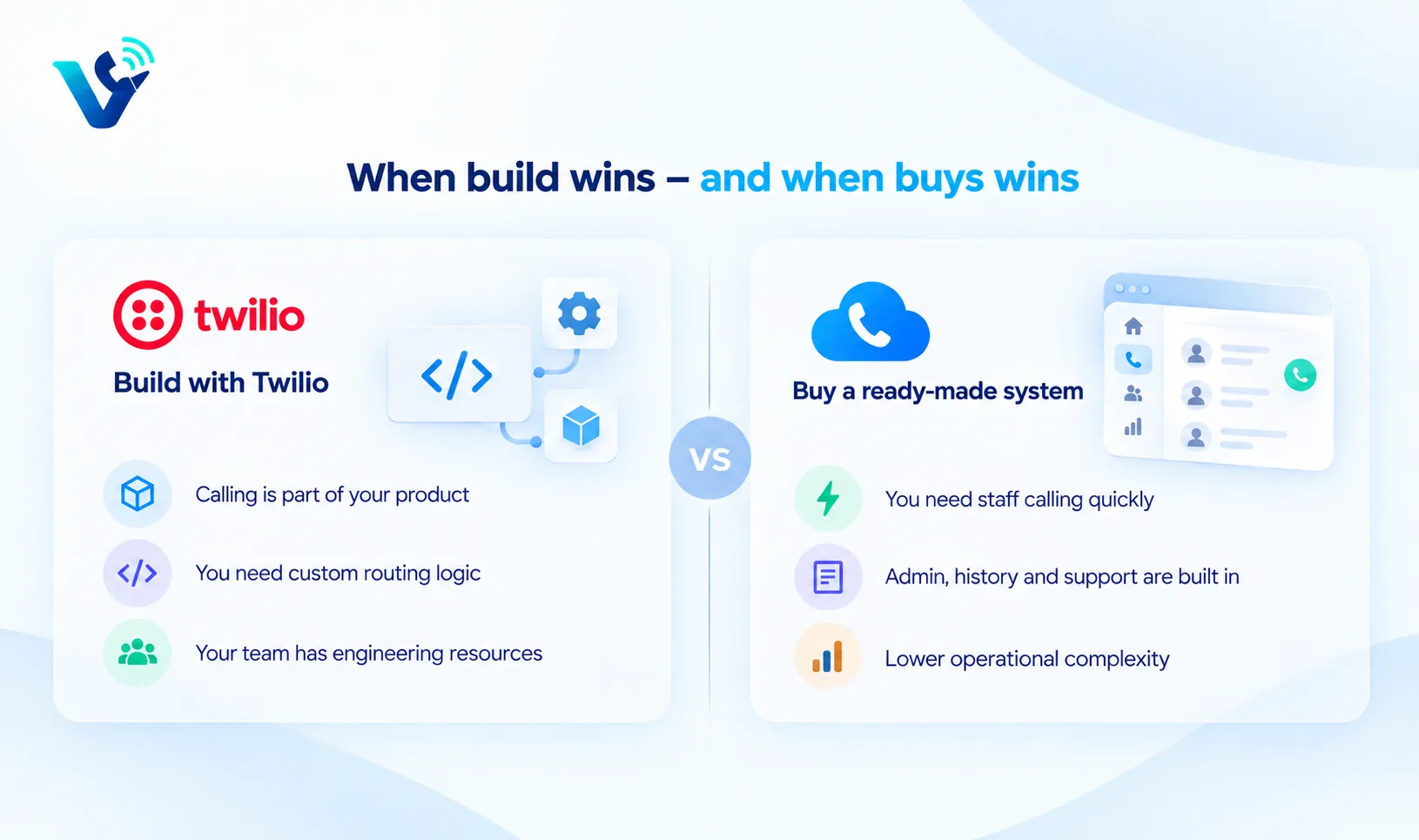
A simple economic test
Estimate engineering hours for the first release, then add ongoing maintenance, on-call support and feature requests for three years. Compare that with the subscription cost of a ready-made platform over the same period. If the build is still justified because it creates a differentiated customer experience or meaningful cost advantage at your volume, Twilio may be the right foundation. If the analysis depends on pretending engineering is free, buy the phone system.
A practical proof-of-concept before you sign
Run a short proof-of-concept instead of choosing from feature grids. Pick three real call journeys: a new sales enquiry, an existing customer needing help, and an after-hours or no-answer case. Configure the same journeys in every shortlisted system and let the people who will actually answer calls use them. Measure answer time, transfer friction, missed-call recovery, mobile reliability, search, reporting and how much administrator work is needed to change a route. Also test a deliberately awkward case such as a transfer to an unavailable user or an integration outage. The best system is usually the one that stays understandable when something goes wrong, not the one with the longest feature page.
Put the hidden costs into one quote
Ask every vendor to price the identical scenario: the same user count, countries, telephone-number inventory, domestic and international usage, recording period, AI requirements, messaging volume and support level. Request separate line items for licences, numbers, minutes, toll-free usage, international calls, messaging registration, AI, storage, implementation, premium support, taxes and regulatory pass-through fees. If a plan is described as unlimited, read the fair-use conditions. If the discount depends on an annual or multi-year term, show the undiscounted renewal position as well. A comparable total-cost worksheet prevents a cheap entry tier from hiding the cost of the tier you actually need.
Migration and exit planning
Before committing, document how numbers are ported in, how long common ports take, what happens during a failed port and how numbers can be ported out later. Export requirements matter too: recordings, transcripts, call logs, messages, contacts and analytics should not become trapped simply because the subscription ends. For a migration, pilot one low-risk number or small team, validate inbound and outbound caller ID, emergency-calling obligations, business hours, voicemail, transfers and integrations, then move larger number blocks in controlled waves. Keeping the old service active until the new routing is proven is usually cheaper than recovering from an aggressive all-at-once cutover.
Try this on your own numbers
Local numbers in 118 countries, AI call notes and one shared inbox. Live the same day, no contract.
Security, privacy and policy checks
Confirm how the service encrypts signalling and media, how administrators control access, and how recordings, transcripts and messages are retained. If SSO or automated user provisioning matters, test the exact identity workflow rather than assuming an enterprise logo means it is included in your tier. Review recording-consent obligations and data-location requirements with the people responsible for privacy and compliance. Also ask how fraud, compromised credentials and unusual international calling are detected. Security features are most useful when administrators can understand and operate them without specialist intervention.
Support and day-two administration
The system still needs to be easy after the implementation team leaves. Have your own administrator add and remove a user, change a number, edit a holiday schedule, update routing, find a recording, export a call report and troubleshoot a poor-quality call. Then review support hours, severity definitions, escalation channels and any extra cost for faster response. For a business phone system, day-two administration and support are part of the product: a small monthly saving can disappear quickly if every routine change becomes a ticket or a consultant task.
Frequently asked questions
- Is Twilio a complete business phone system?
- Twilio provides communications APIs, phone numbers and SIP services. Companies can build a phone system on top, but it is not the same thing as buying a finished employee phone workspace.
- How much does Twilio SIP trunking cost?
- Rates vary by country and route. In the US, Twilio currently lists origination from $0.0034/min and termination from $0.0011/min, with phone numbers and optional features priced separately.
- Is Twilio cheaper than VoIP software?
- It can be at the raw telecom layer, but total ownership must include development, hosting, monitoring, support, compliance and maintenance.
- When should a startup build its own calling?
- When calling is core to the product experience or needs logic that off-the-shelf systems cannot economically provide.
- Can a ready-made system still use APIs?
- Yes. Many business phone platforms expose APIs and integrations, giving you a middle ground between no-code configuration and a full custom build.
- Can Twilio connect to an existing PBX?
- Yes. Elastic SIP Trunking is designed to connect SIP infrastructure to the PSTN, subject to configuration and regional availability.