Aircall Alternatives Compared on Price and Coverage
By Jamila Parker · · 6 min read

Aircall is polished, but its three-seat minimum and country-by-country telephony costs can change the maths. Compare alternatives by published entry price, routing, AI and real geographic coverage.
Key takeaways
- Aircall Essentials is $30 per licence monthly on annual billing and normally starts at three licences.
- Do not compare seat price alone: numbers, international minutes, AI, messaging and support can materially change total cost.
- Zoom Phone and Teams Phone stand out for multinational deployment options; Quo and Dialpad can be cheaper for smaller North American teams.
- Verify that the exact number type and portability you need are supported in every country before signing.
Aircall in 2026: the baseline
Aircall alternatives. Aircall remains a strong cloud phone choice for sales and support teams that want a clean interface, integrations and administration without running telecom infrastructure. Its published Essentials plan is $30 per licence per month when billed annually, with a three-licence minimum. Professional is $50 per licence and includes more advanced analytics, smart routing, queue callback and sales tooling. Aircall also says Professional now includes its standard AI Assist capabilities, including summaries, transcript search, sentiment, topics and action items.
That makes Aircall easy to understand, but not automatically inexpensive. A two-person startup effectively has to buy three seats on its normal Essentials plan, while an international team still needs to check country availability, number eligibility, outbound rates, SMS rules and portability. The best Aircall alternative therefore depends on where the team calls, not just how many people need logins.
Aircall alternatives at a glance
Option |
Published entry point |
Coverage / routing angle |
Best fit |
|
Aircall |
$30/user/mo annual; 3-user minimum |
250+ integrations; country-specific number coverage |
Integrated sales/support teams |
|
Dialpad |
$15/user/mo annual |
Flexible routing; local/international numbers vary by plan |
Teams wanting built-in AI notes |
|
Quo (formerly OpenPhone) |
$15/user/mo annual |
US/Canada-centred calling; international usage metered |
Small teams sharing numbers |
|
Zoom Phone |
Metered plans from $10/user/mo |
Local telephony in 49 countries; partner coverage beyond |
Distributed and multinational teams |
|
Microsoft Teams Phone |
$10/user/mo annual plus eligible Teams/M365 licence and PSTN |
Calling Plans, Operator Connect or Direct Routing |
Microsoft-centric organisations |
Price: compare the invoice, not the headline
For a 10-seat team, the difference between a $15 and $30 published seat price is already $1,800 per year before telephony extras. But the cheapest sticker price can lose once you add the features the team actually uses. Ask whether a phone number is included per user, whether domestic minutes are pooled or unlimited, how international calling is billed, whether AI summaries are bundled, and whether CRM integrations require a higher tier.
Aircall includes one local or toll-free number on Essentials and Professional and lists additional numbers at $6 per month. Dialpad Connect Standard is published at $15 per user monthly on annual billing, while Pro is $25. Quo lists Starter at $15 annually, Business at $23 and Scale at $35. Zoom says its metered phone plans start at $10 and North American unlimited plans at $15. Teams Phone Standard is a $10 add-on but still needs an eligible Teams/Microsoft 365 licence and a PSTN option.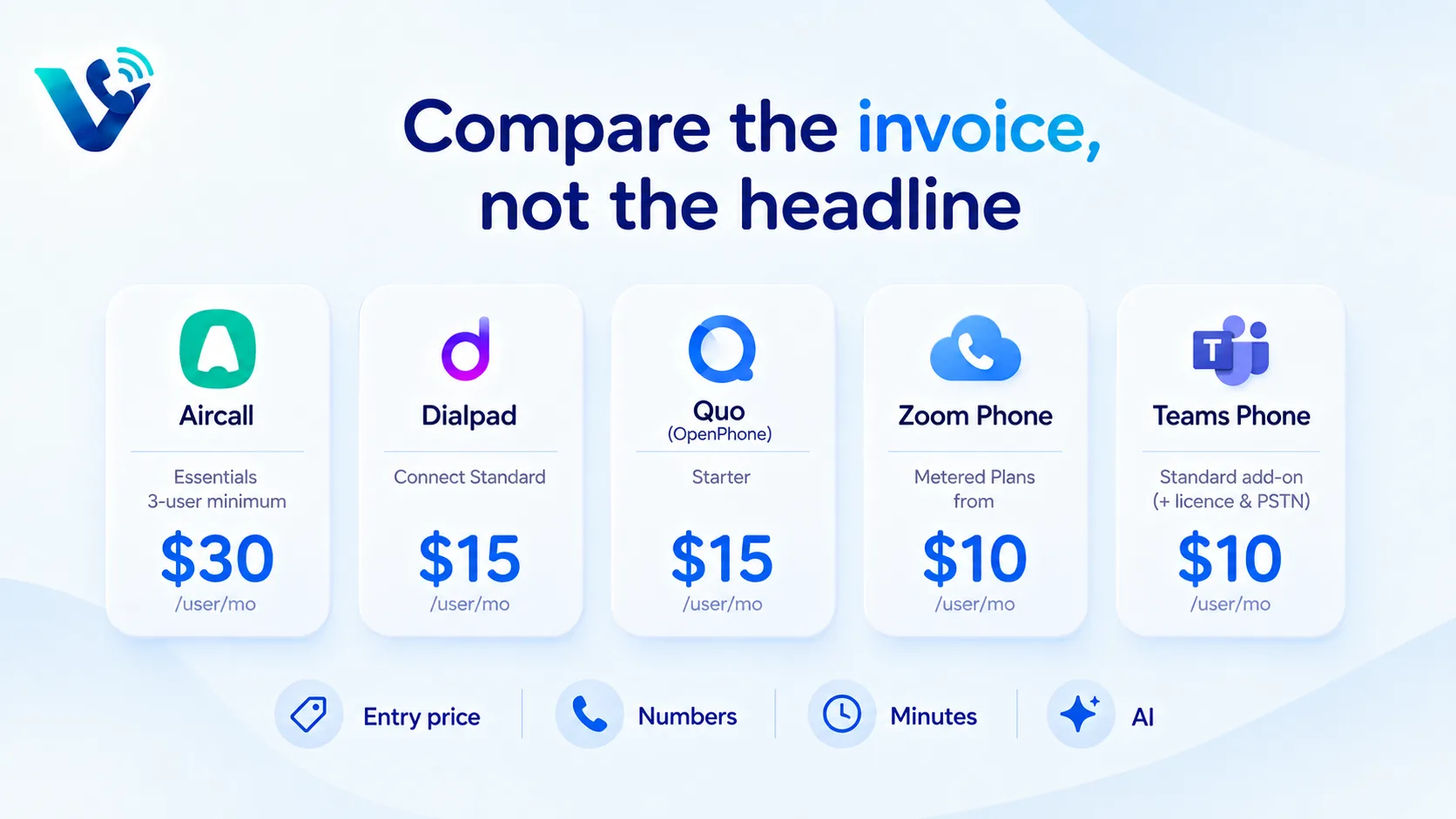
Coverage: the country list is only the first check
A provider saying it supports a country does not mean every customer can instantly buy every number type there. Local regulations may require a registered business, local address or identity documents. Toll-free, national, mobile and local numbers can have different rules. Porting may also be available for some number classes but not others.
Zoom publishes local telephony service across 49 countries and additional coverage through Provider Exchange partners. Aircall publishes a country coverage directory and separates number availability from calling bundles. Teams Phone can use Microsoft Calling Plans where offered, Operator Connect partners, or Direct Routing with a compatible SBC and carrier. This flexibility can matter more than the base licence price for a multi-country rollout.
Which Aircall alternative should you shortlist?
Choose Dialpad when real-time transcription and automatic AI recaps are central to the workflow and the team likes an all-in-one communications app. Choose Quo when a smaller North American team values shared phone numbers, texting and a simple collaborative inbox. Choose Zoom Phone when you already use Zoom Workplace or need a broad multinational footprint with a single administration layer. Choose Teams Phone when staff live in Teams all day and your IT team is comfortable choosing among Calling Plans, Operator Connect and Direct Routing.
If your priority is a simpler business phone stack with virtual numbers, shared team handling, outbound calling, AI summaries and analytics in one workflow, include Votelly in the same proof-of-concept and compare the exact countries and call flows you need.
How to test coverage before a demo ends
- List every country where you need a new number, an existing number ported, or outbound caller ID.
- Specify number type: local, mobile, toll-free, national or virtual service number.
- Ask for written confirmation of documents required for each country.
- Price a realistic month of inbound, domestic outbound and international calls.
- Test emergency calling, SMS registration and recording rules for your operating regions.
- Port one low-risk number before scheduling a large migration.
A practical proof-of-concept before you sign
Run a short proof-of-concept instead of choosing from feature grids. Pick three real call journeys: a new sales enquiry, an existing customer needing help, and an after-hours or no-answer case. Configure the same journeys in every shortlisted system and let the people who will actually answer calls use them. Measure answer time, transfer friction, missed-call recovery, mobile reliability, search, reporting and how much administrator work is needed to change a route. Also test a deliberately awkward case such as a transfer to an unavailable user or an integration outage. The best system is usually the one that stays understandable when something goes wrong, not the one with the longest feature page.
Put the hidden costs into one quote
Ask every vendor to price the identical scenario: the same user count, countries, telephone-number inventory, domestic and international usage, recording period, AI requirements, messaging volume and support level. Request separate line items for licences, numbers, minutes, toll-free usage, international calls, messaging registration, AI, storage, implementation, premium support, taxes and regulatory pass-through fees. If a plan is described as unlimited, read the fair-use conditions. If the discount depends on an annual or multi-year term, show the undiscounted renewal position as well. A comparable total-cost worksheet prevents a cheap entry tier from hiding the cost of the tier you actually need.
Try this on your own numbers
Local numbers in 118 countries, AI call notes and one shared inbox. Live the same day, no contract.
Migration and exit planning
Before committing, document how numbers are ported in, how long common ports take, what happens during a failed port and how numbers can be ported out later. Export requirements matter too: recordings, transcripts, call logs, messages, contacts and analytics should not become trapped simply because the subscription ends. For a migration, pilot one low-risk number or small team, validate inbound and outbound caller ID, emergency-calling obligations, business hours, voicemail, transfers and integrations, then move larger number blocks in controlled waves. Keeping the old service active until the new routing is proven is usually cheaper than recovering from an aggressive all-at-once cutover.
Security, privacy and policy checks
Confirm how the service encrypts signalling and media, how administrators control access, and how recordings, transcripts and messages are retained. If SSO or automated user provisioning matters, test the exact identity workflow rather than assuming an enterprise logo means it is included in your tier. Review recording-consent obligations and data-location requirements with the people responsible for privacy and compliance. Also ask how fraud, compromised credentials and unusual international calling are detected. Security features are most useful when administrators can understand and operate them without specialist intervention.
Frequently asked questions
- What is the cheapest Aircall alternative?
- For published entry pricing, Dialpad Connect and Quo start around $15 per user per month on annual billing, while Zoom says metered phone plans start at $10. Total cost depends on usage, numbers, AI and required tiers.
- Does Aircall have a minimum number of users?
- Aircall lists a three-licence minimum for Essentials and Professional. Its Custom plan has a higher minimum.
- Which alternative is best for international offices?
- Zoom Phone and Microsoft Teams Phone are strong shortlists because both offer multiple approaches to global PSTN connectivity. Confirm exact number availability country by country.
- Does Aircall include AI summaries?
- In 2026 Aircall says AI Assist is included with Professional, while Essentials does not include it by default in the same way.
- Is Quo the same as OpenPhone?
- Yes. OpenPhone rebranded to Quo. Current Quo plans retain the shared-number and team calling model associated with OpenPhone.
- What should I compare besides price?
- Compare number coverage, portability, routing depth, call quality, admin effort, messaging, AI, integrations, support, compliance controls and realistic usage charges.