Google Voice alternatives with real call routing in 2026
By Jamila Parker · · 6 min read

Google Voice has improved its business routing, but teams that need richer queues, analytics, CRM workflows or sales features still have strong alternatives.
Key takeaways
- Google Voice Standard now supports auto attendants, ring groups and call queues, so it is more capable than many older comparisons suggest.
- Nextiva, RingCentral and Zoom Phone offer broader PBX and company-wide communications options.
- Ooma Pro Plus is strong for traditional small offices, while Quo Business is simpler for shared customer numbers.
- Dialpad is a strong option for teams that want AI-first call workflows alongside routing.
First: Google Voice does have business call routing now
Many older Google Voice comparison pages are outdated. In 2026, Google Voice Standard for Workspace supports auto attendants, ring groups and call queuing, while Premier adds features such as automatic call recording and advanced reporting. Standard is $20 per user per month and Starter is $10. So the case for alternatives is no longer simply 'Google Voice cannot route calls.'
The better question is whether Google's routing is deep enough for your operation. Teams may still need more advanced queue analytics, CRM-driven routing, sales diallers, multi-site administration, broader global telephony or a shared conversation workflow. If that sounds familiar, the alternatives below are worth a demo.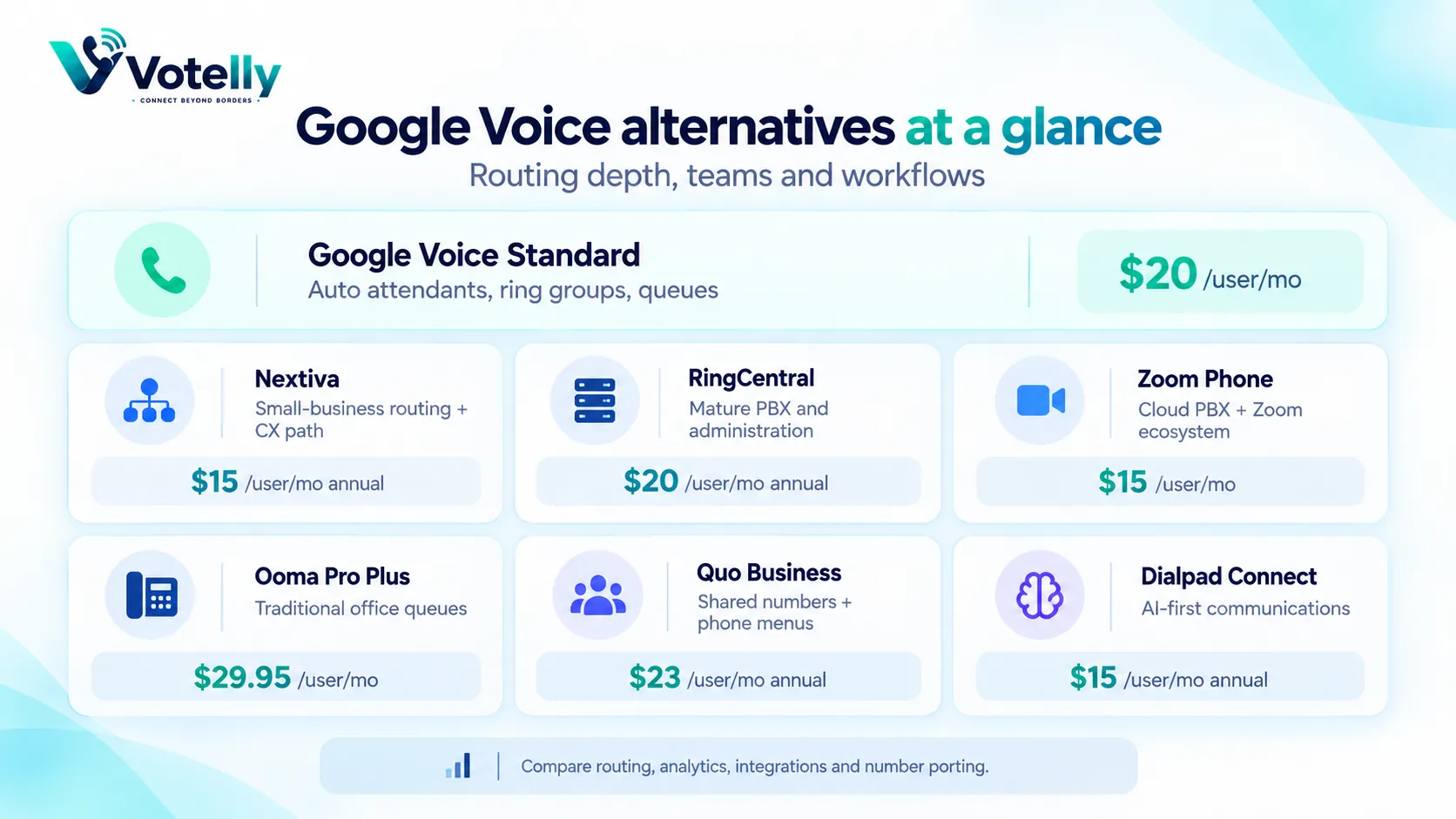
1. Nextiva: best for small businesses that want routing plus customer communications
Nextiva Core starts at $15 per user per month annually and includes voice, business SMS, call routing, team chat and mobile access. Engage adds stronger interaction management and reporting. It is a practical Google Voice alternative for a business that wants the phone system to become part of a broader customer communications stack.
Compared with Google Voice, the value is not merely an auto attendant. It is the expansion path into more advanced routing, reporting and customer-experience tools without leaving the same vendor.
2. RingCentral: best for mature PBX and multi-department needs
RingCentral RingEX Core starts around $20 per user per month annually, Advanced $25 and Ultra $35. It is a strong alternative when the organisation needs richer administration, integrations, recording, analytics or multi-site capabilities. For a business with several departments, the mature PBX controls can matter more than the difference in seat price.
Google Voice Standard is still attractive for Workspace-centric teams. RingCentral becomes more compelling when telephony is operationally complex enough to justify a specialised communications platform.
3. Zoom Phone: best if Zoom is already your collaboration hub
Zoom Phone's North America unlimited service starts around $15 per user per month and includes a phone number, domestic calling, SMS/MMS, recording, integrations and multi-device access. It also supports cloud PBX functions and can expand internationally. The benefit for Zoom users is one application for meetings, chat and phone.
Choose it over Google Voice when you want to consolidate communications into Zoom or need a wider PBX and global telephony path than your Workspace deployment provides.
4. Ooma Office Pro Plus: best for a traditional small office
Ooma Office Essentials starts at $19.95 per user per month, but Pro Plus at $29.95 is the relevant routing comparison because it adds call queues and CRM integration on top of the virtual receptionist and ring-group features available across the product. Ooma is particularly useful for businesses that still use desk phones or want a classic office-phone experience.
There is no annual-contract requirement on standard Ooma Office plans, which can be appealing for a small office that values flexibility.
5. Quo Business: best for shared customer numbers
Quo Business is $23 per user per month annually and adds group calling, custom ring orders, call transfers, phone menus, CRM integrations, analytics and automatic recording. It is less of a conventional PBX than RingCentral or Ooma and more of a collaborative business phone built around shared customer conversations.
For an agency, startup or service team that wants several people working from one number, that shared inbox model can feel simpler than Google Voice administration.
6. Dialpad: best for AI-first phone workflows
Dialpad Connect Standard starts at $15 per user per month annually and Pro at $25. Dialpad is a strong alternative when the phone system is expected to produce transcripts, AI-assisted notes and searchable conversation data as part of the normal workflow. It can also scale into dedicated sales and support products.
Which alternative has the “real” routing you need?
For a simple auto attendant and ring groups, Google Voice Standard may already be enough. For richer company-wide PBX administration, look at RingCentral or Zoom Phone. For a small-business customer communications stack, Nextiva is a strong option. For a traditional office, Ooma Pro Plus is straightforward. For collaborative shared numbers, Quo is unusually simple. For AI-led communications, Dialpad deserves a demo.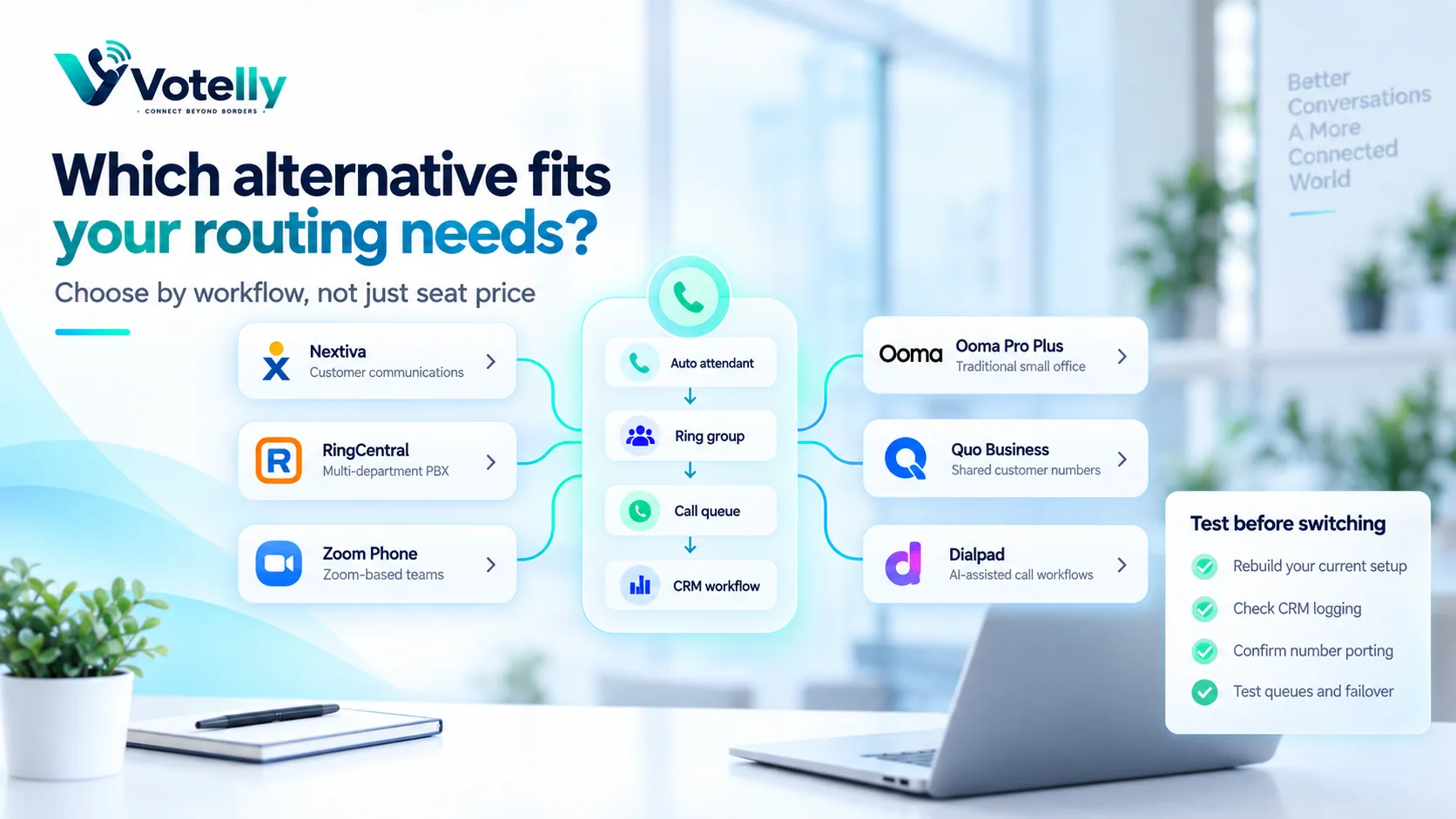
What to test before leaving Google Voice
Recreate your current Google setup in the demo: main number, business hours, auto attendant, ring groups, queue, voicemail, transfers and failover. Then add the features Google Voice is not solving—CRM logging, advanced reporting, sales dialling, cross-country numbers or manager monitoring. Also confirm number porting and SMS registration before cancelling your Google Voice subscription.
Do not migrate merely because a comparison article says Google Voice lacks routing. That claim is outdated for Standard. Migrate because another platform provides a materially better version of the routing, analytics, integrations or customer workflow your business needs.
Where Google Voice Standard is already enough
A small Workspace-based business with one main number, a straightforward auto attendant, a few ring groups and a basic queue may not need to migrate at all. Google Voice Standard now covers that foundation at $20 per user per month. If staff already live in Gmail, Calendar and Meet, the reduced training and administration can outweigh the extra features of a specialist phone platform.
Where specialist routing platforms pull ahead
The gap appears when routing depends on richer business context. Sales and support teams may want CRM-based ownership, advanced queue analytics, live monitoring, diallers, granular reporting, multi-country number management or more sophisticated failover. Those are the use cases where RingCentral, Nextiva, Zoom Phone, Aircall-style platforms or a specialised VoIP provider can deliver more operational control than Google Voice.
Compare the whole Workspace cost carefully
Google Voice business plans are often purchased alongside Google Workspace. When comparing alternatives, do not count the Workspace subscription as a Voice cost if you would keep Workspace anyway. Conversely, if another platform lets you cancel a separate meeting, chat or phone tool, include that saving in the comparison. Total stack cost is more useful than a narrow seat-price comparison.
Migration checklist from Google Voice
Document every number, user, auto attendant, ring group, queue, voicemail greeting and business-hours rule. Confirm the new provider can port all required numbers and support emergency calling in each location. Schedule porting before cancelling Google Voice, and keep a temporary forwarding path where possible. Test inbound, outbound, voicemail, SMS and after-hours routing with real users before declaring the migration complete.
Try this on your own numbers
Local numbers in 118 countries, AI call notes and one shared inbox. Live the same day, no contract.
Bottom line
Google Voice is no longer a 'basic-only' option in the way many old comparison pages describe it. Standard can handle legitimate business routing. The alternatives become worthwhile when you need deeper analytics, CRM-driven workflows, advanced PBX controls, global operations or sales features. Compare that operational gap not an outdated feature claim and the decision becomes much clearer.
At-a-glance comparison
Alternative / plan |
Starting price checked |
Routing angle |
|
Google Voice Standard |
$20/user/mo |
Auto attendants, ring groups, queues |
|
Nextiva |
$15/user/mo annual |
Small-business routing + CX path |
|
RingCentral |
$20/user/mo annual |
Mature PBX and administration |
|
Zoom Phone |
$15/user/mo |
Cloud PBX + Zoom ecosystem |
|
Ooma Pro Plus |
$29.95/user/mo |
Traditional office queues |
|
Quo Business |
$23/user/mo annual |
Shared numbers + phone menus |
|
Dialpad Connect |
$15/user/mo annual |
AI-first communications |
Frequently asked questions
- Does Google Voice support call routing in 2026?
- Yes. Google Voice Standard for Workspace supports auto attendants, ring groups and call queuing. Premier adds more advanced reporting and automatic recording.
- How much is Google Voice Standard?
- Google Voice Standard is $20 per user per month for the Workspace add-on. Starter is $10 and Premier is $30.
- What is the best Google Voice alternative for small businesses?
- Nextiva, Zoom Phone, Ooma Office and Quo are strong options. The best fit depends on routing depth, shared numbers, desk phones and integrations.
- Which Google Voice alternative is best for call queues?
- RingCentral, Nextiva, Zoom Phone and Ooma Pro Plus all support more developed business phone workflows; compare queue rules and reporting in a demo.
- Is RingCentral better than Google Voice?
- RingCentral is generally deeper for PBX administration and integrations, while Google Voice is simpler and tightly integrated with Google Workspace.
- Can I port a Google Voice business number to another provider?
- In many cases yes, subject to number eligibility and carrier rules. Start the port with the new provider before cancelling Google Voice.