Australia Virtual Phone Number: What Businesses Need to Know
By Jamila Parker · · 9 min read

An Australia virtual phone number can route customer calls to teams anywhere, but businesses should understand geographic, 13/1300/1800, caller-ID and telemarketing rules before launch.
Key takeaways
- Australian number types serve different jobs: geographic 02/03/07/08, mobile 04, 13/1300 local-rate style services and 1800 freephone services.
- Virtual routing can send Australian calls to remote teams, but number allocation and provider documentation requirements still apply.
- Caller ID overstamping is allowed in defined circumstances, but invalid or unallocated numbers and 13/1300/1800 numbers cannot be used as overstamped CLI.
- Australian telemarketing rules restrict calling times and require clear identification; a local number does not change those obligations.
An Australia virtual phone number lets a business give Australian customers a familiar contact number while routing calls through a cloud or VoIP system. The answering team might be in Sydney, Melbourne, another country, or distributed across several locations. From the customer's perspective, the important thing is that the Australian number works reliably and connects to the right business.
For international companies, this can simplify market entry and customer support. For Australian companies, virtual routing can connect multiple offices and remote employees behind one public identity. But Australia's numbering system includes several distinct number types, and the right choice depends on geography, call cost, marketing purpose and regulatory requirements.
Before ordering a number, understand what the prefix communicates and how the number can legally be presented on outbound calls.
How Australian virtual numbers work
A virtual number receives calls through a telecommunications provider, then routes them according to software rules. Instead of terminating only on one copper line or one physical handset, the call can ring a VoIP phone, browser, mobile app, call queue, SIP endpoint or international destination.
The business can change the routing without changing the advertised number. That is useful for remote work, follow-the-sun support, disaster recovery and companies that are still building local teams.
"Virtual" does not mean outside the numbering rules. The number is still allocated and used within Australia's telecommunications framework and the provider's service conditions.
Australian number types businesses should know
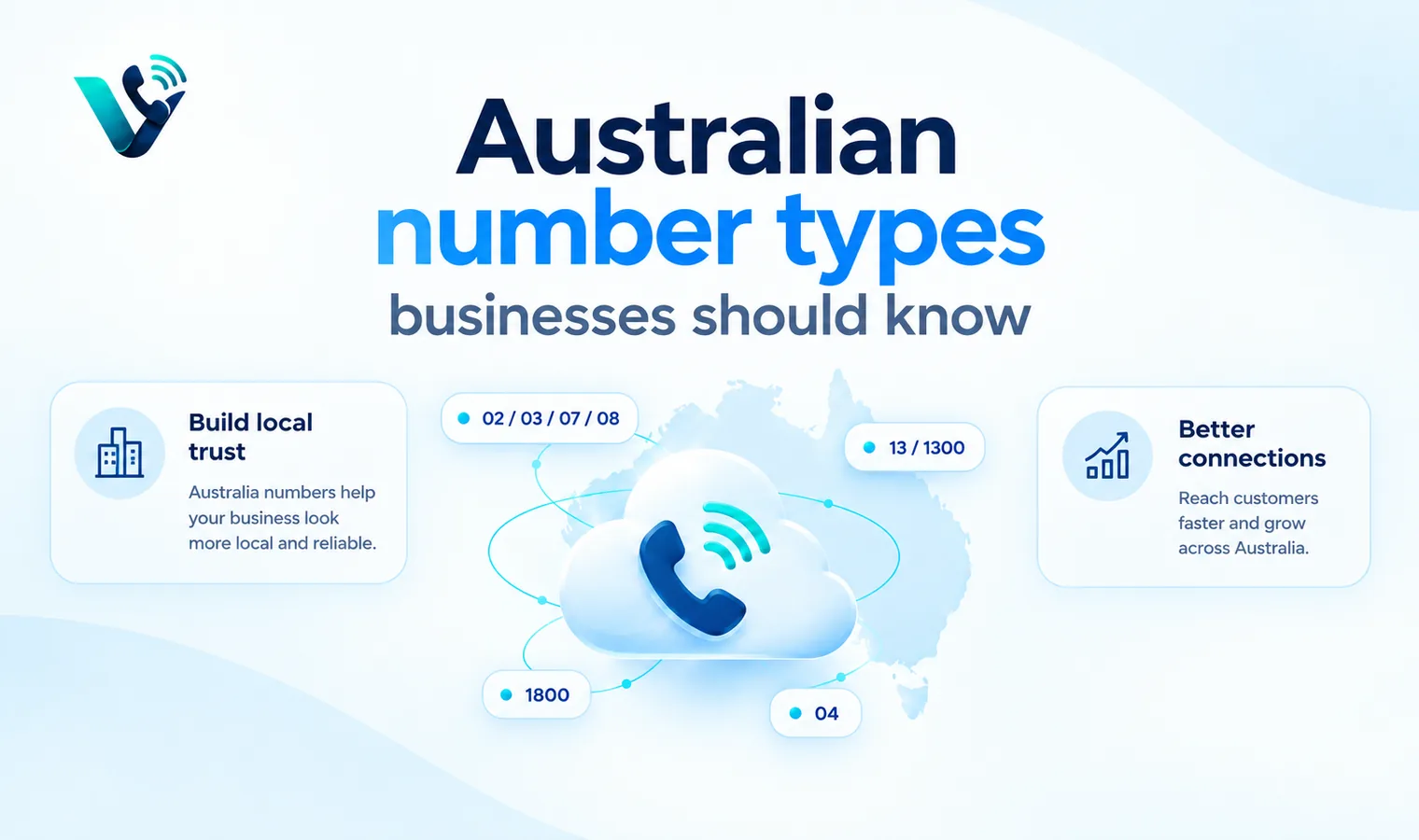
Geographic numbers: 02, 03, 07 and 08
ACMA identifies Australia's geographic numbers by area prefixes including 02, 03, 07 and 08. These numbers are associated with geographic regions and are commonly used for local business lines.
A geographic number can be a good fit when customers expect a regional contact point. An international company serving New South Wales, for example, may prefer a relevant geographic number if the provider can lawfully allocate it based on the applicable requirements.
Do not use a geographic number to make an inaccurate claim about a physical office. Treat it as a communications resource whose allocation and use must match provider and numbering rules.
13 and 1300 numbers
13 and 1300 services are widely used by Australian businesses that want one recognisable number across locations. ACMA describes these as local-rate style business-number categories under the Australian numbering framework.
They are useful for national sales, bookings and customer service because routing can be changed behind the number without changing the public contact identity.
1800 freephone numbers
1800 numbers are freephone services for callers. They are common for support lines, campaigns and businesses that want to remove the caller's direct charge barrier.
The business should still understand the provider's inbound rates and routing fees. "Freephone" describes the caller experience, not that the service has no cost to the business.
Mobile numbers: 04
Australian mobile numbers begin with 04. A business may use mobile numbers for specific teams or messaging use cases, but a mobile identity serves a different purpose from a geographic or national business number.
Choose the number category around the customer journey rather than simply selecting whichever inventory is cheapest.
Which number should an international business choose?
If your business is focused on one Australian region and the provider can supply an appropriate geographic number, a 02, 03, 07 or 08 number may create a familiar regional contact point. If you serve customers nationally, a 13, 1300 or 1800 service can provide one consistent identity.
The decision also depends on how customers call you. A freephone 1800 number may be valuable for high-volume support or response campaigns. A geographic number may suit professional services or a regional office. A 1300 number can work well for a national business that wants central routing.
Many organisations use more than one. VoIP can route regional and national numbers into the same queues while preserving separate reporting.
What is caller ID overstamping in Australia?
Caller ID overstamping is the practice of displaying a different authorised number instead of the technical network number from which a call originates. ACMA explains that overstamping can be legitimate for example, an overseas call centre may display an Australian callback number for the business it represents.
This is useful for international teams because the customer can see and return a relevant Australian number. However, the displayed number must follow the rules and should genuinely connect back to the organisation.
ACMA also notes restrictions: invalid or unallocated numbers cannot be used, and certain number types including 13, 1300 and 1800 services cannot be used for CLI overstamping. That makes provider configuration important. Do not assume every number you own can be displayed as outbound caller ID.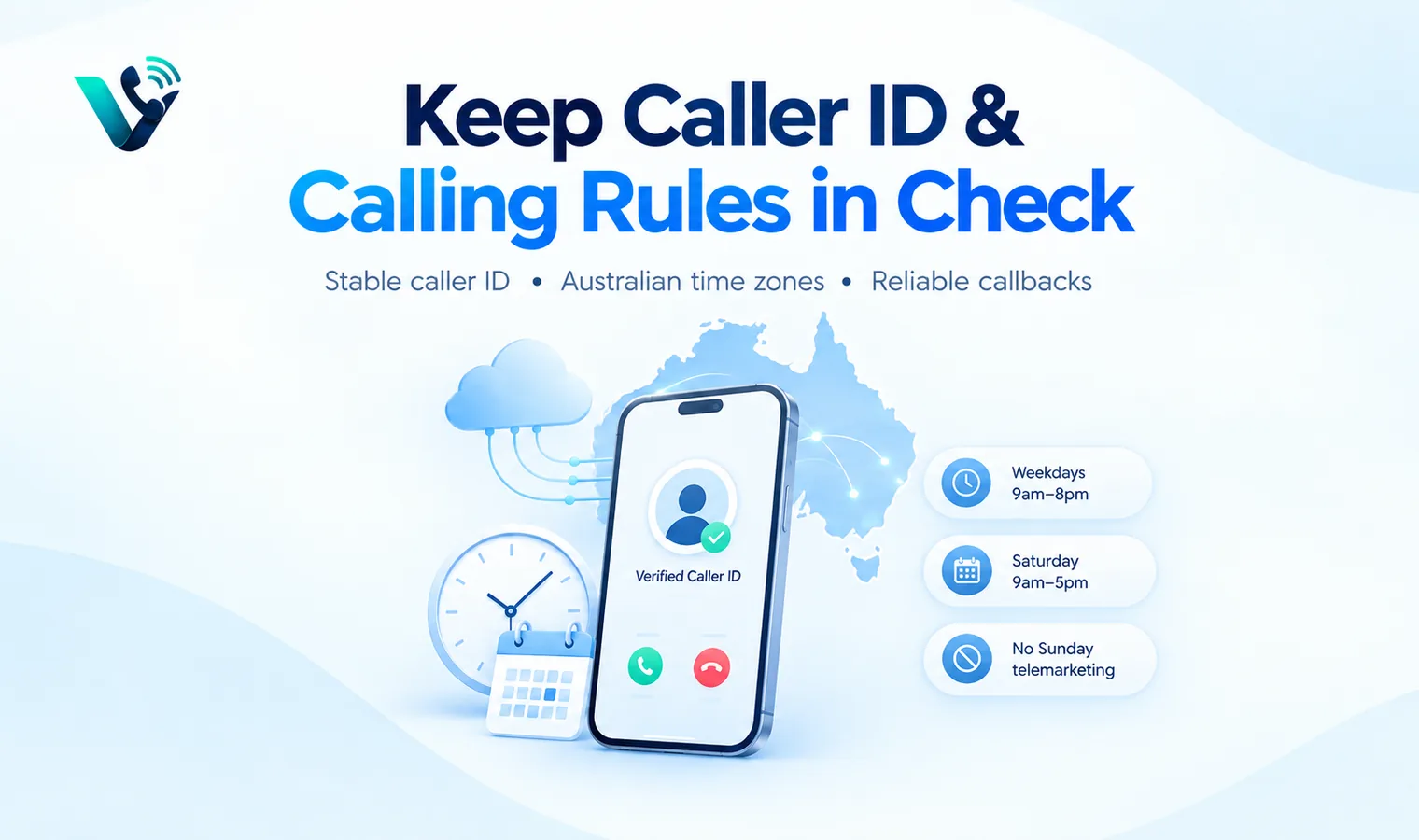
Avoiding caller-ID problems and scam-like behaviour
Australian consumers are highly alert to scam calls. If a business uses many changing local numbers, calls repeatedly or provides a number that cannot be called back, the experience can resemble fraudulent traffic even when the organisation is legitimate.
Use a stable caller-ID strategy, identify the business early in the conversation and keep return routing functional. Ask your provider how the selected number is presented across Australian networks and what options exist for correcting an inaccurate spam or scam label.
For critical customer service, use a published identity that customers can verify on the company's website.
Number porting in Australia
ACMA's portability framework allows customers to keep eligible telephone numbers when changing providers, subject to the relevant rules and processes. Portability is important for businesses because the number can become a long-term brand asset.
Before heavily advertising a number, confirm whether it can be ported to another provider later. Keep account and assignment records. If moving an existing number into VoIP, submit the exact account details held by the current provider and do not cancel the old service before the transfer is complete.
Porting time depends on number type, provider, account accuracy and complexity. Build a migration plan rather than assuming every number will move instantly.
Australian telemarketing calling times
ACMA's current consumer guidance sets permitted telemarketing calling windows. Telemarketers can generally call on weekdays from 9 am to 8 pm and on Saturdays from 9 am to 5 pm, while Sunday telemarketing is not allowed. Public holiday restrictions and other detailed rules may also apply.
These hours should be implemented directly in the dialer or CRM so an overseas team does not accidentally call based on its own local time zone. Time-zone mistakes are easy when agents are outside Australia.
Always check current ACMA guidance before a campaign because rules can be amended.
Identification requirements for telemarketing calls
ACMA guidance also requires telemarketers to provide identifying information such as their name, the organisation they work for, the organisation on whose behalf the call is made where relevant, and the purpose of the call. If the person asks for the call to end, the telemarketer must comply with the applicable rules.
A virtual number does not hide the business from these obligations. In fact, transparent identification helps both compliance and caller reputation.
The Do Not Call Register
Australia's Do Not Call Register lets eligible individuals register numbers to reduce unsolicited telemarketing. Businesses conducting marketing campaigns should understand when they need to check numbers against the register and what exemptions or consent rules apply.
Do not rely on a purchased lead list or a claim from a data provider that "all contacts are safe to call." Your business remains responsible for the campaign practices that apply to it.
For non-marketing service calls, appointment calls or existing customer communications, the legal analysis can be different. Classify each use case accurately rather than applying one rule to every outbound call.
SMS and messaging
If you want the Australian number to support SMS, confirm that separately. Voice capability does not guarantee messaging capability for every number type.
Ask about inbound and outbound SMS, sender registration, international access by agents, throughput, opt-out handling and applicable spam requirements. If customers will receive marketing texts, voice telemarketing rules are not the only requirements you need to consider.
Routing an Australian number to an overseas team
A common architecture is to keep the public Australian number stable and route calls to whichever authorised team is available. During Australian business hours, calls might go to a dedicated market team. Overflow can move to another office, while after-hours calls can reach voicemail or an answering service.
Configure schedules in Australian local time. Australia has multiple time zones and daylight-saving differences, so a single national schedule can produce mistakes if it is not designed carefully.
For customer callbacks, display an authorised Australian number where permitted and make sure the same number has a sensible inbound route.
Choosing an Australia virtual-number provider
Review the following before ordering:
- which geographic and national number types are available;
- documentation required for assignment;
- inbound and outbound call pricing;
- port-in and port-out support;
- international routing and SIP options;
- outbound CLI and overstamping rules;
- spam-label and caller-ID support;
- SMS capability;
- call recording and storage options;
- failover and uptime;
- Australian support coverage and escalation.
A provider should be able to explain not only how to buy a number but how that exact number type can be used.
Try this on your own numbers
Local numbers in 118 countries, AI call notes and one shared inbox. Live the same day, no contract.
Launch checklist
- Choose geographic, 13/1300, 1800 or another appropriate number type.
- Confirm allocation and documentation requirements.
- Configure Australian time zones, IVR, queues and failover.
- Confirm whether and how the number can be displayed as outbound caller ID.
- Review portability before making the number a permanent brand asset.
- Review current telemarketing calling-time and identification rules.
- Check Do Not Call Register obligations for marketing campaigns.
- Confirm SMS separately if needed.
- Test inbound and outbound calls across several Australian networks.
- Monitor complaints, labels and callback success after launch.
Note: Australian numbering and telemarketing rules can change. Use current ACMA guidance and your provider's written terms for the exact service you deploy.
Final takeaway
An Australia virtual phone number can give customers a stable Australian contact point while allowing the business to operate with remote or international teams. The cloud-routing part is easy; the quality comes from choosing the right number type and using it correctly.
Match the prefix to the customer experience, configure compliant caller ID, respect Australian calling rules, plan portability and keep return calls working. That creates a local communications experience without turning "local presence" into a misleading promise.
Australian business number types at a glance
Range |
Type |
Common use |
|
02 / 03 / 07 / 08 |
Geographic |
Regional office or local customer contact |
|
13 / 1300 |
National business service |
One business identity routed across locations |
|
1800 |
Freephone |
Support, helplines and response campaigns |
|
04 |
Mobile |
Mobile teams and supported messaging use cases |
Frequently asked questions
- Can an international company get an Australian virtual phone number?
- Often yes, subject to provider onboarding, number type, allocation rules and documentation requirements.
- What is the difference between 1300 and 1800 numbers?
- Both are national business-number categories, but 1800 is a freephone service for callers while 1300 uses a different charging model. Check current provider pricing.
- Can an overseas call centre show an Australian caller ID?
- Caller ID overstamping can be legitimate in Australia when configured within the rules, but not every number type can be used. Confirm the exact number with the provider.
- Can 1300 or 1800 numbers be used for caller ID overstamping?
- ACMA states that 13, 1300 and 1800 numbers cannot be used for CLI overstamping. Use an eligible, valid number instead.
- What are Australian telemarketing calling hours?
- ACMA guidance generally permits telemarketing Monday–Friday 9 am–8 pm and Saturday 9 am–5 pm, with Sunday calls not permitted. Verify current rules before campaigns.
- Can I port an Australian business number to another provider?
- Eligible numbers can often be ported under Australian portability rules. The process depends on number type, providers and accurate account information.