UAE and Saudi Virtual Numbers: What Is Possible Today
By Jamila Parker · · 9 min read

A practical guide to UAE and Saudi virtual numbers, including numbering rules, VoIP availability, provider requirements, routing and market-entry considerations.
Key takeaways
- UAE and Saudi numbers are regulated national numbering resources, not simply online usernames.
- Saudi Arabia explicitly defines VoIP numbers and has a permit framework for virtual voice services.
- Availability, documentation and local-presence conditions should be confirmed with the licensed provider before launch.
- Voice, SMS, caller ID and verification can have different requirements.
- Use a CRM workflow so calls become owned, measurable leads rather than isolated phone events.
UAE and Saudi Virtual Numbers: What Is Possible Today is best understood as a practical business-telephony question: what number type is available, what rules apply, how will calls or messages reach the team, and how will the resulting customer interaction be measured? This guide focuses on UAE and Saudi virtual numbers and turns those questions into an implementation path. Country-specific regulatory statements are based on the official sources listed at the end of this document.
What a UAE or Saudi virtual number actually means
A virtual phone number is a number whose calls are delivered through a cloud or IP-based communications service rather than a traditional desk line at the employee’s physical location. For a business entering the Gulf, the important distinction is between the technology used to route the call and the regulatory status of the number itself. A number can be delivered through software while still being part of a national numbering plan. In the UAE, TDRA defines the National Numbering Plan as the country’s phone-number plan issued under ITU-T E.164 principles. Saudi Arabia’s CST similarly manages numbering resources as a limited national resource and publishes rules for their structure and allocation.
For implementation, keep this step documented in the provider checklist and test it with a real customer journey. The phone system should have a clear owner, a defined fallback and a measurable outcome. If the number is used for marketing, preserve the campaign or source so the business can compare qualified opportunities rather than only counting calls.
Saudi Arabia: Virtual voice is explicitly recognised
Saudi Arabia provides a useful example of why businesses should check the regulatory layer before purchasing a number. CST describes VoIP numbers as numbers used to provide telecommunications services that allow end users to make and receive calls to and from the Kingdom’s licensed public telecommunications networks using IP networks. CST also provides a specific permit service for virtual voice services. The permit description covers virtual voice calls to and from public telephone networks using E.164 numbering over IP through licensed provider infrastructure. In other words, virtual voice is not inherently impossible, but the service must fit the Kingdom’s regulated framework.
For implementation, keep this step documented in the provider checklist and test it with a real customer journey. The phone system should have a clear owner, a defined fallback and a measurable outcome. If the number is used for marketing, preserve the campaign or source so the business can compare qualified opportunities rather than only counting calls.
UAE: Start with the numbering plan and provider
For the UAE, the practical starting point is the national numbering framework and the provider’s current eligibility process. A business should not assume that every UAE geographic, mobile or service number can be ordered from another country without documentation. The provider should explain which ranges it can supply, what business information is required, whether the service is inbound, outbound or both, and where the call is actually terminated. The same number may also have different capabilities for voice, messaging, caller ID and verification. Those capabilities should be checked separately before the number is used in advertising.
For implementation, keep this step documented in the provider checklist and test it with a real customer journey. The phone system should have a clear owner, a defined fallback and a measurable outcome. If the number is used for marketing, preserve the campaign or source so the business can compare qualified opportunities rather than only counting calls.
Local presence versus remote answering
A local or national number can be useful for a remote sales team because the customer can call a familiar country code and the call can be routed to an available agent. That does not automatically mean the business has a physical office in the city associated with the number. Public-facing copy should describe the service honestly. If the company serves Dubai, Riyadh or another market remotely, the website can explain that it has a local contact route without claiming a physical address that does not exist. This distinction becomes especially important when business directories, verification providers or customers rely on address information.
For implementation, keep this step documented in the provider checklist and test it with a real customer journey. The phone system should have a clear owner, a defined fallback and a measurable outcome. If the number is used for marketing, preserve the campaign or source so the business can compare qualified opportunities rather than only counting calls.
What to verify before buying
Ask the provider for the exact number type, allocation eligibility, documentation requirements, caller ID rules, outbound calling capability, emergency-calling arrangements where applicable, porting options and SMS capability. For Saudi Arabia, also ask how the provider’s virtual voice service fits the CST permit framework. For the UAE, ask what TDRA-related requirements apply to the selected range and service. The safest process is to get the current provider checklist in writing because number ranges and service policies can change over time.
For implementation, keep this step documented in the provider checklist and test it with a real customer journey. The phone system should have a clear owner, a defined fallback and a measurable outcome. If the number is used for marketing, preserve the campaign or source so the business can compare qualified opportunities rather than only counting calls.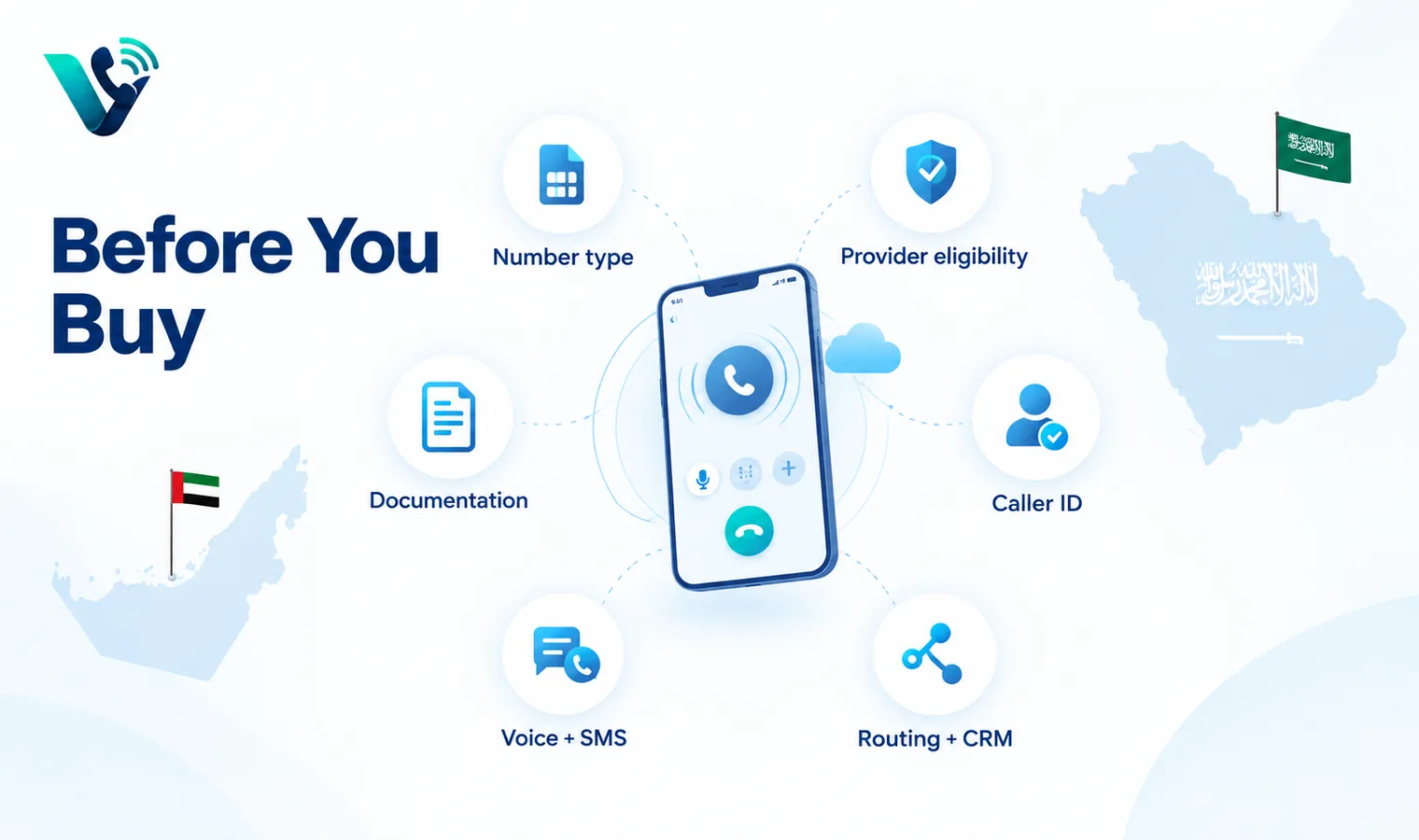
Voice and SMS should be treated separately
A number that can receive calls may not automatically support SMS. Even where a provider advertises messaging, international delivery, sender registration, local restrictions and carrier filtering can affect the actual experience. Businesses planning OTPs, appointment reminders or sales texting should therefore verify the messaging capability of the exact number rather than relying on the phrase “virtual number.” For regulated markets, the compliance model for commercial messaging may also differ from the model for ordinary voice calls.
For implementation, keep this step documented in the provider checklist and test it with a real customer journey. The phone system should have a clear owner, a defined fallback and a measurable outcome. If the number is used for marketing, preserve the campaign or source so the business can compare qualified opportunities rather than only counting calls.
Routing a Gulf number to a remote team
Once the number is eligible, build a simple routing tree. During local business hours, send calls to the primary Gulf sales or support queue. Add an overflow destination for busy periods, then an after-hours path such as voicemail, callback collection or booking. If the team sits outside the Gulf, schedule the queue using the customer’s local time. The goal is to make the number useful, not merely available. A number that rings an unattended laptop during local business hours can damage the customer experience even when the underlying telephony is technically correct.
For implementation, keep this step documented in the provider checklist and test it with a real customer journey. The phone system should have a clear owner, a defined fallback and a measurable outcome. If the number is used for marketing, preserve the campaign or source so the business can compare qualified opportunities rather than only counting calls.
Connect the number to the CRM
Every business call that can become a lead should feed the same ownership workflow as website enquiries. Capture the source, caller, country, campaign, owner, status and next action. LeadMino’s published speed-to-lead guidance emphasises fast ownership and response, while its website-form guidance shows why source information should enter the CRM rather than remain in a separate tool. For Gulf expansion, the same principle lets a company see whether the number is generating real opportunities or simply generating call volume.
For implementation, keep this step documented in the provider checklist and test it with a real customer journey. The phone system should have a clear owner, a defined fallback and a measurable outcome. If the number is used for marketing, preserve the campaign or source so the business can compare qualified opportunities rather than only counting calls.
How to evaluate a Gulf number after launch
Do not judge the setup by the number of calls alone. Track answered calls, missed calls, response time, qualified leads, meetings and commercial outcomes. Review whether callers understand the company identity and whether outbound caller ID appears as expected. If the business uses separate numbers for the UAE and Saudi Arabia, compare each market using the same reporting fields. If one market requires a local provider, documentation or additional routing complexity, record that as an operational requirement rather than assuming the number itself is the cause of performance differences.
For implementation, keep this step documented in the provider checklist and test it with a real customer journey. The phone system should have a clear owner, a defined fallback and a measurable outcome. If the number is used for marketing, preserve the campaign or source so the business can compare qualified opportunities rather than only counting calls.
Try this on your own numbers
Local numbers in 118 countries, AI call notes and one shared inbox. Live the same day, no contract.
A practical UAE and Saudi launch checklist
Before publishing the number, confirm the country and number type, provider eligibility, documentation, local-presence requirements, inbound and outbound capability, caller ID, SMS requirements, routing hours, overflow, CRM integration and compliance responsibilities. Test the number from the target country and from the team’s actual answering locations. Keep public business information accurate and consistent. The main lesson is simple UAE and Saudi virtual numbers are possible in defined regulatory and provider frameworks, but the exact number type and service conditions determine what a business can actually do.
For implementation, keep this step documented in the provider checklist and test it with a real customer journey. The phone system should have a clear owner, a defined fallback and a measurable outcome. If the number is used for marketing, preserve the campaign or source so the business can compare qualified opportunities rather than only counting calls.
Quick comparison / implementation table
Area |
Purpose |
Check |
UAE |
National numbering framework |
Confirm provider and exact range |
Saudi Arabia |
VoIP numbers recognised in CST framework |
Check licensed-provider/permit model |
Both |
Remote routing |
Use local hours and CRM ownership |
Frequently asked questions
- What is the main thing to check about UAE and Saudi virtual numbers?
- Check the exact number type, provider eligibility, required documentation and the communication features you actually need.
- Can a remote team use the number?
- Often yes, if the provider supports the routing and the number is eligible for the intended service.
- Does a virtual number automatically support SMS?
- No. SMS capability is separate and should be verified for the exact number.
- Do I need a local office?
- Not necessarily, but some number types or markets can require local presence or address evidence.
- Can I connect the number to a CRM?
- Yes. Connecting calls and messages to a CRM helps preserve ownership, source, status and next action.
- What should I test before publishing it?
- Test inbound and outbound calling, caller ID, business hours, overflow, SMS if needed, and the CRM workflow.