Call recording for coaching: a manager's workflow that actually scales
By Jamila Parker · · 7 min read

Call recording only helps coaching when managers review consistently. This workflow turns recordings into repeatable, measurable coaching.
Key takeaways
- Call recording becomes useful for coaching only when managers review calls on a consistent schedule and connect feedback to a specific behaviour.
- A balanced sample of strong, weak, random and theme-based calls gives a fairer view than reviewing only obvious wins or failures.
- Use a short scorecard focused on observable behaviours such as discovery, listening, relevance, next-step clarity and compliance.
- Coach one or two behaviours at a time, then review later calls to see whether the rep actually changed what they do.
- Access, consent, retention and deletion rules should be defined before recordings become part of a regular coaching programme.
Call recording for coaching works best when it is treated as a management process rather than a storage feature. Recording every conversation can create a large archive, but an archive alone does not improve sales or service quality. The value appears when managers know which calls to review, what to listen for, how to give feedback and how to check whether behaviour improves on later calls. A scalable workflow therefore needs a repeatable review rhythm, a simple scorecard, clear ownership and sensible privacy controls. The aim is not to listen to more recordings. It is to turn a small, representative sample of calls into better conversations across the whole team.
Recording is not a coaching system
A library of recordings creates no improvement by itself. If managers only open recordings when a complaint appears or a deal is lost, coaching becomes reactive and inconsistent. Reps may receive feedback on different standards, while strong calls that could be used as examples are ignored.
A coaching system adds structure around the recording. Managers decide how many calls will be reviewed, how calls are selected, which behaviours matter, how feedback is documented and when the same behaviour will be checked again. That creates a closed loop: review, coach, practise and re-sample. Over time, the recording is no longer the end product; it is evidence used to improve a specific skill.
It also helps to separate coaching from policing. The purpose of a review should be clear to the rep before the session starts. A call can contain several imperfections, but the manager does not need to correct everything at once. Focusing on the behaviour with the greatest impact keeps the conversation constructive and makes improvement easier to measure.
Build a repeatable sampling rule
Sampling should be predictable enough that every rep is reviewed fairly, but varied enough to reveal real behaviour. A useful weekly sample can include one successful call, one difficult call, one random call and one call connected to the current coaching theme. This prevents managers from judging performance only from memorable wins or obvious failures.
The sample should also reflect the work the rep actually does. If a salesperson handles discovery calls, follow-ups and renewals, the review set should not contain only discovery calls. Support teams may want a mix of straightforward cases, escalations and repeat contacts. The goal is a realistic picture of the conversations that make up the role.
For larger teams, managers can rotate the emphasis. One week may focus on discovery quality, another on objection handling, another on next-step clarity. Random sampling should still remain in the mix because it reduces the risk that people only improve the calls they expect to be reviewed.
Use a short scorecard
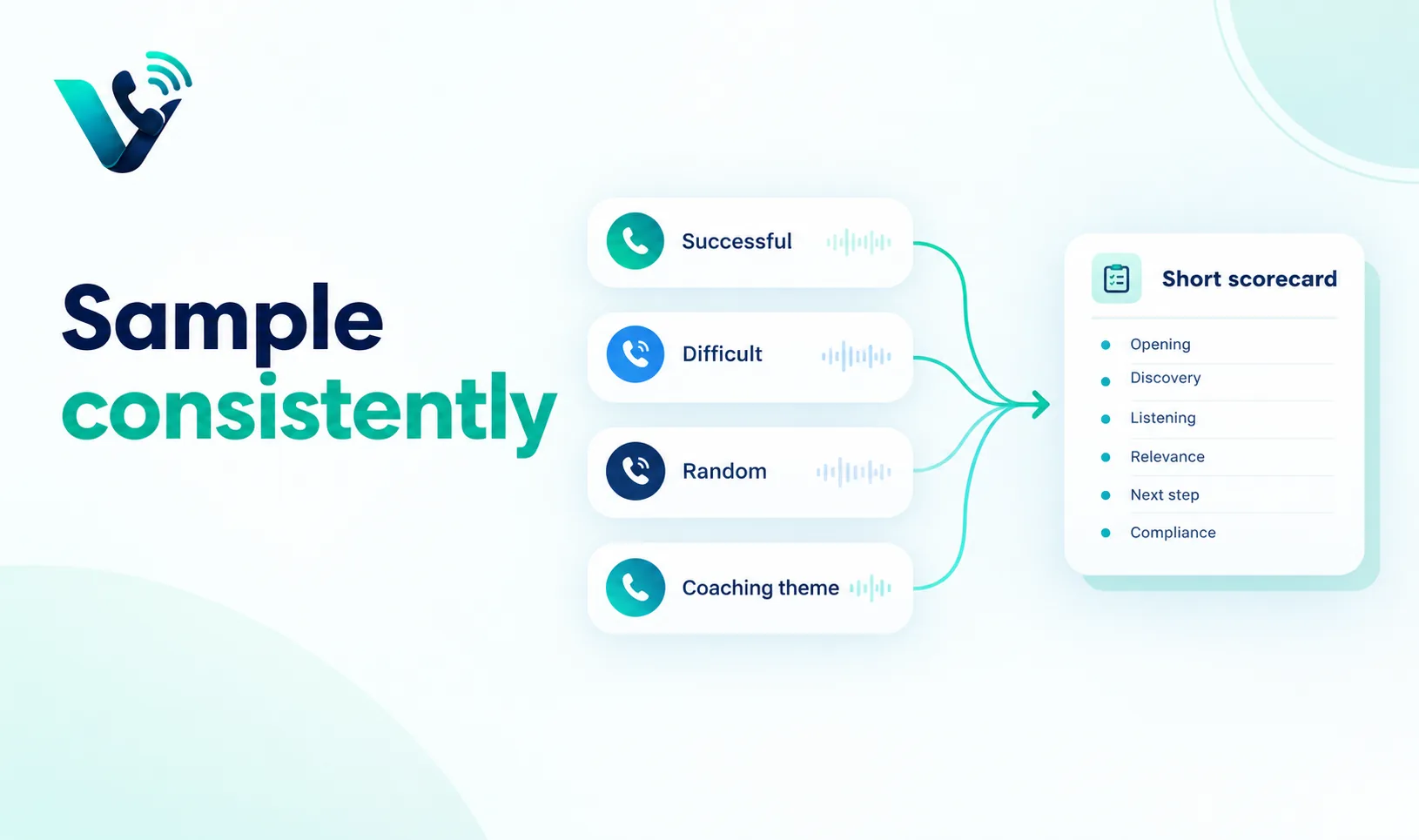
A scorecard should be short enough to use every week. Five or six categories are usually more useful than a long checklist. For example: Opening and agenda, discovery, listening, relevance of the response, next-step clarity and any required compliance behaviour. Each category should describe something a manager can hear on the recording rather than a vague impression such as “good call” or “needs confidence.”
Keep the scoring scale simple and define what each level means. If two managers can listen to the same call and reach completely different scores, the rubric is too subjective. Short written examples help: “next step includes owner and date” is clearer than “strong close.” Consistency matters because the scorecard is useful only when trends can be compared over time.
Do not let the score become the whole coaching conversation. A score is a signal, not the outcome. The most valuable part is the evidence behind it: The exact moment where the rep asked a strong question, interrupted too early, missed a buying signal or left the next step unclear.
Coach one behaviour at a time
Choose one or two behaviours the rep can practise immediately. “Improve discovery” is too broad; “ask one follow-up question before presenting a solution” is observable and easy to practise. “Be more confident” is vague; “state the recommended next step before asking for agreement” gives the rep something concrete to try on the next call.
A short coaching session can follow a simple sequence: Ask the rep what they noticed, play the relevant moment, agree on the behaviour to change, rehearse a better version and record the action for the next set of calls. This keeps the rep involved instead of turning the session into a manager lecture.
The follow-up is what makes coaching measurable. Review another sample after the rep has had enough real calls to practise. If the behaviour improves, move to the next skill. If it does not, narrow the action further or use role-play before expecting the rep to apply it under live pressure.
Privacy and access controls
Recording laws and consent requirements vary by jurisdiction, so teams should define the legal and operational rules before recordings become part of coaching. Decide how callers are notified, who can access recordings, how long files are retained, when recordings are deleted and whether particularly sensitive calls should be excluded. Obtain appropriate legal advice for the locations in which the business operates.
Access should match the coaching purpose. A manager may need recordings for their own team, while a broader group may only need anonymised examples or approved training clips. Avoid treating the recording library as an unrestricted archive. Clear permissions reduce unnecessary exposure of customer information and also make employees more comfortable with how recordings are being used.
Document the policy in plain language for both managers and reps. People should know what is recorded, why it is reviewed, who can listen and what happens when a recording is no longer needed. A transparent process supports trust and makes the coaching programme easier to run consistently.
Try this on your own numbers
Local numbers in 118 countries, AI call notes and one shared inbox. Live the same day, no contract.
Manager workflow that scales
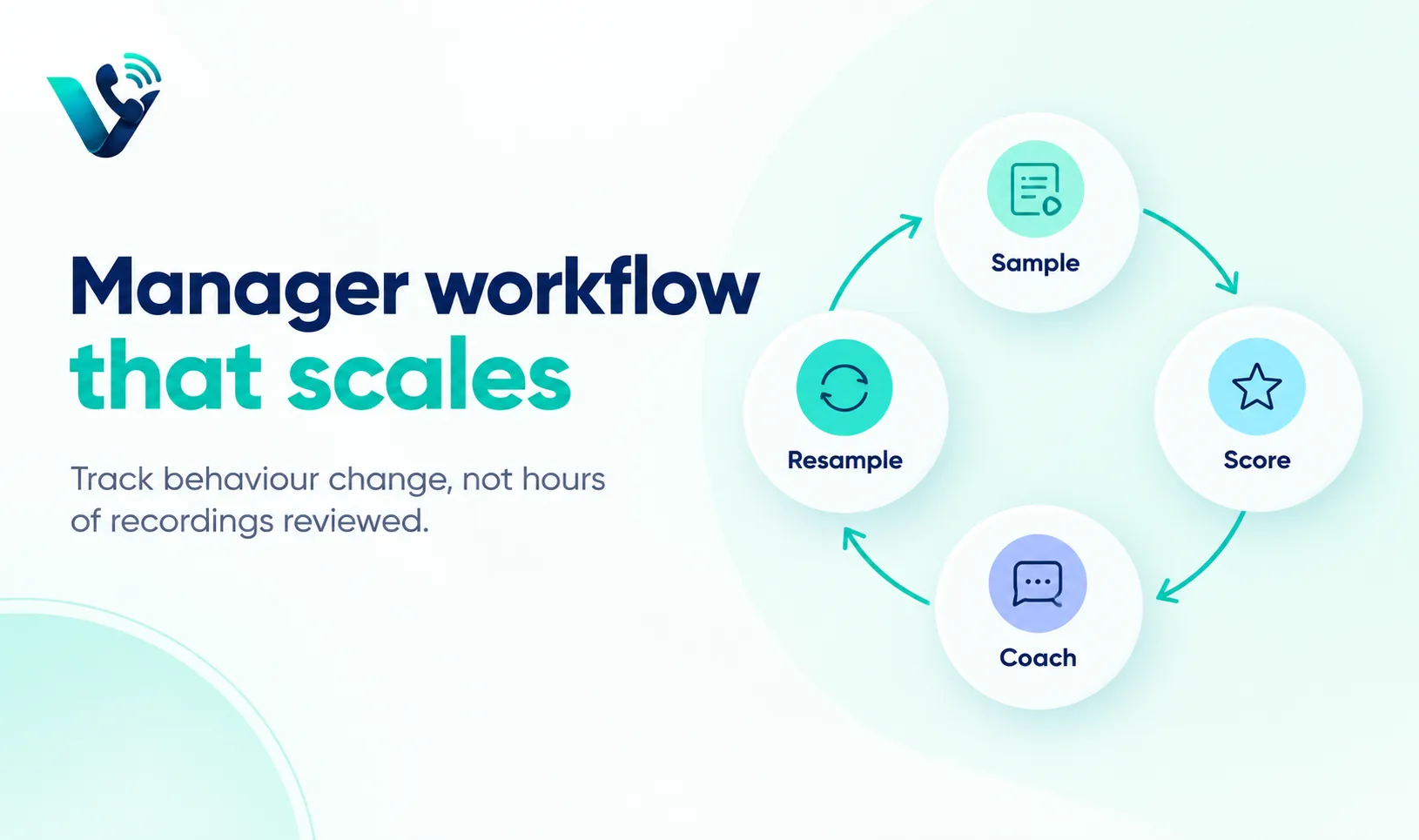
A scalable manager workflow does not require listening to hours of audio every week. It requires a fixed rhythm and a small number of high-value reviews. For example, a manager can select four calls per rep, score them against the same rubric, choose one behaviour for coaching and record the agreed action. The following week, a fresh sample shows whether that behaviour changed.
A practical weekly rhythm is: Sample calls, review and score, hold a short coaching conversation, document one action, then re-sample. Managers should also save a small library of strong examples so the team can hear what effective discovery, objection handling or next-step setting sounds like in real customer conversations.
Measure behaviour change rather than manager activity. Useful coaching measures can include the percentage of reviewed calls with a clear next step, the frequency of a target discovery behaviour, repeat issues on the scorecard and the improvement between one review cycle and the next. Business outcomes such as conversion, repeat contacts or escalation rate can provide context, but they should not be used to judge a single recorded call in isolation.
As the team grows, consistency between managers becomes important. Run occasional calibration sessions where two managers score the same call and compare reasoning. This reveals unclear scorecard definitions and reduces the risk that one team is coached much more strictly than another.
How to connect this topic to Votelly
For Votelly, this topic is best connected to the broader business-calling workflow rather than presented as a claim about a specific coaching feature unless that capability is confirmed on the live product. The educational value is the process: Teams need reliable call activity, clear ownership and a consistent place to review how customer conversations are handled. Link readers to the most relevant live Votelly page once the exact feature set and URL have been confirmed. A safe brand destination remains www.votelly.com.
This article can also sit inside a useful content cluster. Link it contextually to guides on after-hours routing, overflow handling, voicemail workflows and remote call-centre setup. Those topics cover what happens before and after the conversation, while this guide explains how managers can learn from the conversation itself. Together they show how a calling workflow can be routed, recovered, measured and improved without forcing unrelated product claims.
Frequently asked questions
- What is call recording for coaching?
- Call recording for coaching is a structured process in which managers review selected recorded conversations, use a consistent scorecard, give specific feedback and then check later calls to see whether the target behaviour improved.
- How should a small team start with call recording for coaching?
- Start with a small weekly sample, a short scorecard and one manager who owns the process. Coach one behaviour at a time and review later calls before expanding the programme.
- What should be measured?
- Measure observable behaviour change first: Clearer next steps, stronger discovery, fewer repeated coaching issues or better compliance with the agreed call structure. Use business outcomes such as conversion or repeat contacts as supporting context.
- How often should the setup be reviewed?
- A weekly or fortnightly coaching rhythm works well for an active team because reps have enough calls to practise between reviews. The scorecard itself can be reviewed quarterly or whenever the sales or service process changes.
- Can automation replace human ownership?
- Automation can help surface recordings, transcripts or call data, but the manager still needs to choose the coaching priority, interpret context and decide what the rep should practise next.
- How can Votelly fit into the workflow?
- Votelly can be positioned as the business-calling layer around the workflow where relevant live capabilities are confirmed. Keep product claims tied to verified features and use the article primarily to explain the management process behind effective coaching.