Average Handle Time: When Reducing AHT Makes Service Worse
By Jamila Parker · · 7 min read

the AHT formula, why lower is not always better, and how to improve handling efficiency without rushing customers or increasing repeat contacts.
Key takeaways
- NICE describes AHT as the combined time used to handle a transaction, commonly including talk, hold, conference and wrap time, divided by total handled contacts..
- AHT can fall for good reasons: better knowledge search, fewer system clicks, clearer scripts, improved routing or automation of repetitive after-call work..
- If agents are pressured to end calls early, they may skip discovery, avoid complex issues or create unnecessary transfers.
- Measure where time is spent.
- Measure the result after implementation and adjust the workflow using real customer and call data.
Average handle time (AHT) measures the average amount of agent time required to complete an interaction. It typically includes talk time, hold time and after-call work. Because AHT affects staffing and cost, managers often try to reduce it. The danger is turning an efficiency metric into a speed target that encourages agents to rush customers.
Votelly context: For contact-center reporting, phone data becomes more useful when the same queue definitions and call-handling rules are used consistently, so managers can compare performance over time instead of comparing mismatched metrics. Explore Votelly
What is included in AHT?
NICE describes AHT as the combined time used to handle a transaction, commonly including talk, hold, conference and wrap time, divided by total handled contacts.
Operationally, this is where what is included in aht? becomes measurable rather than theoretical. Map the current process first, then change one variable at a time so the team can see whether the new approach improves responsiveness, conversion or customer effort.
The exact components differ by platform, so teams should publish their formula before comparing agents or periods.
A useful way to apply this is to test the rule on a defined segment instead of changing every call flow at once. For average handle time, a controlled rollout makes it easier to spot edge cases, compare before-and-after results and correct problems before scale adds complexity.
Practical note: Set a baseline before changing the workflow so the impact can be measured rather than guessed.
When lower AHT is genuinely better
AHT can fall for good reasons: Better knowledge search, fewer system clicks, clearer scripts, improved routing or automation of repetitive after-call work.
The customer impact should stay visible in the decision. Ask what the caller or prospect experiences before, during and after the call, then make sure the configuration supports that journey rather than only making the internal workflow look efficient.
In these cases the customer gets the same or better outcome with less friction, so efficiency improves without sacrificing quality.
For managers, the important step is ownership: Decide who monitors the result, which threshold triggers a review and what fallback applies when the preferred path is unavailable. That turns when lower aht is genuinely better into a repeatable operating process.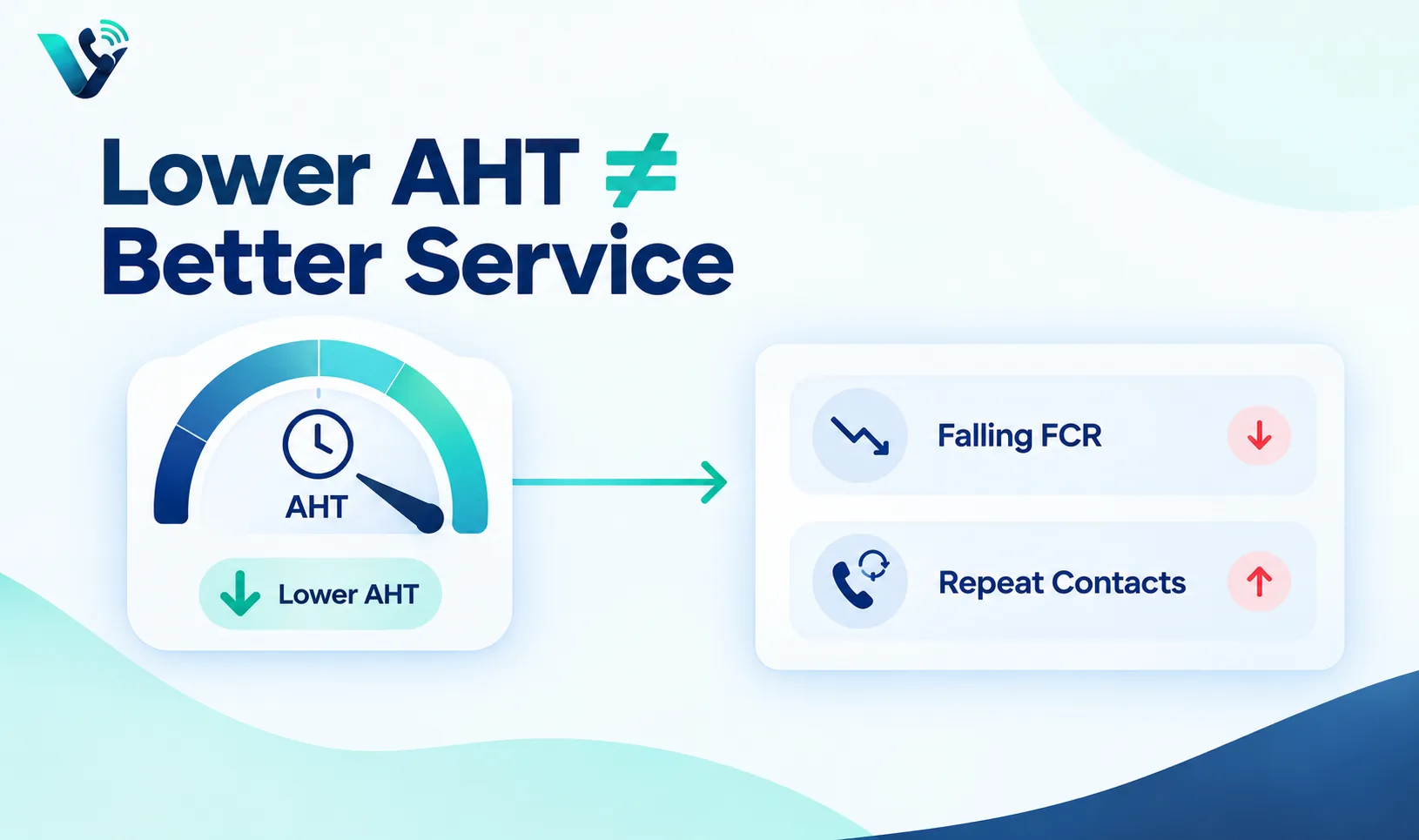
Practical note: Set a baseline before changing the workflow so the impact can be measured rather than guessed.
When lower AHT makes service worse
If agents are pressured to end calls early, they may skip discovery, avoid complex issues or create unnecessary transfers. Customers then call back, increasing total workload.
Data quality can change the result as much as the phone setting itself. Verify contact details, agent availability and routing inputs before judging performance; otherwise the team may blame average handle time for a problem created by incomplete or inconsistent data.
A falling AHT paired with falling FCR or customer satisfaction is a warning sign that the metric is being optimized at the expense of the outcome.
Avoid optimizing this in isolation. Pair the primary metric with a customer-outcome measure so improvements in speed or volume do not quietly increase transfers, repeat contacts, missed calls or low-quality conversations.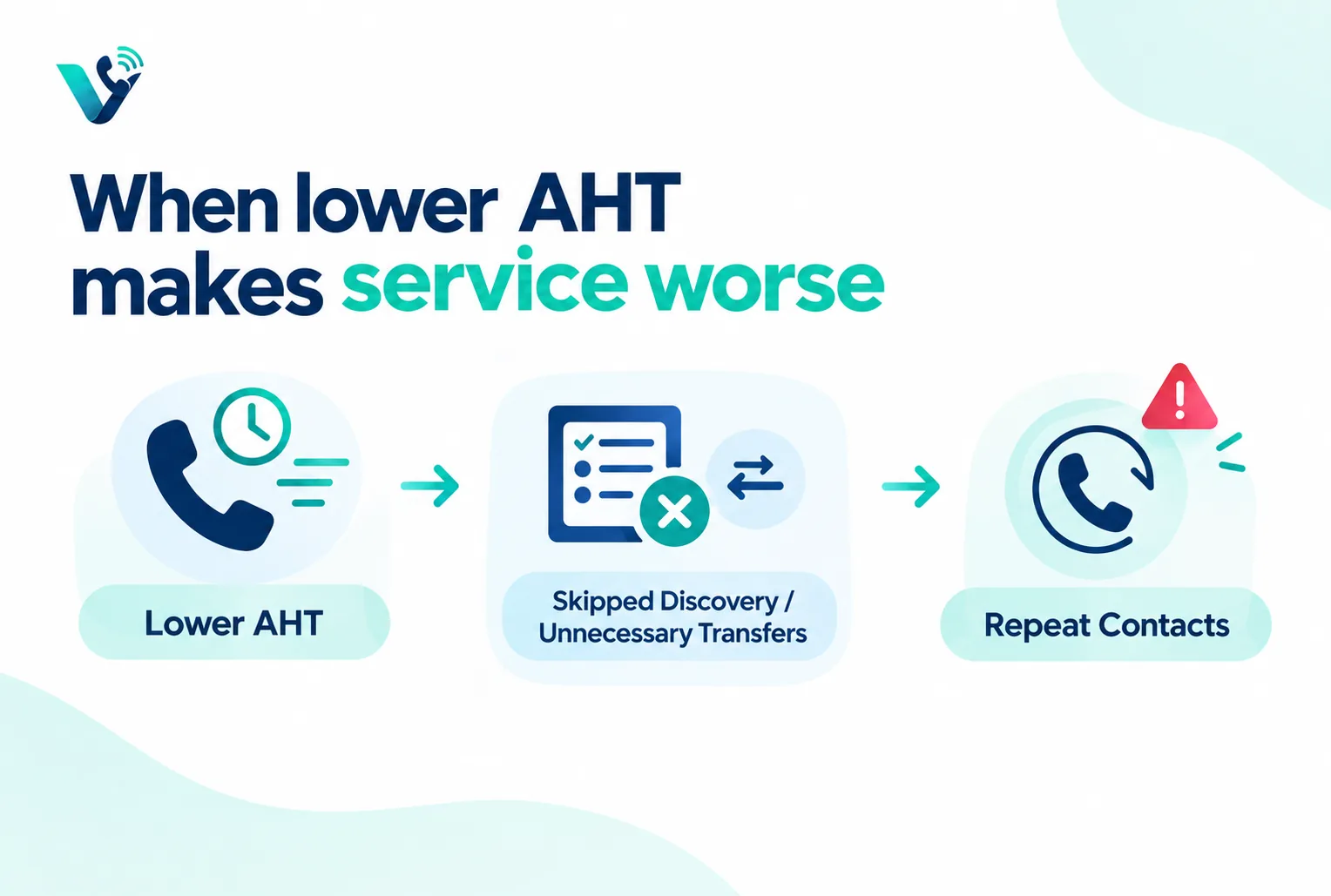
Practical note: Test the experience from the caller side as well as the agent side before expanding the change.
Improve AHT by removing friction, not conversation
Measure where time is spent. Long holds may point to slow internal escalation, while excessive wrap time may indicate duplicate data entry.
The safest implementation is incremental. Define the desired outcome, test the behavior with real traffic, collect agent feedback, and keep the rollback path simple. Once the workflow is stable, expand it to additional teams or markets.
Give agents better customer context, searchable knowledge and standardized dispositions. These changes reduce waste without shortening the part of the call that creates value.
This decision also needs a clear exception path. Calls rarely behave exactly as planned, so document what happens during peaks, after hours, on failed connections and when no suitably available agent can take the interaction.
Practical note: Keep the first rollout narrow enough that the team can identify the cause of any improvement or regression.
Use AHT as an input, not a standalone score
AHT is valuable for forecasting and staffing, but agent-level targets should consider contact complexity. Technical support calls naturally differ from simple account updates.
Operationally, this is where use aht as an input, not a standalone score becomes measurable rather than theoretical. Map the current process first, then change one variable at a time so the team can see whether the new approach improves responsiveness, conversion or customer effort.
Pair AHT with FCR, quality, CSAT, transfer rate and repeat contact rate to understand whether the operation is becoming truly more efficient.
A useful way to apply this is to test the rule on a defined segment instead of changing every call flow at once. For average handle time, a controlled rollout makes it easier to spot edge cases, compare before-and-after results and correct problems before scale adds complexity.
Practical note: Review the result by time window, queue or segment so a good average does not hide a weak customer experience.
How to apply this with Votelly
Translate the idea into a simple operating rule: Decide which number receives or presents the call, who should handle it, what happens when the preferred path is unavailable, and which outcome will be reviewed after launch. Votelly can act as the cloud calling layer while your CRM or support workflow keeps customer context and follow-up connected. For customer-facing service planning, also review the customer support page.
Try this on your own numbers
Local numbers in 118 countries, AI call notes and one shared inbox. Live the same day, no contract.
Implementation checklist
- Break AHT into talk time, hold time and after-call work so the team can see which component is creating avoidable delay.
- Review a sample of longer and shorter calls before setting targets; complex support conversations should not be judged against simple enquiries.
- Remove unnecessary agent steps such as duplicate data entry, repeated verification and slow knowledge searches before asking agents to shorten conversations.
- Give agents clear escalation paths so difficult calls do not accumulate long hold periods while they search for help.
- Track first contact resolution and repeat-contact rate alongside AHT to confirm that faster handling is not creating more customer effort later.
- Coach agents on call control and concise communication, but allow enough time for discovery, troubleshooting and confirmation of the resolution.
- Review wrap-up codes, CRM fields and after-call tasks regularly and automate repetitive post-call work where it is safe to do so.
30-day measurement plan
Days 1-7: Establish a baseline for total AHT and its components - talk time, hold time and after-call work by queue and contact type. Review a representative call sample to understand why the longest interactions take longer and whether the extra time is necessary. Record FCR, transfer rate and repeat-contact rate at the same time so the baseline includes both efficiency and service quality.
Days 8-21: Test one friction-reduction change at a time, such as faster knowledge access, a simpler wrap-up form or a clearer escalation route. Compare the affected queue with its baseline and watch for any rise in repeat calls or transfers. Days 22-30: Review the full pattern with agents and supervisors, identify which time savings came from removing waste rather than rushing conversations, and keep only the changes that reduce handling effort without weakening resolution quality.
Common mistakes to avoid
- Treating every long call as poor performance even when the interaction involves complex troubleshooting, retention or multiple customer requests.
- Reducing talk time by encouraging agents to end conversations before the customer has confirmed that the issue is resolved.
- Focusing on total AHT without separating talk, hold and after-call work, which hides the part of the workflow that actually needs improvement.
- Celebrating a lower AHT while first contact resolution falls or repeat contacts and transfers increase.
- Setting one universal AHT target across queues with very different call types, customer needs and levels of complexity.
Conclusion
Average handle time is most useful when it helps a team find wasted effort, not when it becomes a countdown clock for agents. Break the metric into its components, compare similar types of interactions and connect any AHT change to resolution quality, repeat contacts and customer feedback. The strongest improvement is not simply a shorter call; it is a call that reaches the right outcome with less unnecessary work for both the customer and the agent.
Frequently asked questions
- What is average handle time?
- Average handle time is the topic covered in this guide. In practice, the exact setup or calculation depends on the phone system, market, queue design and the business process around it.
- What is the main business benefit of average handle time?
- The main benefit is better control over how calls are placed, answered, distributed or measured, which can reduce avoidable friction for customers and teams.
- What should I check before changing average handle time?
- Review the current process, the customer journey and the data related to what is included in aht?. Confirm any number, privacy or caller-ID requirements that apply to your market before rollout.
- How should I measure whether average handle time is working?
- Choose metrics that match the objective. Depending on the topic, that may include answer rate, ASA, service level, abandonment, transfers, repeat contacts, qualified conversations or conversion.
- Can a small business use average handle time?
- Usually, yes, but the simplest configuration is often the best starting point. Small teams should avoid adding routing or automation complexity that they do not yet need.
- Can Votelly support a average handle time workflow?
- Votelly is designed around cloud business calling and number management. Check the live product and country availability for the exact feature, number type or routing behavior you plan to use.