Follow-the-sun support: how to route calls across time zones
By Jamila Parker · · 8 min read

Follow-the-sun support keeps customer calls moving between regions as local teams finish their day. Here is how to design the handoff.
Key takeaways
- Follow-the-sun support works only when ownership moves clearly between regions instead of leaving unresolved calls in a shared queue.
- Route callers according to customer region, language, service line and local operating hours rather than one global clock.
- A good handoff includes the customer history, current issue, promised action, priority and the next owner so customers do not have to repeat themselves.
- Short overlap windows between regions make live escalations, urgent callbacks and complex cases much easier to transfer cleanly.
- Holiday calendars, daylight-saving changes and regional outages should be tested because schedule errors can silently send calls to the wrong team.
Follow-the-sun support is designed to keep customer service moving as working hours shift from one region to another. Instead of forcing one team to cover every hour, responsibility passes across time zones so customers can reach an active team for more of the day. The idea sounds simple, but the quality of the experience depends on the handoff. If calls are routed correctly but context, ownership or promised follow-up disappears at the regional boundary, the model creates more frustration rather than less.
A strong follow-the-sun workflow therefore combines time-zone-aware routing with clear case ownership, consistent notes, realistic overlap periods and tested fallback rules. The phone system decides where the call should go; the operating process decides who owns the customer after the call arrives. This guide focuses on both sides so the model works for real customers rather than only looking tidy on a routing diagram.
What follow-the-sun support means
Follow-the-sun support moves active customer responsibility between regional teams as local working days begin and end. For example, an Asia-Pacific team may handle calls first, Europe may take over later, and North America may continue coverage after Europe closes. The customer should experience one support organisation even though different teams are working behind the scenes.
The model is most useful when customers are distributed across time zones, response expectations extend beyond one office day, or the business already has teams in multiple regions. It does not automatically require 24/7 live support. A company can use the same principles to extend coverage from eight hours to sixteen or twenty hours while keeping overnight periods on voicemail or callback.
The key design decision is ownership. A call that reaches the next region must become that team's responsibility until it is resolved or deliberately handed back. If each office sees itself only as temporary cover, customers can end up passed between teams with nobody accountable for the final outcome.
Before changing routing, map the support day on one timeline. Mark when each region opens, when it closes, where shifts overlap and which periods have no live coverage. That simple map usually reveals the real routing rules the phone system needs.
Route by customer time, not company time
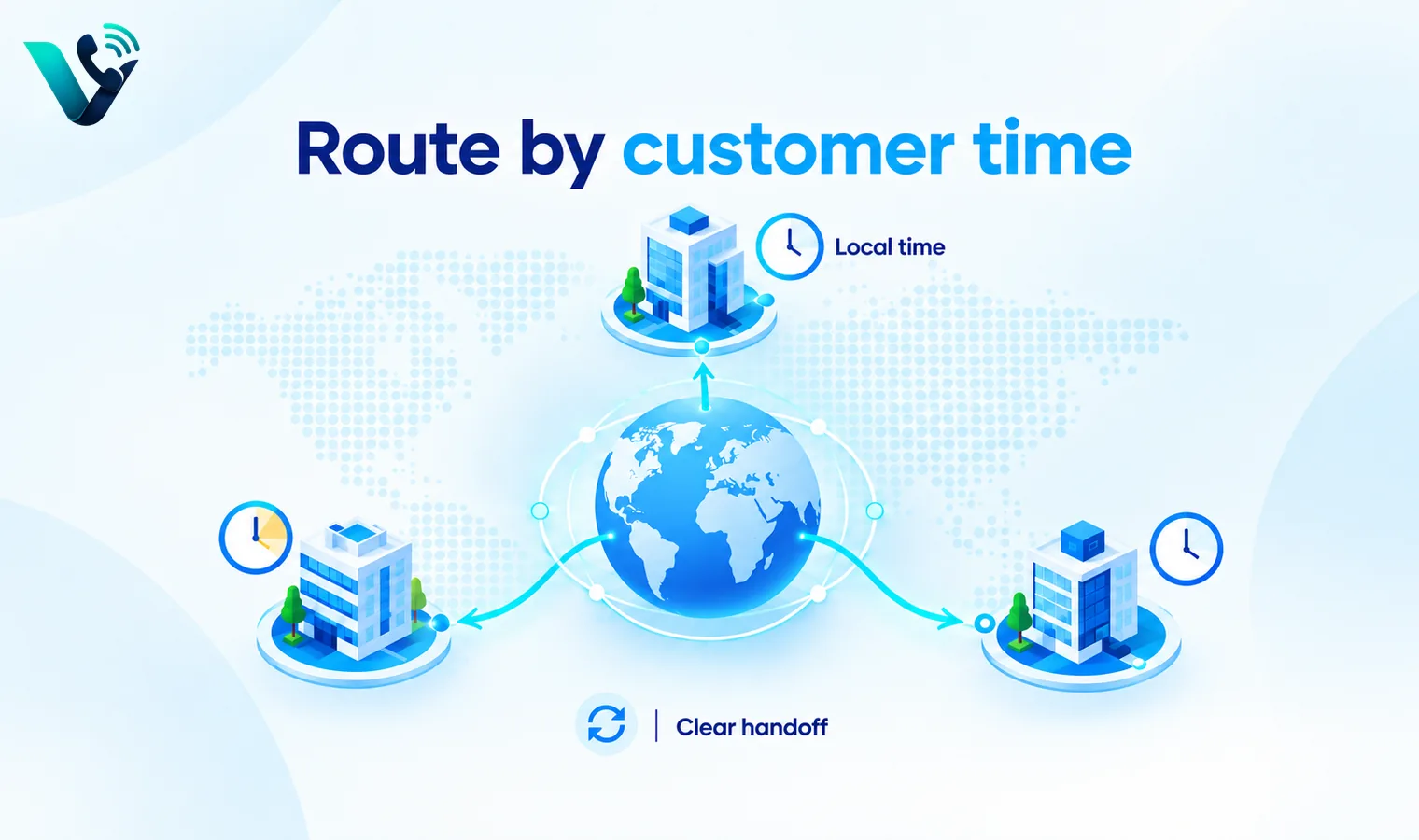
Routing should start from the customer context rather than the headquarters time zone. Useful signals can include the number dialled, the customer's account region, selected language, service line, contract tier or local business hours. A caller in Singapore should not be sent to a sleeping US team simply because the company default time zone is set to New York.
Keep the first routing decision understandable. If region and language are enough to choose the right team, avoid adding unnecessary branches. More conditions make exceptions harder to predict, especially when holidays, temporary closures or staff shortages change normal availability.
For global numbers, decide what should happen when the preferred regional team is open but overloaded. The next-best option might be another region with the same language skills, an overflow queue, or a callback offer. That fallback should be intentional rather than whichever route happens to be configured last.
Test caller-ID presentation and callback behaviour across regions as well. A customer who calls one business number should not receive a confusing callback from an unrelated personal or international number unless that experience is expected and explained.
Design the handoff
The handoff is the most important part of a follow-the-sun model. A receiving team needs enough information to continue the conversation without asking the customer to start again. At minimum, the handoff should show who the customer is, why they contacted the business, what has already been tried, what was promised, the priority level and the next expected action.
Use a shared CRM, support record or case timeline as the source of truth. Avoid relying on private chat messages or personal notes that disappear when the original agent signs off. The record should be updated before the outgoing region closes, not several hours later when memory is less reliable.
Create a clear handoff status. Terms such as 'awaiting customer', 'needs regional follow-up', 'urgent - continue today' and 'monitor only' are more useful than a generic open/closed state. The receiving team should be able to see immediately which items require action and which are simply visible for context.
For high-priority cases, require an explicit acceptance from the next region. A brief acknowledgement prevents urgent work from sitting unnoticed in a shared queue. The outgoing agent can then close their shift knowing that responsibility has actually moved rather than merely being assigned.
Build overlap between regions
A short overlap period between regions makes the handoff much stronger. Even 30 to 60 minutes can give teams enough time to discuss urgent cases, clarify unclear notes and transfer live calls without sending customers back through the main queue.
Use the overlap selectively. It does not need to become a long daily meeting. A quick handoff list can cover active escalations, promised callbacks, incidents affecting many customers and any unusual routing issue the next region should know about.
When there is no overlap, strengthen the written handoff. Require a concise summary and next action before the outgoing team signs off, then let the incoming team review the priority list at the start of the shift. This creates a predictable transfer even when schedules do not physically overlap.
Review whether the overlap is placed at the right time. If most urgent handoffs occur one hour before the scheduled overlap, move the overlap rather than forcing agents to wait. The purpose is to match real demand, not preserve a timetable that looked good during setup.
Holiday and daylight-saving logic
Regional calendars are easy to underestimate. Public holidays, local observances and daylight-saving changes can alter availability even when the normal weekly schedule is correct. A routing plan that works in March may silently fail in October when one country changes clocks and another does not.
Maintain holidays centrally and give one person or team responsibility for updating them. Avoid relying on individual agents to remember to change presence or forwarding rules. Where possible, test future dates in advance so the business can see which region would receive a call on a holiday or clock-change weekend.
Also plan for one-off events such as training days, severe weather or regional outages. These are not holidays, but operationally they create the same problem: The normal destination is unavailable and another team needs to take over without the customer noticing a broken route.
Add a pre-holiday check to the operating calendar. Confirm schedules, overflow destinations, voicemail messages and callback ownership before major regional closures. A ten-minute check can prevent a full day of calls landing in an empty queue.
Measure the model
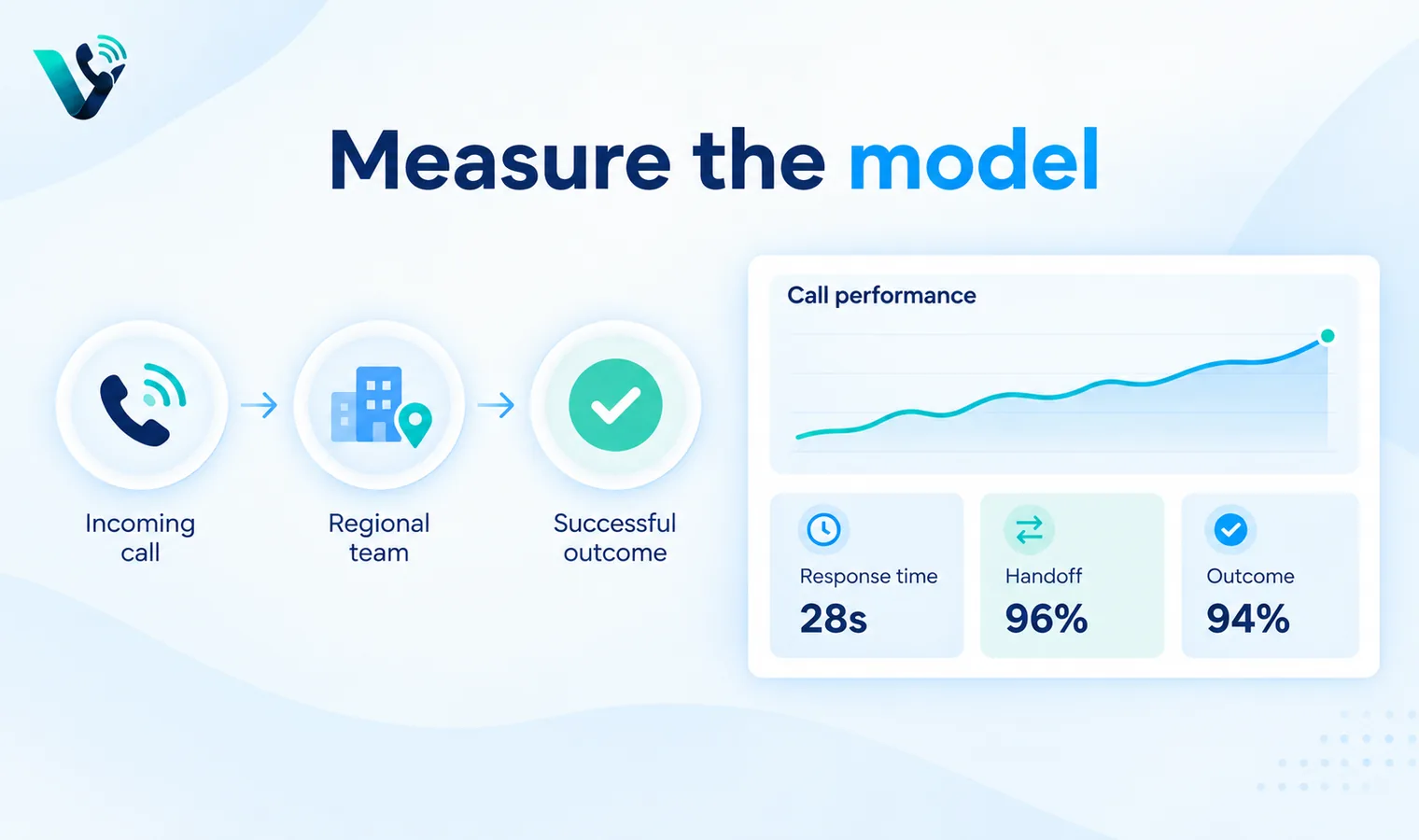
A follow-the-sun operation can appear successful because calls are technically answered somewhere, yet customers may still experience slow follow-up, repeated explanations or too many transfers. Measure the handoff as well as the answer.
Useful measures include response time by region, unresolved interactions at shift end, percentage of priority cases accepted by the next region, transfer rate, repeat contacts within 24 hours, callback completion and cases reopened after a handoff. These reveal whether continuity is real or only theoretical.
Compare regions carefully. One team may handle a different customer mix, language set or issue complexity, so raw call counts are not enough. Look at outcomes and handoff quality alongside workload. A region handling fewer but more complex cases may be performing well even if its average handle time is higher.
Run a monthly handoff review using a small sample of real cases. Ask whether the receiving team had enough context, whether the customer had to repeat information, whether the promised next action happened on time and whether the case should have been transferred at all. The answers often reveal process problems that dashboards miss.
As the model matures, set exception alerts rather than watching every metric continuously. A sudden increase in unresolved handoffs, abandoned calls or callback failures should trigger investigation before the pattern affects a full week of customers.
Try this on your own numbers
Local numbers in 118 countries, AI call notes and one shared inbox. Live the same day, no contract.
How to connect this topic to Votelly
For Votelly, this topic fits naturally around cloud business calling and distributed call routing. The educational message is that one public business number can remain consistent while the internal destination changes according to region, schedule and team availability. Where the live Votelly product supports the required routing behaviour, the article can link readers to the relevant product page. The safe primary brand destination is www.votelly.com.
Keep product claims tied to confirmed live capabilities. The article does not need to promise a specific automation to be useful. It can explain the operating model regional schedules, handoffs, overflow, callbacks and ownership and then show where a cloud calling platform such as Votelly can sit in that workflow.
This guide also connects well to Votelly content on after-hours routing, overflow routing, voicemail workflows, remote call-center setup and call recording for coaching. Those articles cover the neighbouring problems that appear when a preferred team is unavailable or when managers need to maintain quality across distributed agents.
Frequently asked questions
- What is follow-the-sun support?
- Follow-the-sun support is an operating model in which customer responsibility moves between regional teams as working hours shift across time zones. The goal is longer coverage without requiring one team to work around the clock.
- How should a small team start with follow-the-sun support?
- Start with two regions and one clearly defined handoff. Map their working hours, choose the calls or cases that should transfer, define the information that must be passed across, and test the workflow before adding more regions.
- What should be measured?
- Track response time by region, unresolved cases at shift end, handoff acceptance, transfers, repeat contacts, callback completion and whether promised next actions happen on time. These measures show whether customers experience real continuity.
- How often should the setup be reviewed?
- Review routing and handoff performance monthly at first, and always after major schedule, staffing or regional changes. Holiday calendars and daylight-saving transitions should be checked before they take effect.
- Can automation replace human ownership?
- No, automation can route calls, create alerts and move work between queues, but a person or team must still own the customer outcome. High-priority handoffs should have a clearly named receiving owner.
- How can Votelly fit into the workflow?
- Votelly can be positioned as the cloud business-calling layer that supports consistent business numbers and distributed call routing where the live product supports the required behaviour. Verify the exact features and country availability before making detailed product claims.