KYC for International Phone Numbers: Address Proof and Document Checklist
By Jamila Parker · · 6 min read

Buying an international number can require identity, business and address verification. This guide explains the document categories, local-address rules and common rejection reasons.
Key takeaways
- KYC requirements vary by country, number type and whether the end user is an individual or business.
- Names and addresses generally need to match supporting documents exactly.
- Some local numbers require an address inside the country or the number’s locality.
- PO boxes and virtual addresses may not satisfy local-address requirements.
- Check the rule before buying and publishing a number.
Why phone numbers have KYC at all
KYC for international phone numbers exists because regulators and carriers increasingly need to know who is using a number and where the end user is located. Phone numbers are public network resources, and misuse can involve fraud, impersonation, spam, emergency-service problems and national-security concerns.
Providers therefore maintain country-specific compliance programmes. Twilio’s current regulatory guidance, for example, says local rules often require identity documentation, address evidence or business records. There is no single worldwide document checklist the bundle changes with country, number type and end-user category.
The four document categories to prepare
First is proof of identity. Individuals commonly use a passport or government-issued ID. For businesses, identity may be established with a commercial-register extract, incorporation certificate, trade licence or equivalent official record.
Second is proof of address. Common examples include a utility bill, tax notice, government ID showing address, tenancy or rent evidence, title deed or official company register. Third is business registration information such as company number, tax ID, VAT number or local equivalent. Fourth is authorised-representative information for the person responsible for the number.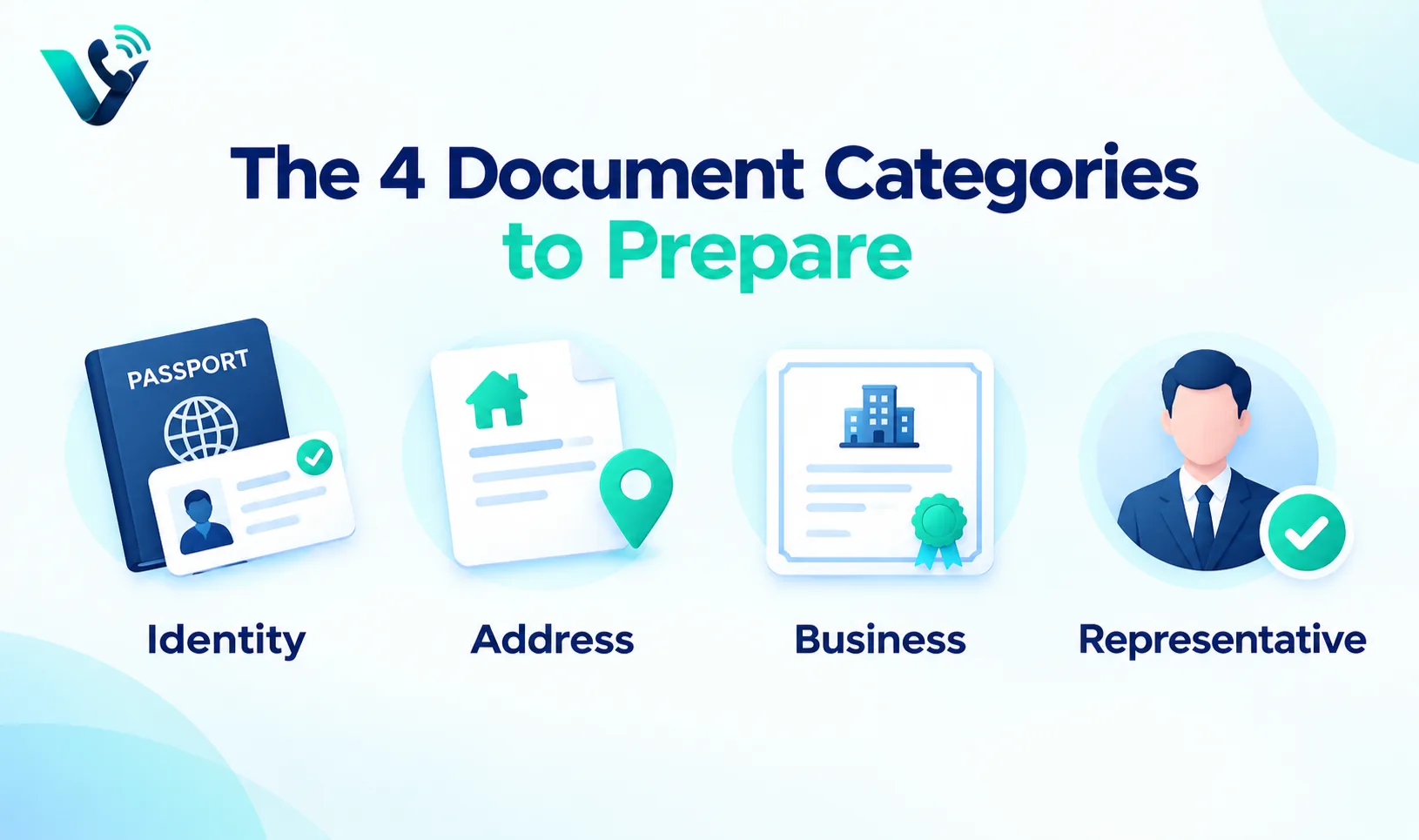
Local address versus any valid address
Some number types allow an address anywhere in the world. Others require an address in the same country. Geographic numbers can require an address in the specific locality or region represented by the prefix.
Twilio’s regulatory FAQ states that a PO box or virtual address is not accepted where a local address is required. It also explains that locality rules often reflect the historical connection between geographic numbers and physical locations. A mailbox that accepts post is not automatically valid regulatory evidence.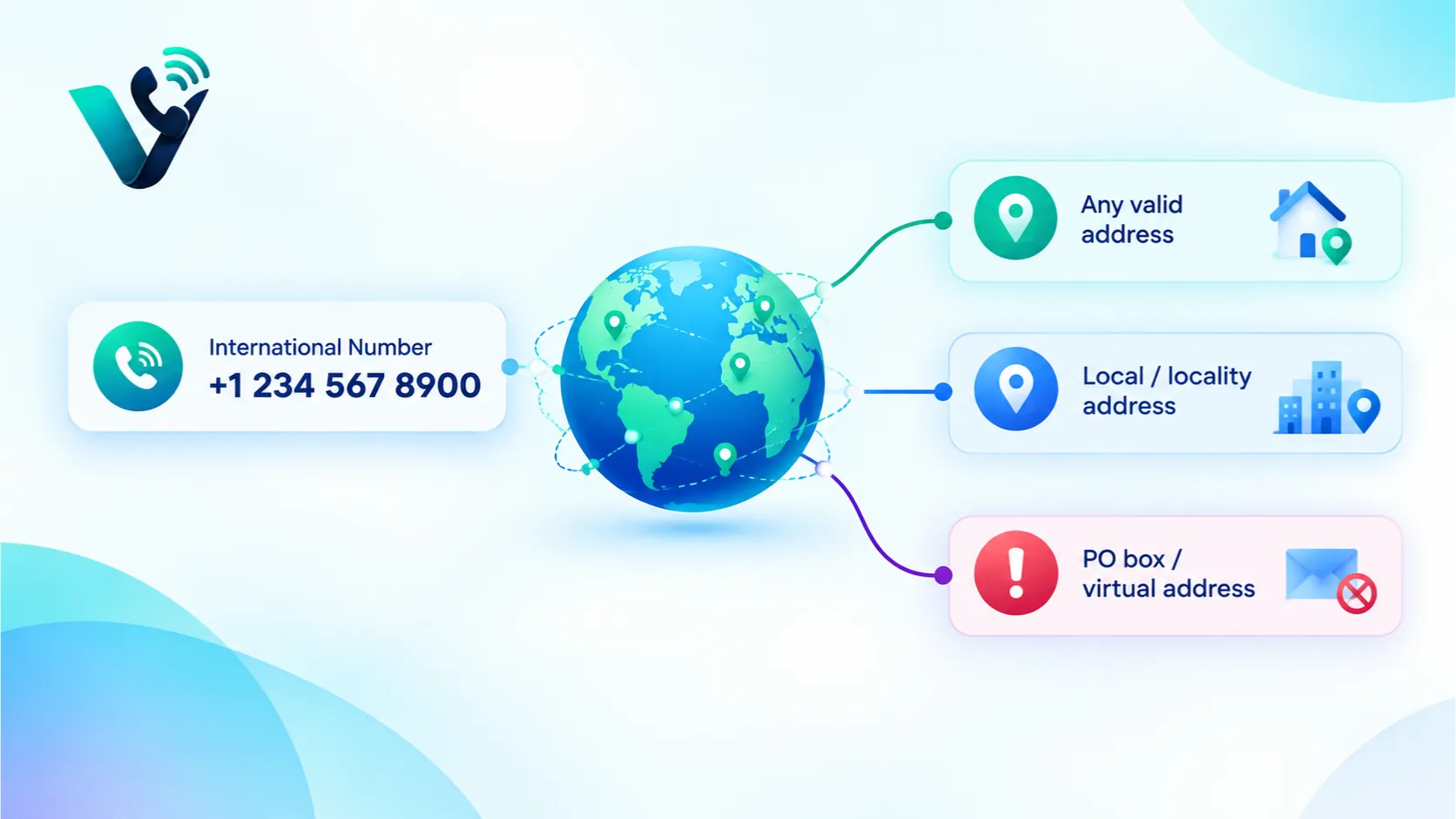
Examples: Germany, Australia and the UK
Germany illustrates a strict local-number model. Twilio’s current guidance says German local numbers are not available to individuals through its service, while businesses may need commercial-register, trade-licence or tax documentation. The address must match the locality or region covered by the prefix.
Australia uses different requirements depending on number type and end user, and some local-number cases require Australian identity and address evidence. In the United Kingdom, Twilio distinguishes local/national numbers from mobile and toll-free numbers; the address requirement can differ between those categories. “A UK number” is therefore not one compliance profile.
Document quality matters as much as document type
A valid document can still fail if it is cropped, blurred, incomplete or inconsistent. Upload the full page and make sure names, addresses, registration numbers and issue dates are readable. If the provider sets a maximum document age, check it before requesting a utility bill or registry extract.
Do not edit or alter documents to make them look cleaner unless the provider explicitly permits redaction. Compliance teams need to verify authenticity, and modified files can trigger additional review.
End user, reseller and provider are different roles
In cloud communications, the account owner is not always the party actually using the number. A software vendor may procure numbers for customers, an agency may manage calling for clients, or a parent company may purchase numbers for subsidiaries.
Regulatory workflows commonly focus on the true end user who will make or receive calls. If you resell numbers, your onboarding process should collect the correct end-user information for each customer rather than reusing the reseller’s details everywhere.
Why KYC bundles get rejected
Common rejection reasons include mismatched names or addresses, expired or unreadable ID, a PO box where a physical local address is required, missing registration numbers, unsupported document types or using an individual application for a number type reserved for businesses.
Another frequent problem is mixing information from several entities. The company name, authorised representative and address proof need to tell one coherent story. Read the rejection literally and fix the failed field rather than changing unrelated details.
Data handling and privacy
KYC files contain sensitive personal and corporate information. Upload them only through the provider’s official compliance workflow. Limit internal access, avoid leaving passport copies in general team folders and record which legal entity was used without retaining unnecessary duplicates of identity documents.
Plan for future updates. Providers can request refreshed information when ownership changes, documents expire or local rules are revised.
Create a reusable country compliance matrix
For international operations, maintain a matrix with country, number type, end-user type, local-address rule, acceptable ID, acceptable address proof, business-registration fields, estimated review time and renewal notes. Store links to the provider’s live rules so staff can verify the latest requirements.
If your company cannot meet the requirement for one number type, choose a lawful alternative whose rules fit your real presence. Do not use false addresses or borrowed identities to force a local number through verification.
A practical document-preparation workflow
Create a folder for each country or legal entity and use consistent filenames such as company-register-date, address-proof-date and authorised-representative-ID. Before uploading, compare every field in the application with the documents character by character. Small differences in punctuation are usually harmless, but different legal names, addresses or registration numbers are not.
If documents are not in a language accepted by the provider, check whether certified translation is required. Never assume an informal translation is sufficient for regulatory review.
KYC for sole traders and freelancers
Sole traders can fall into awkward categories because some countries treat them as individuals while others require business documentation for certain number types. A provider may ask for personal ID plus tax or trade registration, or may simply make the number type unavailable to that category.
This is why freelancers should check eligibility before promising a local number to clients. If the local range is business-only and the sole trader does not qualify, a national or toll-free alternative can be cleaner than trying to force the wrong end-user type through KYC.
Try this on your own numbers
Local numbers in 118 countries, AI call notes and one shared inbox. Live the same day, no contract.
What happens after approval
Approval is not always permanent. A provider can request re-verification when a company changes address, authorised representative or legal name, or when local regulation changes. Keep the compliance owner and renewal process documented.
If a number is transferred to another department, subsidiary or customer, confirm whether the end-user record must change. The compliance file should reflect who actually uses the number today, not only who bought it originally.
Where Votelly fits
Votelly can sit behind the public number as the cloud business-calling layer for routing, team access and call management. Keep product-specific claims aligned with the features currently available in your Votelly account and use the live product pages as the source of truth before publishing.
Frequently asked questions
- What does KYC mean for phone numbers?
- It means verifying the identity and, where required, the address or business details of the end user who will use the number.
- Do all international numbers require proof of address?
- No. Requirements vary by country and number type. Some accept any valid address, while others require a local or locality-matched address.
- Can I use a virtual office as proof of address?
- Not where the provider or regulator requires a physical local address. Some providers explicitly reject PO boxes and virtual addresses for local-address requirements.
- What documents are commonly accepted?
- Common categories include passports or government IDs, utility bills, tax notices, tenancy evidence, commercial-register records and company registration certificates.
- Why was my KYC application rejected?
- Typical causes are mismatched details, missing registration information, expired or unclear documents, or applying for a number type your end-user category cannot use.
- Can requirements change after I buy a number?
- Yes. Regulations and carrier policies change, so providers may request updated information to keep numbers compliant.