Japan and South Korea Numbers: Documentation Checklist
By Jamila Parker · · 8 min read

A practical checklist for Japan and South Korea virtual numbers covering number types, documentation, local presence, routing, portability and messaging.
Key takeaways
- Prepare business identity, authorised-user and address documentation before ordering.
- Japan and South Korea number types have different service expectations.
- South Korea’s 070 internet-phone numbering is a useful reference point for IP telephony.
- Portability, SMS and verification should be checked separately.
- Use a documented provider checklist rather than assuming one APAC country works like another.
For an APAC expansion plan, the safest buying process starts with the exact number category and the documentation attached to that category. Japan and South Korea virtual numbers should be evaluated separately because a feature available in one market does not automatically transfer to the other. Build the provider checklist before launch, then connect the approved number to a clear routing and CRM process.
Why a documentation checklist matters
Japan and South Korea are both advanced digital markets, but businesses should not assume that a virtual number bought in one country can be replicated in the other with the same documents. Numbering, identity verification, service class, address evidence and messaging rules can differ. A good preparation process therefore begins with documentation rather than with the number search screen. The provider should confirm exactly what it needs and whether the requested number can be assigned to a business whose employees are located outside the country.
Treat documentation as part of product selection, not an administrative task left until the end. Ask the provider to list every requirement for the exact Japan or South Korea virtual number being considered, including the business entity, authorised user, address evidence and intended use. Keeping that checklist beside the commercial quote makes it easier to compare providers on real deployability rather than headline price alone.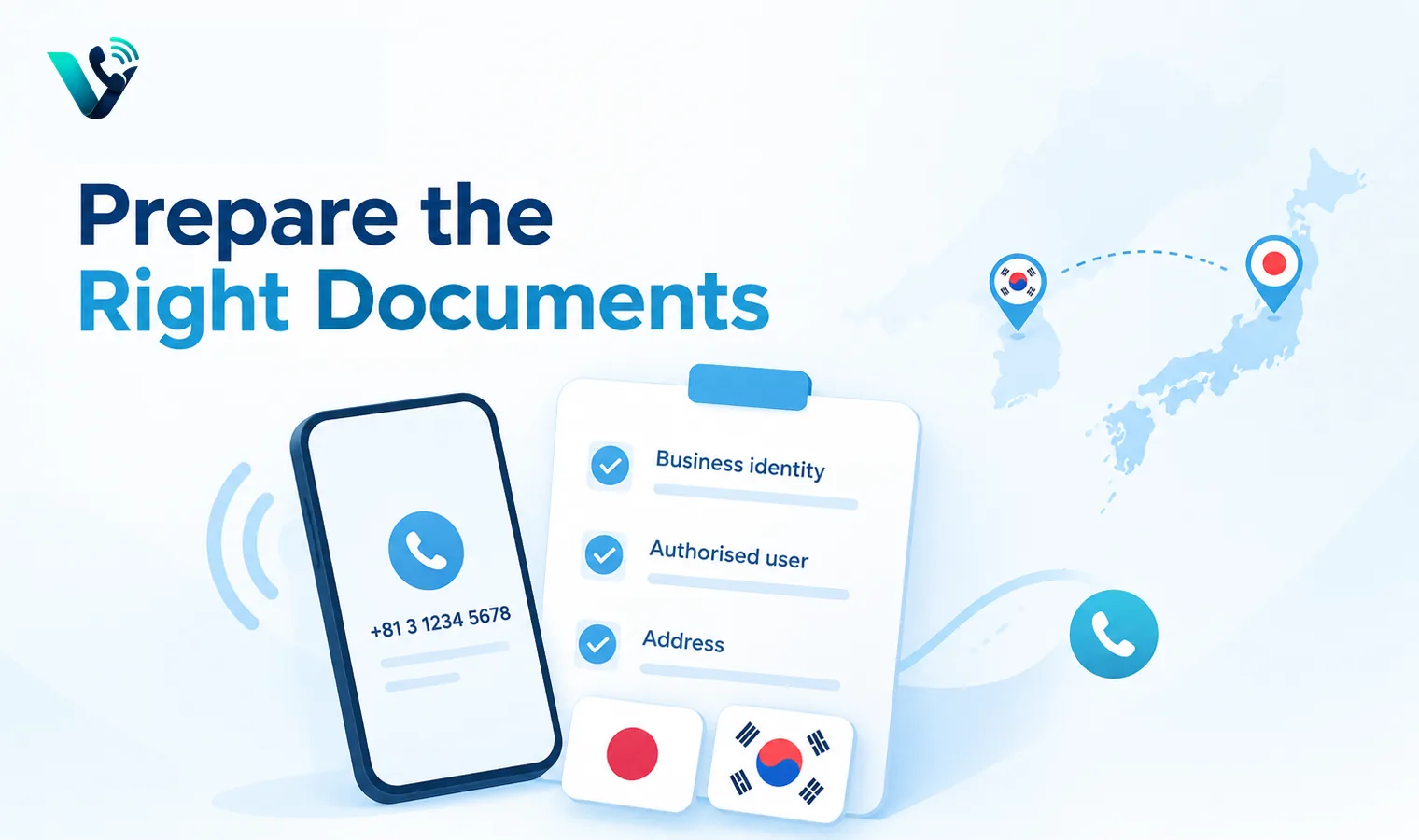
Japan: Define the number type first
For Japan, start by identifying whether the business needs a geographic fixed-line number, a mobile number, an IP-based service or another category. The customer-facing purpose matters because a number associated with a geographic area can create different expectations from a nationwide or IP telephony service. Ask the provider whether the number can be answered abroad, whether a Japanese service address is required, whether outbound caller ID is supported and whether SMS is available on the exact range.
For a Japan virtual phone number, the first decision should be the customer-facing use case. A geographic number, mobile-style service and IP-based service can create different expectations and may support different features. Write down whether the number is for inbound sales, support, appointments or campaign tracking, then ask the provider to confirm remote answering, caller ID, messaging and any service-address requirement for that specific range.
Japan documentation checklist
Prepare the legal business name, company registration details, authorised representative information, service or billing address, identity document for the authorised user if requested, and any proof of address or business relationship the provider requires. Also prepare the intended use case: sales, customer support, appointments, service notifications or another purpose. Providers may use the purpose and business identity to determine which number and communication features can be offered.
Prepare one clean document pack before the provider begins verification. Keep the legal company name consistent across registration records, billing details and authorised-user information. If the provider requests identity or address evidence, use current documents and confirm the accepted format before submission. This reduces avoidable back-and-forth and gives the team a repeatable process if it later adds another Japan business number.
South Korea and the 070 internet-phone category
South Korea has a well-established internet-phone category associated with 070 numbers. A Korean Communications Commission publication describes internet phones as usable wherever internet access is available and notes that existing home-phone numbers could be applied to an internet phone through number porting in the service described. This shows why Korean cloud telephony should be evaluated as a regulated service category rather than simply as an app feature.
The 070 category is a useful reminder that a South Korea virtual phone number belongs to a defined telecom service model. Do not evaluate the number only by whether it can ring a browser or app. Confirm the exact service class, how inbound and outbound calls work, whether porting is supported for the use case and which capabilities are attached to the number itself.
South Korea documentation checklist
For a Korean business number, prepare the company name, registration information, authorised representative details, service address if required, and any identity documentation requested by the provider. Confirm whether the requested number is 070 internet telephony or another category. If the business needs SMS, verification codes or outbound sales calls, list those requirements separately. The provider can then confirm which features are supported by the exact number.
For South Korea, separate identity documentation from feature requirements. One checklist should cover company and authorised-user information; a second should list voice, outbound caller ID, SMS, verification and remote-answering needs. This makes it easier for the provider to say which requirements are mandatory for allocation and which depend on the communication feature the business wants to enable.
Local presence and remote answering
A virtual number can often be answered by a remote team, but number eligibility and public representation should remain accurate. Do not use a local number to imply a physical office unless the business actually has one. Instead, present the number as a customer contact route for the market. If a provider requires a local address for allocation, treat that as an eligibility condition rather than something to bypass with a borrowed address.
Remote answering should solve a service problem, not create a misleading location story. If a Japanese or Korean number is routed to another country, configure local business hours, overflow and callback ownership so customers still receive a predictable experience. Public copy can say the business serves that market and offers a local contact route without claiming an office that is not actually operated there.
Portability before replacement
If the business already has a Japanese or Korean number, ask about portability before ordering a replacement. Porting can preserve recognition and printed materials, but it requires ownership verification and coordination between the old and new providers. Keep the old service active until the port is confirmed. Prepare a temporary forwarding or backup path for the cutover period so customers are not sent into a dead line.
Existing numbers often carry more value than a new number because customers, directories and printed materials already know them. Before replacing a Japan or South Korea business number, ask the provider to check portability for the exact range. Keep the current service active, prepare a fallback route and assign one person to own the cutover so the migration does not interrupt customer access.
Messaging and verification are separate
A number that supports inbound voice may not support SMS or automated verification. Twilio's number documentation illustrates the broader principle by exposing voice and SMS capabilities separately and evaluating SMS eligibility at the number level. For Japan and South Korea, ask the provider specifically whether the number can receive domestic and international SMS, whether application-to-person messaging is permitted and whether third-party verification services accept the number type.
Treat SMS and verification as separate buying decisions. A voice-capable number can still have limited or different messaging support, and a number that receives ordinary texts may not be accepted by a third-party verification service. Ask about domestic and international SMS, application-to-person messaging, sender rules and number-level capability before the marketing or support team designs a workflow around texting.
APAC CRM workflow
The number should be connected to the same CRM workflow as other markets. Store country, language, source, owner, call outcome and next action. If a number is used for a Japan campaign and another for Korea, preserve that distinction. LeadMino's speed-to-lead and website-form guidance supports the idea that source and ownership should be captured immediately. A regional phone number is much more valuable when it produces a visible, accountable lead record.
Create the CRM fields before calls begin. At minimum, preserve market, number dialled, source, language, owner, outcome and next action. That structure lets the team compare Japan and South Korea campaigns without maintaining separate spreadsheets and helps managers see whether a weak result comes from demand, response time or follow-up execution.
Final documentation checklist
Before ordering, confirm the legal entity, authorised user, address, identification, provider eligibility, number type, intended use, voice capability, SMS capability, portability, caller ID and routing destination. Ask for current written requirements and test the service before publishing it. Japan and South Korea can both support modern IP communications, but a successful launch depends on matching the exact number type and documentation to the service the business intends to provide.
Before launch, perform one final cross-check between the provider approval, phone configuration and public website. The approved number type, company identity, routing destination and enabled features should all match what the business intends to publish. Then test representative inbound calls, outbound caller ID, fallback handling, SMS if required and CRM ownership before any paid campaign goes live.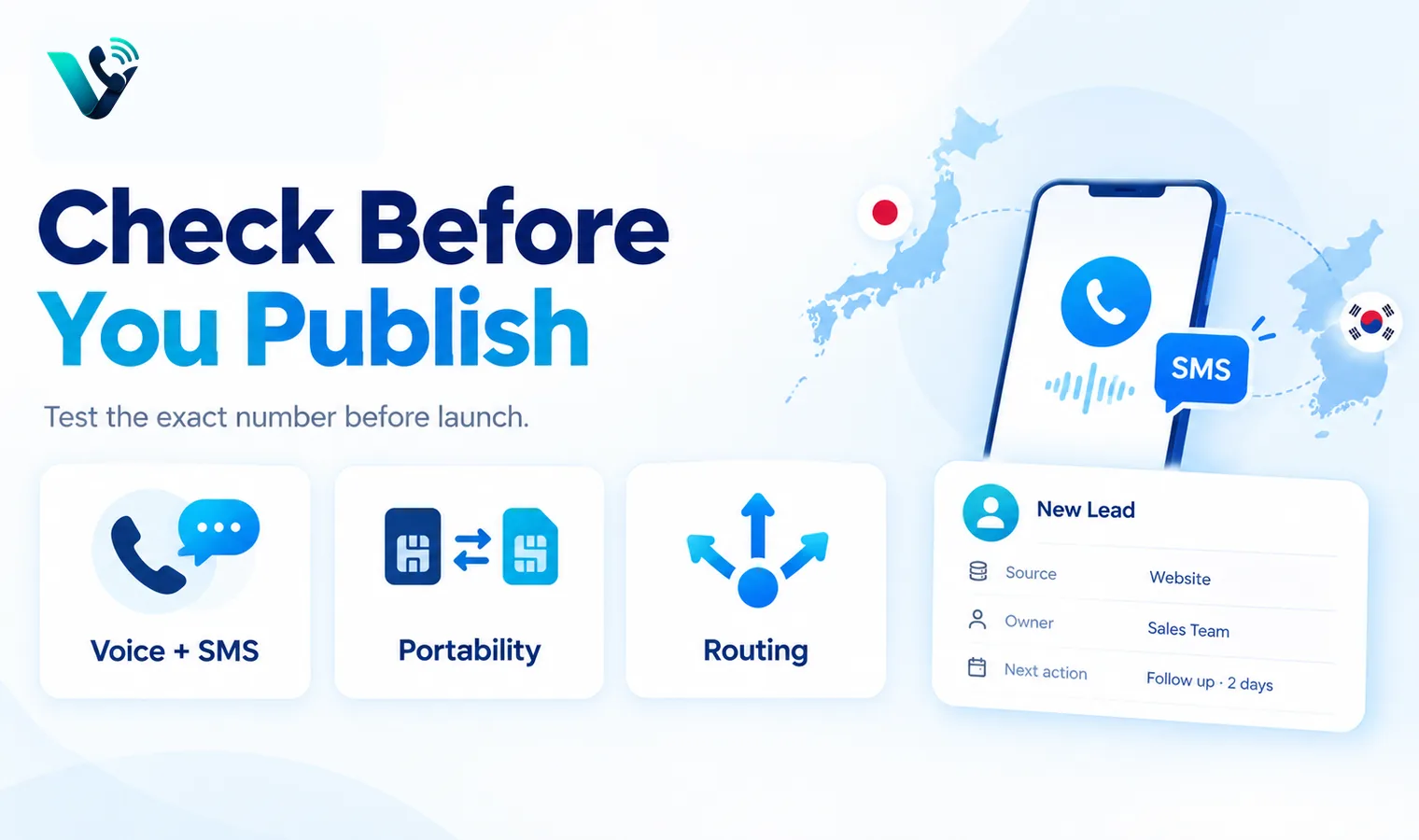
Try this on your own numbers
Local numbers in 118 countries, AI call notes and one shared inbox. Live the same day, no contract.
Common mistakes to avoid
- Using one APAC checklist for both countries: Japan and South Korea should be validated independently because number categories, documents and supported features can differ.
- Ordering before confirming the use case: Decide whether the number is for sales, support, messaging, verification or another workflow before choosing the range.
- Assuming voice includes SMS: Check messaging and verification separately at the exact-number level.
- Replacing an established number too early: Ask about portability first and keep the existing service active until the migration is complete.
- Using a local number as a fake office signal: Keep the customer-facing location story accurate even when calls are answered remotely.
Practical implementation checklist
Area |
Purpose |
Check |
|
Japan |
Number type + documents |
Confirm local/address requirements |
|
South Korea |
070/internet phone |
Confirm provider eligibility |
|
Both |
SMS/porting |
Validate exact capability |
Frequently asked questions
- What is the main thing to check about Japan and South Korea virtual numbers?
- Check the exact number type, provider eligibility, required documentation and the communication features you actually need.
- Can a remote team use the number?
- Often yes, if the provider supports the routing and the number is eligible for the intended service.
- Does a virtual number automatically support SMS?
- No. SMS capability is separate and should be verified for the exact number.
- Do I need a local office?
- Not necessarily, but some number types or markets can require local presence or address evidence.
- Can I connect the number to a CRM?
- Yes. Connecting calls and messages to a CRM helps preserve ownership, source, status and next action.
- What should I test before publishing it?
- Test inbound and outbound calling, caller ID, business hours, overflow, SMS if needed, and the CRM workflow.
- Should Japan and South Korea use the same provider checklist?
- Use a common internal template, but fill it separately for each country and exact number type because documentation and service capabilities can differ.
- What should be tested before an APAC campaign starts?
- Test inbound calling, outbound caller ID, local business-hour routing, overflow, SMS where required and CRM source/owner capture.