Real-time agent assist: Does it help or distract?
By Jamila Parker · · 8 min read

Real-time agent assist can reduce searching and improve live guidance, but too many prompts create cognitive load. Learn how to design it around agent attention.
Key takeaways
- Every recommendation spends agent attention, so fewer better prompts usually win.
- Use assist for approved knowledge, process reminders and context that changes the next action.
- Ground suggestions in current knowledge and CRM context rather than generic scripts.
- Let agents dismiss irrelevant guidance and use rejection data to improve triggers.
- Pilot one queue and measure resolution, transfers, search time and agent effort.
A suggestion that arrives two seconds late can be worse than no suggestion at all. Real-time agent assist promises to listen to a live customer conversation, detect intent, surface knowledge, remind the agent about required steps, and recommend what to do next. When the guidance is timely and selective, it can reduce searching and help a newer agent perform like someone who knows where everything is. When the screen floods with cards, warnings, scripts, summaries, and next-best actions, the software becomes another participant the agent has to manage.
That makes the central design problem surprisingly human: Attention. A live call already asks the agent to listen, understand, speak, navigate systems, read account context, and decide what matters. Real-time agent assist only helps if it removes more cognitive load than it adds. Accuracy is necessary, but timing, relevance, interface placement, and dismissibility are equally important.
Think in an attention budget, not a feature checklist
Every prompt spends attention. A knowledge article that appears exactly when the caller asks about an unfamiliar return policy may save thirty seconds of searching. A generic sales tip that appears during the same moment competes with the customer. The goal is therefore not maximum recommendations. It is minimum useful intervention: The smallest amount of guidance that changes the next decision or prevents an avoidable error.
Assist event |
High-value version |
Distracting version |
|
Knowledge retrieval |
One approved article appears after a clear intent is detected. |
Five loosely related articles stack while the caller is still speaking. |
|
Compliance reminder |
A required disclosure appears before the relevant step. |
Persistent warnings remain on screen for the entire call. |
|
Next-best action |
One action appears after the system has enough context. |
Suggestions change every few seconds as the conversation evolves. |
|
Customer context |
The relevant account fact is surfaced where the agent already works. |
A separate panel forces the agent to switch windows. |
|
Escalation cue |
A defined risk signal recommends supervisor support. |
Sentiment alone triggers repeated alarms without context. |
Where real-time agent assist helps most
Complex knowledge with a clear right answer
Support teams often have hundreds of policies, product variations, regional rules, and troubleshooting articles. An agent may know the process but not the location of the exact page. Real-time assist can identify the topic and surface the approved source without making the agent search. The value is highest when the knowledge base is curated and current. A fast recommendation from outdated documentation is simply a faster mistake.
Process steps people forget under pressure
Compliance disclosures, identity checks, escalation thresholds, retention offers, and required case fields are good candidates because the correct action is known but easy to miss during a difficult conversation. A prompt can arrive at the point of need rather than asking agents to memorize every branch. The system should explain why the reminder appeared and disappear once the step is completed.
New-hire confidence without a manager in every call
For newer agents, assist can reduce the gap between training and production. It can surface the right answer, a short objection-handling pattern, or a troubleshooting sequence while the call is live. That does not remove the need for coaching. It changes the manager's job from answering basic 'where is the article?' questions to reviewing judgement, discovery, empathy, and resolution quality after the call.
Where it distracts instead
- The recommendation appears after the agent has already moved on.
- The system shows too many cards and forces the agent to decide which AI suggestion to ignore.
- Guidance is written like a script rather than a short cue, so the agent starts reading instead of listening.
- Suggestions are grounded in stale or unapproved content.
- The assist window lives outside the primary agent workspace and creates more tab switching.
- False-positive risk alerts train supervisors and agents to tune the system out.
- Managers measure suggestion acceptance instead of customer outcomes, rewarding compliance with the tool rather than good judgement.
The three-second design test
A useful prompt should be understandable in roughly the time an agent can glance at it without losing the conversation. That does not mean every answer must be three seconds long, but the first layer should be. Show a title, one recommended action, and the reason. Let the agent expand for detail. This progressive disclosure respects the live nature of the call and prevents an information dump.
Practical note: If the agent needs to stop listening to the customer in order to understand the assist, the interface has failed even if the recommendation is correct.
Ground the assist in approved knowledge and workflow
NiCE's current guidance emphasizes grounding because a fluent recommendation is useless if it comes from outdated information. The assistant should retrieve from approved knowledge, customer context, and business workflows rather than inventing. When it recommends an action, the next click should ideally open the relevant process or execute a safe workflow, not leave the agent to search for another system.
This is where CRM integration matters. A good assist layer knows the caller, account, open case, product, and recent interaction history. It should not recommend an introductory script to a customer with a five-year relationship or tell an agent to ask for information already captured in the record. Context quality determines recommendation quality.
Run an experiment, not a company-wide launch
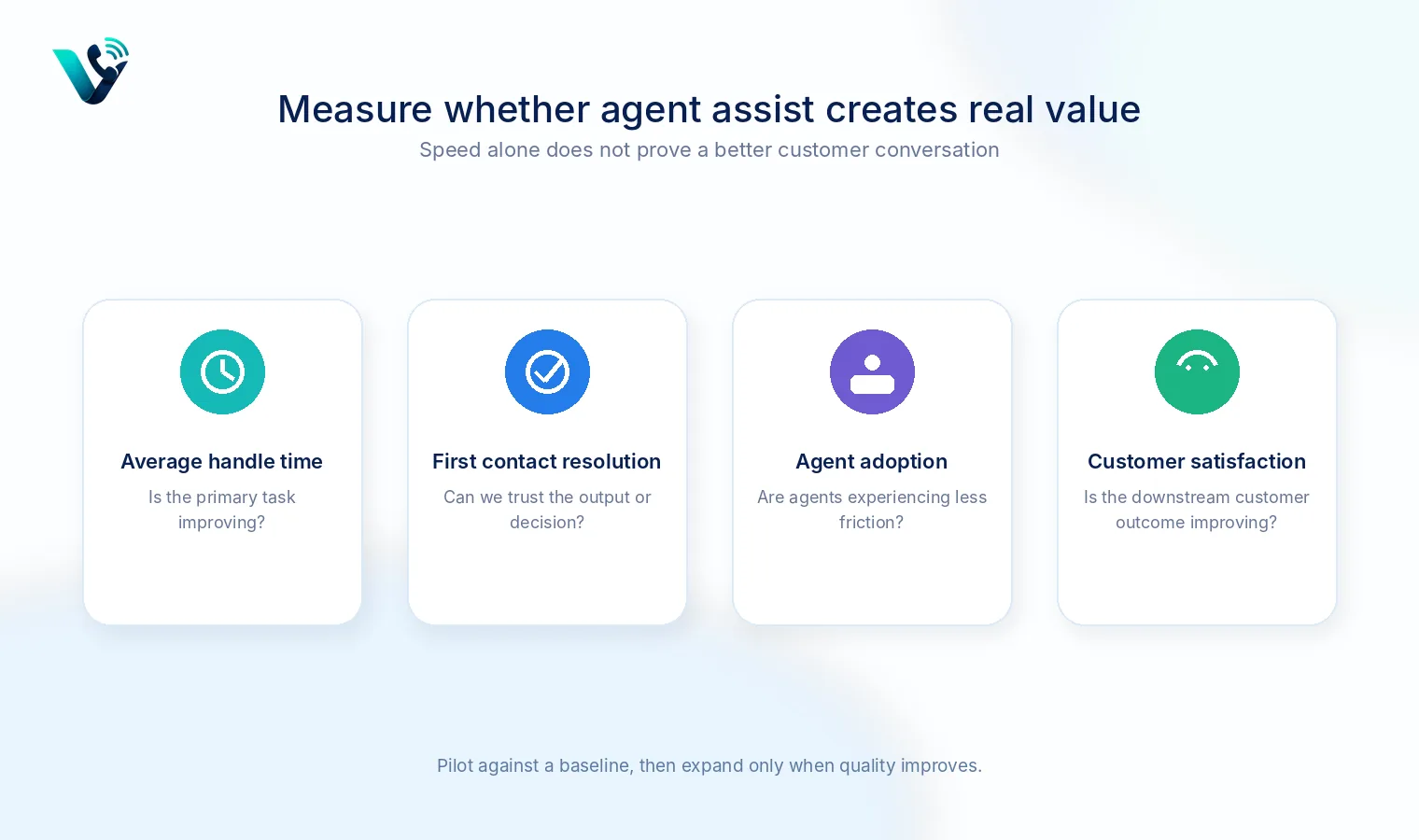
Choose one queue and one use case, such as returns, billing, technical triage, or renewal calls. Run a baseline for two weeks. Measure search time, hold time, transfer rate, first-contact resolution, handle time, after-call work, QA score, and agent-reported effort. Then enable a limited set of assist triggers and compare. The point is to learn whether guidance changes the work, not whether agents say the AI is interesting.
Metric |
Why it matters |
Watch-out |
|
Knowledge search time |
Shows whether assist reduces system navigation. |
Lower search time is not useful if answers are wrong. |
|
First-contact resolution |
Tests whether guidance improves the actual outcome. |
Different case mix can distort the comparison. |
|
Transfer rate |
Shows whether agents can handle more issues themselves. |
A transfer can be the correct outcome for complex cases. |
|
After-call work |
Reveals whether summaries and prompts reduce admin. |
Do not shift work into hidden correction tasks. |
|
Agent effort |
Captures cognitive load and usability. |
Survey alongside behavioural metrics, not instead of them. |
Design for trust, not blind acceptance
Agents should be allowed to ignore or dismiss recommendations. Microsoft smart-assist interfaces explicitly support dismissing suggestions that do not fit the conversation, which is a healthy pattern. Track rejection reasons during rollout. If agents frequently dismiss the same prompt, investigate the trigger or knowledge source instead of coaching people to click accept more often.
Trust also improves when the system exposes its source. A recommendation linked to the approved refund policy is easier to verify than an unexplained sentence. For high-risk guidance, require the agent to open or confirm the underlying source before taking action. The assist should make good judgement easier, not make judgement invisible.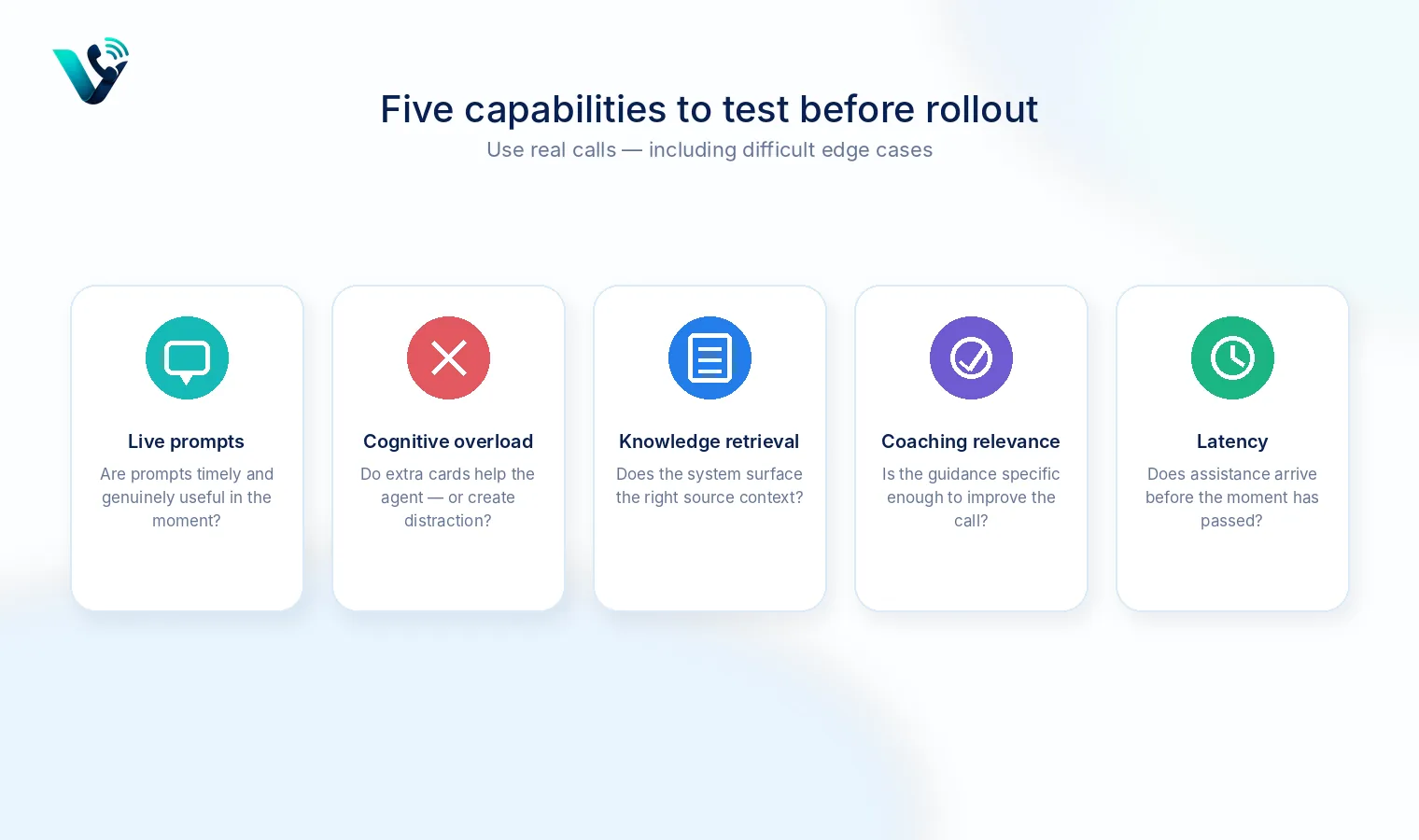
How Votelly can support the surrounding workflow
Votelly's live pages list call analytics, live wallboards, recordings, transcripts, sentiment, AI summaries, CRM integrations, and supervisor tools such as whisper, barge, and scorecards. Those features create the data and management context around agent assistance: Managers can see performance, review the call, coach the behaviour, and keep the customer record current.
If Votelly introduces or markets a dedicated real-time assist capability, the article should link directly to the confirmed feature. Until then, the safe editorial approach is to explain the category and connect readers to related analytics, AI summary, integration, and call-centre pages without implying functionality that is not on the public site.
Supervisor controls need the same attention discipline
Real-time assist is often designed for the agent screen, but supervisors can be overwhelmed too. If every negative word, long pause, policy phrase, or rising queue triggers an alert, the manager gets an alarm console rather than a coaching tool. Create alert tiers. Reserve immediate supervisor attention for a small number of high-consequence events, such as a direct escalation request, a required compliance miss, or repeated failed troubleshooting. Lower-priority signals can feed a post-call review queue instead of interrupting live work. This separates intervention from coaching and keeps managers available for the calls that genuinely need them. It also creates cleaner evaluation data because the team can compare which alerts led to useful action and retire the ones that produced noise.
Try this on your own numbers
Local numbers in 118 countries, AI call notes and one shared inbox. Live the same day, no contract.
Use agent feedback as product telemetry
Give agents a fast reason code when they dismiss a suggestion: Wrong topic, too late, already knew it, outdated source, or not useful for this customer. Those reasons turn everyday use into a tuning dataset. Review them with recommendation acceptance, customer outcomes, and QA samples so the team improves triggers instead of assuming low adoption is a training problem.
So, does real-time agent assist help?
It helps when the agent gets one relevant cue at the moment it can change the call. It distracts when the system treats every detected topic as permission to interrupt. The winning deployment is selective, grounded, embedded in the agent's existing workspace, easy to dismiss, and measured against customer outcomes. Think of real-time agent assist as a quiet expert sitting beside the agent, not a second manager shouting through the screen.
Frequently asked questions
- What is real-time agent assist?
- It is AI-powered guidance that analyzes a live customer interaction and surfaces relevant knowledge, reminders, customer context or next-best actions while the agent is still on the call.
- Does real-time agent assist reduce handle time?
- It can reduce search and navigation time, but the effect depends on recommendation quality, workflow integration and case mix. Measure resolution and quality alongside handle time.
- Can agent assist distract employees?
- Yes. Too many cards, late prompts, stale knowledge and separate windows can increase cognitive load. Selective timing and easy dismissal are important.
- What should a real-time assist system show?
- The best prompts are short, contextual and actionable: an approved article, required disclosure, relevant account fact, next workflow step or escalation cue.
- How should teams evaluate agent assist?
- Run a controlled pilot and compare search time, transfers, first-contact resolution, after-call work, QA results and agent effort against a baseline.
- How does Votelly relate to real-time agent assist?
- Votelly publicly provides analytics, transcripts, AI summaries, sentiment, CRM integrations and supervisor tools that support the surrounding coaching and performance workflow. Verify any dedicated assist feature on the live product.