Sentiment analysis on calls useful signal or expensive vibes
By Jamila Parker · · 8 min read

Call sentiment analysis can surface frustration and recovery at scale, but a score is only useful when it changes a real QA or customer-experience decision.
Key takeaways
- Treat sentiment as a review signal, not a verdict on an agent or customer.
- Pair sentiment with resolution, dispositions, repeat contact and call reason.
- Calibrate models on your own accents, languages and call types.
- Use trend changes and aggregated patterns instead of obsessing over one score.
- Require human review before any high-impact employee or customer decision.
Frustration is easy to hear when a caller raises their voice, repeats the same complaint, or goes quiet after a disappointing answer. Turning those moments into a reliable data point is harder. Sentiment analysis on calls uses AI to estimate whether language or vocal patterns appear positive, neutral, negative, frustrated, uncertain, or improving across the conversation. That can be useful at contact-centre scale because managers cannot manually listen to thousands of calls. The danger begins when a probability score is treated like a fact about the customer, the agent, or the deal.
The right question is therefore not whether call sentiment analysis works. It is whether the signal changes a useful decision. A sentiment score can help a supervisor choose which recordings to review, highlight a policy that repeatedly creates angry calls, or show that customers often calm down after a specific resolution step. It should not become an automatic performance verdict, a compensation input, or a substitute for reading the actual outcome of the interaction.
What call sentiment analysis can actually detect
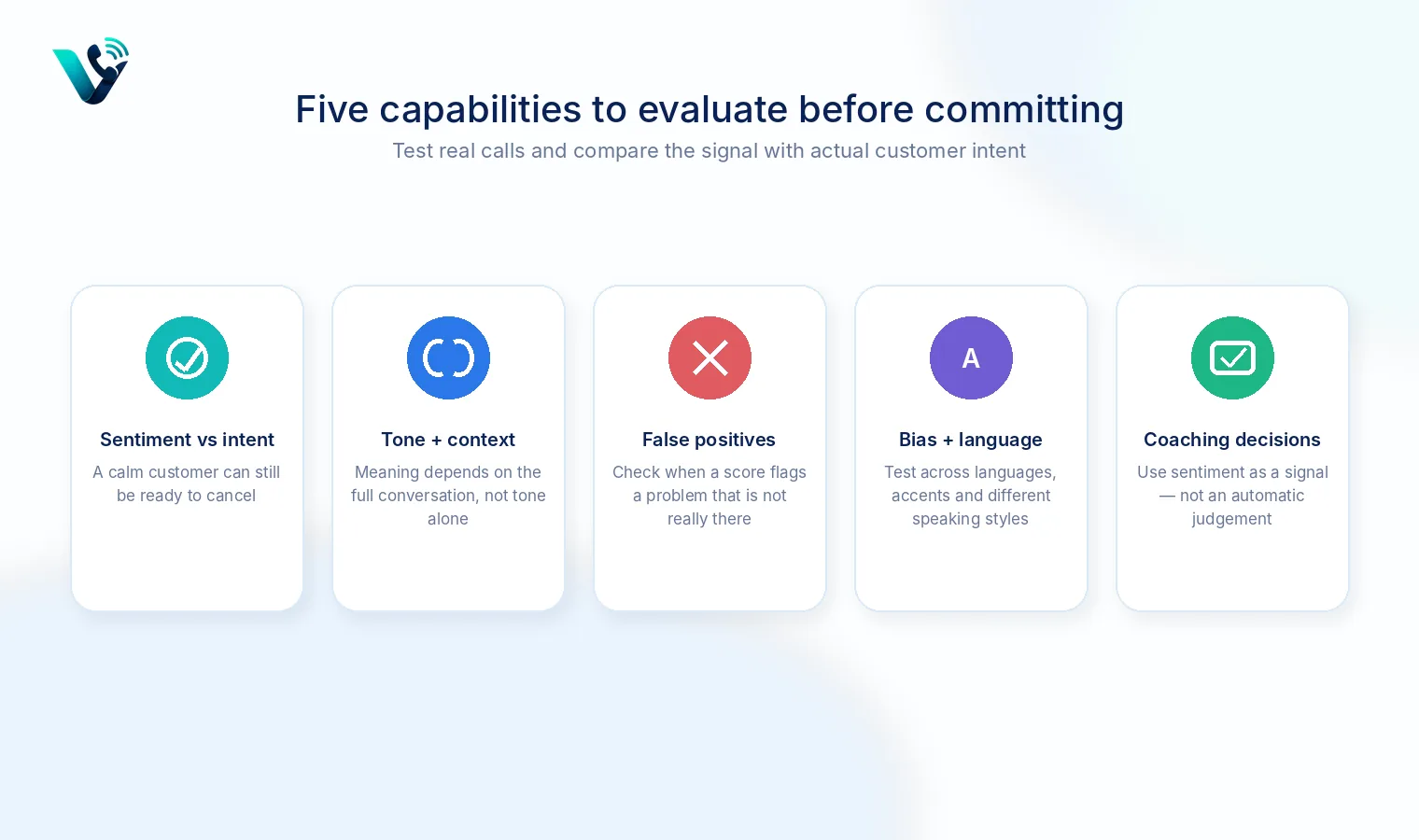
Most modern systems begin with a transcript, acoustic features, or both. Text models look at wording and context; voice models may also consider pace, intensity, pauses, interruptions, and changes across the conversation. The result is usually a score, label, or trend rather than a definitive statement of emotion. That distinction matters because sarcasm, cultural expression, accents, poor audio, background noise, and domain-specific language can all shift the model's interpretation.
- Use sentiment to surface calls that deserve review, not to decide guilt or competence automatically.
- Compare start-to-end movement when possible; a customer who begins angry and ends satisfied tells a different story from one who deteriorates throughout the call.
- Pair sentiment with call reason, resolution, repeat contact, transfer count, CSAT, and disposition data.
- Evaluate the model on your own languages, accents, industries, and audio conditions before relying on dashboard trends.
- Keep the original recording and transcript available so a human can verify why a score changed.
Signal versus verdict: The line that matters
Use case |
Sentiment is useful when… |
Sentiment becomes risky when… |
|
QA sampling |
It helps prioritize a manageable set of calls for a coach to review. |
The score is treated as proof that the agent caused a bad experience. |
|
Customer experience |
It is combined with resolution and repeat-contact data to find recurring friction. |
A negative label is assumed to mean the issue was not resolved. |
|
Live supervision |
A sudden deterioration can prompt a supervisor to inspect a difficult call. |
The model triggers punitive action without context or verification. |
|
Product feedback |
Patterns are aggregated across many calls to identify confusing policies or features. |
One emotional call is generalized into a product conclusion. |
|
Sales analysis |
Sentiment is compared with next steps, objections, and opportunity movement. |
Positive tone is treated as proof that a deal will close. |
Where sentiment analysis earns its keep
-
Finding the calls managers should listen to
A QA team rarely needs another dashboard full of averages; it needs a smarter review queue. Sentiment can narrow a large recording library to calls with sharp changes, prolonged negativity, repeated interruption, or an unusual ending. A coach can then listen to the exact moment, compare it with the transcript, and decide whether the root cause was agent behaviour, a broken process, a product failure, or simply a customer who arrived upset.
-
Finding issues that sit above the agent
Aggregated sentiment is more powerful than a single score. If frustration rises whenever callers discuss a refund rule, delivery delay, identity check, or billing change, the pattern may point to policy friction rather than coaching needs. Combine the signal with topic detection and outcomes. That turns sentiment analysis from a vague mood meter into a way to discover where the customer journey consistently gets harder.
-
Measuring recovery inside the call
A negative opening is not necessarily a bad call. Support agents often inherit frustration created before they answer. A more useful measure is whether the interaction moves toward clarity or resolution. When the customer begins dissatisfied but ends calmer, confirms the next step, and does not call back about the same issue, the conversation may have succeeded even if its average sentiment score remains negative.
Practical note: Votelly's AI call summaries page describes sentiment as a prompt to listen to the recording, not a verdict on a rep or deal. That is the healthiest operating principle for this entire category.
The expensive-vibes problem
Sentiment analysis becomes expensive vibes when a business pays to classify emotion but cannot name the action that follows. A dashboard showing 62% positive, 28% neutral, and 10% negative may look sophisticated while changing nothing. Before buying or enabling the feature, define who reviews the signal, which threshold matters, what other data must be checked, and what decision the result can influence.
-
No owner: Nobody is responsible for investigating negative-sentiment clusters.
-
No denominator: Teams compare sentiment across groups with different call types and customer difficulty.
- No calibration: The model is trusted without checking false positives on real calls
-
No context: Sentiment is separated from disposition, resolution, and repeat contact.
-
No feedback loop: Managers identify a pattern but never change scripts, policies, routing, or coaching.
Build a practical sentiment-review workflow
Start with a narrow use case such as QA prioritization. For four weeks, sample calls flagged as strongly negative or sharply declining, then have human reviewers classify the actual cause. Record whether the alert was useful, misleading, or irrelevant. This creates a local precision benchmark. It also reveals which call categories deserve separate thresholds. Collections, complaints, cancellations, and technical support may naturally sound more negative than appointment booking or renewals.
Next, connect the signal to a second outcome. For support, compare sentiment with first-contact resolution and repeat calls. For sales, compare it with positive dispositions, meetings, and opportunity movement. For customer experience, compare it with complaint themes and CSAT. The combination is more actionable than emotion alone because it answers both how the conversation felt and what actually happened.
Governance: Use sentiment carefully around people
Employee evaluation is the highest-risk use because speech emotion is probabilistic and context-dependent. A customer can sound angry because of the product, not the agent. An agent can sound calm while giving the wrong answer. Use sentiment as supporting evidence for coaching, never as the only reason for performance action. Document who can access recordings and sentiment scores, how long they are retained, and how employees can challenge an obviously incorrect interpretation.
The same caution applies to customers. Do not infer sensitive personal states from a rough emotional score or create hidden treatment rules that customers cannot reasonably understand. Limit the system to business-relevant purposes such as prioritizing review, identifying service friction, or surfacing an escalation cue. Human verification should sit between the model and any high-impact decision.
How this connects to Votelly
Votelly already places sentiment beside live transcription, searchable transcripts, call summaries, analytics, recordings, and CRM sync. That combination is important because sentiment is most useful when the reviewer can move directly from a score to the underlying call and then to the customer record. A team can use the signal to find the conversation, inspect the transcript, check the summary and disposition, and decide whether the issue belongs in coaching, operations, or product feedback.
For SEO and product education, the strongest message is modest: call sentiment analysis can help teams find patterns they would otherwise miss, but the score is not the answer. The answer comes from combining the signal with context, outcome data, and human review. If a business cannot describe that loop, it probably does not need more sentiment data yet.
Try this on your own numbers
Local numbers in 118 countries, AI call notes and one shared inbox. Live the same day, no contract.
Language, accent and calibration deserve their own test
A sentiment model that performs well on one English-speaking support queue may behave differently on another language, regional accent, or noisy mobile connection. Before using sentiment across a multinational team, create a calibration set from real calls in each major language and call type. Have human reviewers label the same moments, then compare where the model agrees and where it repeatedly misreads sarcasm, politeness, silence, or cultural speaking styles. Keep separate thresholds when the data supports it rather than forcing one universal score across every market. Re-run the calibration after major model or transcription changes. This work is less exciting than a live dashboard, but it is what turns sentiment from a decorative AI feature into a measurable operating signal that managers can use with confidence.
Bottom line
Sentiment analysis on calls is useful when it reduces listening time, surfaces recurring customer friction, and points a manager toward the right evidence. It becomes expensive vibes when the business treats a probabilistic label as a truth about a person or celebrates a dashboard that nobody acts on. Buy the signal only when you have a decision waiting for it, keep the recording close, and judge the feature by whether it improves review quality and customer outcomes rather than by how impressive the score looks.
Frequently asked questions
- What is sentiment analysis on calls?
- It is the use of AI to estimate emotional tone or changes in tone from call transcripts, voice features, or both. The output is usually a probabilistic label or score, not a definitive reading of emotion.
- How accurate is call sentiment analysis?
- Accuracy varies by language, accent, audio quality, context and model. Teams should validate the system on representative calls and keep human review for important decisions.
- Should sentiment scores be used to grade agents?
- Not by themselves. A negative caller may have been upset before the agent answered, so sentiment should be combined with QA evidence, process adherence and customer outcomes.
- What metrics should be paired with sentiment?
- Useful companions include resolution, repeat contact, CSAT, transfers, disposition, topic, escalation and next-step completion.
- Can sentiment analysis work in real time?
- Some platforms can estimate sentiment during the interaction, but live alerts should be selective and verified because false positives can distract supervisors and agents.
- How does Votelly fit this workflow?
- Votelly provides live transcription, sentiment signals, searchable transcripts, call summaries and CRM sync, allowing teams to review the score alongside the underlying conversation and customer record.