RingCentral alternatives worth a demo in 2026
By Jamila Parker · · 8 min read

If RingCentral feels too broad, expensive or add-on heavy, these alternatives are worth testing for small business calling, sales, support and unified communications.
Key takeaways
- Nextiva and Zoom Phone are strongest when you want broad business communications rather than a sales-only dialer.
- Aircall and CloudTalk are better demos for call-heavy sales and support teams that care about routing, coaching and CRM workflows.
- Dialpad is compelling for AI-first communications, while Quo is simpler for smaller teams using shared numbers.
- Compare the workflow and total cost, not just the cheapest per-user headline.
Why businesses look for RingCentral alternatives
RingCentral is a mature communications platform, but maturity comes with breadth. Some teams like having phone, messaging, meetings, integrations and add-on products under one vendor. Others discover that they are paying for a large platform when they mainly need one excellent workflow: a shared business number, a sales dialer, a support queue or a simple cloud PBX. That is where RingCentral alternatives become interesting.
The best alternative depends on why you are leaving. If the issue is price, compare feature-equivalent plans. If the issue is complexity, prioritise administration and onboarding. If sales productivity is the problem, focus on diallers, CRM sync and coaching. If your team is global, check number availability and international bundles. A demo should reproduce your real call flow rather than become a generic product tour.
1. Nextiva: best for an all-round business communications replacement
Nextiva is one of the closest alternatives when you still want a broad business communications platform. Its small-business Core plan starts at $15 per user per month on annual billing and includes voice, SMS, video, call routing, team chat and mobile access. Engage adds more customer interaction and reporting capabilities. This is a useful comparison for companies that want to simplify the stack without moving to a sales-only phone product.
Demo Nextiva if your main question is, 'Can we replace RingCentral without giving up the all-in-one approach?' Test administration, routing, mobile use and reporting. Also compare the price of the exact tier that contains your required features, because Nextiva's higher-level customer-experience products change the economics quickly.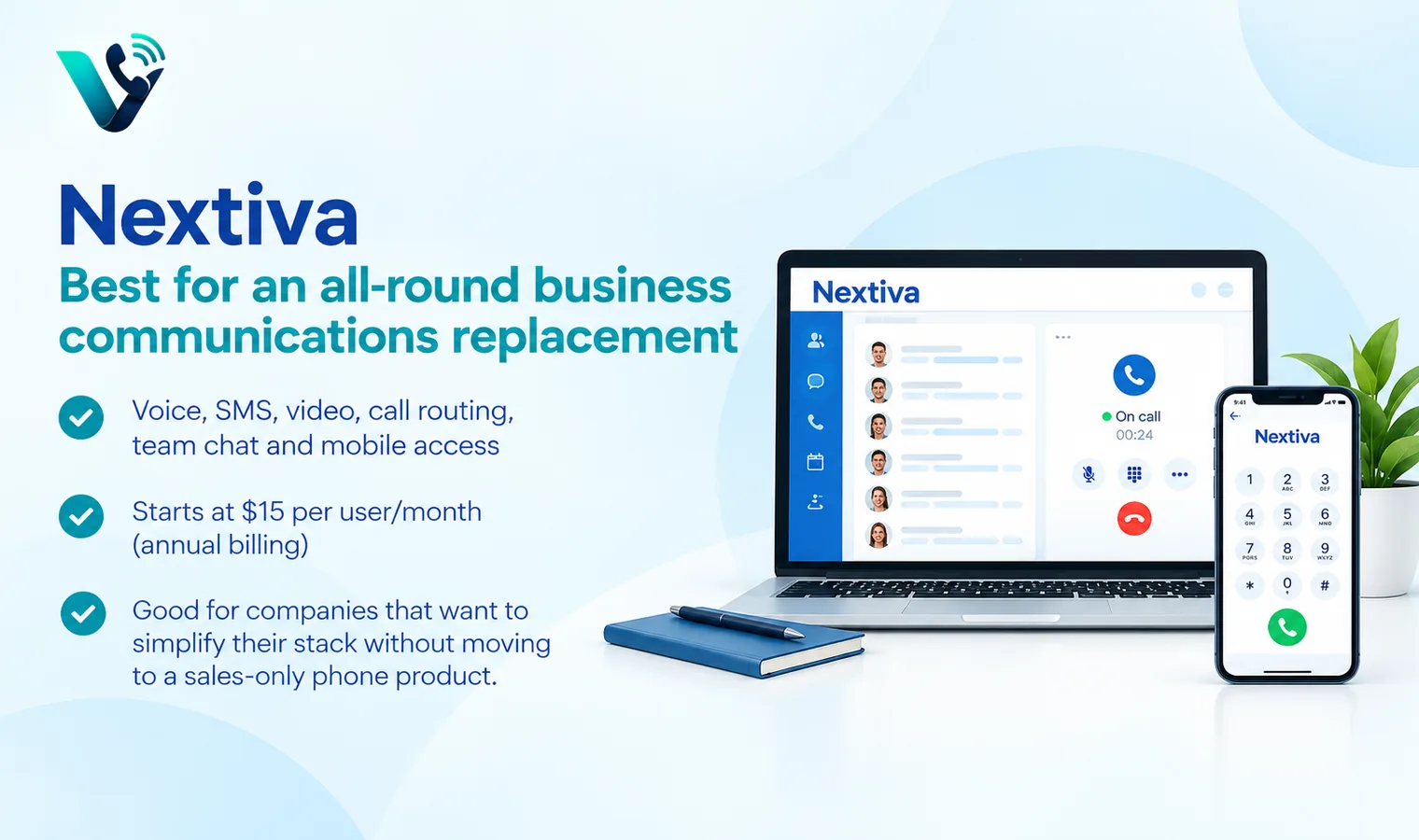
2. Zoom Phone: best for teams already standardised on Zoom
Zoom Phone is a strong RingCentral alternative when Zoom Meetings or Zoom Workplace is already normal inside the company. The North America unlimited phone plan starts at about $15 per user per month and includes domestic calling, SMS/MMS, a number, recording, integrations and multi-device use. The product can also scale internationally through local PSTN coverage and provider exchange options.
The demo question is consolidation. Can your users move from separate phone and meeting apps into one interface without losing the call management they rely on? For organisations already paying for Zoom, the total stack cost can matter more than the standalone phone price.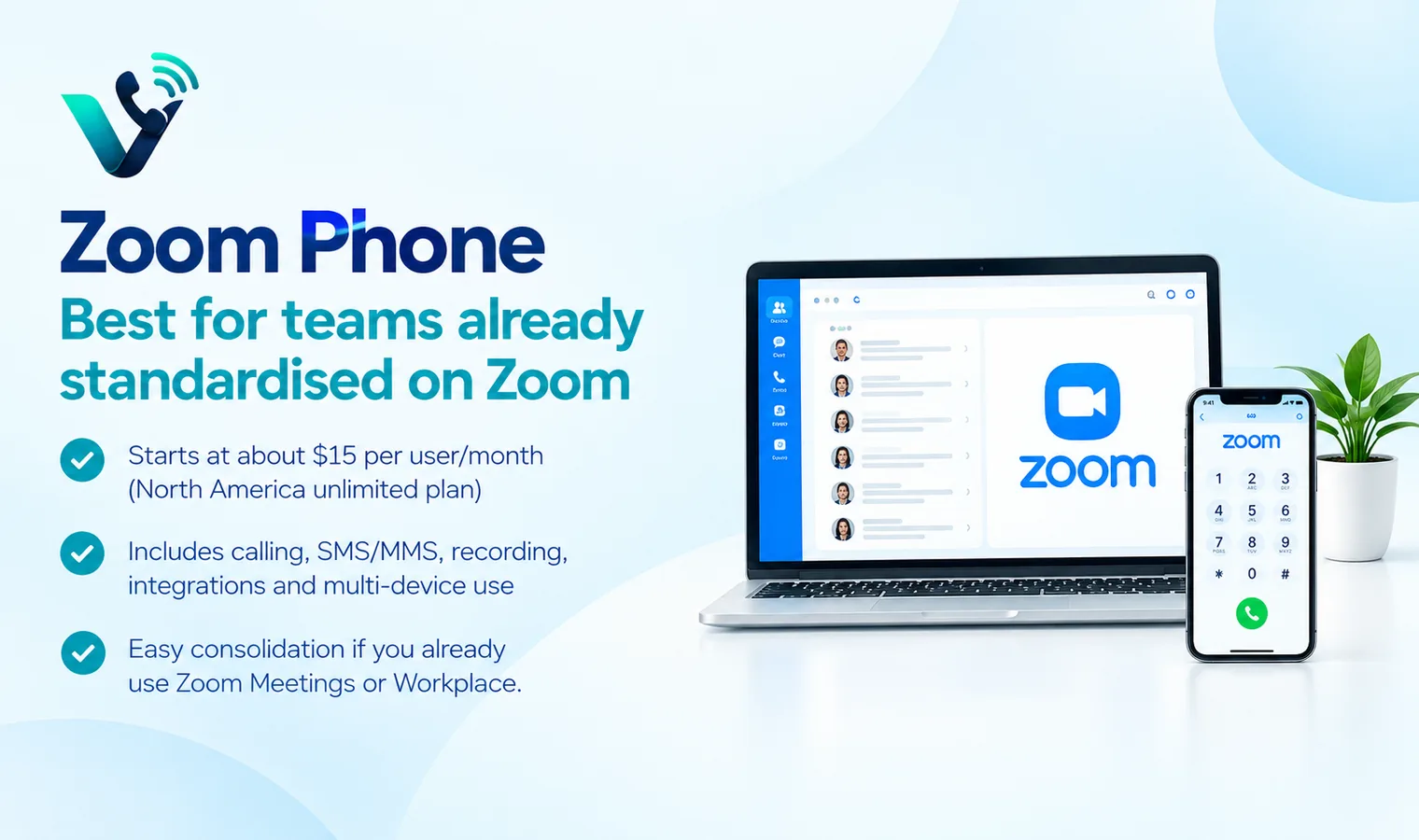
3. Dialpad: best for AI-first calling and conversation workflows
Dialpad Connect starts at $15 per user per month on annual billing, with Pro at $25. Dialpad's differentiation is its AI-heavy approach to communications and its adjacent sales and support products. It is a worthwhile demo for teams that care about transcripts, notes and coaching but do not want to bolt a separate intelligence layer onto their phone system.
During the demo, make the salesperson show which AI capabilities are included in the exact Connect tier you are buying and which belong to Dialpad Sell or Support. The product family is broad, and feature boundaries matter to total cost.
4. Aircall: best for CRM-centric sales and support teams
Aircall is less of a general office collaboration suite and more of a customer-conversation phone system. Essentials starts at $30 per licence per month on annual billing with a three-licence minimum. Professional is $50 and adds the features many call-heavy teams care about: power dialler, voicemail drop, advanced analytics, live monitoring and smarter routing.
Aircall deserves a demo if your team lives in HubSpot, Salesforce or another CRM and needs the phone system to fit that workflow. It can cost more than RingCentral's base RingEX tiers, but a higher seat price can still be rational if it replaces sales tools or reduces manual call logging.
5. CloudTalk: best for sales and support teams that want routing plus dialler options
CloudTalk's 2026 pricing is relatively transparent: Starter is $25 per user per month billed annually, Essential $29 and Expert $49. Essential adds workflow automation and API access, while Expert adds features such as call monitoring and includes the Power Dialer. CloudTalk also offers paid options such as a Parallel Dialer and Conversation Intelligence.
It is particularly worth demoing if RingCentral feels too UCaaS-oriented and your real problem is phone productivity. Ask to see call flows, queue behaviour, dialler setup, CRM logging, reporting and number coverage for the countries you call most.
6. Quo: best for smaller teams that want less admin
Quo, formerly OpenPhone, is the simplicity play. Starter is $15 per user per month annually, Business $23 and Scale $35. Shared conversations, team numbers and a relatively clean interface make it attractive for small companies that do not need a full enterprise phone stack. Business adds group calling, phone menus, transfers, CRM integrations, analytics and automatic call recording.
Quo is not the obvious choice for a large contact centre, but it is a very sensible RingCentral alternative for a 3-20 person company that values fast setup more than deep enterprise administration.
How the alternatives compare
Alternative |
Starting price checked |
Best reason to demo |
|
Nextiva |
From $15/user/mo annual |
Broad business communications |
|
Zoom Phone |
From $15/user/mo |
Zoom ecosystem and global telephony |
|
Dialpad Connect |
From $15/user/mo annual |
AI-first communications |
|
Aircall |
From $30/license/mo annual |
CRM-centric sales/support |
|
CloudTalk |
From $25/user/mo annual |
Routing, analytics and diallers |
|
Quo |
From $15/user/mo annual |
Simple shared phone system |
If you want the closest broad replacement, start with Nextiva and Zoom Phone. If AI is the decision driver, add Dialpad. If your users spend their day selling or supporting customers on the phone, demo Aircall and CloudTalk. If the team is small and RingCentral simply feels like too much system, demo Quo. The right shortlist is usually three products, not ten.
What to test in every demo
Bring a five-step scenario: an inbound call arrives, the first person does not answer, the call routes to a group, a second person answers, and the record is logged to your CRM with notes or recording. Then test an outbound call, transfer, SMS follow-up and after-hours path. Ask what is included in the quoted tier, what is an add-on, what has usage limits and what happens when you add or remove seats mid-contract.
RingCentral is still a strong benchmark because it covers so much. An alternative wins only if it improves the parts your team actually uses cost, simplicity, routing, sales productivity, support operations or integrations. A focused demo makes that difference visible quickly.
Which alternative should replace which RingCentral strength?
If you value RingCentral because it serves the whole company, Nextiva and Zoom Phone are the most logical first demos. If you mainly value the phone channel for customer-facing work, Aircall and CloudTalk can be more focused. If AI assistance is the reason you are re-evaluating the stack, Dialpad deserves a place in the shortlist. If the real complaint is that RingCentral feels too heavy for a small team, Quo changes the comparison by removing much of the enterprise-style administration.
Migration risk matters as much as feature fit
A phone-system switch affects numbers, emergency calling, recordings, SMS registration, voicemail greetings, business hours, call queues and integrations. The migration plan should be part of the demo. Ask each vendor to explain porting lead times, temporary routing, user provisioning and what happens if a port date slips. Sales and support teams should avoid a 'big bang' cutover if a staged migration or parallel test number can expose configuration problems first.
How to score the demos
Use a simple weighted scorecard. Give the highest weight to call quality, routing reliability, administration and the workflow used most often. Then score CRM integration, mobile app, reporting, AI, international coverage and price. Avoid giving equal weight to every feature because that rewards platforms with long lists rather than the platform that solves your real problem. A simpler tool that scores 9/10 on your top three workflows is usually a better choice than a broad suite that scores 7/10 everywhere.
Try this on your own numbers
Local numbers in 118 countries, AI call notes and one shared inbox. Live the same day, no contract.
Contract and support questions people forget
Ask how support works after the trial. Is live support included at your tier? Is onboarding paid? Are configuration changes self-service? What happens to recordings if you downgrade? How are added seats billed during an annual term? What is the renewal notice period? Those operational details affect the experience after procurement and are difficult to judge from pricing pages alone.
Final shortlist recommendation
For a typical 10-50 person business, a sensible three-demo shortlist is Nextiva or Zoom Phone for broad communications, Dialpad for AI-first UCaaS, and Aircall or CloudTalk for customer-facing call teams. Add Quo when simplicity is a priority. Keep RingCentral in the test as the benchmark; replacing it only makes sense if another product clearly improves cost, usability or workflow rather than simply looking newer.
Frequently asked questions
- What is the best RingCentral alternative for small businesses?
- Nextiva, Zoom Phone, Dialpad and Quo are strong starting points. The best choice depends on whether you prioritise all-in-one communications, AI, routing or simplicity.
- What is cheaper than RingCentral?
- Quo, Nextiva Core, Dialpad Standard and Zoom Phone can start below or around RingCentral Core depending on billing and required features.
- What is the best RingCentral alternative for sales teams?
- Aircall and CloudTalk are strong demos for sales teams because they focus heavily on CRM workflows, diallers, monitoring and analytics.
- Is Zoom Phone a good RingCentral replacement?
- Yes for many organisations, especially if they already use Zoom Workplace. Compare routing, reporting, integrations and international coverage for your use case.
- Is Dialpad better than RingCentral?
- Dialpad may be better for teams that prioritise AI-led call assistance and a streamlined communications experience. RingCentral can be stronger for broad UCaaS and enterprise requirements.
- How should I compare RingCentral alternatives?
- Use the same call flow in every demo and compare the total cost of the tier and add-ons required to reproduce it.