VoIP Buyer Scorecard: 24 Questions to Ask Every Vendor
By Jamila Parker · · 6 min read

Use this 24-question VoIP scorecard to compare vendors on telephony, routing, security, migration, support and real cost before a sales demo turns into a contract.
Key takeaways
- Ask the same questions in the same order so every vendor is scored against identical requirements.
- Treat country coverage, number portability and emergency calling as hard gates, not bonus features.
- Ask for a 12-month and 36-month total cost using your real users, numbers and call volume.
- Require proof in a sandbox or pilot for any workflow that matters to revenue or customer support.
How to use this scorecard
Voip buyer scorecard. A good VoIP demo can make almost any platform look easy. The buyer’s job is to move the conversation from prepared screens to operational proof. Before the first demo, write down your user count, countries, existing numbers, average call volume, busiest queues, business hours, required integrations and compliance constraints. Give the same scenario to every vendor.
Score each answer from 0 to 3: 0 means unsupported, 1 means possible with a workaround or paid service, 2 means supported with configuration, and 3 means proven in your trial. Weight non-negotiables such as number portability, emergency calling and security more heavily than convenience features.
The 24 questions
# |
Question |
What a strong answer includes |
|
1 |
Can you provide and port every number type we need in each country? |
Country-by-country written confirmation and document requirements |
|
2 |
What is included in the base licence? |
Users, numbers, minutes, SMS, recording and support clearly itemised |
|
3 |
What is metered or usage-based? |
Domestic, international, toll-free, AI, storage and messaging rates |
|
4 |
Is there a minimum seat or contract commitment? |
Minimum users, term, renewal and cancellation terms |
|
5 |
How do emergency calls and addresses work? |
Supported countries, location management and user obligations |
|
6 |
How does number porting work? |
Lead time, required documents, status visibility and rollback plan |
|
7 |
Can we keep our carrier? |
BYOC, SIP, Operator Connect or other carrier options |
|
8 |
What routing is included? |
IVR, queues, ring groups, skills, priority, overflow and callbacks |
|
9 |
How are holidays and after-hours handled? |
Reusable schedules, exceptions and easy admin changes |
|
10 |
How does mobile calling behave? |
Transfers, caller ID, network handoff, push reliability and history |
|
11 |
What happens during an internet or site outage? |
Forwarding, survivability, failover and status communication |
|
12 |
What call-quality diagnostics do admins get? |
MOS/jitter/packet-loss data, device/network detail and troubleshooting tools |
|
13 |
Which CRM/helpdesk integrations are native? |
Exact objects, logging behaviour, click-to-call and write-back |
|
14 |
What API and webhook access is available? |
Authentication, rate limits, events, sandbox and documentation |
|
15 |
What AI features are included and how are they priced? |
Summary, transcript, actions, languages, limits and opt-out controls |
|
16 |
Where is customer audio/transcript data stored? |
Regions, subprocessors, encryption and retention choices |
|
17 |
Can retention be configured by data type? |
Recording, transcript, message and analytics controls |
|
18 |
What admin and user roles exist? |
Least-privilege roles, team scopes and audit history |
|
19 |
What identity controls are supported? |
SSO, SCIM/provisioning, MFA and directory integration |
|
20 |
What is the uptime commitment and support SLA? |
Contractual SLA, status history, support hours and escalation path |
|
21 |
How fast can support reach a telecom specialist? |
Severity levels, channels, response targets and premium tiers |
|
22 |
How do we export our data if we leave? |
Numbers, recordings, logs, messages, analytics and API export |
|
23 |
What does implementation include? |
Design, porting, training, configuration, project management and fees |
|
24 |
What will our exact first-year invoice look like? |
Line-item quote using your users, countries, numbers and realistic usage |
Turn answers into hard gates and weighted scores
Not every question deserves the same weight. If a vendor cannot port your main sales number or legally provide a number in a required country, there is no reason to keep scoring its AI features. Mark those items as hard gates. Then weight the remaining categories: for example 25% telephony and coverage, 20% routing/workflow, 15% reliability and support, 15% security/compliance, 15% total cost, and 10% integrations and user experience.
Keep written evidence beside the score. “Salesperson said yes” is weak evidence; a documentation link is better; a successful test in your tenant is best.
Ask for the quote in your language, not theirs
Vendor quotes often use product SKUs that make comparison difficult. Give every supplier a common worksheet with the same 50 users, six shared numbers, two toll-free numbers, three countries, expected domestic/international minutes, recording retention, AI requirements, messaging volume and support level. Ask them to map their SKUs to that scenario and identify assumptions.
Also ask what changes at renewal, what is discounted only for year one, what is subject to fair-use policies, and which charges are taxes or pass-through telecom fees. A clean scorecard turns pricing from a negotiation trick into an engineering input.
Use the pilot to test failure, not only success
Most demos show a call that works. Your proof-of-concept should also show what happens when it does not: no agent answers, the office is closed, a transfer target is offline, a mobile user loses Wi-Fi, a CRM API is unavailable, or a queue exceeds expected volume. Those cases reveal routing quality, fallback design and administrator visibility.
Finish by asking three actual users and one administrator whether the new system makes everyday work simpler. A platform can score well on paper and still create friction if the interface does not match how the team operates.
A practical proof-of-concept before you sign
Run a short proof-of-concept instead of choosing from feature grids. Pick three real call journeys: a new sales enquiry, an existing customer needing help, and an after-hours or no-answer case. Configure the same journeys in every shortlisted system and let the people who will actually answer calls use them. Measure answer time, transfer friction, missed-call recovery, mobile reliability, search, reporting and how much administrator work is needed to change a route. Also test a deliberately awkward case such as a transfer to an unavailable user or an integration outage. The best system is usually the one that stays understandable when something goes wrong, not the one with the longest feature page.
Try this on your own numbers
Local numbers in 118 countries, AI call notes and one shared inbox. Live the same day, no contract.
Put the hidden costs into one quote
Ask every vendor to price the identical scenario: the same user count, countries, telephone-number inventory, domestic and international usage, recording period, AI requirements, messaging volume and support level. Request separate line items for licences, numbers, minutes, toll-free usage, international calls, messaging registration, AI, storage, implementation, premium support, taxes and regulatory pass-through fees. If a plan is described as unlimited, read the fair-use conditions. If the discount depends on an annual or multi-year term, show the undiscounted renewal position as well. A comparable total-cost worksheet prevents a cheap entry tier from hiding the cost of the tier you actually need.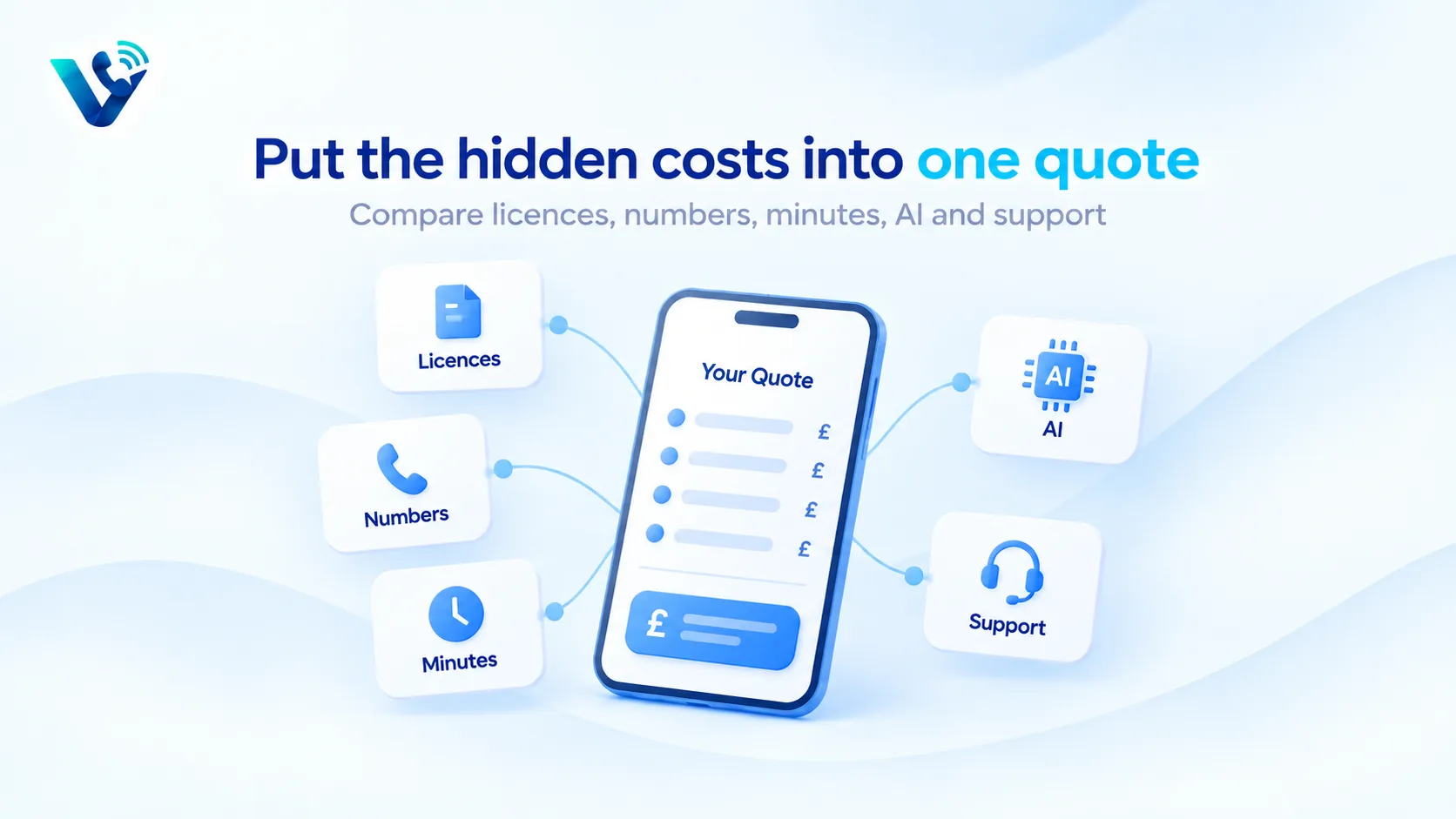
Migration and exit planning
Before committing, document how numbers are ported in, how long common ports take, what happens during a failed port and how numbers can be ported out later. Export requirements matter too: recordings, transcripts, call logs, messages, contacts and analytics should not become trapped simply because the subscription ends. For a migration, pilot one low-risk number or small team, validate inbound and outbound caller ID, emergency-calling obligations, business hours, voicemail, transfers and integrations, then move larger number blocks in controlled waves. Keeping the old service active until the new routing is proven is usually cheaper than recovering from an aggressive all-at-once cutover.
Frequently asked questions
- How many VoIP vendors should I compare?
- Three serious vendors is usually enough: one preferred option, one price challenger and one architecture alternative.
- What is the most important VoIP buying question?
- Whether the provider can support and port the exact numbers, countries and call flows the business requires.
- How long should a VoIP pilot run?
- Long enough to cover real inbound, outbound, mobile, queue and integration workflows; one to two working weeks is practical for many SMBs.
- Should I ask for an uptime SLA?
- Yes. Also ask for service history, support escalation and what credits or remedies the contract provides.
- Do I need to test emergency calling?
- Yes, where emergency calling applies. Validate location management and the responsibilities of remote users.
- How should I compare total cost?
- Use the same users, numbers, call volume, countries, AI, recording, support and term across every quote.