RingCentral pricing in 2026: what a 20-seat team actually pays
By Jamila Parker · · 7 min read

RingCentral pricing looks simple per seat, but a 20-person team should budget for billing cadence, feature tiers, usage caps and optional add-ons.
Key takeaways
- For 20 seats, RingEX base subscription cost is roughly $400, $500 or $700 per month on annual billing for Core, Advanced or Ultra.
- Paying monthly raises the same 20-seat base to about $600, $700 or $900 per month.
- The base licence is not the whole budget: SMS, toll-free usage, advanced analytics, AI and contact-centre needs can change the total.
- Advanced is the practical comparison point for many teams because CRM integrations and automatic call recording matter in real operations.
RingCentral pricing in 2026: the short answer
RingCentral's current RingEX structure is built around three published plans: Core, Advanced and Ultra. Current 2026 pricing pages and recent official/partner materials show annual-billing rates of about $20, $25 and $35 per user per month respectively, with month-to-month pricing around $30, $35 and $45. RingCentral promotes annual savings of up to 33%, so the commitment period materially affects a 20-seat budget.
For a 20-person team, that converts into a clean base calculation: Core is about $400 per month on annual billing, Advanced about $500, and Ultra about $700. If you stay month-to-month, those figures rise to roughly $600, $700 and $900. Annualised, the difference between 20 Core seats on an annual plan and monthly billing is about $2,400 before taxes, fees or add-ons.
What each RingEX tier changes
Core: the basic business-phone layer
Core covers the fundamentals: business calling, a phone number, messaging and core administration. It is attractive when your 20 users mainly need reliable calling and do not depend on advanced CRM integrations or automatic recording. The issue is not that Core is unusable; it is that a 20-seat company often already has enough process complexity to need features higher in the stack.
Advanced: the realistic midpoint for many 20-seat teams
Advanced is usually the tier to model first for a growing sales, support or professional-services team. It adds deeper integrations, automatic call recording and more management capability. If your staff work in Salesforce, Zendesk or another connected system, comparing Core only because it has the lowest sticker price can understate the cost of the setup you actually want.
Ultra: higher limits and broader analytics/storage
Ultra is aimed at teams with heavier usage, storage and analytics requirements. The price jump from Advanced is $10 per seat on annual billing, so a 20-person team pays roughly $200 more each month, or $2,400 more per year. That can be reasonable if the extra limits replace another tool or solve a real compliance, reporting or storage need. It is expensive if the team buys it only because 'top tier' feels safer.
The 20-seat RingCentral cost table
The table below shows base subscription math only. It does not include taxes, regulatory charges, optional hardware, international calling, add-on products or negotiated discounts. RingCentral can quote differently by region, seat volume and contract, so use these figures as a budgeting baseline rather than a final invoice.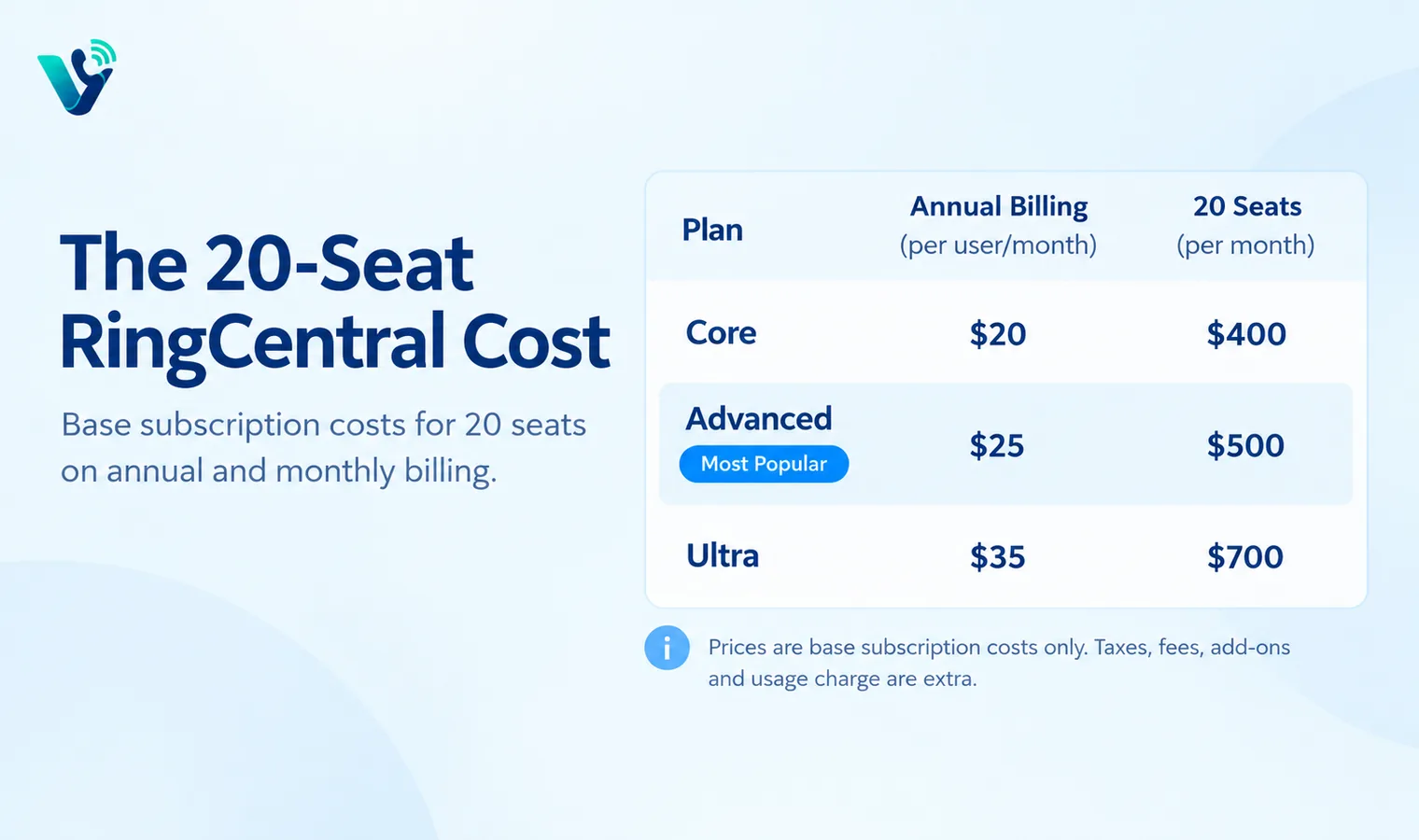
What can push the real bill above the seat price?
SMS and toll-free usage limits
Unlimited domestic calling does not mean every communications channel is unlimited. RingEX tiers have different allowances for toll-free minutes and business SMS. A 20-seat team that texts customers heavily should estimate monthly message volume before choosing a plan. If texting becomes a meaningful sales or service channel, the cost comparison should include any booster or higher-volume arrangement rather than assuming the seat fee covers unlimited use.
Conversation intelligence and AI
RingCentral has expanded its AI portfolio, but not every advanced AI capability is simply included in every RingEX seat. Conversation intelligence, AI receptionist functions and specialised sales products can sit outside the base plan. That matters for 20-seat sales teams because per-user add-ons compound quickly. A $10 per-seat difference is $200 per month at this size; a $60 per-seat add-on is $1,200 per month.
Contact-centre requirements
A queue-based support operation with advanced routing, outbound dialling, workforce tools or formal contact-centre reporting may need RingCX rather than relying only on RingEX. Treat that as a separate buying decision. If half of the 20 users need contact-centre capabilities and the other half only need business calling, ask RingCentral to quote the mixed deployment rather than licensing everyone the same way by default.
Hardware, international calls and taxes
Softphone users may not need hardware at all, while front desks and fixed offices may still want desk phones. International destinations are also priced differently from unlimited US/Canada calling. Finally, taxes and telecom-related charges can vary by location. None of those costs are safely estimated from the headline per-seat figure, so leave a buffer in procurement and verify the order form before signing.
Which RingCentral plan makes sense for 20 seats?
Choose Core when the phone system is intentionally simple and most users do not need advanced integrations or automatic recording. Choose Advanced when CRM connectivity, recording and stronger management are part of the normal workflow. Choose Ultra when the higher usage limits, storage and reporting are valuable enough to replace separate tools or reduce administration.
For many 20-person businesses, Advanced is the cleanest starting budget at around $500 per month on annual billing. The key is not to stop there. Add every required feature to a 'must-have' column, mark whether it is included, and price the missing items. That single exercise turns RingCentral pricing from a vague per-seat number into a realistic annual cost.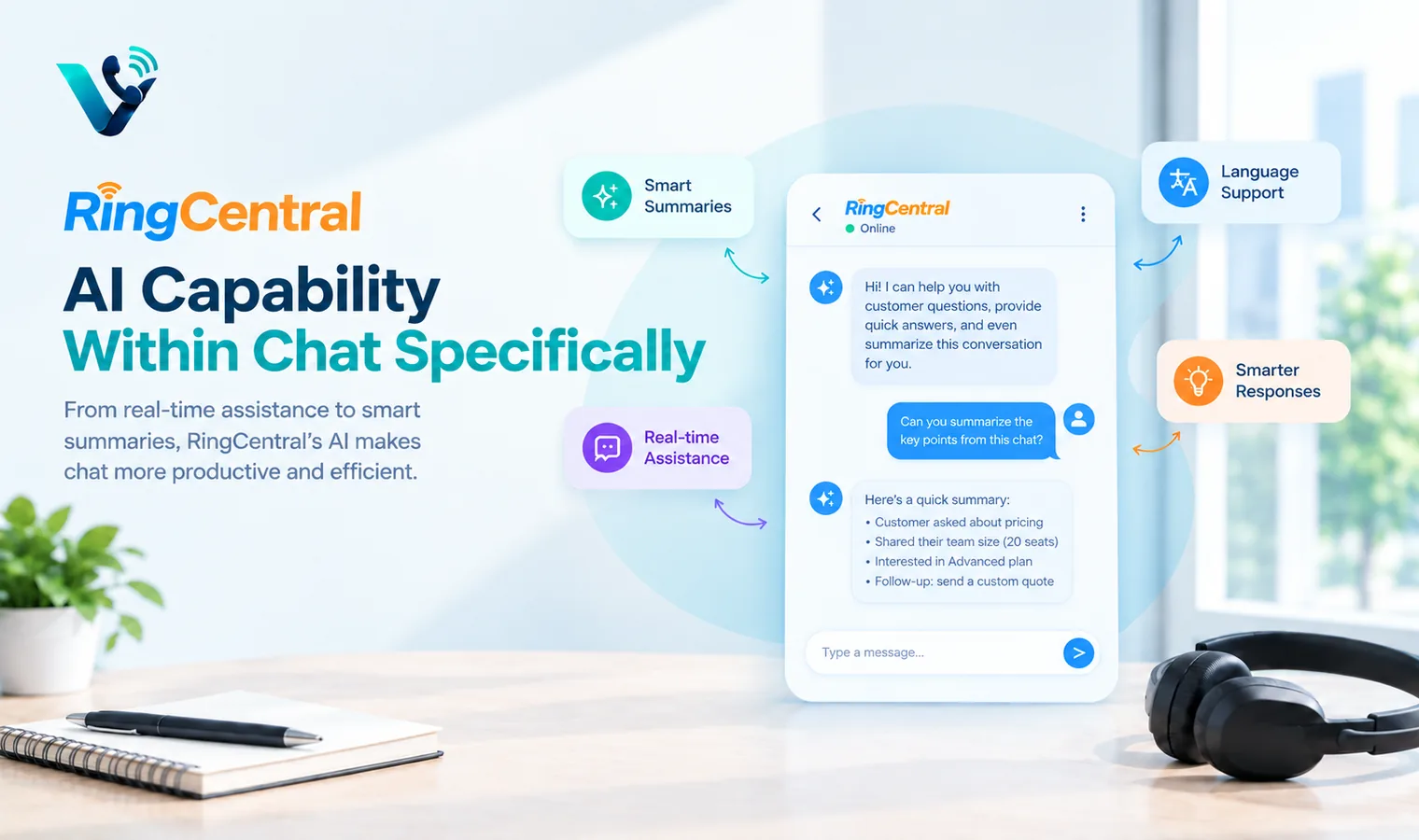
How to get a useful RingCentral quote
Ask for two numbers: the base subscription and the expected first-year total. Provide the exact seat count, the number of SMS-heavy users, toll-free needs, countries called, CRM integrations, recording requirements, analytics requirements and whether any users need contact-centre features. Then request the annual and month-to-month versions side by side. A quote that maps to your workflow is more valuable than a percentage discount on a plan you did not need.
Three realistic 20-seat budget scenarios
A simple office-phone deployment might put all 20 users on Core, producing a $400 monthly base on annual billing. A CRM-driven team might choose Advanced at roughly $500 monthly because automatic recording and deeper integrations are part of normal work. A more analytics- and storage-heavy operation might choose Ultra at about $700. The difference between the lowest and highest of those scenarios is $3,600 per year before add-ons. That is enough money to justify a proper requirements review instead of defaulting everyone to the same tier.
Scenario 1: mixed licences can be better than one plan for everyone
Ask whether every user actually needs the same capability. Front-desk staff, executives, sales reps and support agents can have very different requirements. If commercial terms allow mixed products or separate contact-centre licences, the cheapest design may combine basic business-phone seats with more advanced licences only for the users who need them. Even when a vendor prefers standardisation, asking the question can reveal where the quote is flexible and which features truly drive the price.
Annual billing: discount versus seat risk
A 20-seat company can save materially by paying annually, but an annual commitment also shifts the risk to the buyer. If the team shrinks, reorganises or moves part of customer service to another platform, unused licences can erase the discount. Before signing, ask how seat reductions work at renewal, whether additional seats are prorated, and whether acquisitions or restructures allow licence reassignment. The best contract is not necessarily the one with the lowest monthly equivalent; it is the one whose flexibility matches your hiring plan.
What to put in the procurement spreadsheet
Create one row for each cost driver: base seats, phone numbers, SMS, toll-free minutes, international calling, AI features, contact-centre seats, hardware, onboarding and taxes or regulatory charges. Add a second column for whether the item is required on day one or optional later. This makes it easy to compare RingCentral with Nextiva, Zoom Phone, Dialpad or a specialised sales platform on the same basis. It also prevents an attractive seat discount from hiding a more expensive finished configuration.
Try this on your own numbers
Local numbers in 118 countries, AI call notes and one shared inbox. Live the same day, no contract.
Bottom line for a 20-seat buyer
RingCentral's published pricing is competitive when the team uses a meaningful share of the platform. For 20 seats, Advanced is often the most sensible starting model because it represents the point where many operational features appear. But the correct plan can be Core, Advanced, Ultra or a mixed design. Model the first-year total, require every add-on to be explicit in the quote and compare renewal terms before choosing.
At-a-glance comparison
RingEX plan |
Annual billing / seat |
20 seats / month |
Monthly billing / seat |
20 seats / month |
|
Core |
$20 |
$400 |
$30 |
$600 |
|
Advanced |
$25 |
$500 |
$35 |
$700 |
|
Ultra |
$35 |
$700 |
$45 |
$900 |
Frequently asked questions
- How much is RingCentral for 20 users in 2026?
- Using published US rates, 20 RingEX seats are about $400/month for Core, $500 for Advanced and $700 for Ultra on annual billing, before extras.
- How much does RingCentral cost month to month for 20 users?
- At roughly $30, $35 and $45 per seat, Core is about $600/month, Advanced $700 and Ultra $900 before taxes and add-ons.
- Is RingCentral Core enough for a 20-person team?
- It can be if calling needs are basic. Teams needing CRM integrations, automatic recording or deeper administration often compare Advanced instead.
- Does RingCentral include unlimited calls?
- RingEX includes unlimited domestic calling in the US and Canada on standard plans, but toll-free, SMS, international and other usage can have separate limits or charges.
- Are RingCentral AI features included in the base price?
- Some AI capabilities are bundled, while specialised conversation intelligence, receptionist or sales features may be separate. Check the current quote for the exact feature.
- Can RingCentral pricing be negotiated?
- Larger seat counts and contract terms may qualify for custom pricing. A 20-seat team should request a written quote and compare the effective annual cost, not only list price.