VoIP vs landline: what changes when you cut the copper
By Jamila Parker · · 9 min read

Switching from a landline to VoIP changes more than the cable carrying your calls. Compare cost, reliability, hardware, mobility, features, and outage planning before you replace a copper-based business phone system.
Key takeaways
- A landline is built around traditional telephone infrastructure; VoIP carries voice as data over IP networks.
- Moving to VoIP makes numbers, users and routing more software-driven and less dependent on one physical location.
- VoIP generally scales faster and supports remote work more naturally than a traditional fixed-line setup.
- Reliability planning changes: VoIP needs internet and local power, so backup connectivity, UPS power and failover matter.
- The cost comparison should include hardware, maintenance, internet, calling, integrations, support and redundancy—not just monthly line price.
- Special-purpose analogue equipment should be audited before any copper line is disconnected.
The practical difference between VoIP and a landline is not just “internet versus copper.” When a business cuts the copper, the phone number, routing logic, user devices and administration can move from fixed physical infrastructure into software. That changes how quickly the system can scale, where employees can answer calls, what happens during an outage and which features can be added without installing more hardware.
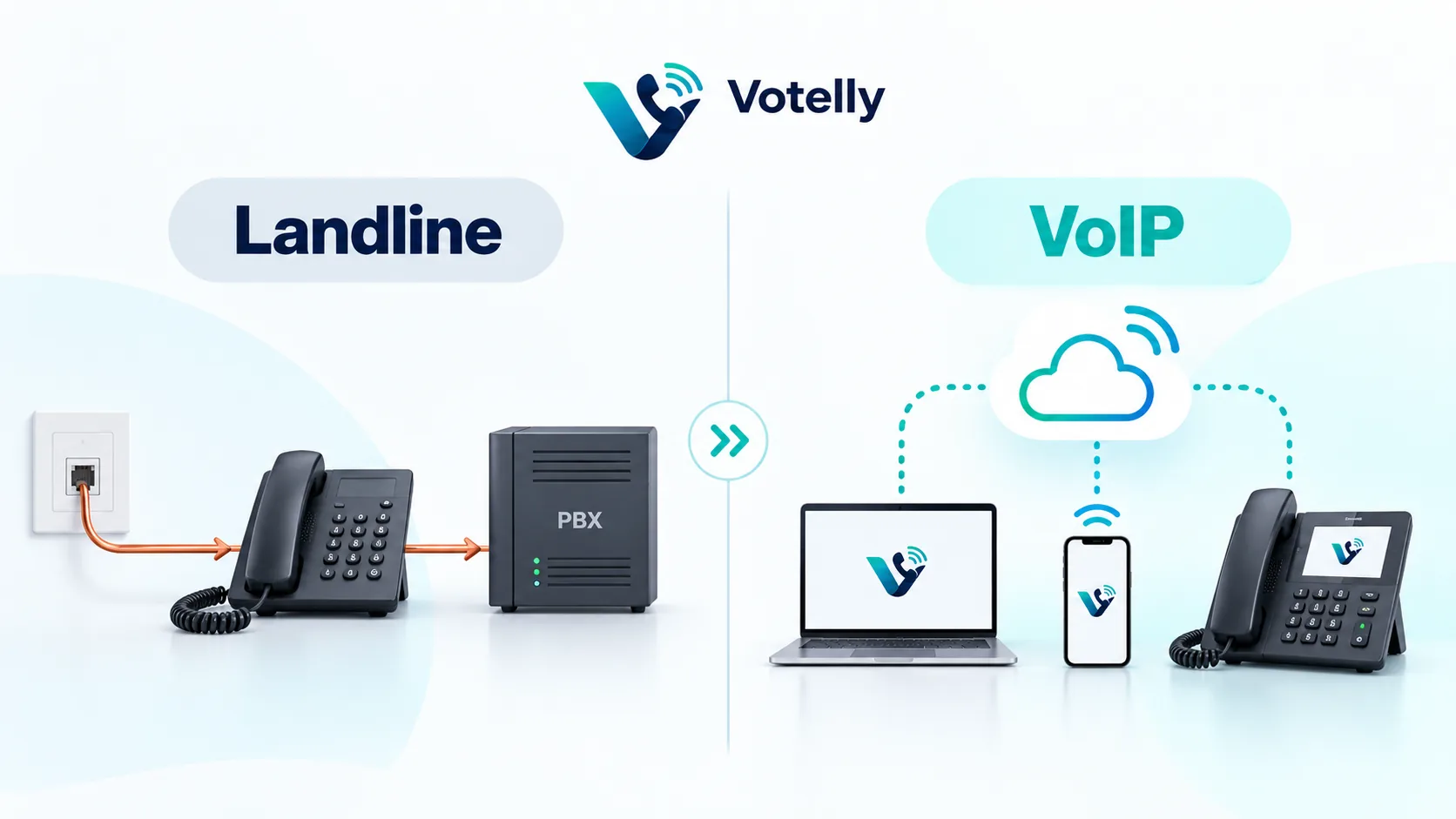
A traditional landline is built around a physical connection to the public switched telephone network. A VoIP system converts voice to data and carries it over IP networks. Both can still let a customer dial a familiar telephone number, but almost everything behind that number can be different.
VoIP vs landline: the short answer
For most modern businesses with reliable connectivity, VoIP is usually the more flexible option because it supports remote users, software-based routing, easier scaling and a wider set of digital features. Landlines can still be useful where broadband is poor, where certain legacy devices require an analogue line, or where a business has specific continuity requirements built around traditional telephone infrastructure.
|
Area |
Traditional landline |
VoIP |
|
Transport |
Dedicated/legacy telephone infrastructure |
Voice sent as data over IP networks |
|
Location |
Usually tied closely to a physical site/line |
Numbers and users can be more location-independent |
|
Hardware |
Handsets, cabling and often PBX equipment |
Can use IP phones, apps, browsers and cloud PBX |
|
Scaling |
Often requires new lines, ports or hardware |
Usually add users and numbers in software |
|
Remote work |
Limited without forwarding or extra systems |
Designed to work across approved internet-connected devices |
|
Features |
Often added separately or through PBX upgrades |
Routing, analytics, recording, inboxes and integrations can be built in |
|
Outage profile |
Some analogue services can operate during local power loss |
Depends on internet, local power and provider/network resilience |
|
Administration |
May require carrier or technician changes |
Commonly managed from an online admin portal |
1. Your phone number stops behaving like a physical line
With a traditional landline, the service is historically associated with a particular circuit and location. In a cloud VoIP system, a business number is managed as part of a software platform. That makes it possible to route one number to a desk phone, a browser, a mobile app, a queue or several users based on rules rather than wiring.
For a company with multiple offices or remote staff, this is a major operational shift. The public-facing number can stay consistent while the people answering it move. A sales team can use local numbers in different markets, and support calls can be routed to whichever team is available rather than whichever desk has the physical line.
If international local presence is part of the plan, review Votelly virtual phone numbers to see how number coverage can be separated from the physical location of the person taking the call.
2. The PBX can move out of the equipment room
Older office systems often rely on an on-premises PBX that connects extensions, external lines and features such as transfers or voicemail. A cloud VoIP service can move many of those functions into a hosted platform. Menus, queues, ring groups, business hours, forwarding rules and voicemail can be changed through software rather than by adding cards, ports or new cabling.
That does not mean every business must throw away every desk phone. IP handsets can still look and feel like familiar office phones. The real difference is that the intelligence of the phone system no longer has to live in the same building as the users.
Replacing a legacy PBX? See how Votelly’s cloud phone system handles IVR menus, ring groups, business hours, overflow and voicemail without a rack-mounted phone system.
3. Adding a new employee becomes a software task
Scaling a landline-based system may require another line, another physical port, more PBX capacity or a technician visit. With hosted VoIP, admins can often create a user, assign a number or extension, set permissions and send login details from an online console. That is especially useful for seasonal teams, fast-growing businesses and companies that open new locations frequently.
The same flexibility works in reverse. If headcount changes, licences, users or numbers can often be adjusted without being left with unused physical infrastructure. The commercial model still varies by provider, so businesses should compare per-user pricing, call charges, number costs and any setup or porting fees rather than assuming every VoIP plan is automatically cheaper.
4. Remote and hybrid work become native rather than patched on
A landline is excellent at ringing where the line terminates. Making it follow an employee home or across countries usually requires call forwarding, additional services or a separate collaboration tool. VoIP starts from a different assumption: the user is an account that can sign in on approved devices. That makes remote and hybrid calling far easier to build into the primary business phone system.
For customers, the experience can remain consistent. They call the same business number. Behind the scenes, the call might ring a browser in one country, a mobile app in another and then overflow to a support queue if nobody answers.
5. Features move from “extras” to software capabilities
Traditional phone systems can support sophisticated features, but they may depend on specific PBX hardware, licences or carrier services. Cloud VoIP platforms typically treat call handling as software, which makes it easier to add capabilities such as call recording, voicemail transcription, live analytics, AI summaries, CRM logging, shared inboxes, click-to-call and programmable workflows.
This matters because the value of a business phone system is increasingly about what happens around the call. Sales leaders may care about answer rates and call activity; support teams may care about queues and response time; managers may want searchable notes; operations teams may want calls logged automatically against a contact record.
6. Reliability changes shape
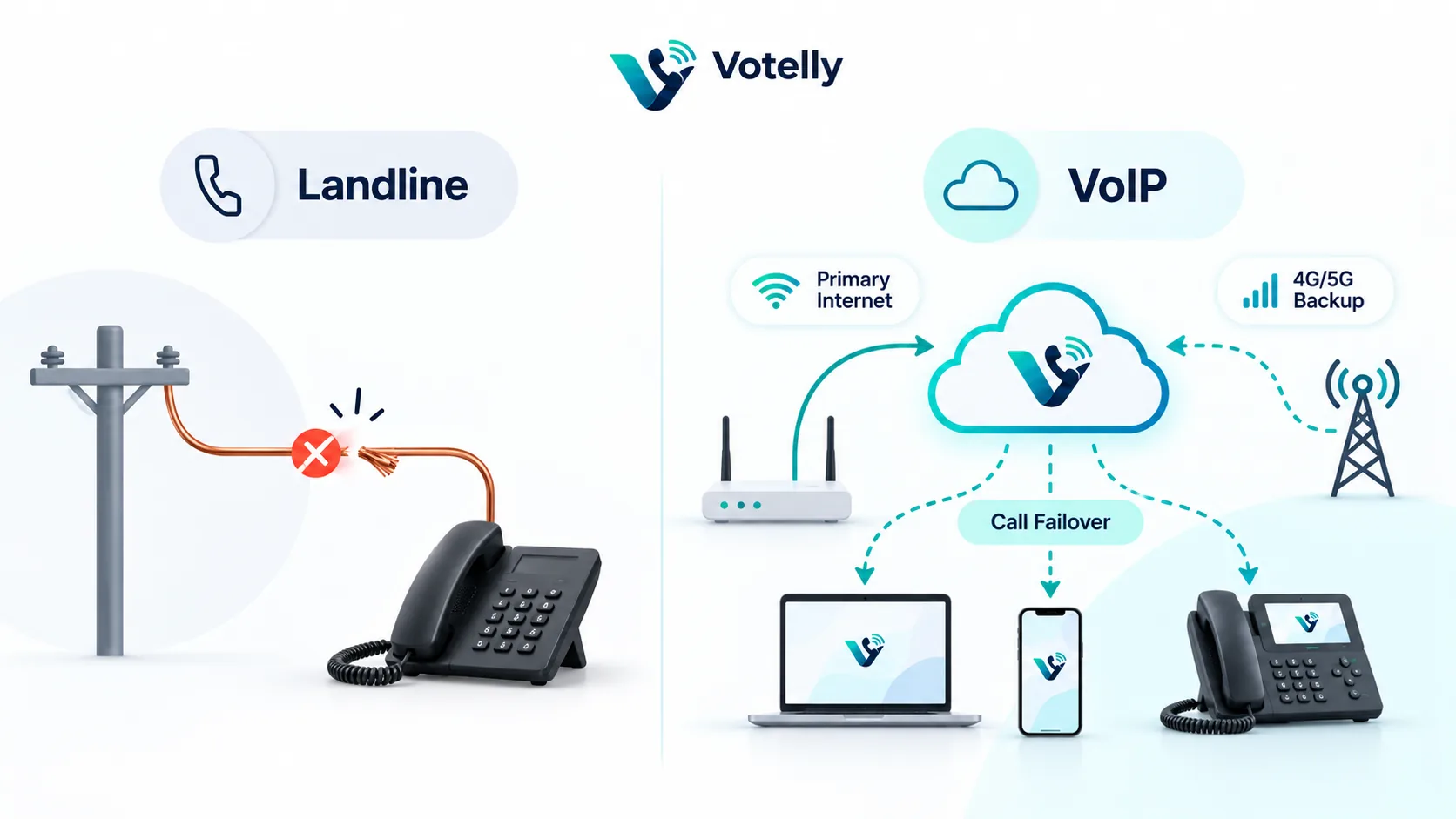
Landlines have a reputation for reliability because classic analogue telephone service could continue to work during some local power outages, provided the network itself remained available and the phone did not need mains power. VoIP relies on data connectivity, and office routers, switches, Wi-Fi access points and IP phones usually require electricity. That creates a different failure model—not necessarily an unreliable one, but one that must be designed for.
A strong VoIP continuity plan can include dual internet connections, 4G/5G backup, UPS power, provider redundancy, mobile apps and network-level failover rules. The key question is not “which technology never fails?” because no system can promise that. The useful question is “how does each system fail, and how quickly can calls move to a working path?”
7. Call quality depends on different parts of the stack
A landline separates voice from the office data network. VoIP shares network infrastructure with other applications, so local congestion, weak Wi-Fi, packet loss, jitter or excessive latency can affect audio. That means a VoIP migration should include basic network planning, not just a provider signup.
At the same time, modern codecs and well-managed networks can deliver excellent voice quality. Businesses with heavy calling volumes should test real traffic, confirm router and Wi-Fi capacity, use wired connections where appropriate and monitor performance after migration.
8. Security becomes part of your IT security model
A copper line and a cloud phone platform face different threat models. With VoIP, businesses need to protect user accounts, admin portals, integrations and network traffic. Strong passwords, multi-factor authentication, role-based access, secure signalling and media, logging and fraud controls should be part of deployment. The advantage is that these controls can also be centrally managed and monitored like other cloud applications.
9. Moving providers can become less tied to a building
Number porting can allow businesses to keep existing numbers while changing provider, subject to local eligibility and regulation. Once the service is cloud-based, future changes may involve less physical work at each office because users and routing are managed centrally. That can be valuable for companies opening, relocating or consolidating sites.
10. Cost moves from infrastructure toward service
Landline costs can include monthly lines, installation, PBX hardware, maintenance contracts, technician visits and separate charges for features or long-distance calling. VoIP often shifts more of the cost into a recurring software subscription plus numbers and usage. That can reduce capital equipment and simplify expansion, but the cheapest-looking per-seat price is not the only number that matters.
When comparing total cost, include internet upgrades, headsets or IP phones, international calling, recording storage, integrations, number rental, support, compliance needs and redundancy. For an existing phone estate, a savings calculator is a useful starting point but a real migration decision should compare the complete three-year operating picture.
Run your current phone setup through Votelly’s VoIP savings calculator, then compare the result with pricing for the users, numbers and calling regions you actually need. VoIP savings calculator, Votelly pricing.
When a landline can still make sense
VoIP is not automatically the right answer for every endpoint. Some locations have unreliable broadband. Some alarm panels, lift phones, door systems, fax equipment or specialist devices may depend on analogue signalling and need dedicated migration planning. Certain resilience or regulatory requirements may also lead to hybrid designs instead of an immediate all-or-nothing replacement.
The sensible approach is to inventory every line before disconnecting anything. Separate ordinary employee calling from special-purpose analogue lines, confirm which devices are compatible with IP alternatives, and test emergency calling and location behaviour where required. Cutting the copper should be a planned technology transition, not simply a billing change.
When VoIP is usually the stronger fit
- Your team works across offices, homes or countries.
- You expect headcount or call volume to change regularly.
- You want one system for routing, recording, analytics, messaging or integrations.
- You need local or toll-free numbers in multiple markets.
- You want admins to change call flows without waiting for a carrier or onsite technician.
- You are replacing ageing PBX hardware or paying to maintain unused telephone infrastructure.
A practical migration checklist
- List every phone number, extension and special-purpose line.
- Measure internet and local network quality during real working hours.
- Decide which users need desk phones and which can use browser, desktop or mobile apps.
- Design call flows, queues, business hours and failover destinations before porting numbers.
- Confirm emergency calling, number portability and regulatory requirements for each country or site.
- Run a pilot with a small team and collect call-quality feedback.
- Port numbers in a controlled sequence and keep a rollback or failover plan for critical lines.
The bottom line
When you replace a landline with VoIP, the biggest change is that business calling becomes an application rather than a fixed circuit. That creates more flexibility, but it also shifts responsibility toward internet resilience, account security and network design. For companies that need mobility, rapid scaling and modern call workflows, that trade is usually attractive. For specialised analogue use cases, a hybrid approach may still be the safer path.
Try Votelly with your own pipeline
One or two lines about the offer, plus what it costs.
Frequently asked questions
- Is VoIP better than a landline for business?
- For many businesses with reliable internet, VoIP offers more flexibility, easier scaling, remote access and software features. A landline or hybrid setup can still be appropriate for poor-connectivity locations or specialist analogue equipment.
- What is the biggest difference between VoIP and a landline?
- A landline relies on traditional telephone infrastructure, while VoIP converts voice into digital data and sends it over IP networks. That changes how numbers, users, routing and features are managed.
- Will VoIP work during a power outage?
- VoIP equipment such as routers, switches and IP phones usually needs power. Businesses can improve continuity with UPS batteries, backup internet, mobile apps and provider-level call failover.
- Can I keep my landline number when switching to VoIP?
- Often yes, through number porting, but eligibility and timing depend on the country, number type and carriers involved. Confirm portability before cancelling the old service.
- Is VoIP always cheaper than a landline?
- Not always. VoIP can reduce hardware, maintenance and line costs, but total cost depends on users, internet upgrades, devices, call destinations, features and support. Compare the full operating cost.
- What should I check before cutting a copper phone line?
- Inventory all numbers and connected devices, identify alarms or specialist analogue equipment, test internet and network quality, design failover, verify emergency calling requirements and plan number porting carefully.