ACD Explained: How Calls Decide Which Agent to Ring
By Jamila Parker · · 6 min read

Automatic call distribution applies routing rules to incoming work and chooses a queue or agent. Learn how round-robin, skills, priority and availability shape the decision.
Key takeaways
- ACD means automatic call distribution, the system that sends calls to queues or agents using defined criteria.
- Routing can use availability, round-robin order, longest idle, skills, language, priority, customer data or combinations.
- IVR gathers intent; ACD usually uses that intent and other context to decide where the call goes.
- The best routing strategy balances customer outcome, fairness, service level and agent capability.
What is an ACD?
Acd explained. An automatic call distributor is the routing engine that decides where an incoming call should go. Twilio describes call routing as sending calls to a queue using predetermined criteria and notes that a call routing system is also known as an ACD. In a modern contact centre, the same idea can extend beyond voice to chat, messages and other work items.
The ACD sees inputs such as the number dialled, IVR choice, customer record, language, priority, business hours, queue status and agent availability. It then applies rules to select a destination.
A simple ACD decision
Imagine a customer calls support and selects “billing.” The IVR provides the intent. The ACD checks whether the billing queue is open, identifies available agents with billing skill, applies the routing strategy - for example longest idle - and rings the selected agent. If nobody is free, the call waits, overflows to another skill group or is offered a callback depending on configuration.
The important distinction is that “the queue” is not necessarily a fixed list of phones. It can be a dynamic pool of logged-in agents with skills and states.
Common routing strategies
Strategy |
How it chooses |
Useful when |
|
Simultaneous ring |
Rings several endpoints at once |
Very small teams and urgent calls |
|
Round robin |
Rotates calls among agents |
Simple fairness matters |
|
Longest idle |
Chooses the agent waiting longest since last work |
Balanced distribution in queues |
|
Skills-based |
Matches required skill/language/product |
Specialised support or sales |
|
Priority/VIP |
Raises selected customers or intents |
Contracts or severity require differentiated service |
|
Data-driven |
Uses CRM/account/context attributes |
Routing depends on customer history/value |

Availability is more complicated than “online”
An agent can be signed in but not ready for a new call. Contact-centre platforms use presence or states such as available, busy, after-call work, break or offline. Wrap-up time after a call can prevent a new interaction arriving before notes are complete. Maximum concurrency rules matter when agents handle digital channels as well as voice.
Bad state design causes two familiar problems: customers wait while “available” agents are not truly available, or agents get overloaded because the platform does not account for their existing work. Define states around actual work and monitor state abuse as an operational issue, not only a software setting.
How ACD and IVR work together
IVR is usually the conversation with the caller; ACD is the routing decision behind the scenes. The IVR might collect “Spanish” and “technical support,” then the ACD looks for agents with both skills. A CRM lookup might add a priority flag, while time-of-day rules decide whether the call routes to an after-hours team.
Keep the interaction efficient by passing all collected context to the agent. If callers enter an account number and still have to repeat it, the IVR/ACD integration has failed the user experience.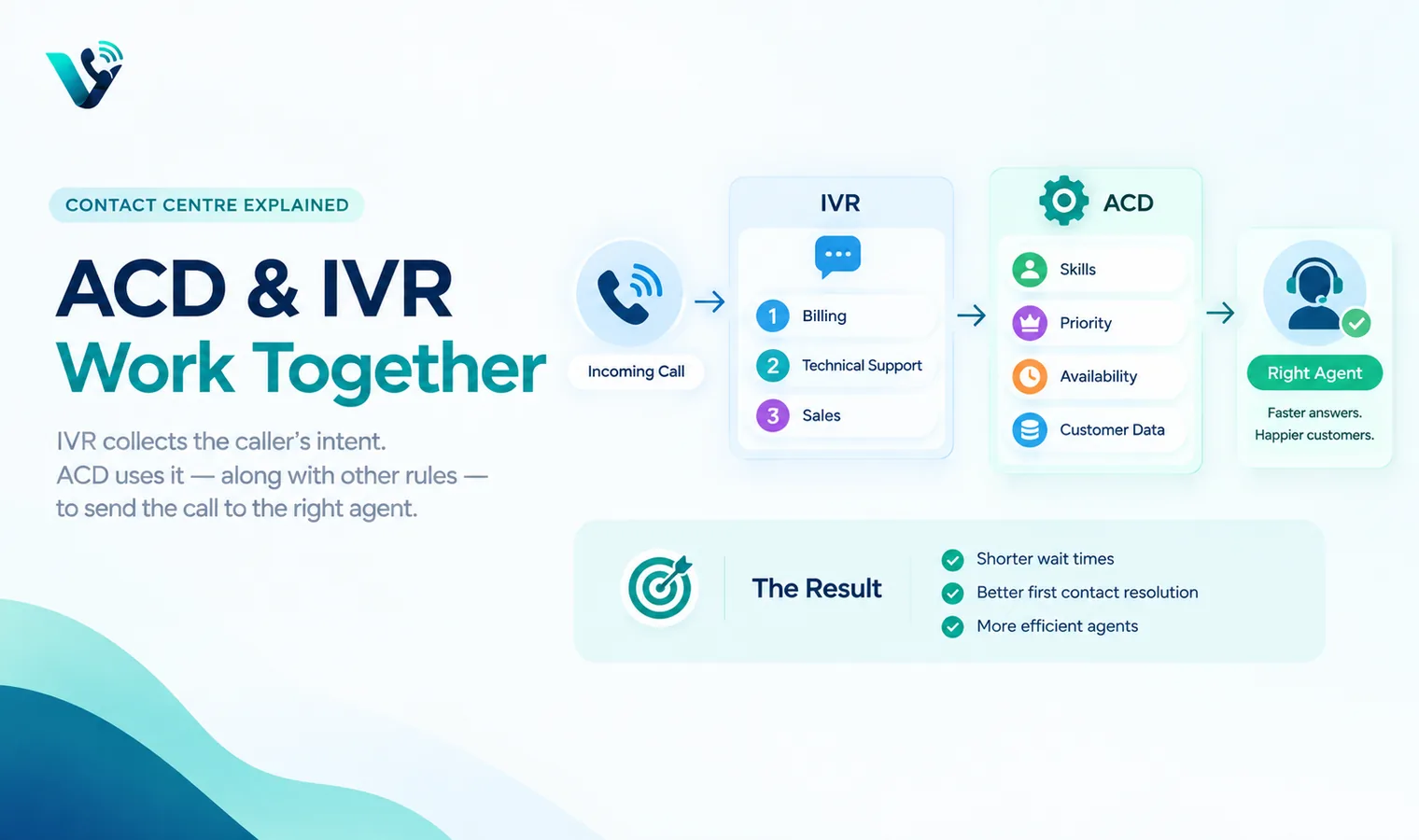
What to measure
Measure service level, average speed of answer, abandonment, transfer rate, queue depth, routing accuracy and agent occupancy together. A routing change that improves speed but increases transfers may not be an improvement. Listen to calls that bounce between queues and inspect why the original rule picked the wrong destination.
For sales, also look at answer rate, lead-response time and conversion by route. For support, track first-contact resolution and repeat contact. The ACD should optimise business outcomes, not only distribute volume.
What this means when choosing a business phone provider
Translate the technical concept into an operational requirement. Ask the provider to show the setting or workflow in a live tenant, explain which plan includes it, and identify any country, number, device or network limitations. The same technical term can hide very different implementations. A simple queue, for example, may be enough for a five-person team while a contact centre needs skills, priority, callbacks, supervisor controls and detailed reporting. Document the outcome you need before comparing terminology, then test it with a real call rather than accepting a diagram as proof.
Common implementation mistakes
Most failures happen around the edges: number porting is scheduled before routing is tested; remote users are not told how emergency location works; Wi-Fi is assumed to be fine because ordinary web browsing works; recording is enabled without a retention or consent policy; or an integration is purchased without checking what fields it actually writes back. Treat the phone system as an end-to-end service that includes carrier, network, devices, users, identity, data and support. A short pre-launch checklist and named owner for each area prevents far more problems than adding another advanced feature.
A simple validation checklist
Test inbound and outbound calls on desktop and mobile, hold and transfer, voicemail, caller ID, business hours, no-answer behaviour and at least one failure path. If the design uses queues or IVR, call every branch of the flow. If it uses an API or CRM, verify both successful write-back and what happens when the destination is unavailable. Review call-quality data during the pilot and ask users about audio, delay and ease of use. Finally, confirm support escalation and a rollback route before moving a high-value published number.
Try this on your own numbers
Local numbers in 118 countries, AI call notes and one shared inbox. Live the same day, no contract.
Security, privacy and policy checks
Confirm how the service encrypts signalling and media, how administrators control access, and how recordings, transcripts and messages are retained. If SSO or automated user provisioning matters, test the exact identity workflow rather than assuming an enterprise logo means it is included in your tier. Review recording-consent obligations and data-location requirements with the people responsible for privacy and compliance. Also ask how fraud, compromised credentials and unusual international calling are detected. Security features are most useful when administrators can understand and operate them without specialist intervention.
Support and day-two administration
The system still needs to be easy after the implementation team leaves. Have your own administrator add and remove a user, change a number, edit a holiday schedule, update routing, find a recording, export a call report and troubleshoot a poor-quality call. Then review support hours, severity definitions, escalation channels and any extra cost for faster response. For a business phone system, day-two administration and support are part of the product: a small monthly saving can disappear quickly if every routine change becomes a ticket or a consultant task.
Frequently asked questions
- What does ACD stand for?
- Automatic call distribution, the system that routes incoming calls or interactions to queues and agents.
- Is ACD the same as IVR?
- No. IVR interacts with the caller; ACD applies routing rules to choose the destination. They commonly work together.
- What is skills-based routing?
- It matches an interaction with agents who have required attributes such as language, product knowledge or certification.
- What is longest-idle routing?
- It sends the next call to the eligible agent who has been idle the longest.
- Can ACD use CRM data?
- Modern platforms can use customer/account attributes for routing when integrations and data policies allow it.
- What is a good ACD KPI?
- Use several: service level, abandonment, transfer rate, routing accuracy and customer outcome rather than one speed metric.