AI Call Scoring for QA: Replacing the 2% Sample
By Jamila Parker · · 8 min read

AI call scoring can expand QA coverage from tiny manual samples to far more conversations. The hard part is calibration, evidence, appeals and knowing where human review still belongs.
Key takeaways
- Automated QA can expand coverage dramatically, but coverage is not the same as perfect accuracy.
- Scorecard questions must be specific enough for both humans and AI to interpret consistently.
- Calibrate against a human-reviewed reference set before automated scores affect performance decisions.
- Use AI to route reviewer attention toward risk, uncertainty, complaints and disputed calls.
- Keep humans responsible for policy, appeals, coaching and high-stakes compliance judgment.
Manual quality assurance has a math problem. A supervisor can deeply review only a small slice of a contact centre’s calls, yet the resulting score is often treated as if it represents the agent’s whole month. AI call scoring changes the coverage model. Instead of selecting a tiny sample first and scoring only those interactions, an automated system can evaluate a much larger share of conversations against a defined QA scorecard, then direct human reviewers toward exceptions, disagreements, and high-risk calls.
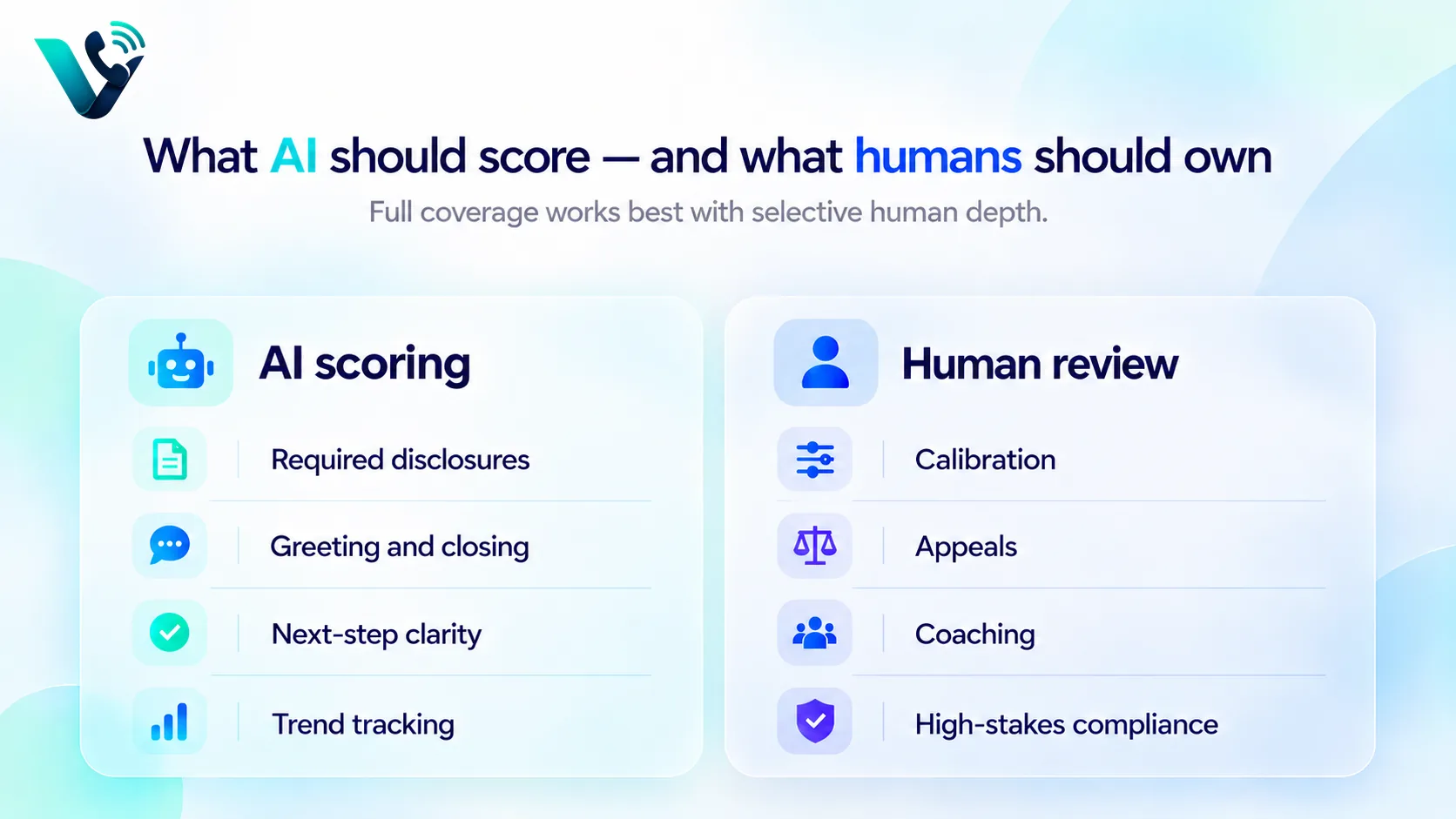
The promise is not that AI should replace QA managers. The stronger model is that AI expands coverage while humans own policy, calibration, appeals, coaching, and edge cases. Google Cloud describes automated Quality AI as a way to move from manual review of less than one percent of interactions toward analysis of all conversations. That scale is useful, but only if the scoring rules are designed and validated carefully.
Why the traditional sample creates blind spots
A two-percent QA sample can miss rare but serious failures. It can also overreact to one unusual call. Random sampling gives every call a chance to be reviewed, but it does not guarantee that every important behavior appears in the sample. New agents, difficult queues, escalations, complaint calls, and compliance-sensitive interactions may need different review intensity.
Sampling also changes behavior indirectly. Agents know that only a few calls will be scored, while supervisors spend time locating calls, completing forms, and documenting evidence. The result is often more effort spent on measurement than on coaching.
What AI call scoring actually does
AI call scoring typically starts with a transcript or conversation record and a scorecard. The scorecard contains questions such as whether the agent greeted the customer correctly, verified required information, demonstrated empathy, followed a disclosure, resolved the issue, or agreed a clear next step. The model evaluates the conversation, selects an answer, produces a score, and ideally shows the evidence or explanation behind that score.
QA dimension |
Good AI-scoring candidate? |
Why |
|
Required phrase or disclosure |
Strong candidate |
The criterion can be defined precisely and checked against transcript evidence |
|
Greeting and closing structure |
Strong candidate |
Observable behavior with relatively clear boundaries |
|
Issue-resolution evidence |
Useful with calibration |
May require context from systems outside the call |
|
Empathy |
Useful but subjective |
Language and context matter; scorecard wording must be specific |
|
Complex regulatory judgment |
Human-led |
High stakes and policy nuance make escalation essential |
Design the scorecard for machine readability
A scorecard written for humans may contain vague questions such as 'Did the agent show ownership?' An AI evaluator needs clearer instructions. Define what counts as evidence, what exceptions are allowed, and whether the question is binary, scaled, or multi-select. Microsoft’s current quality-assurance documentation similarly emphasizes specific questions, answer types, scores, and AI instructions that clarify acceptable and unacceptable behavior.
- One question should measure one behavior whenever possible.
- Define examples of acceptable evidence and common exceptions.
- Separate compliance-critical items from coaching-only items.
- Keep the scoring direction consistent so higher scores always mean better performance.
- Version the scorecard when policy changes instead of silently changing historical meaning.
Do not automate before you calibrate
Before scoring every call, build a calibration set that experienced QA reviewers score independently. Compare human agreement first. If two senior reviewers disagree constantly, the criterion itself is ambiguous and AI will only automate that ambiguity. Resolve the definition, then compare AI scores with the agreed human reference.
Calibration should include normal calls, difficult calls, edge cases, transfers, noisy audio, accents, interruptions, and calls where required context lives partly in the CRM. Measure disagreement by question, not only by final score. An overall score can look close while one critical compliance question is consistently wrong.
Replace random sampling with risk-based human review
Once automated call scoring is reliable enough for a defined scorecard, human QA time can move toward higher-value review. Instead of manually scoring a random two percent, reviewers can inspect calls with low AI scores, uncertain evidence, policy-sensitive keywords, customer complaints, large score changes, unusual outcomes, or disagreement between automated signals.
Automated layer |
Human layer |
|
Score eligible calls against defined criteria |
Own the scorecard and policy definitions |
|
Flag low scores and unusual patterns |
Review high-risk and disputed interactions |
|
Create evidence snippets or explanations |
Judge context the transcript cannot see |
|
Track trends across the full population |
Coach agents and approve remediation |
|
Surface potential compliance misses |
Make final high-stakes compliance decisions |
Coverage is not the same as certainty
Evaluating 100% of calls does not mean every score is 100% correct. Automated QA can create a false sense of precision if managers treat every number as objective truth. Speech recognition errors, ambiguous instructions, overlapping speakers, missing system context, sarcasm, or policy exceptions can all influence the result.
A mature QA program stores confidence, evidence, and review status alongside the score. It gives agents a path to challenge a result. It also audits false positives and false negatives over time, especially for criteria tied to compliance or compensation.
Use the larger dataset for coaching, not punishment
The best reason to score more calls is that coaching becomes less anecdotal. A supervisor can see whether a behavior is improving across dozens of conversations instead of arguing about one recording. The team can compare trends by queue, tenure, topic, or week. If the scorecard is used mainly as surveillance or as an unquestionable performance ranking, agents will focus on gaming the metric instead of improving customer outcomes.
A practical rollout in four stages
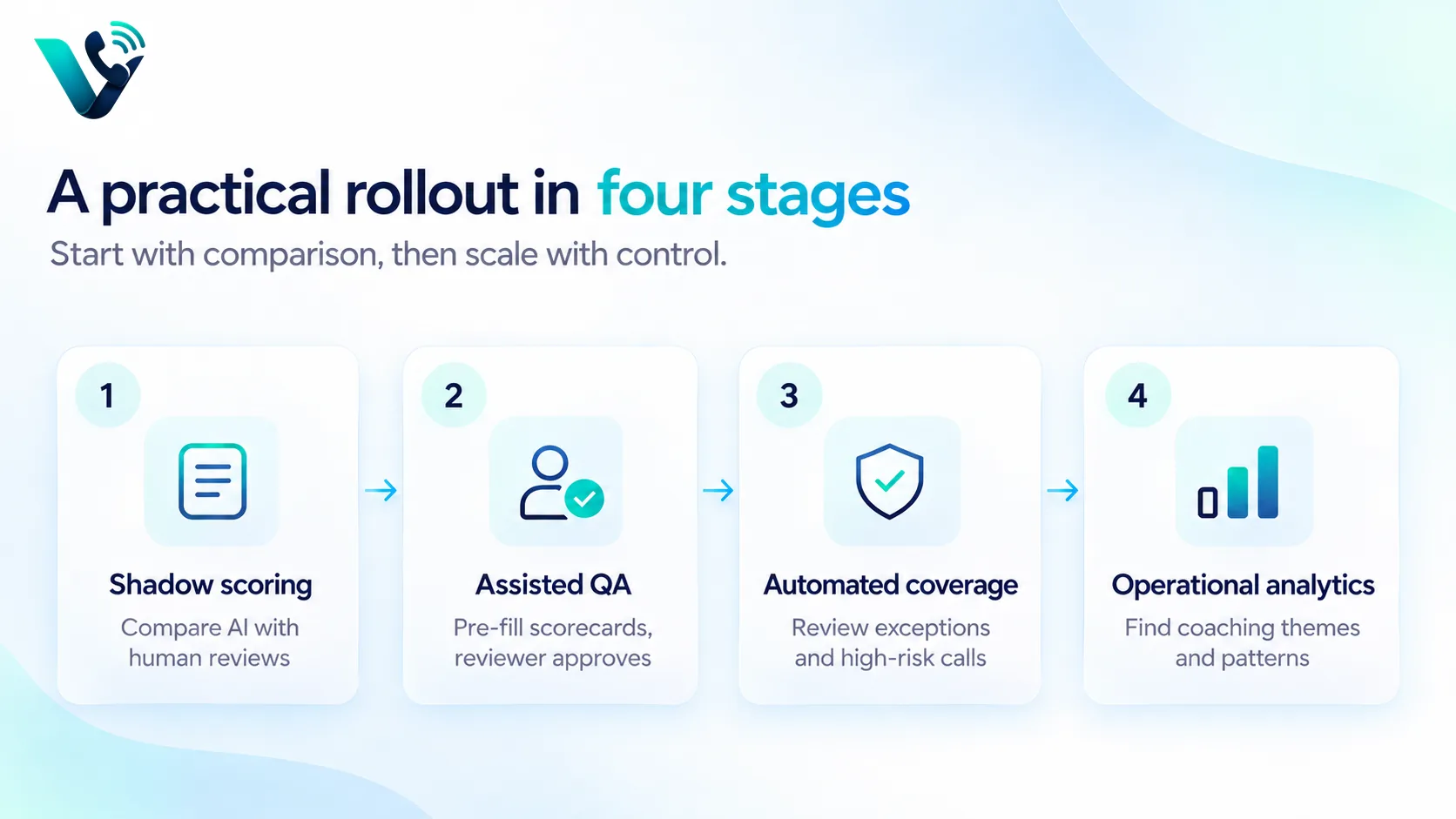
Stage 1: Shadow scoring
Run AI scoring without changing official QA results. Compare it with human reviews and identify criteria where disagreement is concentrated.
Stage 2: Assisted QA
Let the AI pre-fill scorecards or recommend answers while reviewers approve or edit them. This reduces manual effort without removing human control.
Stage 3: Automated coverage with exception review
Score the broad population automatically and send defined exceptions to human QA. Track appeal rates and calibration drift.
Stage 4: Operational analytics
Use the expanded score dataset to find coaching themes, process failures, policy confusion, and queue-level patterns. Recalibrate whenever the scorecard, product, or policy changes.
How this connects to Votelly
Votelly’s current site lists sentiment and scorecards, call recording, live transcription, wallboards, and call-centre coaching features. That makes AI call scoring a natural content topic for its call-centre and support audience. The article should still distinguish between automated scoring, supervisor review, and final compliance judgment rather than presenting a scorecard as an infallible verdict.
The better QA model is full coverage plus selective human depth
AI call scoring for QA is most valuable when it changes where humans spend their attention. Automate the repeatable questions, evaluate far more interactions, and use human expertise for calibration, risk, appeals, and coaching. Replacing the two-percent sample should not mean replacing human judgment. It should mean that human judgment is finally applied to the calls where it matters most.
Audit the QA model itself
Automated call scoring needs its own quality assurance. Track which questions generate the most human overrides, which agent groups appeal scores most often, and whether disagreement changes by language, queue, call type, or audio condition. A model that appears accurate overall may still fail systematically on one workflow.
Review a random slice even when risk-based routing is in place, so unseen failure modes can still surface.
- Measure override rate by scorecard question, not only by total score.
- Recalibrate after policy changes, new scripts, major model updates, or new languages.
- Keep a dated benchmark set so changes in automated scoring can be detected over time.
This turns AI QA from a one-time deployment into an operating system. The target is not zero disagreement. The target is known, monitored error that is small enough for the decisions the score supports.
The practical test is whether the workflow changes a decision, reduces manual review, improves customer understanding, or creates more reliable data. Teams should keep measuring the operational outcome rather than assuming that a sophisticated AI feature automatically produces business value.
Try this on your own numbers
Local numbers in 118 countries, AI call notes and one shared inbox. Live the same day, no contract.
Choose where automated scores can and cannot drive decisions
Not every QA score should have the same consequence. A low-confidence coaching score can safely trigger a supervisor review or training recommendation. A score tied to disciplinary action, compensation, regulatory reporting, or customer remediation needs a higher evidence threshold and a clearly documented human decision point. Define those boundaries before deployment so teams do not gradually turn a convenience score into an authority it was never designed to be.
It also helps to separate operational monitoring from individual performance management. Queue-level trends can reveal a broken process even when no single agent is at fault. If every agent loses points on the same new policy question, the correct response may be better training or a clearer workflow rather than tougher scoring.
What to report to supervisors
- Overall score trend plus the specific questions driving the change.
- Calls with high model uncertainty or missing evidence.
- Appeals, overrides, and recurring disagreement patterns.
- Team-level themes that suggest a process problem rather than an individual problem.
This reporting design keeps AI call scoring useful as a diagnostic layer. The score becomes a starting point for investigation and coaching instead of a single number that hides how the interaction was actually judged.
Frequently asked questions
- Can AI score every customer call?
- Many modern QA systems are designed to evaluate all eligible conversations, but actual coverage depends on product configuration, language support, transcript quality and policy.
- Is AI call scoring more accurate than human QA?
- It can be more consistent on well-defined criteria, but humans are still needed for calibration, context, policy interpretation and high-stakes decisions.
- What should an AI QA scorecard include?
- Use specific observable criteria such as required disclosures, greeting, verification, resolution evidence, next-step clarity and other behaviors relevant to your operation.
- Should agents be allowed to appeal AI scores?
- Yes. An appeal and review path helps catch model errors, unclear criteria and missing context, especially when scores affect coaching or performance management.
- Does automated QA eliminate sampling?
- It can reduce dependence on random sampling by scoring a much larger population, while humans selectively review exceptions and high-risk cases.
- How does Votelly relate to AI QA?
- Votelly lists call recording, live transcription, sentiment, scorecards and call-centre coaching features, which are relevant building blocks for a quality-review workflow.