Detecting Churn Risk From Support Call Language
By Jamila Parker · · 8 min read

Support calls reveal churn risk before cancellation. Combine intent phrases, sentiment trajectory, repeat-contact language and CRM context without overreacting.
Key takeaways
- Treat churn risk as a combination of language, account context and service history.
- Explicit cancellation intent should outrank generic negative sentiment.
- Track sentiment trajectory so resolved frustration is not confused with deteriorating risk.
- Build intervention ownership before enabling real-time churn alerts.
- Measure false positives and retained outcomes, not only the number of flags.
Cancellation rarely begins with the sentence 'I am going to churn.' Support calls usually reveal softer language first: Repeated frustration, a comparison with a competitor, doubt that the problem will be fixed, questions about contract exit, or a shift from collaborative language to resignation. Detecting churn risk from support call language means finding those patterns early without pretending that a sentiment score can read the customer's mind.
Churn risk is a pattern, not a keyword
Explicit phrases such as 'close my account' are valuable, but they capture the end of the risk curve. Earlier signals often appear as combinations: Negative sentiment plus repeated contact, an unresolved issue plus a competitor mention, or a high-value account expressing low confidence in the resolution. The best churn-risk model therefore combines language with operational context.
Language signal |
Possible meaning |
Do not assume |
|
'I have called three times' |
Repeated unresolved effort |
Customer will definitely cancel |
|
'Your competitor does this better' |
Active comparison / switching consideration |
Competitor has already won |
|
'What happens if I cancel?' |
Exit-path exploration |
Cancellation is final |
|
'I don't think this will be fixed' |
Loss of confidence |
Agent caused the issue |
|
Flat resignation after escalation |
Emotional withdrawal |
Negative sentiment alone equals churn |
Use explicit intent as the highest-confidence signal
AWS gives a practical example of contact-center rules that identify customers at risk when negative sentiment is paired with language such as 'close my account' or 'I am taking my business elsewhere'. That combination illustrates a useful hierarchy: Direct cancellation intent should outrank broad emotional scoring. Build alerts so explicit intent reaches the right retention or escalation owner immediately.
Sentiment trajectory matters more than one label
A call can begin negative and end positive because the agent solved the issue. Another can begin neutral and deteriorate as the customer loses confidence. Turn-level or time-based sentiment therefore provides more information than a single whole-call score. Google and Microsoft both expose conversation sentiment as a dynamic signal; the operational lesson is to track direction and recovery.
Three trajectories worth separating
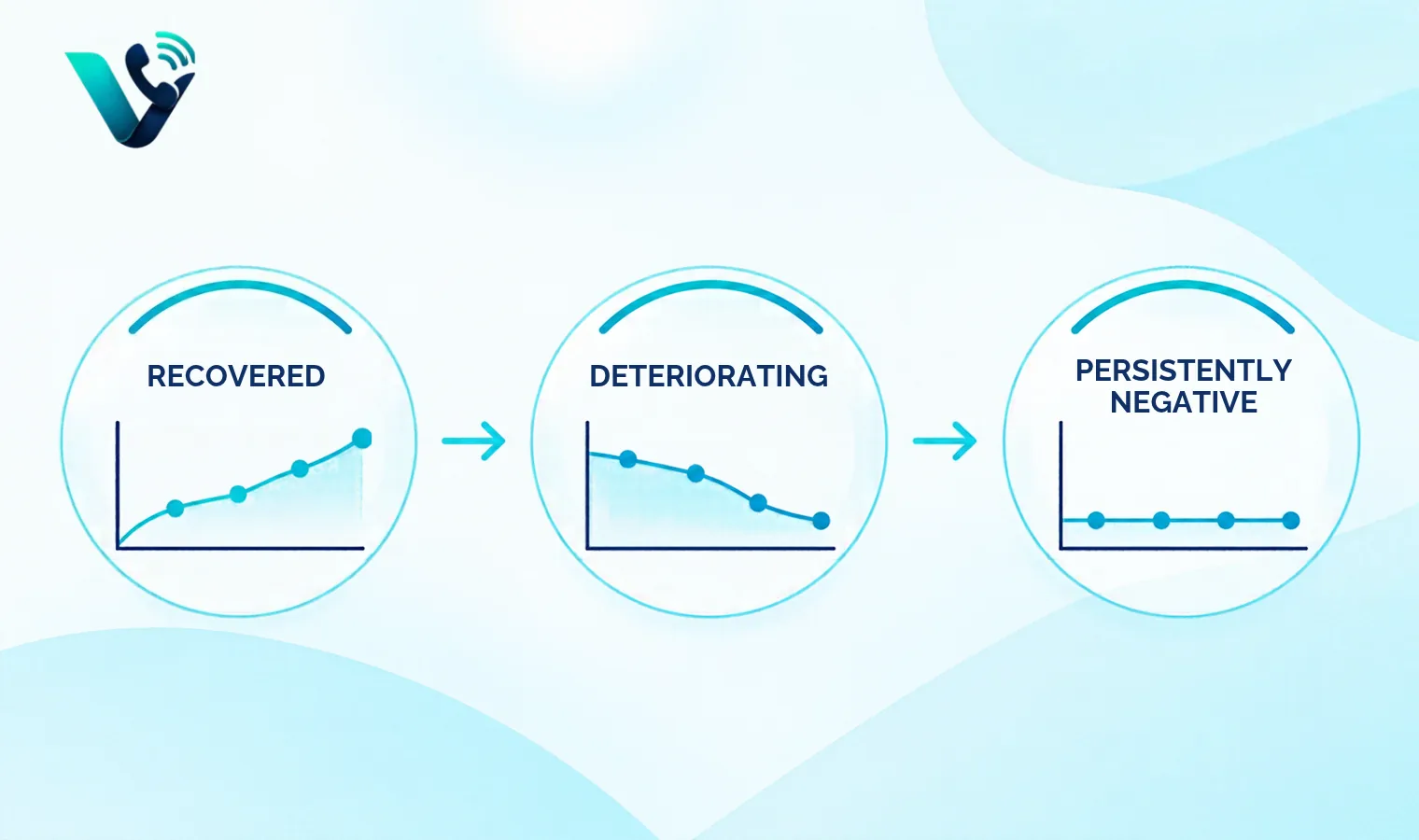
- Recovered: Negative early, improving after resolution. Usually coaching-positive rather than churn-critical.
- Deteriorating: Neutral or mixed at the start, strongly negative near the end. Often deserves review.
- Persistently negative: Low sentiment throughout, especially with repeat-contact or cancellation language. High-priority investigation.
Listen for effort language
Churn risk often hides in descriptions of customer effort: 'I already explained this', 'I was transferred again', 'nobody called me back', 'I keep getting the same answer'. These phrases signal process failure rather than product dissatisfaction alone. Tag them separately so retention work does not become a script problem when the real issue is broken ownership.
Add account context before triggering an alert
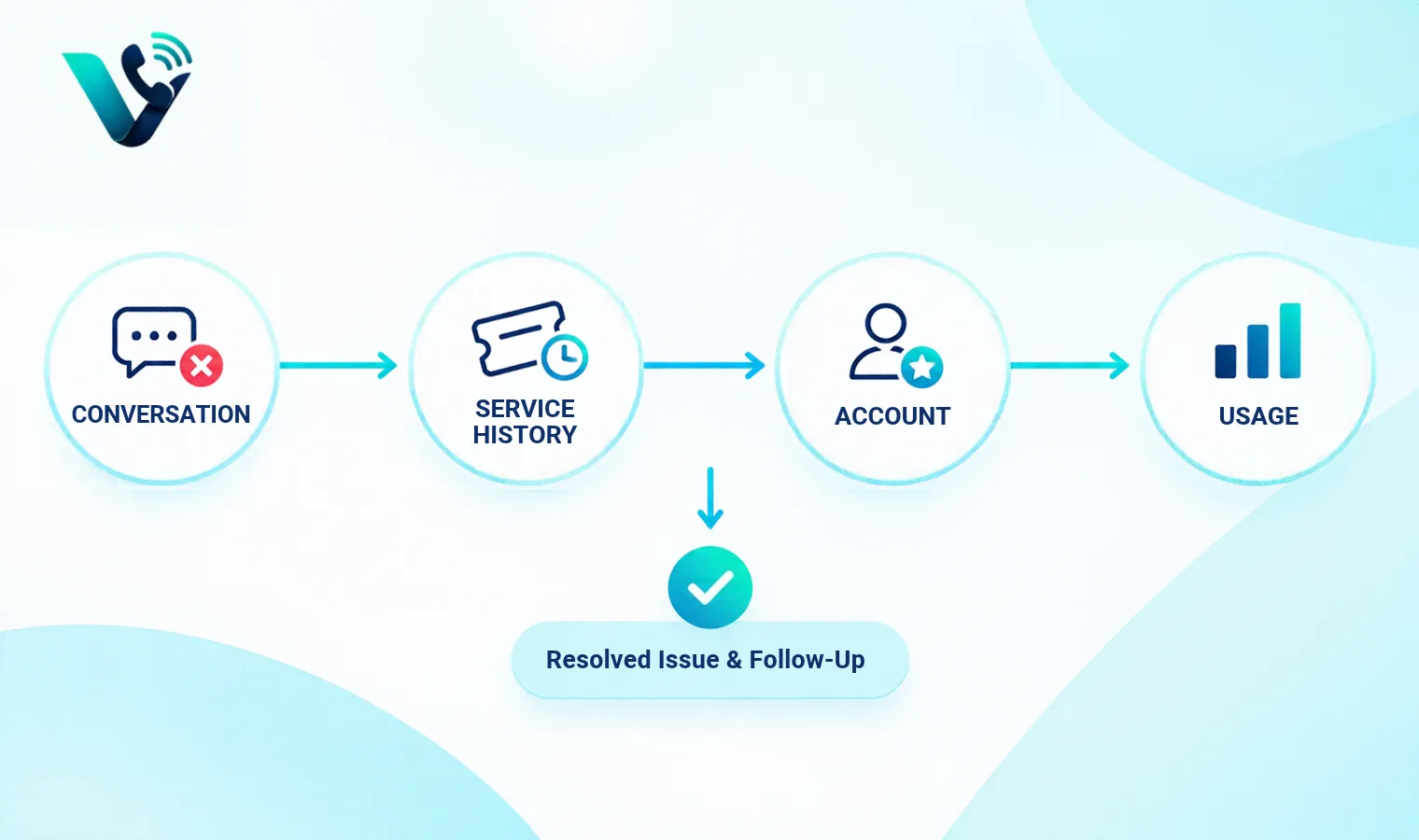
Language becomes more useful when combined with CRM data. A new trial user who asks about cancellation may be exploring policy; a long-term enterprise customer with three recent support cases and declining usage may represent material churn risk. Build a scoring model that uses conversation evidence plus account signals rather than allowing the transcript alone to decide.
Signal family |
Example inputs |
Role in risk model |
|
Conversation |
Cancellation intent, competitor mention, frustration |
Immediate evidence |
|
Service history |
Repeat contacts, unresolved cases, escalations |
Operational context |
|
Account |
ARR, tenure, segment, renewal date |
Business impact |
|
Usage |
Declining adoption, inactive seats |
Behavioral context |
|
Outcome |
Issue resolved, callback promised, escalation accepted |
Risk reducer or follow-up |
Do not overreact to sentiment
Sentiment analysis is useful but imperfect. Accents, sarcasm, calm complaints, cultural communication styles and transcript errors can distort the score. Some customers stay polite while preparing to leave; others sound angry and remain loyal after a fast resolution. Treat sentiment as a prioritization signal, not an automatic churn label.
Design the intervention, not just the detection
A churn-risk alert without an owner creates anxiety rather than retention. Define who receives the alert, how quickly they act, what context they see and what outcome closes it. For high-confidence cancellation intent, that may be a retention specialist. For repeated-contact language, it may be a senior support owner. For competitor mentions, the follow-up may belong to account management.
Measure whether alerts save customers
Track precision first: What percentage of flagged calls represent genuine risk after review? Then track action: Was the account contacted, was the issue resolved, did renewal risk change, and did the customer stay? A model that flags every negative call will look busy but overwhelm the team. The useful system is selective enough that people trust the alert.
How Votelly can support the workflow
Votelly lists live transcription, sentiment, searchable transcripts, AI summaries and CRM integrations. Those features can provide the language and context layer for a churn-risk workflow. The actual risk model can live in CRM automation, analytics or a review process. Keep the product claim narrow: Use Votelly conversation data as input unless a dedicated churn feature is explicitly confirmed.
A practical pilot
- Define five high-confidence phrases or intents that require review.
- Add sentiment trajectory and repeat-contact context rather than using sentiment alone.
- Limit the pilot to one support queue or customer segment.
- Route alerts to one named owner with a response target.
- Review 50-100 flagged calls manually and record false-positive reasons.
- Compare flagged accounts with renewal, cancellation and escalation outcomes.
- Adjust thresholds before expanding to every queue.
Separate saveable risk from structural churn
Not every at-risk customer can be saved by a better support response. Some calls reveal product-market mismatch, budget cuts, mergers or policy changes outside the agent's control. Tag these separately from service-recovery risk so retention teams do not measure agents against impossible saves.
A useful churn program therefore has at least two outputs: an immediate intervention queue for recoverable issues and a product or executive insight feed for structural reasons. The same conversation can support both without forcing every signal into one churn score.
Churn intelligence should make support more human
The point is not to reduce customers to a red risk score. It is to notice when language shows lost confidence, repeated effort or switching intent early enough for a person to respond well. Support-call language is powerful because it captures the customer's own words. Combine those words with case history, account context and human judgment, and churn detection becomes a prioritization system rather than a prediction gimmick.
Build phrase families instead of a blacklist
Customers express the same risk in many ways. A churn detector should therefore group phrase families rather than hunt for one exact sentence. Exit intent may appear as 'close the account', 'end the service', 'move us off the platform' or 'what do I need to do to cancel?' Competitor comparison may appear as a named competitor, 'another provider' or a statement that the customer is evaluating alternatives.
Phrase families should include exclusions. 'I cancelled my old provider to move to you' contains the word cancel but signals the opposite of churn. 'How do I cancel an add-on?' may not mean the customer wants to leave the core product. Use local context around the phrase and, where possible, the product or account object being discussed.
Weight recency and repetition
One frustrated call six months before renewal is different from three escalations in the last ten days. Churn-risk scoring should decay old conversation signals and amplify repeated recent evidence. The exact weighting depends on your business cycle, but the principle is straightforward: Current, repeated language should matter more than isolated historical frustration.
This is also where CRM integration becomes valuable. A conversation signal can be joined with renewal date, open cases, usage trend and account tier. The model does not need to predict the future perfectly; it needs to make the next review queue more relevant than a random list of accounts.
Try this on your own numbers
Local numbers in 118 countries, AI call notes and one shared inbox. Live the same day, no contract.
Use recovery language as a risk reducer
Risk models often detect negative language but ignore evidence that the problem was repaired. Statements such as 'that solves it', 'I am happy with that option' or an accepted resolution can reduce the urgency of a churn flag. Likewise, an agent's promised callback is not a resolution until it actually happens, so the workflow should update risk when the commitment is completed.
A good model therefore looks at the ending state of the conversation as well as the worst moment. This prevents teams from treating every angry opening as a retention emergency and focuses attention on calls that ended unresolved, uncertain or explicitly at risk.
Give retention teams evidence, not just a score
An alert that says 'Churn risk: 82' forces the reviewer to investigate from scratch. Include the evidence: The relevant transcript snippet, trend in sentiment, recent case count, account value and reason the rule fired. Explainable alerts make human review faster and help teams identify bad rules. They also reduce the temptation to treat the score as objective truth.
Before automating retention outreach, compare churn flags with a holdout sample of unflagged accounts. This shows whether the language model is actually concentrating risk or merely surfacing ordinary support frustration. A useful system should produce a meaningfully higher cancellation or escalation rate in the flagged group while keeping the review volume manageable.
Frequently asked questions
- Can support call language really predict churn?
- It can provide useful risk signals, especially explicit cancellation language, competitor comparisons, repeated-effort phrases and deteriorating sentiment. It should be combined with account and service context.
- What phrases indicate high churn risk?
- Examples include direct cancellation intent, switching language, repeated unresolved-contact statements and loss-of-confidence phrases. Context matters, so avoid treating one keyword as definitive.
- Is negative sentiment enough to trigger a retention workflow?
- Usually not. Negative sentiment can occur in calls that end successfully. Combine sentiment with intent, history and call outcome.
- Should churn alerts be real time?
- High-confidence signals can justify real-time alerts if a named owner can act. Lower-confidence patterns may be better for daily or weekly review.
- How do we measure a churn-detection model?
- Track precision, false positives, intervention completion, resolution, renewal/cancellation outcomes and whether the alert changed action.
- How does Votelly fit into churn-risk detection?
- Votelly provides transcription, sentiment, summaries, searchable transcripts and CRM integrations that can feed a downstream churn-risk workflow.