Ramping a new rep in 30 days using call recordings
By Jamila Parker · · 8 min read

A new rep does not need to shadow random calls for a month. Use a curated recording library, weekly skill gates and call scorecards to build a focused 30-day sales ramp.
Key takeaways
- Ramping a new rep in 30 days requires a sequence of skills, not a giant library of recordings and a request to "listen and learn".
- Curate recordings by skill: opening, discovery, objection handling, qualification, next-step setting and strong calls that still lost.
- Use the same short scorecard for examples, role-plays and live calls so the rep always knows what good performance looks like.
- Increase live-call difficulty in stages, with manager review and self-coaching between each stage.
- Graduate the rep on observable behaviours and reliable workflow use, not simply because 30 calendar days have passed.
Ramping a new rep in 30 days sounds aggressive only when onboarding is built around passive learning. A calendar full of product presentations, generic sales theory and random call shadowing can consume a month without showing whether the rep is actually ready to speak with buyers. Call recordings make the process more concrete because the new hire can hear what good execution sounds like, replay difficult moments and compare their own calls with real examples.
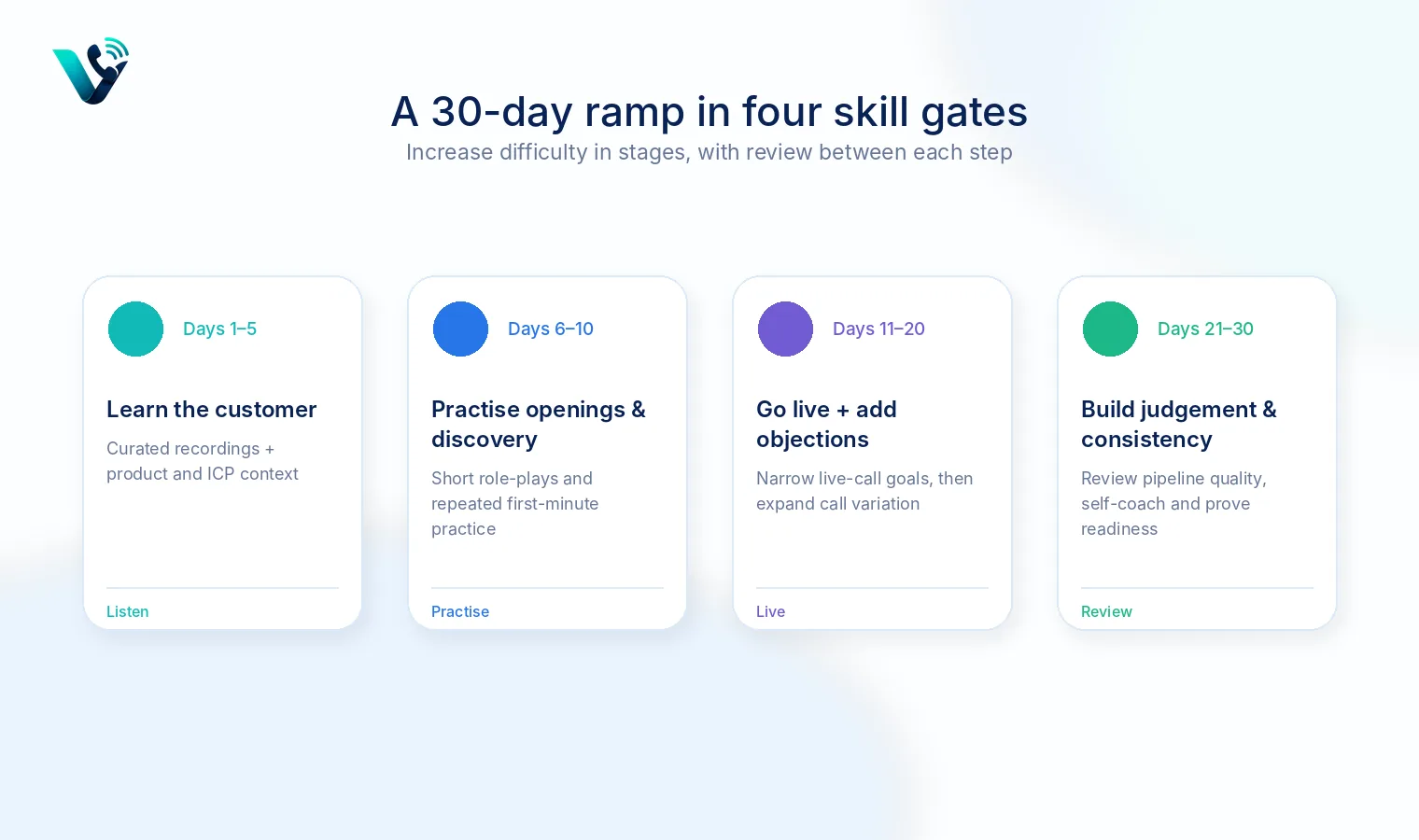
The key is curation. A folder containing hundreds of recordings is not an onboarding programme. The rep needs a deliberate path: First understand the market and call structure, then hear examples, then practise the same skill, then use it live, then review the recording and repeat. Gong explicitly positions recording libraries as a scalable alternative to relying only on call shadowing, and its customer case studies show how structured conversation visibility can shorten ramp time. A 30-day plan can use that idea without turning onboarding into surveillance: Recordings become learning assets, scorecards create common language, and each week has a clear skill gate.
Before day one: Build the call library
The manager should prepare the learning environment before the rep starts. Choose a small set of calls rather than dumping the entire archive into a folder. Include strong calls from more than one rep so the new hire does not confuse one personality with the only correct style. Add a few imperfect calls where the seller recovered well, and a few losses that teach something useful.
Label each recording by the skill it demonstrates: Cold-call opening, discovery, qualification, objection handling, pricing transition, stakeholder mapping, next-step setting or disqualification. Add a one-sentence note telling the learner what to listen for. The note should direct attention, not give away every answer.
Use one scorecard across the whole 30-day ramp
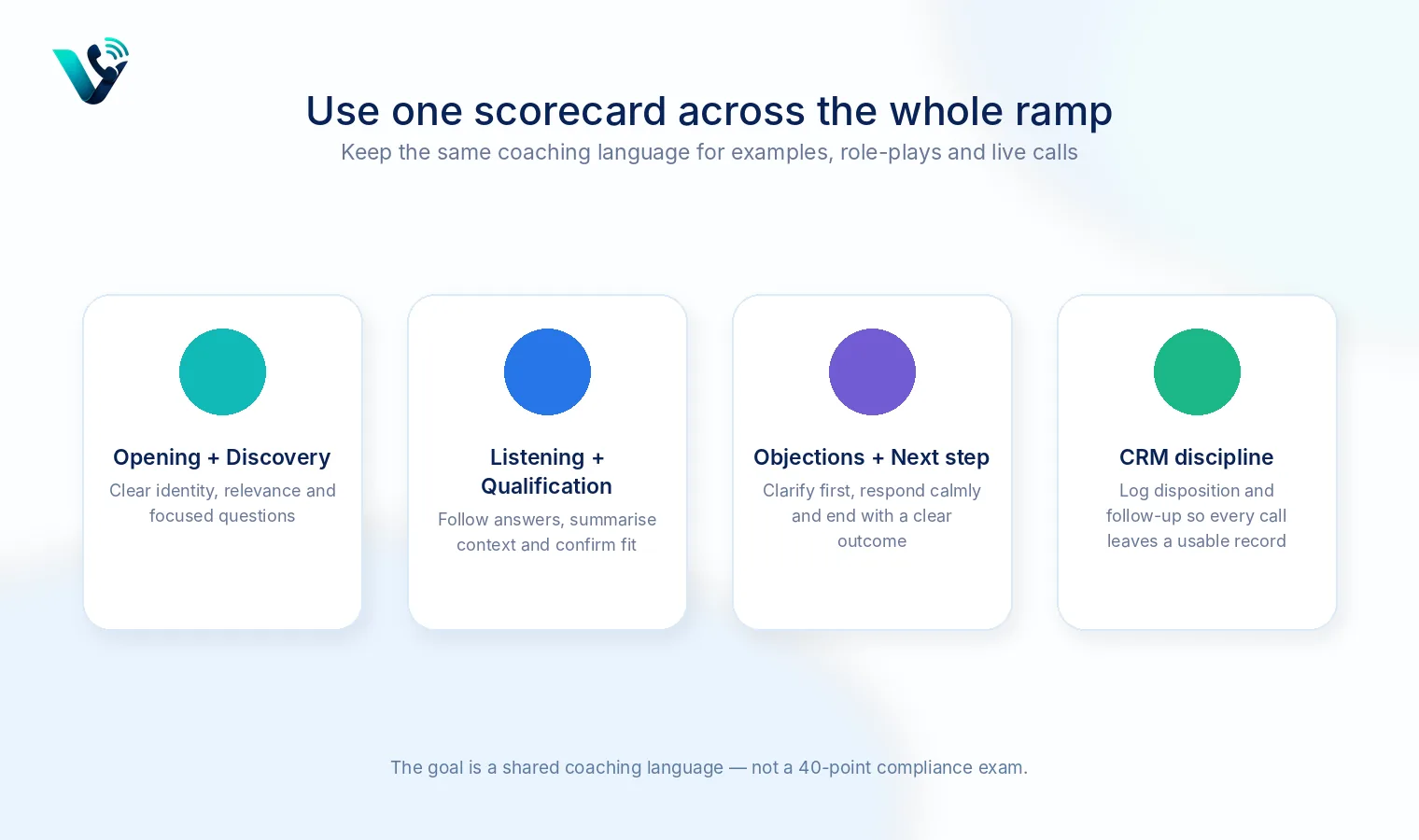
A short scorecard becomes the backbone of the programme. The same categories should be used when the rep listens to an example, performs a role-play, reviews their first live call and joins a manager coaching session. Consistency reduces cognitive load because "good" does not change depending on the exercise.
Skill |
Observable behaviour |
Early ramp standard |
|
Opening |
Clear identity, reason and relevance |
Can deliver naturally without reading |
|
Discovery |
Asks focused questions and follows answers |
Finds at least one real business problem |
|
Listening |
Does not interrupt or rush to pitch |
Summarises buyer context accurately |
|
Qualification |
Confirms fit, timing or stakeholder reality |
Knows when not to force a meeting |
|
Objections |
Clarifies before answering |
Handles common objections without defensiveness |
|
Next step |
Sets owner, action and timing |
Ends live conversations with a clear outcome |
|
CRM discipline |
Logs disposition and follow-up correctly |
Leaves a usable record after every call |
The scorecard should stay small enough that a manager can review a call in minutes. The goal is to create a shared coaching language, not a 40-point compliance exam.
Days 1-5: Learn the customer before copying the script
The first week should answer who the team calls, why those buyers care and what a normal conversation sounds like. Start with five to eight curated recordings covering different outcomes. Ask the rep to write what the buyer cared about, what question changed the conversation and why the next step was or was not earned.
Pair recordings with product and ICP learning. Instead of a two-hour feature lecture, attach each product concept to a real customer question from a recording. The rep hears the problem first, then learns the capability in context. This makes the language more buyer-centred from the beginning.
End the week with short role-plays that use the same scorecard. The rep should be able to open the call, ask two or three discovery questions, explain the value proposition in plain language and close for a logical next step. Do not demand perfect objection handling yet; the first gate is clarity and structure.
Days 6-10: Practise openings and discovery at high repetition
The second phase should create muscle memory around the first minutes of the call. Give the rep several strong and weak openings, then ask them to identify the difference. Useful recordings include a prospect who is impatient, a gatekeeper, a buyer who immediately asks "what is this about?" and a call where the rep earns more time through relevance.
Run short practice loops. The rep delivers the opening, the manager interrupts with a realistic response, and the rep continues into discovery. Record the role-play if possible. Self-review is powerful because the rep can hear habits they do not notice live: Filler words, rushed pace, long monologues or questions stacked on top of each other.
The gate for day ten is not "sounds like the top rep". It is "can hold a natural first two minutes and reach a useful question without hiding behind a script".
Days 11-15: Introduce live calls with a narrow objective
Live calling should begin before the rep feels completely comfortable, but the objective should be narrow. Start with a defined list, lower-risk segment or monitored block where the manager can review several calls quickly. The rep is not expected to master the whole sales cycle. The target is to apply the opening and discovery behaviours under real pressure.
After each block, select one call for self-review and one for manager review. The rep scores their own call first. Then compare the manager's score and discuss the biggest difference. This forces the new hire to develop judgement rather than waiting for somebody else to tell them what went wrong.
Keep coaching to one or two behaviours. If the rep interrupted twice, missed a qualification question, overexplained pricing and forgot the next step, choose the behaviour with the highest leverage. Trying to fix everything at once makes the next live block harder.
Days 16-20: Add objection handling and call variation
Once the rep can open and discover reliably, expand the recording library to objection patterns. Group calls by objection type: Not interested, timing, existing supplier, price, authority, "send me information" and "call me later". Ask the rep to identify whether the objection is real, a reflex or a request for clarity.
Teach a simple sequence: Acknowledge, clarify, respond, confirm. Recordings help because the learner can hear tone. The same words can sound combative or collaborative depending on pace and delivery. Include examples where the best move is to disqualify or pause rather than push through.
Vary the live call list. Give the rep different personas or industries that still fit the ICP. The goal is to adapt the core conversation instead of memorising one perfect script.
Days 21-25: Coach pipeline quality, not just call quality
A rep can sound confident on calls while creating weak pipeline. Use recordings together with CRM outcomes. Review which calls booked meetings, which meetings were held, which created opportunities and which were disqualified. Ask whether the original call contained signals that predicted the later result.
This is where qualification becomes more important. A meeting is not automatically a good outcome if the buyer has no fit, no need or no plausible next step. Teach the rep to value useful disqualification. A high-quality "not now" with a documented future date is better than forcing a calendar invite that will never happen.
Have the rep build a personal highlight reel: One strong opening, one discovery moment, one objection response and one clear next step from their own calls. The exercise changes the identity from trainee to seller and creates examples they can revisit.
Days 26-30: Prove consistency and independent self-coaching
The final week should test whether the rep can perform without constant manager intervention. Choose a representative sample of calls rather than the single best one. Score them for the same behaviours used throughout the month. Look for consistency across different buyers and outcomes.
The rep should also bring one self-selected call to the final coaching session and explain what they would keep, what they would change and what they will practise next month. A new hire who can diagnose their own calls is much easier to coach at scale than one who depends on the manager for every answer.
Graduation criteria can include scorecard consistency, CRM hygiene, reliable follow-up, appropriate disqualification, product accuracy and the ability to run the normal call workflow without assistance. Quota attainment may still take longer than 30 days depending on the sales cycle. The 30-day goal is readiness and repeatable behaviour, not an artificial revenue promise.
Manager cadence: Keep coaching short and frequent
A 30-day ramp fails when coaching is saved for one long weekly meeting. Use shorter loops. A manager can review one recording before a 15-minute session, discuss one strength and one behaviour to change, then ask the rep to bring evidence from later calls. The next session begins with whether the behaviour moved.
Create calibration across managers as the team grows. Two managers should occasionally score the same recording and compare why. If their ratings differ widely, the scorecard needs clearer definitions.
Try this on your own numbers
Local numbers in 118 countries, AI call notes and one shared inbox. Live the same day, no contract.
Privacy and trust around recordings matter
Call recordings are powerful onboarding material, but access and use need policy. Recording and consent rules vary by jurisdiction. Define which calls can be recorded, how customers are notified where required, who can access recordings, how long they are retained and whether sensitive calls are excluded from the training library.
Tell new hires how recordings will be used.
How to use Votelly in a 30-day call-recording ramp
Votelly's product positioning includes call recordings, transcripts, analytics, scorecards and supervisor tools for call-centre and sales workflows.
Use www.votelly.com to confirm the live recording, access and coaching capabilities available on the plan you intend to use.
Frequently asked questions
- Can you really ramp a new sales rep in 30 days?
- You can build reliable call readiness and workflow discipline in 30 days when the programme is focused. Full quota ramp may take longer depending on deal complexity and sales cycle.
- How many call recordings should a new rep listen to?
- Start with a curated set of high-value examples rather than a huge archive. Add recordings by skill as the rep progresses and include both strong and instructive imperfect calls.
- What should a sales call scorecard include?
- Use a short set of observable behaviours such as opening, discovery, listening, qualification, objection handling, next-step clarity and CRM discipline.
- When should a new rep start live calls?
- Usually before the end of the second week, once the rep can demonstrate the basic opening and discovery structure in role-play. Start with a narrow objective and strong review support.
- Should managers review every new rep call?
- No, use representative sampling. The goal is to identify patterns, coach one or two behaviours and teach the rep to self-review rather than create manager dependency.
- How can Votelly support sales onboarding?
- Where the live plan supports recordings, transcripts, analytics or supervisor tools, Votelly can provide the conversation layer for a structured ramp. Confirm recording permissions and product capabilities for your markets before rollout.