Best times to cold call, by industry and timezone
By Jamila Parker · · 12 min read

There is no universal perfect hour, but patterns exist. Use buyer local time, industry routines and your own answer-rate data to find the best windows.
Key takeaways
- The best times to cold call should be tested in the prospect's local time, not the sales rep's time zone.
- Late morning can be a useful starting window, but industry routines, buyer role and geography can shift the strongest cold calling times.
- Track answer rate, meaningful conversations, positive dispositions and meetings booked by time block; pickup rate alone can be misleading.
- Use separate calling windows for different industries and regions instead of applying one global schedule to every prospect list.
- Review cold call timing every few weeks because seasonality, daylight-saving changes, campaigns and prospect behaviour can change the result.
The best times to cold call are not defined by one universal hour. A calling window that works for a SaaS decision-maker in London may perform poorly for a restaurant owner in Sydney, a logistics manager in Chicago or a healthcare administrator in Singapore. The strongest cold calling times depend on buyer local time, industry routines, role seniority, list quality and what outcome the sales team is trying to create.
For most teams, the right goal is not to find a magical hour. It is to identify a small number of repeatable time windows where answer rate, meaningful conversations and meeting conversion are consistently stronger. That requires treating cold call timing as a measurable sales variable rather than a habit.
This guide explains how to find the best times to cold call by industry and timezone, how to test morning and afternoon calling windows, how to compare answer rate with meeting rate, and how to build a practical outbound calling schedule without forcing every prospect into the same pattern.
Local time is the first rule

The first rule for cold calling by timezone is simple: Plan around the prospect's local time. A 10 a.m. call should mean 10 a.m. where the buyer is working, not 10 a.m. where the rep happens to sit. This matters even more when an outbound team covers multiple countries from one office.
Build prospect lists with a reliable timezone or region field and schedule call blocks accordingly. This reduces accidental calls before the workday begins, during dinner hours or after local offices have closed. It also gives managers cleaner data because each time block represents a comparable part of the buyer's day.
Time-zone logic should also account for daylight-saving changes. Two regions that are normally eight hours apart may temporarily move to seven or nine hours apart when one changes clocks before the other. A schedule that is correct in one month can quietly become wrong later in the year.
For international prospecting, group contacts into practical calling regions rather than asking reps to calculate time differences manually. A well-organised list might separate Australia and New Zealand, Asia, Europe, the UK, and North American time zones so each block can be called during an appropriate local window.
What recent research says
The source material for this draft cites HubSpot's 2025 survey, where respondents who cold call most commonly identified late morning, roughly 10 a.m. to noon, as a productive period, with Tuesday reported as the strongest day in that survey. That is useful as a starting hypothesis, not a guaranteed benchmark for every market.
The practical lesson is to use published cold calling benchmarks to choose the first windows to test, then replace those assumptions with your own data. A late-morning block may work well because many buyers have settled into the day but are not yet deep into afternoon deadlines. In some industries, however, that same period can be the busiest operational window.
Do not optimise around answer rate alone. A time slot can produce many short pickups but few useful conversations. Another slot may generate slightly fewer answers but more decision-maker connects and more meetings. The best time for cold calls is the window that produces the strongest business outcome, not simply the most people saying hello.
Treat every external study as directional evidence. Differences in prospect seniority, country, data quality, caller-ID reputation and sales motion can materially change cold call connect rates and meeting conversion.
Industry changes the window
Industry routine can change the best times to cold call more than a broad benchmark suggests. Office-based buyers often have more predictable desk time than operators in hospitality, retail, healthcare, logistics or field service. The right calling window is usually the period when the buyer is available enough to talk but not yet buried in the busiest part of the day.
For SaaS, agencies, finance and professional services, late morning and selected afternoon windows can be sensible starting points because buyers often work around meetings, email and focused desk work. Test before and after common meeting blocks rather than assuming every office-based prospect follows the same schedule.
For hospitality and restaurants, meal-service periods can be poor cold calling times. A manager may be far more reachable between service peaks than during lunch or dinner preparation. Retail can behave similarly: Store opening, shift changes and peak shopping hours may matter more than the generic business-day average.
For logistics, construction and field-service businesses, very early office hours may be productive for some roles because operations often begin before a standard corporate day. At the same time, site managers and drivers may be least available once activity is fully underway. Separate office-based decision-makers from field roles before deciding on a calling schedule.
Healthcare requires additional care because clinical and administrative schedules vary widely. Avoid treating patient-facing periods like a normal office calendar. If the target is an administrator, procurement contact or practice manager, build calling windows around the specific role and organisation type rather than around the healthcare category as a whole.
The strongest industry strategy is therefore not a fixed timetable but a testable hypothesis: Identify when the buyer is least operationally busy, run enough calls to measure the result, and keep only the windows that consistently create useful conversations.
Buyer role can matter as much as industry
Cold calling times should also reflect the role you are trying to reach. Senior executives, frontline managers, founders and individual contributors often structure their days differently. A time block that works for one persona may fail for another even inside the same company.
Founders and small-business owners may be reachable outside the most crowded meeting hours because they move between operations, sales and administration. Enterprise executives may have calendars filled with internal meetings, making short gaps more important than broad “business hours.” Frontline managers may be easiest to reach before a shift becomes busy or after a peak operating period.
Segment cold call performance by persona or seniority when the sample size is large enough. If the VP-level list responds best in one window and manager-level prospects perform better in another, create separate call blocks instead of averaging the two together.
This is one reason the best times to cold call should be treated as a dataset, not a rule printed on the wall. Buyer behaviour becomes clearer when industry, role and local time are analysed together.
Test two or three windows
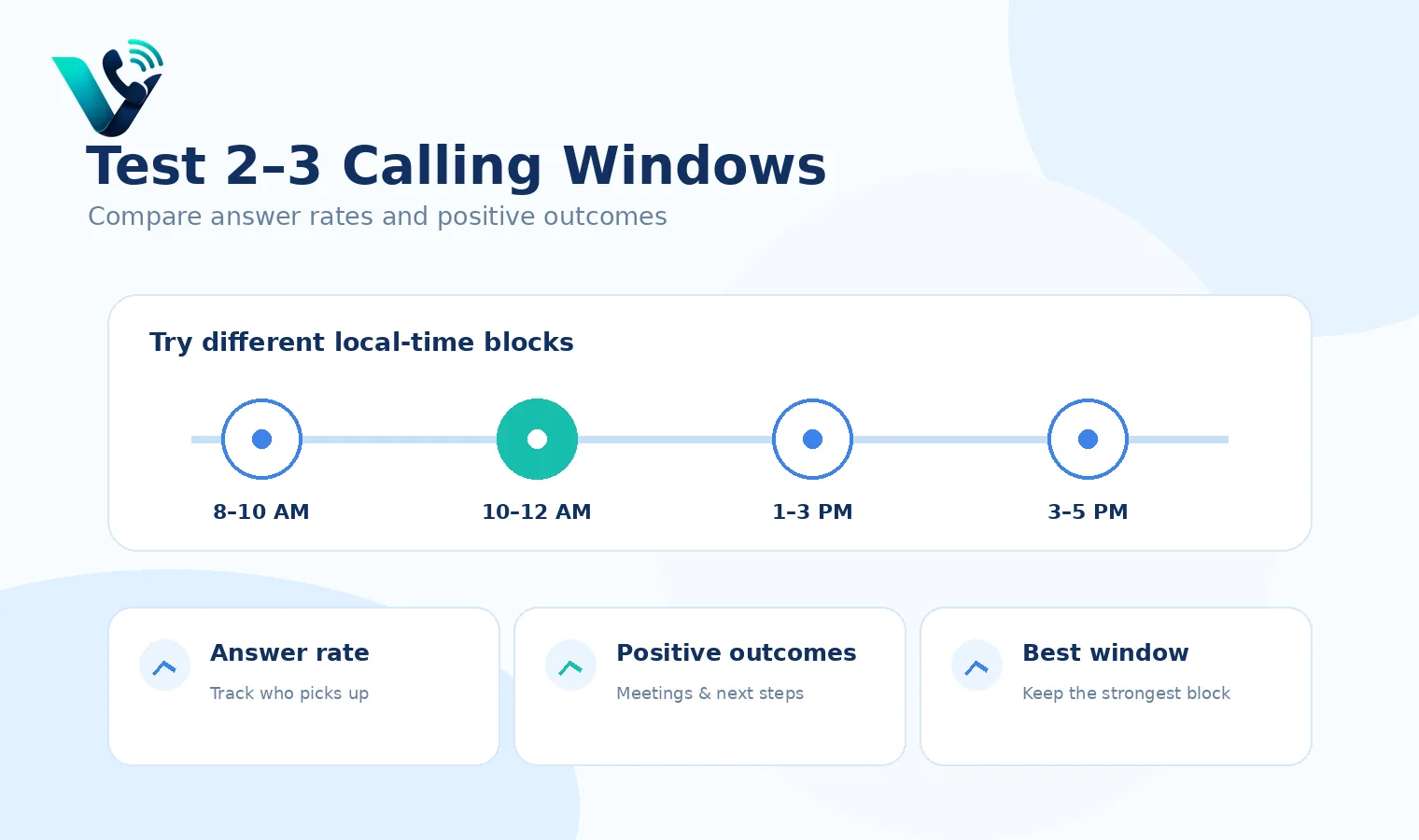
Start with two or three clear calling windows rather than changing the schedule every day. Practical test blocks might include 8-10 a.m., 10 a.m.-noon, 1-3 p.m. and 3-5 p.m. in the prospect's local time. You do not need to test every possible hour at once.
Run enough calls in each window to reduce random noise, then compare the same funnel metrics: Dials, intended-person connects, meaningful conversations, positive dispositions, meetings booked and meetings held. Use the same prospect type and similar list quality where possible so time of day is the main variable being tested.
Avoid declaring a winner after one strong afternoon. Small samples can swing dramatically because of a few unusual calls. Look for a pattern across several days or weeks, especially if the campaign targets a narrow segment.
Change one main variable at a time. If you change the list source, script, caller number and calling window together, you will not know which change improved the result. A controlled test makes cold call timing data far more useful.
Once a strong window appears, keep a smaller amount of activity in the weaker periods. Buyer behaviour changes, and a window that underperforms today may improve as seasonality, staffing or market conditions shift.
What about the best day to cold call?
Time of day gets most of the attention, but day of week can influence cold call performance as well. The draft's cited HubSpot survey identified Tuesday as the strongest day among its respondents, which makes Tuesday a reasonable test point for teams building a new outbound schedule.
Still, the best day to cold call should be tested with the same discipline as the best hour. Monday may be crowded with planning meetings in one industry but relatively open in another. Friday afternoons may be weak for some B2B audiences, while owner-operated businesses can behave differently.
Build a simple heat map of answer rate and meeting conversion by weekday and time block. Patterns become much easier to see when the team can compare Tuesday late morning with Thursday afternoon rather than looking at one blended weekly average.
Do not eliminate a day solely because the average is lower. A smaller but valuable segment may still respond well on that day, especially when the target market operates on different schedules from the rest of the list.
Time-zone operations
Distributed sales teams can turn time zones into an advantage. Instead of asking one rep to start unusually early and finish unusually late, route regional prospecting to people whose normal working hours overlap with the strongest buyer windows.
A follow-the-sun SDR model can cover early and late cold calling windows across several markets while keeping individual schedules reasonable. The important part is consistent ownership: Each region or call block should have a clear list, clear local-time rules and the same outcome definitions.
If one central team covers every geography, build the day in regional blocks. For example, a rep might begin with one market that is already in late morning, move to another region as its business day opens, and finish with a later time zone. This is more reliable than mixing contacts from several zones in one unsorted queue.
Regional scheduling also reduces compliance and reputation risk. Teams are less likely to call outside acceptable local hours when the calling list itself is organised around the prospect's time zone.
Optimise for outcome, not pickup alone
The best times to cold call are the windows that create the best downstream outcome, not simply the highest answer rate. A pickup can be a gatekeeper, a rushed prospect or an immediate rejection. Sales teams need to know whether the time block creates real conversations and qualified next steps.
Track answer rate, intended-person connect rate, meaningful conversation rate, positive disposition rate, meetings booked and meetings held by time block. If a 10-12 window produces more answers but a 3-5 window creates more meetings per conversation, the second window may be more valuable for that segment.
Also watch talk duration carefully. Longer is not always better, but a window dominated by extremely short calls can indicate poor timing or weak targeting. Combine duration with call disposition codes so managers know whether the conversations are progressing.
For mature teams, calculate pipeline or opportunity creation by calling window. That prevents the schedule from being optimised around meetings that rarely convert into real sales opportunities.
The final schedule should balance productivity and coverage. Concentrate more activity in the strongest cold calling times, but preserve enough testing elsewhere to detect new opportunities and avoid overfitting to one historical pattern.
Try this on your own numbers
Local numbers in 118 countries, AI call notes and one shared inbox. Live the same day, no contract.
30-day test plan for finding your best cold calling times
Days 1-7: Establish the baseline. Record dials, answers, intended-person connects, meaningful conversations, positive dispositions and meetings for each major local-time block. Do not change the script or list source during this first week unless something is clearly broken.
Days 8-14: Segment by industry and buyer role. Compare the same time windows for different prospect groups. Look for obvious mismatches, such as hospitality prospects performing poorly during meal-service hours or enterprise buyers becoming more reachable between common meeting blocks.
Days 15-21: Shift more calls into the strongest two windows while keeping a smaller control sample in the weaker periods. This tests whether the pattern remains strong when volume increases.
Days 22-30: Compare outcomes, not only pickups. Review meetings booked, held-meeting rate and any opportunity data available. Document the best times to cold call for each major segment and schedule the next review rather than treating the result as permanent.
At the end of the month, create a simple playbook showing preferred windows by region, industry and persona. Revisit the playbook after major campaign changes, daylight-saving transitions or noticeable changes in connect rate.
Common mistakes when choosing cold calling times
- Using the rep's timezone instead of the buyer's local time. This can make a strong schedule look weak simply because prospects are being called at the wrong part of their day.
- Copying one published benchmark without testing the team's own market. External data is a starting point, not a substitute for first-party call data.
- Comparing industries with different routines in one blended report. Segment by buyer type before deciding that one hour is universally best.
- Optimising only for answer rate. The best cold calling times should also produce meaningful conversations, positive outcomes and meetings.
- Changing the script, list and timing at the same time. This makes it difficult to understand why performance moved.
- Ignoring daylight-saving and holiday changes. A schedule that is correct most of the year can still create bad calling windows around regional calendar changes.
- Locking the schedule permanently. Prospect behaviour changes, so the team should retest its best times to cold call periodically.
How to connect this topic to Votelly
For Votelly, this topic fits naturally into sales calling, regional number management and outbound workflow planning. The educational value is the scheduling logic: Teams should organise calls around prospect local time, compare performance by window and use call activity data to refine when outreach happens. The primary website destination is www.votelly.com.
Keep detailed product claims tied to confirmed live Votelly capabilities. The blog can still explain an ideal workflow without promising a specific feature: Segment prospects by timezone, run scheduled call blocks, record outcomes consistently and compare answer and meeting rates across those blocks.
This article can also link naturally to Votelly guides on cold call connect rates, dials per meeting, sales call activity metrics, call disposition codes and power dialers. Together, those topics show how timing, list quality, call volume and conversion interact in a complete outbound sales process.
Frequently asked questions
- What is best times to cold call?
- The best times to cold call are the local-time windows in which a specific prospect segment is most likely to answer, have a meaningful conversation and move to a useful next step. The strongest window varies by industry, buyer role, geography and campaign.
- How should a small team start with best times to cold call?
- Start with two or three local-time call blocks, such as 8-10 a.m., 10 a.m.-noon and 3-5 p.m. Run enough calls in each window, keep the list and script reasonably consistent, and compare answer rate, conversations and meetings.
- What should be measured?
- Measure dials, answer rate, intended-person connect rate, meaningful conversations, positive dispositions, meetings booked and meetings held by weekday and local-time block. This shows whether a window produces real sales outcomes rather than just pickups.
- How often should the setup be reviewed?
- Review cold call timing every few weeks while testing and at least quarterly once the schedule is stable. Retest after major campaign changes, seasonal shifts, daylight-saving transitions or noticeable changes in connect rate.
- Can automation replace human ownership?
- Automation can organise timezone-aware lists, schedule tasks and record activity, but sales managers still need to interpret the results and decide which calling windows fit each market and buyer segment.
- How can Votelly fit into the workflow?
- Votelly can be positioned as part of the business-calling layer around outbound sales where the live product supports the required calling workflow. Teams can use call activity alongside CRM outcomes to evaluate which local-time windows produce the best results.