Brazil, Mexico and LATAM Numbers for Cross-Border Sellers
By Jamila Parker · · 8 min read

A practical guide for cross-border sellers using Brazil, Mexico and other LATAM business numbers, covering +55/+52 formats, toll-free options, routing and compliance checks.
Key takeaways
- Brazil uses +55 and two-digit area codes; Mexico uses +52 and a national ten-digit numbering plan.
- LATAM is not one telecom market. Number types, documentation, caller-ID rules and toll-free reachability vary country by country.
- Cross-border sellers should separate sales, order support and logistics routing so callers reach the right team quickly.
- Use official regulator data or a provider with transparent carrier coverage before promising local numbers in a new country.
Quick answer:Usecountry-specific numbers,notasingle “LATAM number”
Cross-border sellers usually get the best customer experience by using country-specific business numbers in their priority markets and routing those numbers into one commerce or support operation. Brazil and Mexico are common first choices because of their market size, but their numbering plans are different and should be implemented separately.
A +55 Brazil number and a +52 Mexico number can both terminate on the same cloud platform, yet they may have different documentation, number types, caller pricing and compliance rules. LATAM strategy should standardise the technology layer while respecting local numbering requirements.
Brazil: +55, DDD area codes and 0800
Brazil uses country code +55 and two-digit area codes known as DDD codes. Anatel states that fixed-line subscriber numbers use eight digits and mobile subscriber numbers use nine digits under the national plan. For cross-border sellers, geographic numbers can support city-focused sales or service, while non-geographic services can support nationwide contact.
Brazil also uses 0800 as a non-geographic toll-free range where the receiving subscriber bears the telecommunications cost and the originating consumer is not charged for the service under the relevant framework. Anatel provides processes for non-geographic code reservation and publishes numbering information.
Mexico: +52 and a ten-digit national plan
Mexico uses country code +52 and a ten-digit national numbering structure. Major urban areas are associated with familiar location codes such as 55 for Mexico City, 33 for Guadalajara and 81 for Monterrey, while other areas use different codes within the national plan. Mexico also has non-geographic service-number ranges, including 800 services.
For a seller, the practical choice is usually between a local market number and a nationwide service number. Confirm availability through an authorised provider and verify whether the exact number supports outbound caller ID, SMS or other required functions.
Routing design for ecommerce and cross-border sales
Separate at least three intents: Pre-sale questions, order or delivery support, and returns or account issues. A customer calling a Mexico campaign number should not sit in the same generic queue as a Brazilian logistics escalation unless agents can handle both markets and languages.
Use the dialled number as routing metadata. A single contact-centre platform can show “Brazil sales” or “Mexico support” to the agent before the call is answered. That allows one global team to provide a local entry point without losing market context.
Language and business-hours design
Brazilian Portuguese and Spanish-speaking LATAM markets should not be treated as one language queue. Even when some agents are multilingual, IVR prompts, saved replies and quality monitoring should reflect the market. Mexico and Brazil also operate across different time zones and holiday calendars.
Publish service hours clearly and route after-hours calls deliberately. Cross-border ecommerce often sees spikes during campaigns and delivery issues, so overflow capacity matters more than having a decorative local number.
Documentation and compliance are country-specific
Brazil’s numbering resources are managed by Anatel, while Mexico’s numbering framework has been managed through the national regulator and numbering systems. Providers may require business or identity documentation, and geographic numbers can have location-related conditions. The exact checklist depends on the number type and carrier.
Active outbound marketing adds another layer. Contact permissions, telemarketing identifiers, consumer protection and spam controls can change independently of number provisioning. A valid number does not automatically make a campaign compliant.
Toll-free versus local numbers in LATAM
Toll-free can work well for high-volume customer care because it reduces caller cost and creates a national support identity. Local geographic numbers can be stronger for city-focused sales, local service operations and partner relationships. Some companies use both: Local numbers for sales and toll-free for post-purchase support.
Compare reachability from mobile networks, inbound rates, business documentation and answer behaviour. Toll-free is not automatically cheaper for the business because the receiving company absorbs more of the cost.
What to measure after launch
Track calls by country, number, campaign and intent. Monitor answer time, abandoned calls, conversion, first-contact resolution, repeat-call rate and complaints. For ecommerce, connect phone activity to order status so the team can see whether calls cluster around payment, delivery or returns issues.
If a country number generates little traffic, decide whether it is still valuable as a trust and support channel. If not, retire it carefully and update all public references.
Expanding beyond Brazil and Mexico
Use the same launch checklist for each new LATAM market: Identify customer demand, Choose number type, Confirm real inventory, Complete KYC, Test routing, Confirm pricing, Verify outbound and Messaging features, and Document ownership. Do not assume requirements in Colombia, Chile, Argentina or another market match Brazil or Mexico.
A regional provider can simplify operations, but local carrier coverage and regulation still determine what is possible in each country.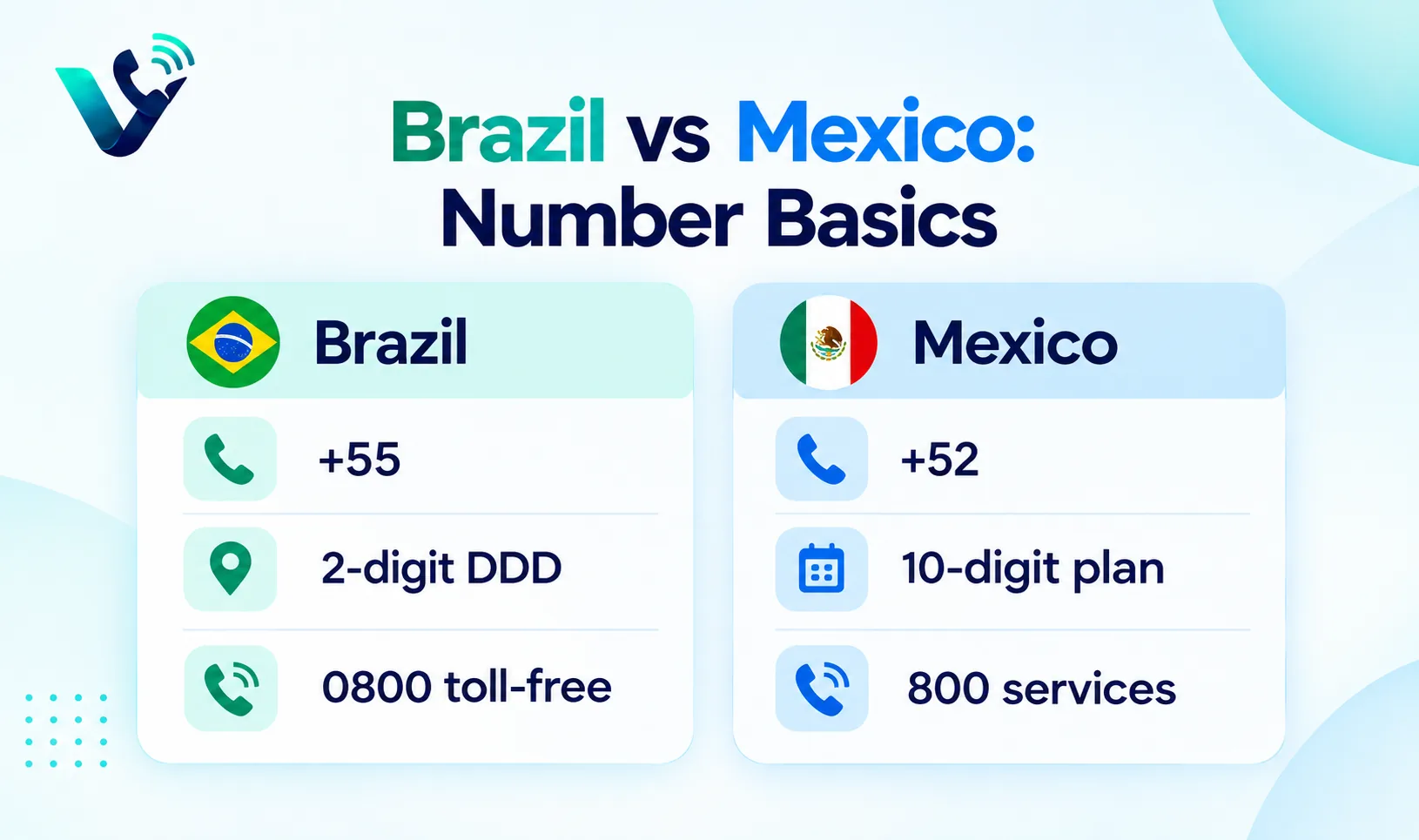
Ecommerce-specific call flows
For ecommerce, route callers using order context whenever possible. An authenticated customer can enter or confirm an order number, after which the system routes delivery issues to logistics and payment issues to billing. Even without deep automation, separate “buying” and “existing order” paths can reduce transfers.
During peak campaigns, temporarily increase queue capacity and publish realistic wait expectations. Cross-border customers are especially sensitive to uncertainty because they may already be worried about customs, shipping time or payment confirmation.
Procurement questions to ask before committing
When evaluating Brazil Mexico and LATAM numbers for cross-border sellers, ask the provider to answer the commercial and technical questions in writing. Confirm the exact number type, current inventory, monthly rental, inbound and outbound call rates, included channels, overage pricing, minimum term, cancellation process and whether the number can be ported later. Then ask which capabilities are tied to the exact number rather than to the platform in general. This distinction matters because a dashboard may support SMS, recording or outbound caller ID even when a particular country range does not.
Compliance questions deserve the same treatment. Ask which carrier or licensed operator supplies the number, what KYC or business documents are required, whether a local address or entity is needed, and whether any intended-use restriction applies. Brazil uses +55 and two-digit area codes; Mexico uses +52 and a national ten-digit numbering plan. A provider that can explain these dependencies clearly is usually easier to work with than one that promises universal instant activation without qualifying the number type or market.
Test the complete customer journey before launch
A successful Brazil Mexico and LATAM numbers for cross-border sellers deployment should be tested from the customer side, not only from the admin portal. Place calls from the networks your customers are likely to use, listen for post-dial delay, confirm two-way audio, press IVR keys, transfer between agents, leave voicemail and trigger after-hours routing. If the workflow includes outbound calling, verify that the intended caller ID is presented correctly and that callbacks return to a monitored destination. If SMS is important, test sending and receiving with the real number instead of assuming support from a feature list.
Also test failure conditions. Temporarily make the primary queue unavailable and confirm that overflow or failover works. Check what happens when all agents are busy, when a call arrives outside business hours and when the destination system is offline. LATAM is not one telecom market. Number types, documentation, caller-ID rules and toll-free reachability vary country by country. These tests are inexpensive compared with discovering a broken route after the number has been printed on a campaign, customer portal or product packaging.
Measure the first 30 days and adjust
After launch, treat Brazil Mexico and LATAM numbers for cross-border sellers as an operating channel with measurable outcomes. Track total calls, unique callers, answer rate, missed calls, average speed to answer, abandoned calls, call duration, transfer rate and the business result that matters for the use case. For sales that might be qualified meetings or revenue; for support it may be first-contact resolution, reopen rate or customer satisfaction. Segment performance by number so the team can see whether the chosen market or number type is actually useful.
Review cost at the same time. Include rental, usage, forwarding, recording, contact-centre licences and any carrier surcharges, then compare that total with the value created. If the number receives little traffic, consider whether it still serves a brand or compliance purpose. If demand is high, add channels or more specialised routing before adding more public numbers. Good virtual numbers / latam strategy usually comes from improving a small number of well-managed customer entry points rather than accumulating numbers with no clear owner.
Try this on your own numbers
Local numbers in 118 countries, AI call notes and one shared inbox. Live the same day, no contract.
Final operational check before scaling
Before scaling Brazil Mexico and LATAM numbers for cross-border sellers, run one final review with sales, support, IT and whoever owns telecom compliance. Confirm who owns the number, where calls route, which hours are covered, what happens during an outage, how recordings or customer data are handled, and how the number will be retired if the market strategy changes. A short cross-functional review catches problems that are easy to miss when procurement, routing and customer experience are handled by separate teams.
Bottom line
Brazil, Mexico and LATAM numbers can make cross-border selling easier when they are tied to a coherent sales and support design. Use +55 and +52 numbers as real customer access points, not cosmetic local identities. Keep routing centralised, language and hours market-specific, and compliance checks country-specific.
Frequently asked questions
- What is the country code for Brazil?
- Brazil uses +55.
- What is the country code for Mexico?
- Mexico uses +52.
- Does Brazil have toll-free numbers?
- Yes. Brazil uses 0800 non-geographic toll-free service numbers under Anatel’s numbering framework.
- Does Mexico use ten-digit phone numbers?
- Mexico uses a national ten-digit numbering structure, with location codes included in the national number.
- Can one support team answer Brazil and Mexico numbers?
- Yes. Cloud routing can send both numbers into one platform while preserving the dialled-number context for language and market routing.
- Should LATAM sellers use local or toll-free numbers?
- It depends on the workflow. Local numbers can fit market-specific sales, while toll-free can be useful for nationwide customer support. Many businesses use both.