Caller ID Reputation: Why Your Business Calls Get Marked as Spam
By Jamila Parker · · 10 min read

Legitimate business calls can still be labelled Spam, Scam Likely or Suspected Spam. This guide explains caller ID reputation, common triggers and a practical recovery process.
Key takeaways
- STIR/SHAKEN authentication helps verify the calling path and caller-ID authority, but it does not guarantee a positive reputation or prevent spam labels.
- Complaint patterns, blocks, call volume behaviour, inaccurate identity and poor callback experience can all damage caller ID reputation.
- Registering or branding a number can help establish identity, but reputation systems still react to how the number is used.
- Recovery requires diagnosis, provider coordination, analytics-vendor disputes where appropriate, and changes to calling behaviour—not endless number rotation.
A business can own a real phone number, pay for a legitimate VoIP service and still see its calls appear as Spam, Scam Likely, Potential Spam or another warning on a customer's screen. That is frustrating, but it usually reflects how modern caller-ID reputation systems work: the number shown on the screen is only one signal among many.
Caller ID reputation is the accumulated trust profile associated with a calling number and, in some systems, the business identity and call patterns behind it. Mobile carriers, handset ecosystems and call-analytics companies may evaluate complaint feedback, blocking behaviour, call frequency, answer patterns, authentication information and historical use. Their exact scoring models are proprietary and can differ across networks.
That is why the same business number may look normal on one carrier and display a warning on another. Solving the problem starts with identifying which layer is creating the label instead of assuming the telephone provider alone controls it.
What caller ID reputation means in practice
Traditional caller ID mainly presented a number and sometimes a name. Modern call treatment adds a reputation layer. Networks try to protect users from unwanted or fraudulent calls, so they may classify traffic before the customer answers.
A good reputation generally means the number behaves consistently with a legitimate calling purpose and does not generate strong negative signals. A poor or uncertain reputation can lead to warning labels, lower answer rates, aggressive call filtering or, in some environments, blocking.
Reputation is dynamic. A number that has been clean for months can deteriorate after a sudden high-volume campaign. A newly assigned number can also inherit historical baggage if it was previously used by another party, although providers and analytics vendors may have processes for correction.
Why legitimate business calls get marked as spam
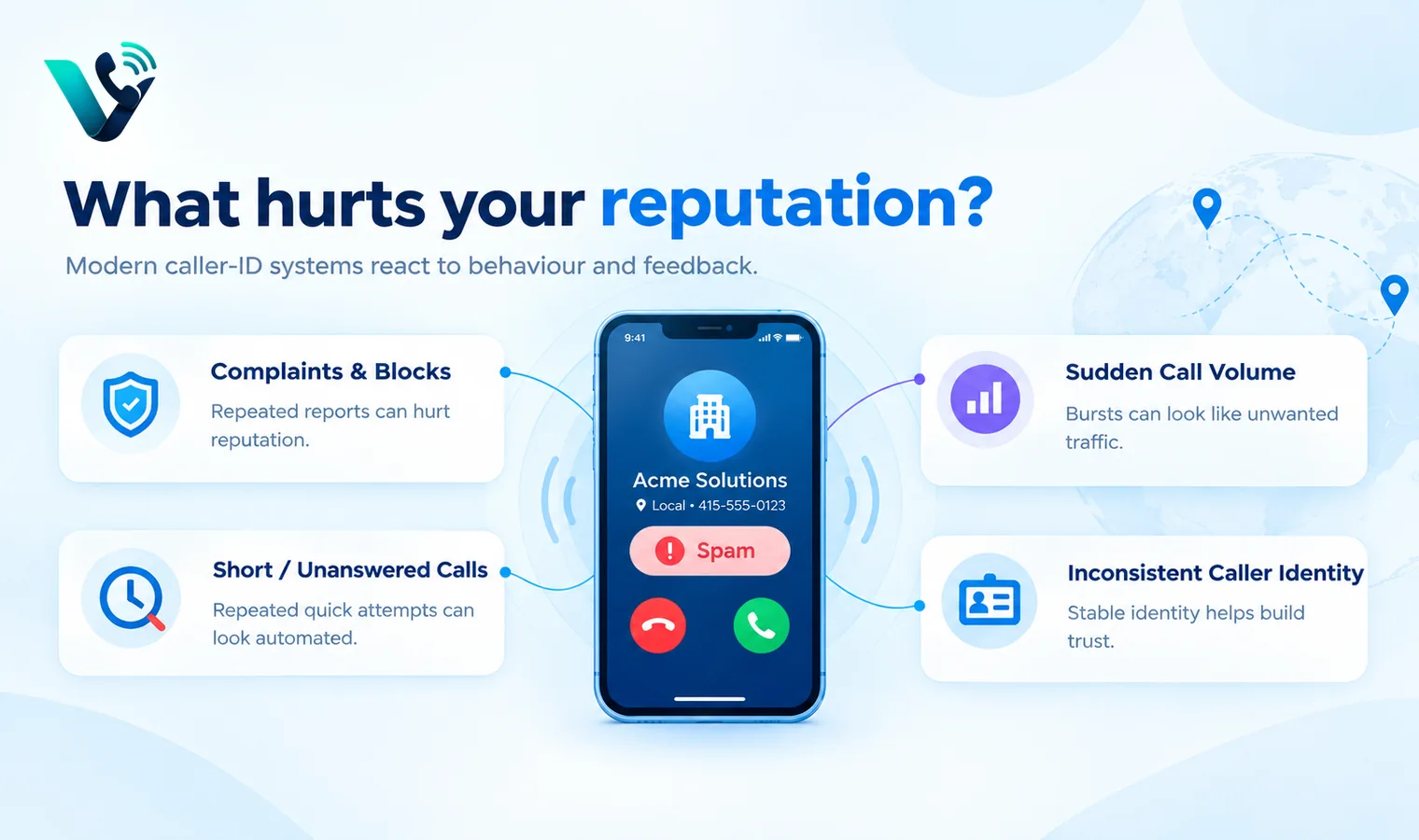
High complaint or block rates
User feedback is one of the clearest reputation signals. Hiya explains that reputation is influenced by consumer feedback such as spam reports and blocked calls. If many recipients repeatedly reject, block or report a number, analytics systems have evidence that the traffic is unwanted even if the caller is a real company.
This is why purchased or poorly qualified lead lists can create a reputation problem quickly. The issue is not simply call volume; it is call volume directed at people who did not expect or want the contact.
Sudden or unnatural call-volume patterns
A number that normally makes 30 calls a day and suddenly makes several thousand can look unusual. Predictive dialers, burst traffic and very short repeated attempts may also resemble unwanted calling behaviour.
There is no single public threshold that guarantees a spam label. The safer approach is to scale campaigns gradually, distribute legitimate traffic appropriately, and monitor the outcome instead of trying to stay just below an imagined numeric limit.
Repeated unanswered calls and short-duration traffic
A healthy business number usually produces a mix of answered calls, conversations, callbacks and normal duration patterns. A number generating mostly unanswered attempts, immediate hang-ups or very short calls can look more like automated or nuisance traffic.
Operational causes matter too. A misconfigured dialer that drops calls when no agent is available can create a poor recipient experience and increase complaints.
Inconsistent or misleading caller identity
If a business rotates through large pools of unrelated numbers, changes identity frequently, or displays a caller name that recipients do not recognise, trust can fall. Inconsistent caller ID also makes it harder for customers to call back and for analytics systems to associate the number with a stable organisation.
For customer service, collections, appointment reminders and account notifications, consistency is especially valuable. A published number tied to a known business name gives the recipient context.
Previous history of a reassigned number
Telephone numbers are reused. A newly acquired number may have been used by another business or individual in the past. If that earlier use generated negative reputation, a legitimate new owner may encounter a label before establishing its own call history.
Keep assignment records and provider documentation. If you need to dispute a label, evidence that the number is now assigned to a different legitimate business can be useful.
STIR/SHAKEN: Important, but not a reputation score
In the United States, the STIR/SHAKEN framework helps authenticate caller ID information on IP networks. In simplified terms, participating providers digitally sign and verify information about the calling number and the provider's level of confidence that the caller is authorised to use it.
This is a major anti-spoofing control, but it is often misunderstood. Authentication does not mean the call is automatically wanted, reputable or safe. A fully authenticated call can still be an unwanted sales call. Conversely, a call traversing networks with incomplete authentication is not automatically fraudulent.
Think of authentication as an identity-chain signal, while caller reputation is a behavioural and trust assessment. They interact, but they are not the same system.
Why registration does not guarantee a clean label
Businesses are often advised to register their numbers with caller-identity or analytics services. That can be useful because it provides business information and may help establish that the number has a legitimate owner. Branded calling can also show a verified business name, logo or call reason on supported devices and networks.
However, registration is not a magic whitelist. Hiya's support guidance explicitly notes that number registration does not override reputation. If recipients continue to report or block the calls, the number can still be labelled.
That distinction is healthy. Otherwise, an abusive caller could simply register once and bypass all reputation protections.
How to diagnose a spam-label problem
Start by documenting exactly what customers see. Ask for screenshots where possible and record the carrier, device type, date and warning text. Test the number from several networks because a label on one ecosystem may not exist on another.
Next, check your own calling data. Compare the period before and after the problem began. Look for a campaign launch, a major volume increase, a new lead source, a dialer configuration change, unusually short calls or a spike in opt-outs.
Then contact your VoIP or telecom provider. Ask whether the number is correctly provisioned, whether outbound caller ID is authorised, whether STIR/SHAKEN signing is operating as expected for US traffic, and whether the provider sees network-level errors or blocks.
Finally, use the correction or dispute process of the analytics vendor associated with the label where available. Provide accurate business information and be prepared to explain the purpose of calls.
A practical caller ID reputation recovery plan
Step 1: Stop the behaviour that created the signal
If complaints increased because of a specific list or campaign, pausing that activity is more useful than disputing the label while continuing the same calls. Remove invalid records, honour opt-outs and review consent or telemarketing requirements.
Step 2: Stabilise the number set
Avoid constantly abandoning numbers as soon as one develops a problem. Excessive number rotation can look suspicious and destroys continuity. Keep a manageable pool of legitimate, callable numbers with clear ownership and defined use cases.
Step 3: Register and verify business identity
Complete available business-number registration processes and branded-calling programmes that are appropriate to your market. Use the same business identity across the provider account, website and customer communications wherever practical.
Step 4: Improve the callback experience
Every outbound number should have a sensible destination when someone calls back. Route it to a queue, receptionist, IVR or voicemail that clearly identifies the business. A dead line or unrelated message damages trust.
Step 5: Monitor before scaling again
Resume volume gradually and watch answer rates, call duration, complaints, opt-outs and label status. Reputation recovery is not always immediate because analytics systems need new evidence.
Caller ID reputation for sales teams
Outbound sales creates a particular challenge because recipients may not know the company yet. Good data hygiene and targeting therefore become reputation controls, not just sales-efficiency controls.
Call people for whom the offer is relevant. Use reasonable frequency caps. Avoid repeated same-day attempts from multiple numbers. Train agents to identify the company quickly and respect requests not to call again. If your market requires consent or a do-not-call check, integrate that requirement before the dialer.
A smaller number of relevant conversations is usually healthier than a huge volume of low-intent calls that generate complaints.
Caller ID reputation for customer support and service calls
Existing-customer calls should normally be easier to identify. Publish key numbers on your website, invoices, booking messages or account portal. Where supported, use branded caller ID. Keep account notifications and service callbacks on stable numbers rather than mixing them with aggressive prospecting traffic.
Some businesses separate use cases for example, customer service, appointment reminders and outbound sales so a reputation problem in one campaign does not affect every customer interaction. The exact architecture depends on provider capabilities and local rules.
What not to do when your calls are marked as spam
- Do not spoof unrelated numbers to escape a label.
- Do not buy endless replacement numbers and repeat the same calling pattern.
- Do not assume STIR/SHAKEN attestation is a guarantee that carriers will display your call normally.
- Do not ignore opt-outs or complaint trends because "the leads are business contacts."
- Do not use a caller ID that customers cannot call back.
- Do not promise management that a single registration form will permanently remove all labels.
Note: Spam labels and call blocking are produced by multiple carriers and analytics providers. A correction on one network may not instantly change every device or carrier.
Building a healthier reputation from the start
The easiest spam label to fix is the one you never create. Choose a stable caller-ID strategy before launching volume. Verify that the displayed number belongs to the business and routes correctly. Warm up new outbound campaigns progressively. Keep lead sources documented. Review call outcomes weekly, not only after answer rates collapse.
For US traffic, work with a provider that supports appropriate caller authentication and understands traceback and robocall-mitigation obligations. For other countries, confirm the local caller-ID, telemarketing and number-use rules because the US framework is not universal.
Try this on your own numbers
Local numbers in 118 countries, AI call notes and one shared inbox. Live the same day, no contract.
Final takeaway
Caller ID reputation is a business asset. A telephone number is not only a routing address; it is an identity customers learn to recognise and networks continuously evaluate.
When legitimate calls are marked as spam, the solution is usually a combination of technical verification, identity registration, dispute processes and better calling behaviour. Treating the warning label as a pure carrier error misses the larger system.
Build predictable, relevant and accountable calling practices, and your numbers have a better chance of earning the thing a local area code or a shiny dialer cannot manufacture trust.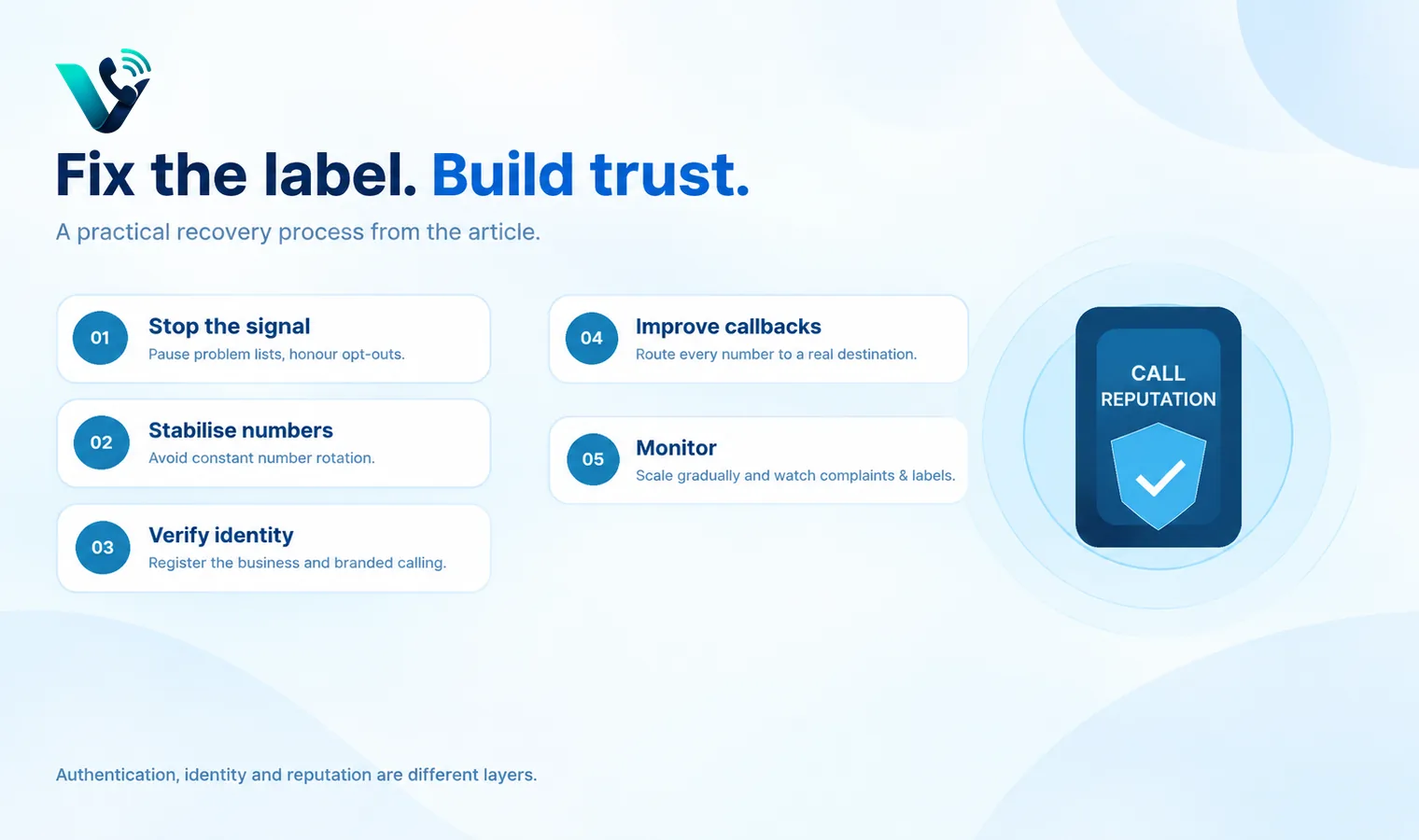
Authentication, identity and reputation are different layers
Layer |
What it helps answer |
What it does not guarantee |
|
STIR/SHAKEN authentication |
Was caller-ID information signed and verified through participating IP networks? |
That the call is wanted or has a good reputation |
|
Business registration / branded calling |
Which legitimate business is associated with the number? |
Permanent immunity from spam labels |
|
Caller ID reputation |
How networks/analytics assess the number based on behaviour and feedback |
A universal label across every carrier and device |
Frequently asked questions
- Why is my business number showing as Spam Likely?
- Carriers and analytics services may react to complaint patterns, blocks, call behaviour, historical number use, identity uncertainty and other reputation signals.
- Does STIR/SHAKEN stop spam labels?
- No. It helps authenticate caller-ID information on participating IP networks, but an authenticated call can still be unwanted and can still receive a spam label.
- Will registering my number remove a spam label?
- Registration can help establish business identity, but it does not override reputation. You may also need to dispute an incorrect label and change problematic calling patterns.
- Can a new number already have a bad reputation?
- Yes. Numbers can be reassigned, so historical use may affect how a newly acquired number is treated. Keep assignment records and use vendor dispute processes when appropriate.
- Should I rotate numbers when one is marked spam?
- Constant rotation is usually a poor long-term strategy. It weakens identity continuity and may repeat the same problem if the underlying calling behaviour does not change.
- How long does caller ID reputation recovery take?
- There is no universal recovery time. It depends on the carrier or analytics service, the cause of the label, dispute processing and the new behavioural signals associated with the number.