Canadian Virtual Numbers and Area Code Strategy
By Jamila Parker · · 9 min read

Learn how Canadian virtual numbers work, how Canadian area codes affect local presence, and how to choose local, toll-free, routing, SMS, and CRM options for business calling.
Key takeaways
- Choose Canadian virtual numbers around the customer journey, target market, and routing model not only the country or city name.
- Use Canadian area codes strategically when a regional identity matters, but confirm current availability and provider requirements first.
- Decide early whether the business needs voice, SMS, toll-free service, number porting, call queues, or campaign tracking.
- Connect each Canadian virtual phone number to a measurable CRM workflow with source, region, owner, and next action.
- Test inbound calls, fallback routing, business hours, voicemail, SMS eligibility, and CRM attribution before publishing the number.
Canadian virtual numbers give businesses a way to establish a Canadian calling presence without tying every phone number to a physical desk or office. For a sales, support, or remote team, the value is not simply having a +1 number. The real advantage comes from choosing the right number type, Canadian area code, routing rules, and follow-up workflow for the customers the business wants to serve.
A strong Canadian virtual number strategy should answer several questions at the same time. Which market are you targeting? Do customers expect a local number? Should calls reach one person, a team queue, or different departments? Do you need SMS as well as voice? How will calls be attributed in the CRM? And what happens when nobody answers?
This guide explains how Canadian virtual numbers work and how to build an area code strategy that supports local presence, national coverage, remote teams, campaign tracking, and reliable follow-up.
How Canadian virtual numbers work
Canada is part of the North American Numbering Plan (NANP), so Canadian telephone numbers use the +1 country code and a ten-digit national format. The first three digits are the numbering plan area (NPA) commonly called the area code, and the next three digits form the central office code. Historically, these combinations were closely associated with local exchange communities and rate centres. Wireless service, VoIP, number portability, and overlay area codes have made geography less absolute, but the area code can still influence how a number is perceived.
For businesses, Canadian virtual numbers separate the public phone identity from the physical location of the person answering the call. A Canadian virtual phone number may route to a desk phone, mobile device, browser, softphone, SIP endpoint, call queue, or another destination supported by the provider. That flexibility is especially useful for distributed teams, international companies serving Canada, and businesses that want one consistent number while staff work from different locations.
Treat the number, routing rule, and CRM record as parts of one workflow. When a call arrives, the system should make it clear where the lead came from, who owns the conversation, and what the next action should be. This is more useful than viewing Canadian virtual numbers as standalone telephony assets.
Why Canadian area code strategy still matters
Customers may still recognise Canadian area codes as regional signals. A business targeting Toronto, Montreal, Vancouver, Calgary, Ottawa, or another market may prefer a local-looking number when regional positioning supports the customer experience. A local Canadian virtual number can make it easier for marketing teams to align ads, landing pages, and outbound calling with a specific market.
That does not mean every business needs a separate number in every city. A company with nationwide coverage may be better served by one primary number, a toll-free option, or a small set of regional numbers. The right choice depends on the market, call volume, brand strategy, customer expectations, and how much operational complexity the team can manage.
When using Canadian area codes in public campaigns, confirm the exact number and area-code availability before writing marketing copy. Overlay plans mean several area codes can serve the same geographic region, so an older one-city-one-area-code assumption may be incomplete.
Local Canadian virtual number vs toll-free number
A local Canadian virtual number can support city-level or regional positioning. It is often useful when a business wants prospects to see a familiar geographic area code or when separate teams serve distinct regional markets. For example, a campaign aimed at one metropolitan area may use a local number while the main business number remains unchanged.
A toll-free number can be a better fit for broader Canadian coverage, centralised customer service, or a brand that does not want to emphasise one city. Businesses can also use dedicated tracking numbers for selected campaigns, but those numbers should have a clear measurement purpose. Too many numbers can create routing complexity, inconsistent branding, and fragmented reporting.
A practical rule is to keep one stable customer-facing identity wherever possible, then add local or campaign numbers only when the regional or attribution benefit is meaningful.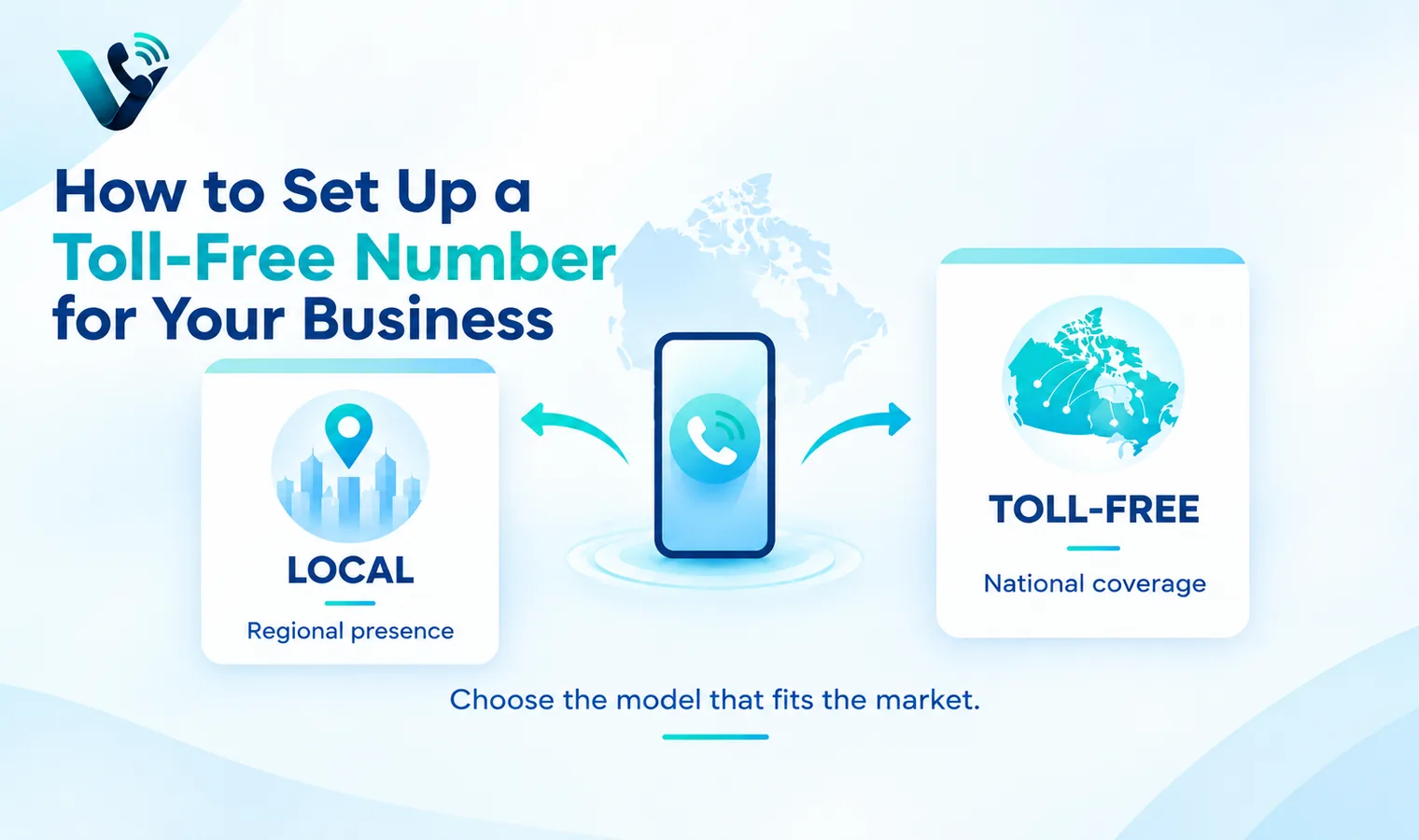
Check the exact Canadian area code before buying
Canadian numbering plans evolve over time. Some regions use overlays, meaning multiple area codes can serve the same geographic territory. Availability also depends on the provider's inventory and any documentation or eligibility rules that apply to the number type.
Before purchasing Canadian virtual numbers, verify the current area code, geographic association, activation requirements, voice capability, SMS capability, emergency-service limitations if relevant, and porting support. Do this before publishing the number in ads, directories, websites, printed materials, or customer onboarding flows.
If a specific area code is central to a campaign, build a fallback plan. The exact code a marketing team wants may not always be available, while another code serving the same region may still support the intended local strategy.
Canadian virtual numbers for remote and distributed teams
One of the strongest use cases for Canadian virtual numbers is remote work. Calls can be routed to employees in Canada or elsewhere, depending on provider capabilities and service requirements. This lets a business maintain a Canadian business phone number while the team works across several offices, provinces, or countries.
Routing should reflect the customer's local time rather than only the team's location. Set business-hour rules, after-hours handling, voicemail, overflow, and escalation in advance. If one team serves several provinces, use a shared queue or region-aware routing so callers reach the right person without needing to understand the internal structure.
For sales teams, route high-intent enquiries quickly and make missed-call handling explicit. A missed Canadian virtual phone call should create a clear follow-up action rather than disappear into a general call log.
Voice and SMS are separate considerations
Voice availability does not automatically mean every SMS use case will work on the same number. Messaging may have separate carrier, registration, throughput, consent, and compliance requirements. If the business needs two-way SMS, appointment reminders, customer notifications, or automated messaging, confirm the intended use with the provider before choosing the number.
Do not build a campaign around SMS until the number is confirmed as eligible for the required messaging workflow. For Canadian virtual numbers used in both voice and messaging, test inbound and outbound behaviour separately and document which team owns each channel.
Use CRM source and region fields with Canadian virtual numbers
When Canadian virtual numbers are used for marketing or sales, store the source and region in the CRM. A Toronto-focused number might represent one paid campaign, while a national number could represent organic website enquiries or broader advertising. Without that context, the business may know that calls happened but not which market or campaign produced qualified opportunities.
A useful CRM record should capture the number or channel, region, lead source, owner, stage, recent activity, and next action. LeadMino's lead-management approach follows the same operating principle across forms, calls, and other channels: capture the source when the lead arrives, assign clear ownership, and keep the next step visible.
Reporting should compare meaningful outcomes not just raw call volume. Track qualified conversations, appointments, opportunities, conversions, response time, and missed-call recovery where those measures are available.
Porting an existing Canadian business phone number
If a company already has an established Canadian business phone number, ask about porting before replacing it. Keeping the existing number can preserve customer recognition, listings, printed materials, and long-term marketing value. The exact porting process and timing depend on the carrier, provider, number type, account information, and documentation.
Do not cancel the old service before the port is confirmed. Prepare the new routing rules, users, queues, voicemail, and CRM workflows before the cutover, then test incoming and outgoing calling after the number moves.
Number continuity matters most when the existing Canadian number is already visible in search results, business directories, advertisements, customer records, or long-running campaigns.
Avoid over-segmenting your Canadian virtual number pool
A common mistake is buying separate Canadian virtual numbers for every province, campaign, salesperson, and landing page. That can make attribution look detailed while creating unnecessary operational work. The team then has to maintain more routing rules, more caller identities, more reporting logic, and more numbers that customers may save or call back.
Start with the minimum useful set. That might be one main Canadian virtual phone number, one regional number for a priority market, and dedicated tracking numbers only for high-value campaigns where attribution genuinely improves decisions.
Add another number when there is a clear customer-service, regional, compliance, or measurement reason not simply because another area code is available.
How to choose a Canadian virtual number for your business
Define the target market: Decide whether the number is for one city, one province, several regions, or nationwide Canadian coverage.
Choose local or toll-free positioning: Use a local area code when regional identity supports the customer journey; use toll-free or a broader model when national reach matters more.
Confirm voice, SMS, and documentation requirements: Check provider availability, intended messaging use, activation requirements, and any documentation before publishing the number.
Design the routing workflow: Decide who answers, what happens after hours, how missed calls are handled, and when calls overflow to another user or queue.
Connect the number to CRM attribution: Store source, region, ownership, activity, and next action so the team can measure what the Canadian virtual number actually produces.
Test before launch: Call the number from the target market, test voicemail and fallback rules, verify caller experience, and confirm that CRM records are created or updated correctly.
Try this on your own numbers
Local numbers in 118 countries, AI call notes and one shared inbox. Live the same day, no contract.
Canadian virtual number strategy checklist
Choose the geography, number type, Canadian area code, provider, routing model, and CRM workflow together. Confirm number availability and any documentation requirements. Decide whether voice, SMS, or both are needed. Set business hours, fallback routing, missed-call ownership, and porting requirements. Finally, test calls from the target market and confirm that the correct source, region, and owner appear in the CRM.
A Canadian virtual number is most effective when it supports a complete lead-handling process rather than acting only as a local-looking phone number.
Practical implementation checklist
Element |
Purpose |
What to check |
|
NPA / area code |
Regional identity |
Check current regional availability and overlays |
|
Local number |
City or regional presence |
Use when regional positioning supports the customer journey |
|
Toll-free number |
National identity |
Consider for broad Canadian coverage and centralised service |
|
Voice routing |
Call delivery |
Test business hours, queues, overflow, voicemail, and missed calls |
|
SMS |
Messaging |
Confirm eligibility, registration, consent, and intended use separately from voice |
|
Porting |
Number continuity |
Do not cancel the old service until the port is confirmed and tested |
|
CRM |
Attribution and ownership |
Store region, source, owner, activity, and next action |
|
Reporting |
Performance measurement |
Compare qualified outcomes, not only total calls |
Frequently asked questions
- Do Canadian virtual numbers use +1?
- Yes. Canada is part of the North American Numbering Plan, so Canadian numbers use the +1 country code.
- What is an NPA in Canadian phone numbering?
- NPA means numbering plan area. It is the three-digit area code at the beginning of the ten-digit Canadian national number.
- Should I choose a local Canadian area code?
- Choose a local Canadian area code when regional positioning is useful for customers and the desired number is available under the provider's rules.
- Can one Canadian virtual number serve multiple provinces?
- Yes, depending on the provider and routing model. A single number can support a broader service area, while selected regional campaigns may use separate tracking numbers.
- Can Canadian virtual numbers support SMS?
- Some can, but SMS eligibility, registration, carrier requirements, and the intended messaging use should be confirmed separately from voice.
- Can I port an existing Canadian business phone number?
- Often, yes, depending on the provider, carrier, number type, and account details. Confirm portability before cancelling the current service.
- Do I need many Canadian virtual phone numbers?
- Usually not. Start with the smallest set that supports customer service, regional positioning, and meaningful attribution, then add numbers only when there is a clear operational reason.
- Are Canadian virtual numbers useful for remote teams?
- Yes. They can provide a consistent Canadian business phone identity while calls are routed to distributed employees, queues, or supported devices.