How many dials does one meeting actually take?
By Jamila Parker · · 12 min read

The number of dials per meeting depends on connect rate, qualification and conversion. Use a simple funnel model instead of a universal benchmark.
Key takeaways
- Dials per meeting is a funnel metric, not a universal quota: connect rate and meeting-booking rate determine how many calls are required.
- Track unique prospects, total dials, intended-person connects and booked meetings separately so dials per meeting does not hide repeated attempts.
- Calculate dials per meeting by segment because list quality, persona, geography, campaign and calling time can change both connect and booking rates.
- Improve dials per meeting by fixing the weakest stage of the funnel instead of simply asking reps to make more calls.
- Use booked meetings, held meetings and opportunities together so a lower dials per meeting
Dials per meeting is one of the most useful outbound sales efficiency metrics when it is calculated with the right context. It answers a simple question: How many call attempts does a sales team need, on average, to create one booked meeting? The number can help with capacity planning, campaign comparison and rep coaching, but it becomes misleading when teams treat it as a universal benchmark.
The real dials per meeting figure is created by several conversion steps. A rep has to reach a valid number, get the intended person or a useful conversation, qualify enough interest, and then convert that conversation into a scheduled meeting. Weakness at any stage increases the number of dials required.
That is why a team making 100 calls is not automatically more productive than a team making 60. If the second team uses cleaner contact data, reaches more of the right people and converts conversations into meetings at a higher rate, its dials per meeting can be much better.
This guide explains how to calculate dials per meeting, how to build a realistic outbound calling benchmark, how to work backwards from a meeting target, and how to reduce wasted dials without lowering meeting quality.
There is no universal dial number
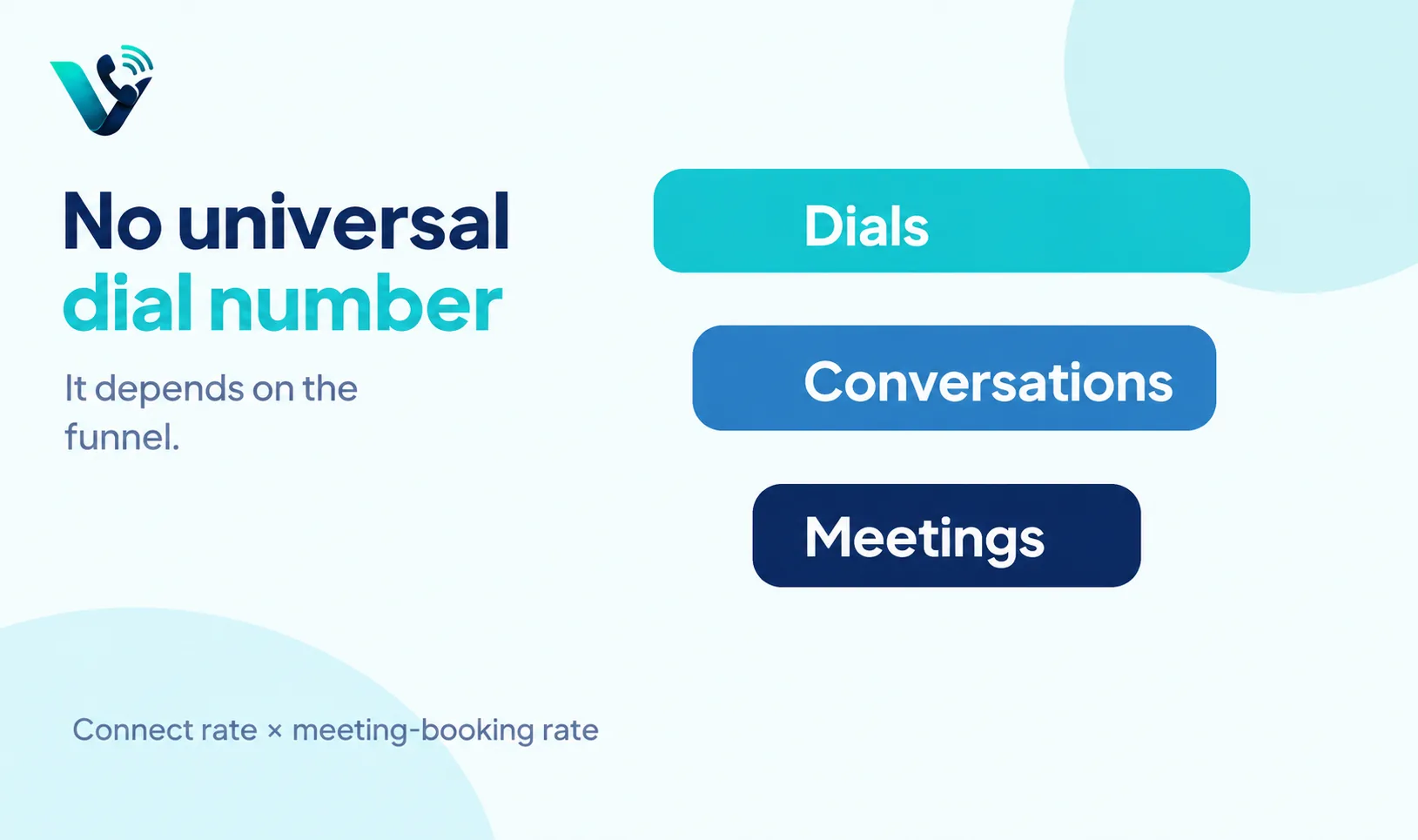
There is no single number of dials that guarantees a meeting. Dials per meeting depends on the entire outbound funnel, especially connect rate and meeting-booking rate from real conversations. Two teams can make the same number of calls and produce very different meeting totals because the quality of their lists, targeting and conversations is different.
A benchmark only becomes useful when the definitions match. One company may count any answered phone as a connect, while another counts only conversations with the intended prospect. One team may count a calendar invite as a meeting, while another counts only meetings that are accepted or held. Comparing dials per meeting across those definitions creates false conclusions.
Instead of asking, “What is a good dials per meeting benchmark?” start with, “How does our own funnel perform by segment?” Build an internal baseline first. Once the team knows its normal connect rate, meeting conversion rate and show rate, external data can be used as context rather than as a target copied from another sales motion.
A useful dials per meeting target should also be stable enough to coach against. If the figure changes dramatically every week because campaign mix or list quality changes, separate those segments before judging rep performance.
Use a funnel formula
The simplest dials per meeting formula is:
Dials per meeting = 1 / (connect rate x meeting-booking rate from connects)
The formula works because every dial has to pass through both stages before it becomes a meeting.
For example, if 10% of dials produce a real conversation and 20% of those conversations produce a booked meeting, the total meeting conversion from dials is 2%. That means the team needs about 50 dials per meeting on average.
A second example shows why small funnel changes matter. If the connect rate remains 10% but the meeting-booking rate improves from 20% to 25%, the dial-to-meeting conversion becomes 2.5%. The expected dials per meeting falls from 50 to 40 without increasing call volume.
The same logic works in the other direction. If conversation quality remains strong but the connect rate falls because the list contains inaccurate numbers, dials per meeting rises even though the rep's sales skill has not changed. That is why managers should inspect both inputs before blaming the final ratio.
For reporting, keep the formula consistent across campaigns. Decide exactly what counts as a dial, a connect and a booked meeting, then document those definitions so every dashboard uses the same calculation.
What should count as a dial?
A dial should represent a real call attempt placed to a prospect number. Automated retries, accidental duplicate calls or technical failures should be handled consistently so they do not inflate the denominator. If the phone system records every technical attempt differently from the CRM, reconcile the definitions before calculating dials per meeting.
The same principle applies to meetings. Decide whether the metric uses booked meetings, accepted meetings or held meetings. Booked meetings are useful for measuring rep conversion, while held meetings reveal whether the appointments were strong enough to survive cancellations and no-shows.
Many teams benefit from tracking two related metrics: Dials per booked meeting and dials per held meeting. The first measures booking efficiency; the second adds meeting quality and show rate to the picture.
Separate attempts from prospects
Total dials and unique prospects are not the same thing. Ten dials to ten different prospects tells a different story from ten attempts spread across four prospects. If a campaign needs repeated attempts before people answer, dials per meeting can rise even when the underlying prospect list is strong.
Track at least three activity levels: Unique prospects contacted, total call attempts and attempts per prospect. This shows whether the team is expanding coverage or repeatedly recycling the same names.
Attempts per prospect is especially useful when evaluating a calling cadence. A high number may be reasonable if later attempts produce meaningful connects, but it becomes wasteful when additional calls rarely improve contact or meeting conversion.
Also monitor time between attempts. Five calls to the same person in a short period should not be treated as equivalent to a structured multi-day cadence. Dials per meeting becomes more actionable when managers can see how the attempts were distributed.
Use external data carefully
External cold-calling benchmarks can provide context, but they should not replace your own dials per meeting baseline. Published results often come from different industries, contact-data sources, sales roles and definitions of a successful call.
The source material referenced in this draft notes that Cognism's 2026 reporting shows large differences between broad industry benchmarks and teams using verified contact data. The practical lesson is not that every team should copy one percentage; it is that better targeting and cleaner data can reduce wasted attempts.
Before using an external dials per meeting benchmark, check what sits underneath it. Does the data use direct dials or switchboards? Are the contacts cold or warm? Is the meeting conversion based on answers, conversations or intended-person connects? Are the meetings simply booked or actually held? Without those details, the comparison may not be meaningful.
Use external data as a diagnostic range. Your own trend over several weeks is usually more useful for operational decisions because it reflects the exact list, market, product and sales process your team is running.
Plan capacity backwards
Dials per meeting becomes particularly useful when planning sales capacity. Instead of starting with a dial quota, start with the number of meetings the business actually needs and work backwards through the funnel.
Suppose a team needs 20 booked meetings in a week and its current average is 50 dials per meeting. At the current conversion level, the plan implies about 1,000 dials. But that is only the first layer of planning. If only part of booked meetings are held, the team may need more booked meetings to reach the real pipeline target.
A better capacity model therefore starts with held meetings or opportunities required, adjusts for meeting show rate, then works backwards through booking conversion and connect rate. This exposes whether the target is realistic before managers turn it into an activity quota.
Capacity planning should also account for available calling time. If the required dials cannot reasonably fit into the rep's week after research, follow-up and meetings are included, the answer is not automatically 'dial faster.' The team may need better data, tighter targeting, more automation around admin work or a different channel mix.
Use dials per meeting as a planning ratio, not a pressure metric. Its purpose is to show how much activity the current funnel requires and where efficiency improvements would have the greatest impact.
Improve the denominator
The fastest way to improve dials per meeting is often to reduce wasted dials. Remove invalid numbers, duplicates, clear opt-outs and contacts that do not match the target profile before they reach a rep's call list.
Prioritise contact data that is more likely to reach the intended person, call within appropriate local hours and use campaign context to choose who should be contacted first. Cleaner inputs can improve connect rate without asking reps to work a larger list.
Then improve the conversation stage. Review opening lines, targeting, discovery and meeting positioning. If the team already reaches the right people but very few conversations become meetings, list quality is probably not the primary constraint.
Finally, protect the metric from low-quality bookings. A rep should not be encouraged to lower dials per meeting by scheduling meetings that are poorly qualified and unlikely to happen. Track held-meeting rate and downstream opportunity creation alongside the headline ratio.
The goal is not the lowest possible dials per meeting. The goal is an efficient number of calls that creates enough qualified, held meetings to support pipeline.
Diagnose dials per meeting by funnel stage
When dials per meeting gets worse, break the ratio into stages before changing the sales process. A falling connect rate points toward list quality, direct-dial accuracy, caller recognition, timing or market conditions. A healthy connect rate with weak meeting conversion points toward targeting, messaging or conversation quality.
If meetings are booked at a healthy rate but few are held, the issue is later in the funnel. Review qualification, calendar confirmation, reminder process and whether the meeting is valuable enough for the prospect to attend.
This stage-based diagnosis keeps managers from applying the wrong solution. More dialing cannot repair a poor meeting proposition, and a new script cannot repair thousands of inaccurate phone numbers.
Create a simple funnel view with dials -> connects -> meaningful conversations -> meetings booked -> meetings held -> opportunities. Dials per meeting is most useful when it sits inside that full chain rather than appearing as an isolated KPI.
Segment dials per meeting before comparing reps
Overall team averages can hide major differences between campaigns. Calculate dials per meeting by lead source, persona, industry, geography, rep, campaign and time period where the sample size is large enough to be useful.
A senior executive list may naturally have a different connect rate from a small-business owner list. A warm reactivation campaign should not be compared directly with a fully cold prospecting campaign. If managers compare reps without adjusting for those inputs, the metric can reward the easiest territory instead of the strongest execution.
Use segmentation to identify repeatable advantages. If one list source consistently produces fewer dials per held meeting, invest more in that source or investigate why its data is stronger. If one time block produces better connect rates, test whether moving more calling into that window improves the overall funnel.
Keep the number of segments practical. The purpose is to explain meaningful differences, not create dozens of tiny dashboards that nobody can interpret.
Common mistakes when using dials per meeting
Treating one external benchmark as a universal target. Sales motions differ too much for one number to define good performance everywhere.
Counting any answered call as a meaningful connect. This can make the funnel look stronger than the real intended-person contact rate.
Ignoring repeated attempts to the same prospects. High dial volume may come from recycling a small list rather than creating broad coverage.
Optimising only for booked meetings. A low dials per meeting result is not valuable if meetings cancel, no-show or fail to create qualified opportunities.
Comparing reps with very different list quality or territories. Segment the data before using the metric for coaching or performance decisions.
Changing several variables at once. If the list, script, cadence and calling window all change together, it becomes difficult to know why dials per meeting improved or declined.
Try this on your own numbers
Local numbers in 118 countries, AI call notes and one shared inbox. Live the same day, no contract.
30-day dials per meeting measurement plan
Days 1-7: Establish the baseline. Record total dials, unique prospects, attempts per prospect, intended-person connects, meaningful conversations, meetings booked and meetings held. Confirm that everyone uses the same definitions.
Days 8-14: Segment the funnel. Compare dials per meeting by campaign, lead source, persona, geography and calling window. Look for the stage where conversion changes most.
Days 15-21: Test one improvement. Clean a list, change a calling window, improve the opener or tighten targeting - but change one main variable so the effect can be measured.
Days 22-30: Compare the new result with the baseline. Review dials per booked meeting, dials per held meeting, connect rate, meeting conversion and downstream opportunity quality. Keep the change only if efficiency improves without reducing meeting quality.
At the end of the month, document the new internal benchmark and repeat the process with the next weakest stage of the funnel.
How to connect this topic to Votelly
For Votelly, dials per meeting fits naturally into the broader sales-calling and outbound productivity conversation. A cloud business calling platform can provide the calling activity layer, while sales teams use CRM outcomes and meeting data to calculate how efficiently those calls create conversations and meetings. The primary website destination is www.votelly.com.
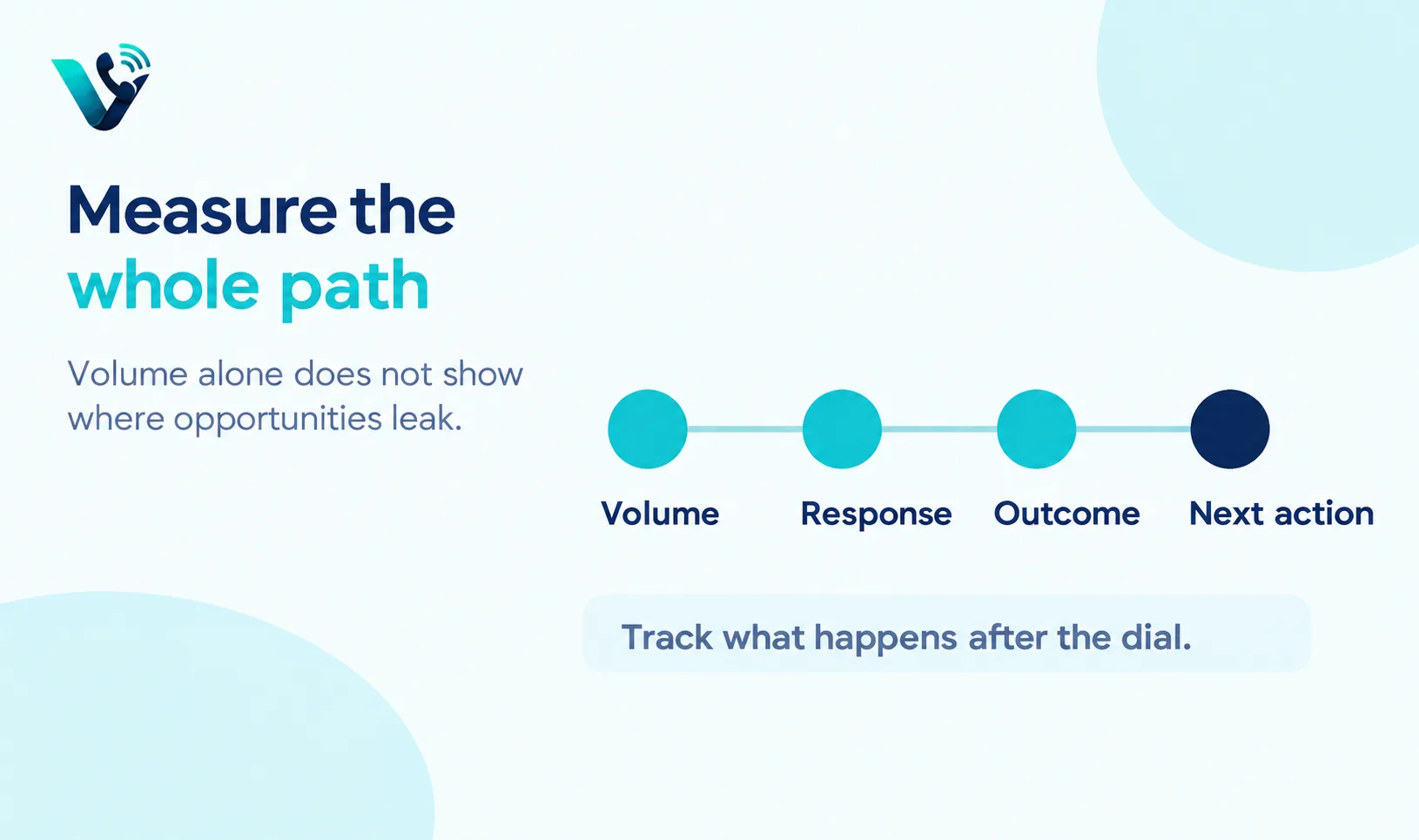
Keep detailed product claims tied to confirmed live Votelly capabilities. The article can still explain the ideal workflow clearly: Track call attempts consistently, connect activity to sales outcomes, compare conversion by campaign and use the resulting dials per meeting data to improve targeting and capacity planning.
This article also connects naturally with Votelly content on cold call connect rates, sales call activity metrics, call disposition codes and power dialers. Together, those topics show how call volume, contact quality and conversion combine to determine outbound efficiency.
Frequently asked questions
- What is dials per meeting?
- Dials per meeting is a sales efficiency metric that shows the average number of call attempts required to book one meeting. It is usually calculated from total dials and booked meetings, or modelled from connect rate multiplied by meeting-booking rate.
- How should a small team start with dials per meeting?
- Start by defining what counts as a dial, a meaningful connect and a booked meeting. Track those stages for several weeks, calculate an internal baseline and then segment the result by campaign or lead source before setting a target.
- What should be measured?
- Track total dials, unique prospects, attempts per prospect, connect rate, meaningful conversations, meetings booked, meetings held and opportunities created. These metrics explain why dials per meeting changes.
- How often should the setup be reviewed?
- Review dials per meeting weekly while a campaign is changing and monthly once the process is stable. Recalculate the benchmark whenever list quality, targeting, geography or sales motion changes significantly.
- Can automation replace human ownership?
- Automation can reduce manual dialing and logging, but it cannot fix poor targeting or weak conversation quality. Managers still need to review the funnel and decide which stage should be improved.
- How can Votelly fit into the workflow?
- Votelly can be positioned as part of the cloud business-calling layer used for outbound activity where the live product supports the required calling workflow. Combine call activity with CRM meeting outcomes to calculate and improve dials per meeting.