India Virtual Phone Number for Business: Use Cases and Routing
By Jamila Parker · · 8 min read

Understand how an India virtual phone number can be used for sales, support and distributed teams, with practical guidance on +91 routing, KYC and current DoT numbering controls.
Key takeaways
- India numbering resources are centrally managed and allocated to eligible telecom licensees; businesses normally obtain numbers through providers rather than directly from DoT.
- Choose the number and routing design around the use case: inbound support, local sales, campaign tracking, branch presence or shared regional teams.
- KYC, business documents and number-type restrictions can affect activation, so verify eligibility before launch.
- Do not assume a +91 virtual number supports every messaging, caller-ID or outbound workflow.
Quick answer: What is an India virtual phone number for business?
An India virtual phone number for business is a +91 telephone number used through a cloud or carrier platform so calls can be routed to teams, queues, apps or SIP systems instead of being tied to one physical line. It can support customer care, sales, branch communication and market-entry workflows, but the exact number types and features available depend on the licensed provider and current regulatory requirements.
India is not a market where a company should assume that any overseas VoIP platform can freely generate local numbers. The Department of Telecommunications manages numbering resources through its Numbering Resource Management System, with allocation processes designed for licensees. In practice, businesses should obtain service from providers that can explain the regulatory and KYC basis for the number they supply.
Common business use cases
Customer support is a natural use case because one published number can route to several agents and departments. Sales teams may use separate numbers for regions, campaigns or account groups, while marketplaces and service companies may use controlled numbers to keep employee personal mobiles private. Large organisations may also use numbers as entry points to IVR, call recording, analytics and CRM workflows.
A virtual number can also help international teams test demand in India before building a larger local communications operation. That does not automatically remove local compliance or documentation obligations. Treat the number as a service delivered through the telecom framework, not as a loophole around it.
Understanding +91 routing
The public number is only the front door. Behind it, the business can route incoming calls to a cloud PBX, SIP trunk, contact-centre queue, browser app or permitted forwarding destination. Routing rules can use time of day, department, language, agent availability, customer status or campaign source.
For a national organisation, a single routing layer can send billing calls to one queue, enterprise leads to another and after-hours calls to a third-party support desk. For distributed teams, media routing and latency matter: Voice may sound poor if every call takes an unnecessarily long international path before reaching the agent.
Choosing the right number type
India has multiple telecom numbering categories, including fixed-line, mobile and toll-free/service numbers. The right option depends on how customers will call, whether outbound caller ID is needed, whether messaging is required and what documents the provider can accept for that range.
Do not choose solely on familiarity. A sales team that needs two-way voice has different requirements from a support operation that wants a toll-free inbound channel. A messaging workflow may involve separate sender or platform registration obligations. Ask the provider for an exact capability table and regulatory checklist for the number being offered.
DoT numbering and provider eligibility
DoT’s Numbering Resource Management System is designed to allocate and manage resources such as fixed-line numbers and other telecom identifiers for licensees. The system maintains central records and routes allocation requests through the relevant authorities. This matters to business buyers because legitimate number supply sits downstream of those licensed allocation processes.
India’s telecom authorisation framework has also been transitioning under the Telecommunications Act, 2023 and new authorisation rules. Because the regulatory framework can change, publish date-stamped guidance and confirm requirements with the provider before promising activation times, document lists or number features.
KYC, documents and activation
Providers may request identity, company registration, address, authorised representative details, intended use and other documents. The exact list varies with the number type and service model. International companies should plan for verification rather than treating it as an unexpected obstacle after the marketing launch date has already been announced.
If the number is needed for a campaign, complete provisioning and live-call tests before adding it to paid ads or printed materials. A delayed KYC review is inconvenient; a campaign pointing to an inactive number is much worse.
Routing patterns that work for sales and support
For inbound support, use a short IVR, queue callback where available, business-hours rules and overflow to a trained backup team. For sales, route calls by product, region or CRM account owner and make missed-call follow-up visible to the team. For high-value accounts, direct numbers can coexist with a main switchboard so the customer has both a personal route and a reliable fallback.
If outbound calling is part of the plan, separate your outbound strategy from inbound routing. Confirm caller-ID presentation, consent requirements, telemarketing rules and spam-reputation monitoring. Buying more numbers is not a substitute for responsible contact policy.
How to evaluate an India virtual-number provider
Ask how the number is sourced, what authorisation or carrier relationship supports it, which KYC documents apply, whether number portability is available, and which features work on the exact range. Then evaluate technical performance: Call quality, failover, concurrent channels, SIP support, recording, security and regional support hours.
Pricing should be modelled around actual traffic. Include number rental, inbound minutes, outbound minutes, forwarding, recording, storage and contact-centre seats. Low headline pricing can become expensive when a busy support operation adds forwarding or per-minute charges.
Operational controls for high-volume calling
High-volume teams should set concurrency, pacing and quality controls at the platform level. If thousands of calls are attempted through a new route, monitor answer patterns, carrier errors, complaints and audio quality before increasing traffic. Sudden volume changes can reveal capacity or reputation issues that are invisible during a small test.
Maintain clear ownership of caller IDs and do not let individual teams upload unverified numbers for presentation. A central policy reduces accidental spoofing, broken callbacks and inconsistent customer identity.
Procurement questions to ask before committing
When evaluating India virtual phone number for business, ask the provider to answer the commercial and technical questions in writing. Confirm the exact number type, current inventory, monthly rental, inbound and outbound call rates, included channels, overage pricing, minimum term, cancellation process and whether the number can be ported later. Then ask which capabilities are tied to the exact number rather than to the platform in general. This distinction matters because a dashboard may support SMS, recording or outbound caller ID even when a particular country range does not.
Compliance questions deserve the same treatment. Ask which carrier or licensed operator supplies the number, what KYC or business documents are required, whether a local address or entity is needed, and whether any intended-use restriction applies. India numbering resources are centrally managed and allocated to eligible telecom licensees; businesses normally obtain numbers through providers rather than directly from DoT. A provider that can explain these dependencies clearly is usually easier to work with than one that promises universal instant activation without qualifying the number type or market.
Test the complete customer journey before launch
A successful India virtual phone number for business deployment should be tested from the customer side, not only from the admin portal. Place calls from the networks your customers are likely to use, listen for post-dial delay, confirm two-way audio, press IVR keys, transfer between agents, leave voicemail and trigger after-hours routing. If the workflow includes outbound calling, verify that the intended caller ID is presented correctly and that callbacks return to a monitored destination. If SMS is important, test sending and receiving with the real number instead of assuming support from a feature list.
Also test failure conditions. Temporarily make the primary queue unavailable and confirm that overflow or failover works. Check what happens when all agents are busy, when a call arrives outside business hours and when the destination system is offline. Choose the number and routing design around the use case: Inbound support, local sales, campaign tracking, branch presence or shared regional teams. These tests are inexpensive compared with discovering a broken route after the number has been printed on a campaign, customer portal or product packaging.
Try this on your own numbers
Local numbers in 118 countries, AI call notes and one shared inbox. Live the same day, no contract.
Measure the first 30 days and adjust
After launch, treat India virtual phone number for business as an operating channel with measurable outcomes. Track total calls, unique callers, answer rate, missed calls, average speed to answer, abandoned calls, call duration, transfer rate and the business result that matters for the use case. For sales that might be qualified meetings or revenue; for support it may be first-contact resolution, reopen rate or customer satisfaction. Segment performance by number so the team can see whether the chosen market or number type is actually useful.
Review cost at the same time. Include rental, usage, forwarding, recording, contact-centre licences and any carrier surcharges, then compare that total with the value created. If the number receives little traffic, consider whether it still serves a brand or compliance purpose. If demand is high, add channels or more specialised routing before adding more public numbers. Good virtual numbers / india strategy usually comes from improving a small number of well-managed customer entry points rather than accumulating numbers with no clear owner.
Bottom line
An India virtual phone number for business can centralise sales and support communication while giving customers a familiar +91 contact path. The strongest implementation combines legitimate number provisioning, clear KYC planning, reliable routing and measurable service outcomes. Start with the business workflow, then choose the number and provider that can support it lawfully and technically.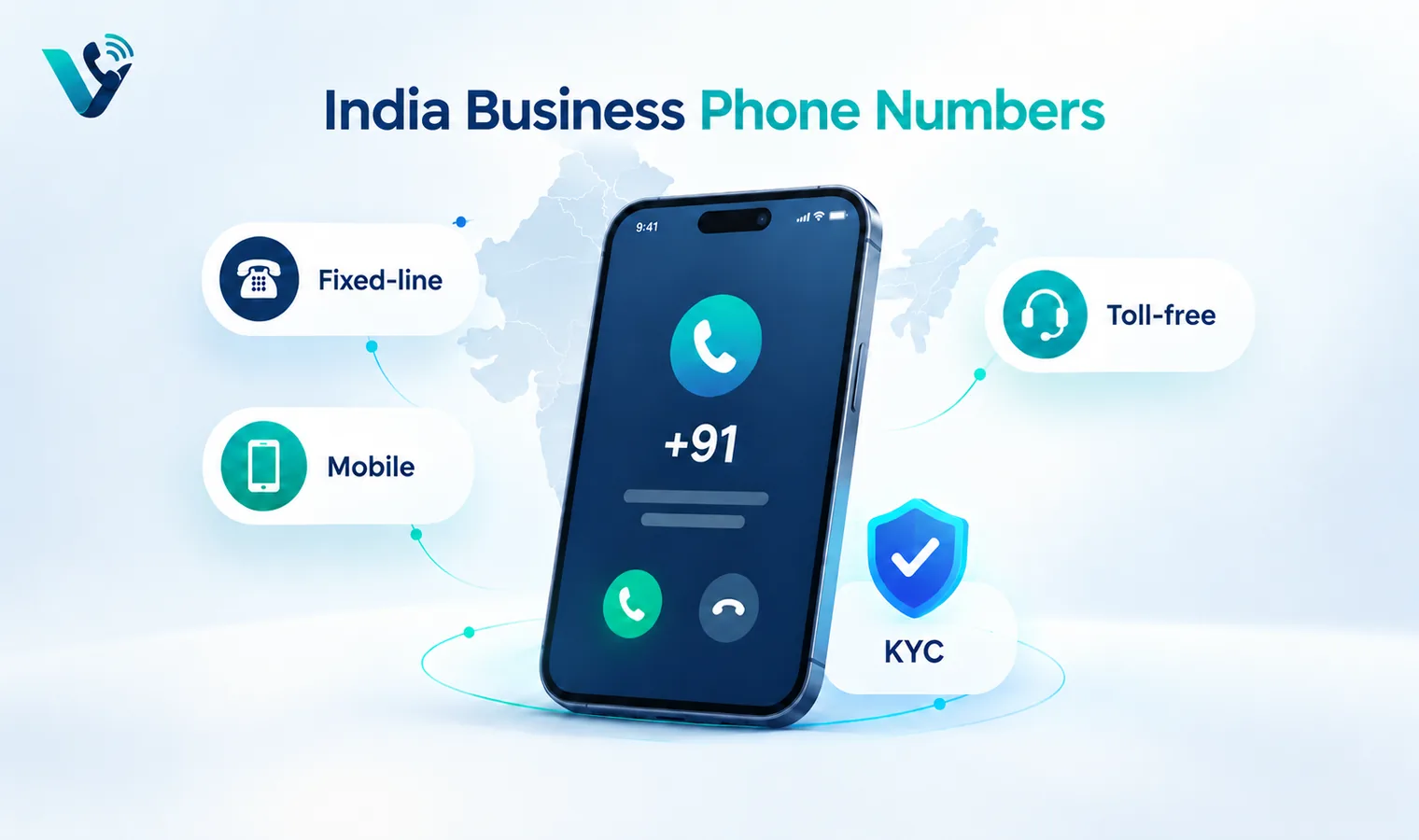
Frequently asked questions
- Can an international company get an India virtual phone number?
- It may be possible through an eligible provider, but number type, KYC, business eligibility and current telecom rules affect availability.
- Who manages numbering resources in India?
- The Department of Telecommunications manages numbering resources and provides the Numbering Resource Management System for allocation and administration.
- Can an India virtual number route to a remote team?
- Cloud telephony can route calls to distributed teams and SIP systems, subject to provider and regulatory constraints.
- Do India virtual phone numbers require KYC?
- Business and identity verification is commonly required. The exact documents depend on the number type and provider.
- Can the same +91 number support voice and SMS?
- Not necessarily. Voice, SMS and outbound caller-ID support can differ by range, carrier and service.
- What should I test before publishing an India number?
- Test inbound calling, caller routing, IVR, audio quality, failover, business hours, transfers, recording policy and any outbound caller-ID function you plan to use. Suggested Votelly internal links Internal-linking note: Votelly URLs were not reliably discoverable in public search during this research pass, so the paths below are editorial targets rather than invented live URLs. Map each anchor to the matching live Votelly page in your CMS before publishing.