Missed call recovery: how fast should your team call back?
By Jamila Parker · · 9 min read

A missed call is not automatically a lost opportunity. The recovery process depends on callback speed, ownership, context and prioritisation.
Key takeaways
- Missed call recovery works best when every missed call is captured, prioritised and assigned to a clear owner instead of sitting in a generic notification list.
- Callback speed matters most for high-intent sales enquiries, urgent support issues and existing customers waiting on an active case.
- A useful missed call recovery process combines caller context, voicemail or transcript data, CRM history and the number or queue the customer originally called.
- Set different callback targets by call type rather than forcing every missed interaction into the same service level.
- Measure recovered conversations and outcomes, not only how many missed calls received a callback.
Missed call recovery is the process of turning an unanswered inbound call into a structured follow-up instead of allowing it to disappear into a call log. For sales teams, a missed call may be a prospect who is ready to speak now. For support teams, it may be an existing customer calling about an active problem. In both cases, the quality of the recovery process depends on more than simply calling the number back.
A strong missed call recovery workflow captures the caller, the time of the call, the number or queue they contacted, any voicemail or transcript, the related CRM record and the reason the call was missed. It then assigns the follow-up to the right person with a realistic callback target. The goal is to reduce lost opportunities while avoiding rushed, repetitive or poorly informed callbacks.
There is no single perfect callback time for every business. A new inbound sales lead may need attention within minutes, while a routine account enquiry may still be handled well later the same day. The right target depends on customer intent, urgency, staffing and the promise your business wants to make. This guide explains how to build a practical missed call recovery process and how to measure whether it is actually recovering valuable conversations.
Speed matters, but context matters too
Fast callback time can improve the chance of reconnecting, but speed without context can create a weak experience. An agent who calls back immediately and opens with “someone called us from this number” forces the customer to repeat the entire reason for calling. A better missed call recovery record gives the agent enough information to continue the conversation naturally.
Capture the basics automatically where possible: Caller number, timestamp, dialled business number, queue or campaign, voicemail, transcript and any CRM match. If the customer has an open deal, support case or scheduled appointment, surface that information before the callback begins. Even a few seconds of context can make the recovery feel intentional rather than random.
Context also helps the team prioritise. A missed call to a sales campaign number may have different value from a general office line. A customer who called twice within ten minutes may deserve faster attention than a single unanswered call with no voicemail. The more accurately the workflow identifies intent, the easier it is to use callback speed where it matters most.
For unknown numbers, avoid overcomplicating the first step. Return the call, identify the business clearly and confirm whether the customer still needs help. If the number matches a CRM record later, the agent can update the history after the conversation.
Create response tiers
Not every missed call should have the same callback SLA. A single target sounds simple, but it often causes teams to spend equal effort on interactions with very different urgency and commercial value. Response tiers make missed call management more realistic.
A practical model might separate missed calls into three groups. Priority calls include active customers with urgent issues, high-value accounts and high-intent inbound sales enquiries. Standard calls include general customer questions and routine follow-ups. Low-priority calls may include unknown numbers with no voicemail, non-customer enquiries or calls outside the supported service scope.
Each tier should have a clear target and owner. For example, priority calls might trigger an immediate alert and a callback within a short staffed-period window. Standard calls can enter the normal team queue with a same-day target. Lower-priority calls can remain visible without interrupting urgent work.
Keep the number of tiers small. If agents need a complex decision tree before they can return a call, the workflow will be ignored. Three simple levels with obvious examples are usually more useful than ten finely tuned categories.
Use a practical callback target
For high-intent sales and urgent service calls, callback speed should usually be measured in minutes during staffed hours rather than hours. The customer has already demonstrated intent by calling, and that intent can fade quickly if they contact another provider or solve the problem elsewhere.
For routine missed calls, a clearly communicated same-day target may be more realistic and easier to meet consistently. The important point is to choose a standard the team can actually deliver. A five-minute target that is achieved only occasionally is less useful than a twenty-minute target that is monitored and met reliably.
Measure callback time from the moment the original call is missed, not from the moment an agent notices it. Otherwise the report can hide the delay created by a notification sitting unseen for thirty minutes. The clock should reflect what the customer experienced.
Also separate staffed and unstaffed periods. A missed call at 2:00 AM should not distort daytime performance if the business does not promise overnight callbacks. Instead, set a clear next-business-period rule and measure whether the morning team clears those missed interactions promptly.
Assign ownership automatically
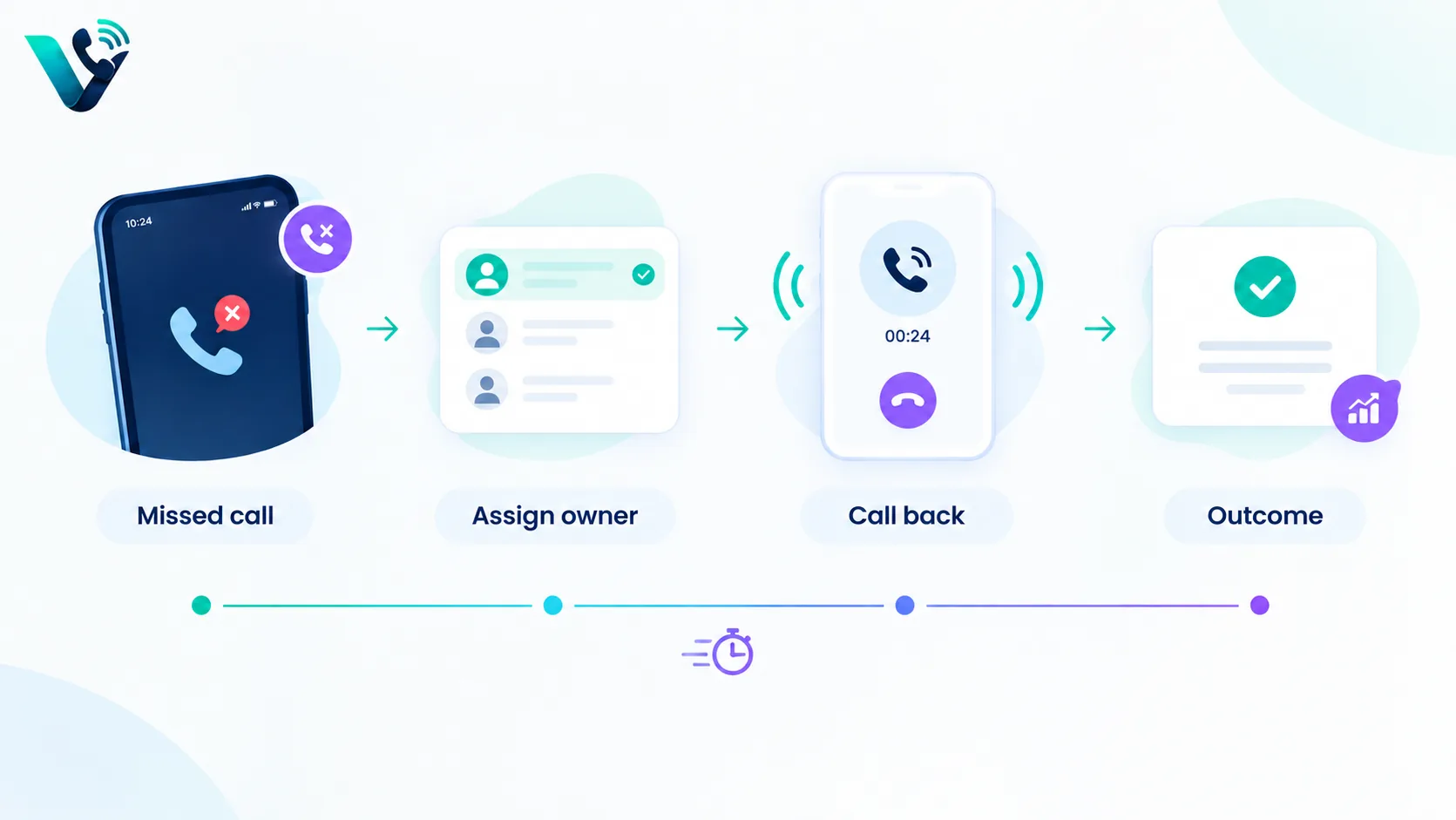
A missed call without an owner often becomes everybody’s responsibility and therefore nobody’s. The recovery workflow should assign the interaction as soon as it is created instead of depending on someone remembering to scan a missed-call list.
Ownership can follow the original queue, the account owner, a sales territory, the next available agent or a dedicated callback team. The best rule is the one that matches how the business already manages customer relationships. Existing customers usually benefit from continuity, while new inbound enquiries may be better handled by whoever can respond first.
Add escalation when the callback target is at risk. A missed call that remains untouched for fifteen minutes can move to another eligible agent or alert a supervisor. Escalation should solve the delay rather than merely generate another notification.
When the callback is completed, close the recovery item with an outcome such as connected, voicemail left, wrong number, follow-up scheduled, sales opportunity created or issue resolved. Clear outcomes prevent the same customer from being called repeatedly by different people.
What to say when calling back
The callback opening should reduce friction. Identify the business, acknowledge that the customer tried to reach you and confirm whether now is a good time to continue. A simple opening such as “Hi, this is Maya from Votelly. We saw that you called us a few minutes ago, so I’m calling you back. Is now a goo time?” is usually enough.
If the customer left a voicemail or the system captured useful context, refer to it naturally: “I saw your message about changing the billing contact.” That signals that the business listened and saves the customer from repeating the same information.
Avoid pretending to know more than the record shows. If the original call has no context, ask an open question rather than guessing: “How can I help with the call you made earlier?” This is clearer and more professional than making an incorrect assumption.
If the customer does not answer the callback, record the attempt and follow the retry policy rather than repeatedly calling in quick succession. Depending on the use case, a voicemail, SMS or email may be a better next step if the customer has consented to that channel.
Recovery metrics
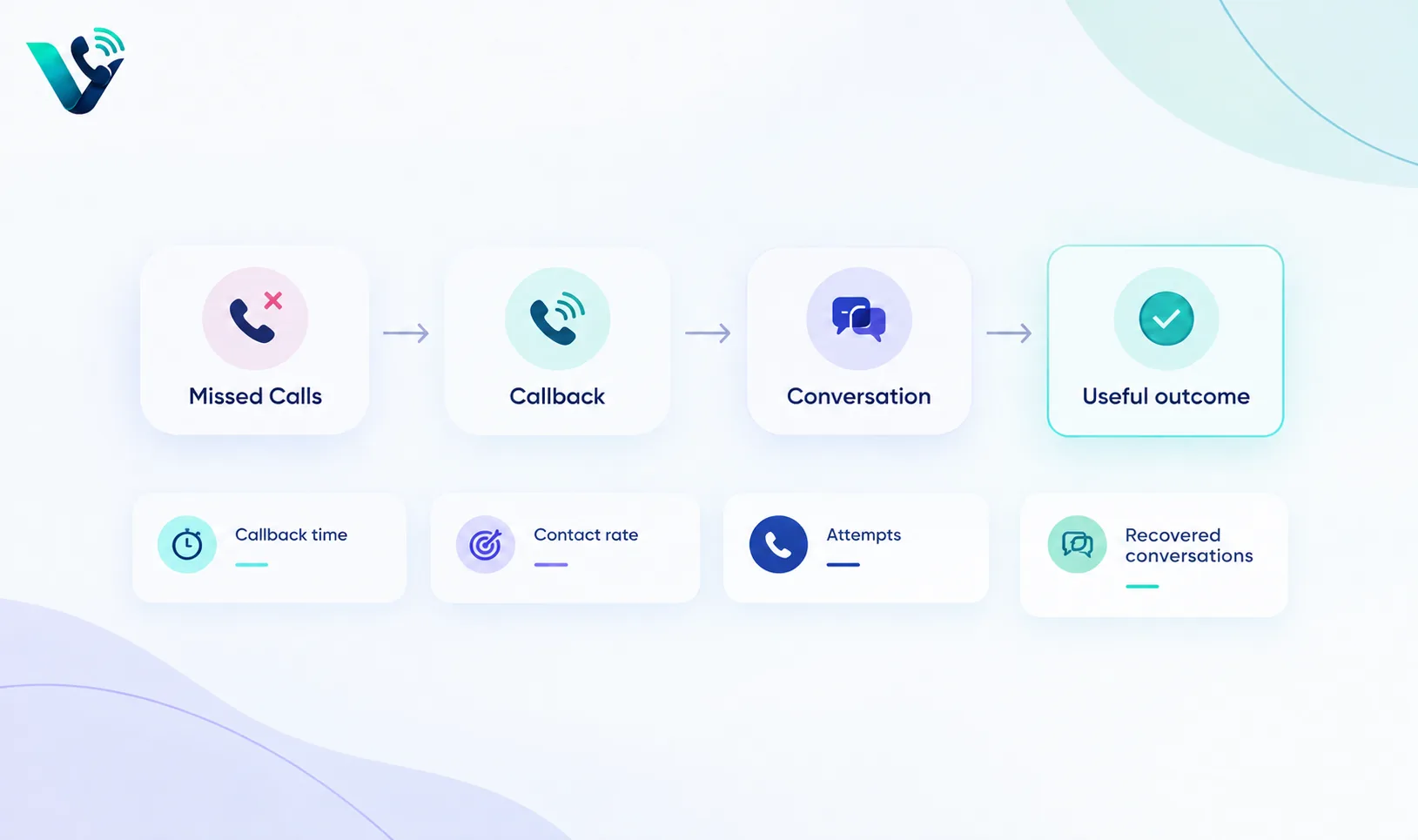
Missed call recovery should be reported as a funnel, not as one total. “We called back 92% of missed calls” sounds positive, but it does not show how quickly the callbacks happened or whether they produced useful conversations.
Start with missed calls received, then track how many were assigned, how many were attempted within the target, how many customers were reached, and what happened next. Sales teams can add meetings booked, opportunities created or conversions. Support teams can add issues resolved, cases created and repeat contacts avoided.
Useful missed call recovery metrics include median callback time, percentage within SLA, callback contact rate, attempts per recovered conversation, unrecovered calls, repeat inbound calls before callback and outcomes by source number or queue. Median time is often more informative than a simple average because a few extreme delays can distort the result.
Break the data down by time of day and day of week. If recovery performance falls sharply during lunch, shift change or campaign peaks, the problem may be staffing rather than the callback workflow itself. That distinction matters before adding more automation.
Review quality alongside speed. A very fast callback that leads to poor qualification, duplicate contact or a rushed support interaction is not a successful recovery. The best process balances response time with the quality of the final customer outcome.
Prevent the next missed call
Missed call recovery is important, but repeated misses should also feed back into the inbound routing design. If the same queue produces a high number of missed calls every Monday morning, the business should not rely only on faster callbacks. It should investigate staffing, queue thresholds, overflow rules and whether callers can reach another suitable person.
Look for patterns by number, campaign, queue and time period. A marketing campaign may generate a predictable burst that needs temporary coverage. A support line may need overflow after a certain wait time. An after-hours number may need clearer voicemail and callback expectations.
The healthiest missed call recovery programme becomes smaller over time because the business learns which calls can be answered correctly the first time and which truly need a recovery workflow.
Try this on your own numbers
Local numbers in 118 countries, AI call notes and one shared inbox. Live the same day, no contract.
How to connect this topic to Votelly
For Votelly, missed call recovery fits naturally into the wider cloud business calling workflow. The article can explain how teams should capture missed interactions, route ownership, maintain business-number consistency and connect the callback process to customer context. The primary website destination is www.votelly.com.
Keep detailed product claims tied to confirmed live Votelly capabilities. Even without promising a specific automation, this guide can show where a cloud calling platform sits in the process: The call arrives on a business number, the missed interaction becomes visible, the team knows which line or queue it came from, and the callback can be managed as part of a consistent customer workflow.
This topic also supports a strong internal-link cluster. Connect it to guides on after-hours call routing, overflow routing, voicemail-to-email vs shared inbox and call queue best practices. Those articles explain why calls are missed and how the business can reduce or recover them.
Frequently asked questions
- What is missed call recovery?
- Missed call recovery is the structured process of identifying an unanswered inbound call, assigning it to the right person, returning the call within a defined target and recording the final outcome.
- How should a small team start with missed call recovery?
- Start by making every missed call visible in one place, assigning a clear owner and setting one realistic callback target for business hours. Once that process is reliable, add priority tiers for urgent customers or high-intent sales enquiries.
- What should be measured?
- Track missed calls received, callback time, percentage returned within target, contact rate, unrecovered calls and final outcomes such as meetings, opportunities, resolved issues or scheduled follow-ups.
- How often should the setup be reviewed?
- Review missed call recovery weekly while the process is new. Once performance is stable, a monthly review by queue, campaign and time period is usually enough to identify recurring gaps.
- Can automation replace human ownership?
- No, automation can create callback tasks, assign missed calls, send alerts and escalate overdue items, but someone still needs responsibility for making the callback and closing the outcome.
- How can Votelly fit into the workflow?
- Votelly can be positioned as the cloud business-calling layer around missed call recovery where the live product supports the required numbers, routing or call activity. Use www.votelly.com as the primary brand destination and verify exact product capabilities before publishing detailed claims.