Predictive Dialling: When It Helps and When It Burns Your List
By Jamila Parker · · 8 min read

Predictive dialling can lift agent utilisation in high-volume campaigns, but aggressive pacing, weak lists and abandoned calls can damage customer experience and number reputation.
Key takeaways
- Predictive dialling works best where call volume is high and contacts are relatively interchangeable.
- List quality, pacing and agent availability determine whether efficiency becomes customer friction.
- Abandoned calls and dead air are operational and regulatory warning signs.
- Relationship-led B2B outreach often fits a power or preview dialler better.
- Measure answer quality, complaints and list exhaustion alongside agent utilisation.
What Predictive Dialling Actually Does
Predictive dialling uses software to call ahead based on expected answer rates and agent availability. The system assumes many calls will be unanswered, busy, disconnected or sent to voicemail, so it places more than one attempt around the time an agent is expected to become free. When the prediction is right, the next live person is connected with very little idle time for the agent.
That is different from a power dialler, which normally places the next call when an agent is already available. Predictive dialling trades some certainty for utilisation. The potential upside is more live conversations per paid agent hour. The downside is that the system can connect a person before a rep is available, creating delay, dead air or an abandoned call.
This is why predictive dialling is not automatically better than other dialler modes. It is a pacing strategy for specific campaign conditions. If those conditions are wrong, the same mechanism that increases throughput can burn through a list quickly while delivering a poor first impression.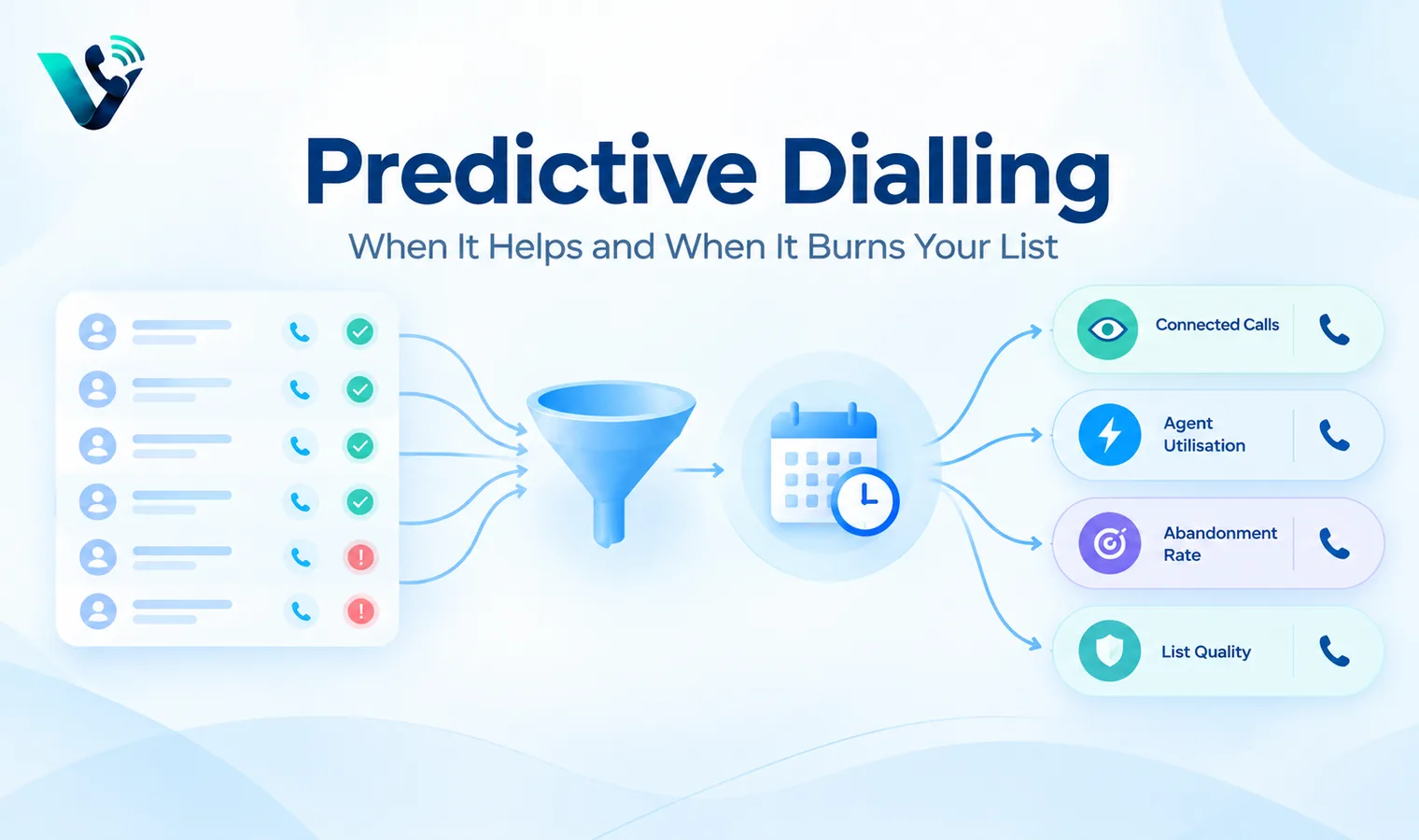
When Predictive Dialling Helps
Predictive dialling is most useful when the campaign contains a high number of contacts, the call purpose is relatively standardised, and the team has enough simultaneous agents for the prediction model to work with. Larger pools give the system more capacity to smooth the gap between unanswered attempts and live connections.
It can also help when answer rates are low but list quality is still acceptable. In that situation, manual dialling wastes agent time on ring-outs and non-working numbers. Predictive pacing can absorb some of that dead time, provided the system is configured conservatively and the campaign can tolerate faster list consumption.
The strongest use case is operational consistency rather than cleverness. Predictive dialling suits campaigns where many contacts can be worked with the same routing, opening and follow-up logic. The more each account requires pre-call research or named-rep continuity, the less attractive aggressive predictive pacing becomes.
When Predictive Dialling Burns The List
A predictive dialler can burn a list in three ways. First, it can simply consume records faster than the team can learn from them. If the segment is poorly targeted, the system discovers that at scale. Second, aggressive pacing can create abandoned calls or short delays after answer, which makes recipients less willing to engage on later attempts. Third, repeated high-volume calling from the same caller identities can contribute to declining number reputation or spam labelling.
The list is also being burned when the campaign keeps calling people who have clearly said no, asked not to be called, or repeatedly failed for a reason that should remove them from the active pool. A predictive system needs clean suppression logic because small operational mistakes are multiplied by volume.
The lesson is simple:Predictive dialling amplifies the quality of the operating model. Clean segment, appropriate pacing and clear outcomes can create efficiency. Bad targeting and weak governance become a faster path to complaints.
Pacing Is The Control That Matters Most
Pacing determines how aggressively the dialler calls ahead. If pacing is too low, the team gets little benefit over a simpler dialler. If pacing is too high, the chance of connecting a live person before an agent is available increases.
In US telemarketing, the FTC Telemarketing Sales Rule includes an abandoned-call safe harbour with specific conditions. The FTC describes an outbound call as abandoned when a person answers and the telemarketer does not connect the call to a sales representative within two seconds of the completed greeting. The safe harbour includes a maximum three per cent abandonment rate for live-answered calls, ring-time requirements, a recorded identification message when a rep is unavailable, and recordkeeping. Campaigns may also be subject to FCC rules and state law.
That regulatory detail is one reason predictive dialling should have a compliance owner, not just a sales-operations owner. The dial ratio should be conservative enough to protect the customer experience and the rules that apply to the campaign.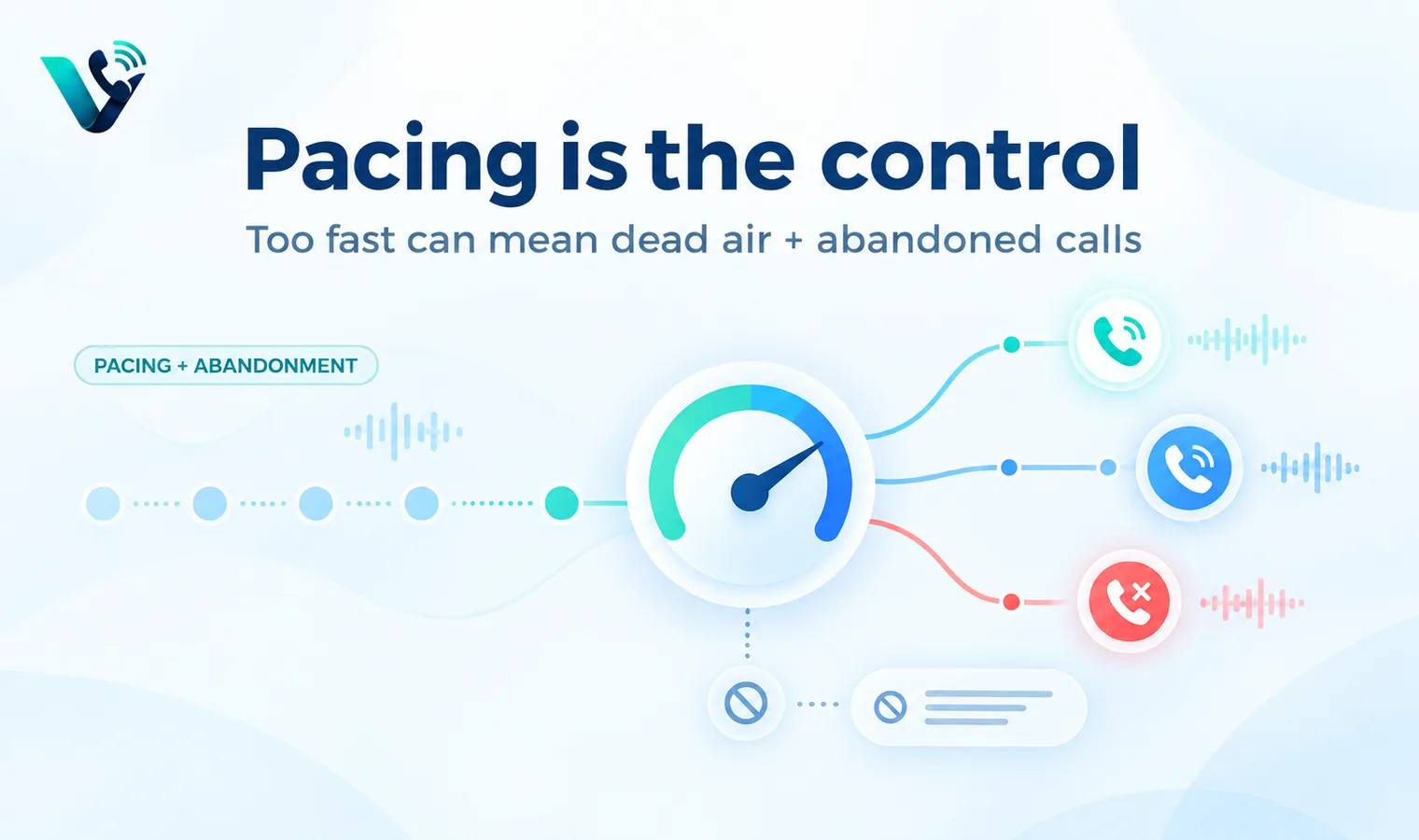
List Quality Changes The Right Dialler Mode
A strong list does not simply contain valid phone numbers. It contains contacts the campaign has a defensible reason to call, accurate routing information, and enough segmentation for the rep to use a relevant opening. Predictive dialling removes the opportunity to spend much time reviewing the next record, so poor data becomes especially expensive.
If a campaign needs account-by-account research, a preview dialler can be a better fit because the rep sees the record before the system calls. If the team wants speed but still wants a guaranteed rep available on answer, a power dialler often provides the middle ground.
Campaign condition |
Better fit |
Why |
|
High-volume, standardised outreach |
Predictive dialler |
Maximises agent utilisation when the list and staffing can support pacing |
|
Relationship-led B2B prospecting |
Power dialler |
Keeps one rep ready for each live answer |
|
Research-heavy accounts |
Preview dialler |
Gives the rep context before calling |
|
Tiny agent pool |
Power or preview |
Predictive models have less room to smooth availability |
The right question is not “Which dialler is fastest?” It is “Which mode fits the value and complexity of this contact list?”
Watch The Signals That The List Is Being Overworked
- Rising wrong-number or invalid-number rates.
- More do-not-call requests or complaints.
- Falling answer rate from the same caller IDs.
- High repeat-attempt counts without new information.
- More abandoned calls or dead-air reports.
- Connected calls rising while qualified outcomes fall.
- Reps unable to explain why a contact is in the list.
One weak signal does not prove list burn, but several together should trigger a review. Pause the campaign long enough to inspect the segment, pacing, attempt policy and caller identities. A list is an asset; using it more slowly with better relevance can produce more pipeline than exhausting it quickly.
Build Attempt Limits And Cooling Periods
Predictive dialling should have an attempt policy. Define how many attempts are allowed, how failures are spaced, what happens after a voicemail, and which outcomes remove a contact permanently. The system should not continue calling simply because a record remains technically dialable.
A cooling period protects both the recipient and the list. If a prospect did not answer today, another attempt in a different reasonable window may make sense. Calling again minutes later without a new reason usually adds pressure without adding information.
Do-not-call requests need immediate suppression. Wrong numbers should leave the sales sequence and enter a data-cleaning workflow. “Not now” should create a future date rather than more calls in the current campaign.
Use Agent Availability Honestly
Predictive models work from assumptions about when agents will finish current conversations. If agents are frequently pulled into meetings, admin or manual follow-up while still marked available, the dialler is working with false capacity.
Give agents clear states and make the system respect them. Wrap-up time should be long enough to capture meaningful outcomes. Managers should not reduce wrap time purely to increase calls if CRM quality starts falling.
For small teams, the operational gain from predictive dialling can be modest because a few unusually long calls can distort availability. That is another reason to test the mode against a power dialler rather than assuming the more automated option wins.
Measure Efficiency And Damage In The Same Dashboard
Predictive dialling should be judged on two sides. Efficiency metrics include agent talk time, live connections, utilisation and calls per hour. Damage metrics include abandonment, complaints, suppression requests, answer-rate decline, data errors and number-reputation issues.
A campaign is healthy when efficiency improves without the damage side deteriorating. If talk time rises but qualified conversations fall, the team may simply be reaching more of the wrong people. If answer rates collapse after several days, caller identity or attempt frequency may be part of the problem.
The safest predictive dialling strategy is deliberately boring:Clean list, conservative pacing, enough agents, simple dispositions, immediate suppression and frequent review. That produces sustainable throughput instead of a short burst of volume followed by a burned list.
Try this on your own numbers
Local numbers in 118 countries, AI call notes and one shared inbox. Live the same day, no contract.
How To Test Predictive Dialling Before Scaling
Run a controlled pilot with one segment and a stable group of agents. Keep the list source, offer and calling window as consistent as possible so the team can separate the effect of dialling mode from the effect of different data.
Compare the pilot with a power-dialler or manual baseline. Track live conversation minutes, qualified outcomes, abandonment, complaints, wrong-number rate, attempts per contact and the percentage of the list consumed per day. The predictive campaign should earn the right to scale by improving useful output without increasing damage signals.
If the pilot shows that the list is exhausted faster than meetings are created, do not solve the problem by raising pacing again. Revisit segmentation, attempt policy and whether predictive dialling is the right mode for that audience.
Frequently asked questions
- What is predictive dialling?
- Predictive dialling calls ahead using expected answer rates and agent availability so live answers can be connected to available reps with less idle time.
- When is predictive dialling useful?
- It is most useful for high-volume, standardised campaigns with enough agents and a clean list.
- What does it mean to burn a calling list?
- It means exhausting contacts or damaging future response through excessive attempts, poor targeting, abandoned calls, complaints or caller-ID reputation problems.
- What is an abandoned call?
- Under the US FTC Telemarketing Sales Rule, an outbound call can be considered abandoned if a live answer is not connected to a sales representative within two seconds of the person’s completed greeting. Other rules may also apply.
- Is a power dialler safer for B2B sales?
- It can be a better fit when each answered call needs a rep immediately and the prospecting motion is relationship-led or research-heavy.
- How should predictive dialling be measured?
- Track utilisation and talk time together with abandonment, complaints, do-not-call requests, answer rates, qualified outcomes and list-quality metrics.