Phone Number Availability: How to Check Before Launching in a New Market
By Jamila Parker · · 8 min read

Learn how to verify business phone number availability before entering a new country, including inventory, KYC, geographic rules, capabilities, porting and launch testing.
Key takeaways
- A number shown on a provider country page is not proof that the exact range or city is available today.
- Check four things separately: inventory, eligibility, capabilities and activation timing.
- Reserve or provision critical numbers before publishing ads, packaging, app screens or sales collateral.
- Keep a fallback plan if a preferred area code, vanity pattern or toll-free range is unavailable.
Quick answer: Availability is more than “does the number exist?”
Phone number availability has at least four layers. Inventory asks whether a provider currently has numbers in the requested range. Eligibility asks whether your business is allowed to obtain that number. Capability asks whether it supports the required voice, SMS, caller-ID and routing features. Activation asks how long carrier and document review will take.
A launch can fail even when the first layer is positive. For example, a provider may advertise a country but require a local address for a particular geographic range, or the available numbers may be voice-only when the product team expected SMS verification.
Step 1: Define the exact number requirement
Write down the country, preferred city or area, number type, inbound versus outbound needs, SMS requirements, toll-free expectations, concurrent calls and intended use. “We need a Brazil number” is too vague; “we need a Sao Paulo business number for inbound support and authorised outbound caller ID” is actionable.
Also define what is optional. If the preferred city code is unavailable, can the launch use a national number? If toll-free activation takes longer, can a local number serve as a temporary contact point?
Step 2: Verify live inventory, not marketing coverage
Provider country pages usually describe possible coverage, not guaranteed real-time inventory. Ask the provider or use its number search tool to verify the actual range. For scarce or highly specific patterns, availability can change quickly.
Do not reserve a marketing slogan, print packaging or submit app-store screenshots with a phone number until the number is controlled by the business. If vanity digits matter, reserve them early because pattern choice can be much narrower than ordinary inventory.
Step 3: Check eligibility and documentation
Geographic and mobile numbering resources can have local-presence, address, identity or company-document requirements. Other ranges may be easier for international buyers. The exact rule depends on the national regulator, carrier and number category.
Create a standard KYC pack containing company registration, authorised representative ID, address evidence and a short intended-use description. This speeds review, but never assume one country’s documents satisfy another country’s rules.
Step 4: Confirm feature availability for the exact number
Ask whether the number supports inbound voice, outbound caller-ID presentation, SMS, emergency calling, porting, fax if relevant, SIP trunking and the required concurrent call capacity. A country can be “supported” while a specific feature is not.
Messaging deserves extra attention. Some virtual numbers are voice-only. Some receive SMS but cannot send. Some platforms do not accept certain hosted or VoIP ranges for verification. Run a real test of the business workflow before the launch depends on it.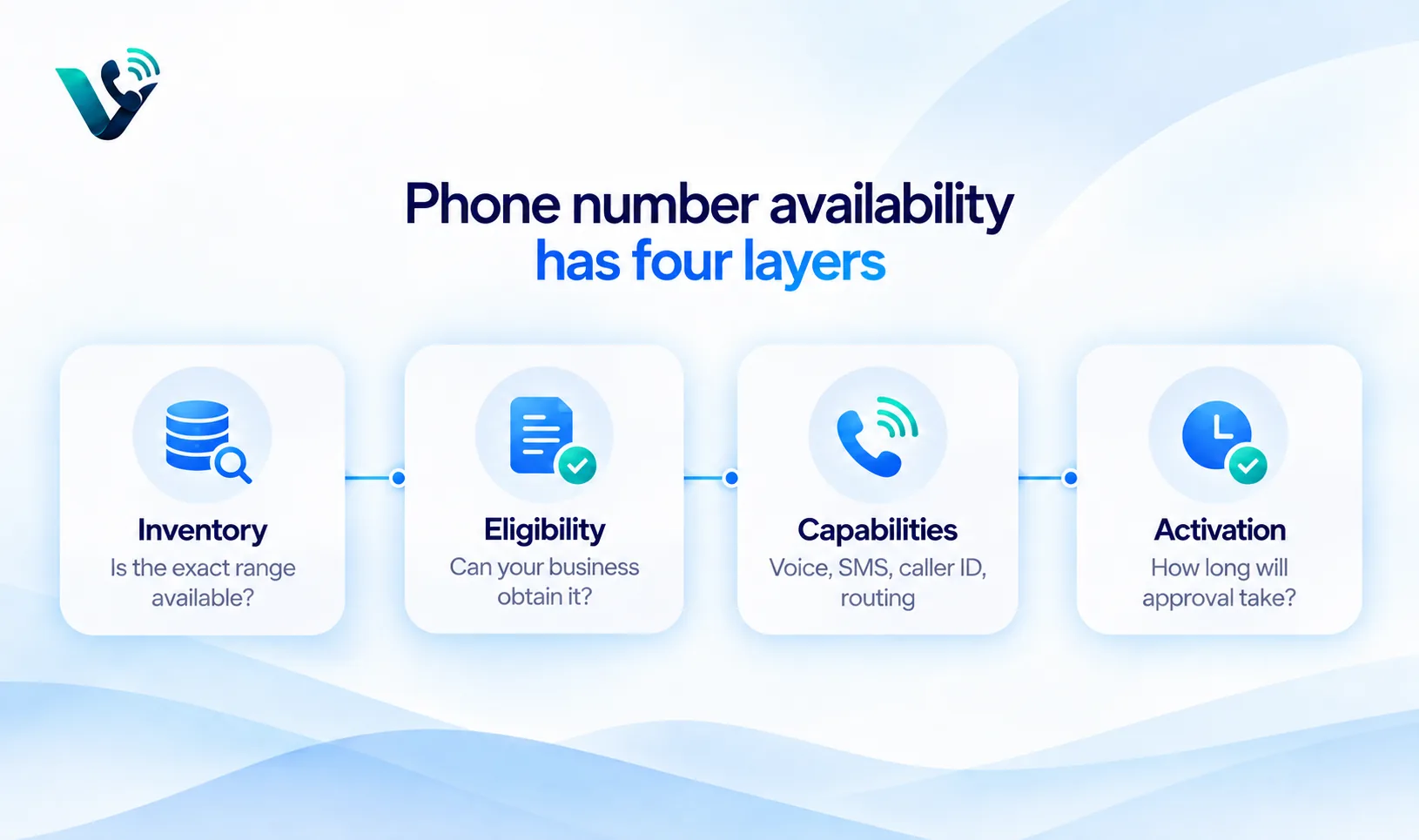
Step 5: Check routing and quality
Provisioning a number is not the same as delivering a good call. Test audio from local networks, DTMF through IVR, transfers, voicemail, business hours and failover. If agents are remote, confirm the media path does not create unnecessary latency.
For contact centres, test concurrent calls and queue overflow. A number that works perfectly for one test call can still fail operationally when a campaign generates twenty simultaneous calls.
Step 6: Understand timing and dependencies
Activation can be instant for some ranges and several business days or longer for others. Document review, carrier ordering, local address validation or manual approval can add time. Build telecom provisioning into the launch plan rather than treating it as a final-day task.
If the launch date is fixed, maintain a fallback number and redirect strategy. Do not improvise by publishing an employee’s personal mobile unless the company has consciously accepted the privacy, continuity and ownership implications.
Step 7: Decide whether to port or buy new
If the business already has a valuable customer-facing number, porting may preserve continuity. But porting has its own lead time and documentation, and not every number type is portable between every provider. New numbers are faster in some markets but require updating every public reference.
During a port, keep the existing service active until completion and test inbound routing immediately after the cutover.
Launch-day checklist and ownership
Before publishing, confirm the number is active, billing is correct, routing is live, voicemail and failover work, staff know how to answer, and analytics are recording. Document who owns the number commercially and technically. Add it to the company’s central number inventory.
After launch, monitor failed calls, complaints, answer rate, queue time and feature failures. Availability is not complete until the number works reliably in the real customer journey.
Create a pre-launch telecom risk register
For each market, record the preferred number, backup type, document owner, provisioning lead time, provider dependency and launch impact if the number is delayed. This turns an invisible telecom dependency into a normal project-management item.
Classify risks as blocking or non-blocking. If a toll-free number is nice to have, the launch might proceed with a local number. If a regulated support hotline is required for the product, the launch may need to wait until the correct number is active.
Procurement questions to ask before committing
When evaluating phone number availability, ask the provider to answer the commercial and technical questions in writing. Confirm the exact number type, current inventory, monthly rental, inbound and outbound call rates, included channels, overage pricing, minimum term, cancellation process and whether the number can be ported later. Then ask which capabilities are tied to the exact number rather than to the platform in general. This distinction matters because a dashboard may support SMS, recording or outbound caller ID even when a particular country range does not.
Compliance questions deserve the same treatment. Ask which carrier or licensed operator supplies the number, what KYC or business documents are required, whether a local address or entity is needed, and whether any intended-use restriction applies. A number shown on a provider country page is not proof that the exact range or city is available today. A provider that can explain these dependencies clearly is usually easier to work with than one that promises universal instant activation without qualifying the number type or market.
Test the complete customer journey before launch
A successful phone number availability deployment should be tested from the customer side, not only from the admin portal. Place calls from the networks your customers are likely to use, listen for post-dial delay, confirm two-way audio, press IVR keys, transfer between agents, leave voicemail and trigger after-hours routing. If the workflow includes outbound calling, verify that the intended caller ID is presented correctly and that callbacks return to a monitored destination. If SMS is important, test sending and receiving with the real number instead of assuming support from a feature list.
Also test failure conditions. Temporarily make the primary queue unavailable and confirm that overflow or failover works. Check what happens when all agents are busy, when a call arrives outside business hours and when the destination system is offline. Check four things separately: Inventory, Eligibility, Capabilities and Activation timing. These tests are inexpensive compared with discovering a broken route after the number has been printed on a campaign, customer portal or product packaging.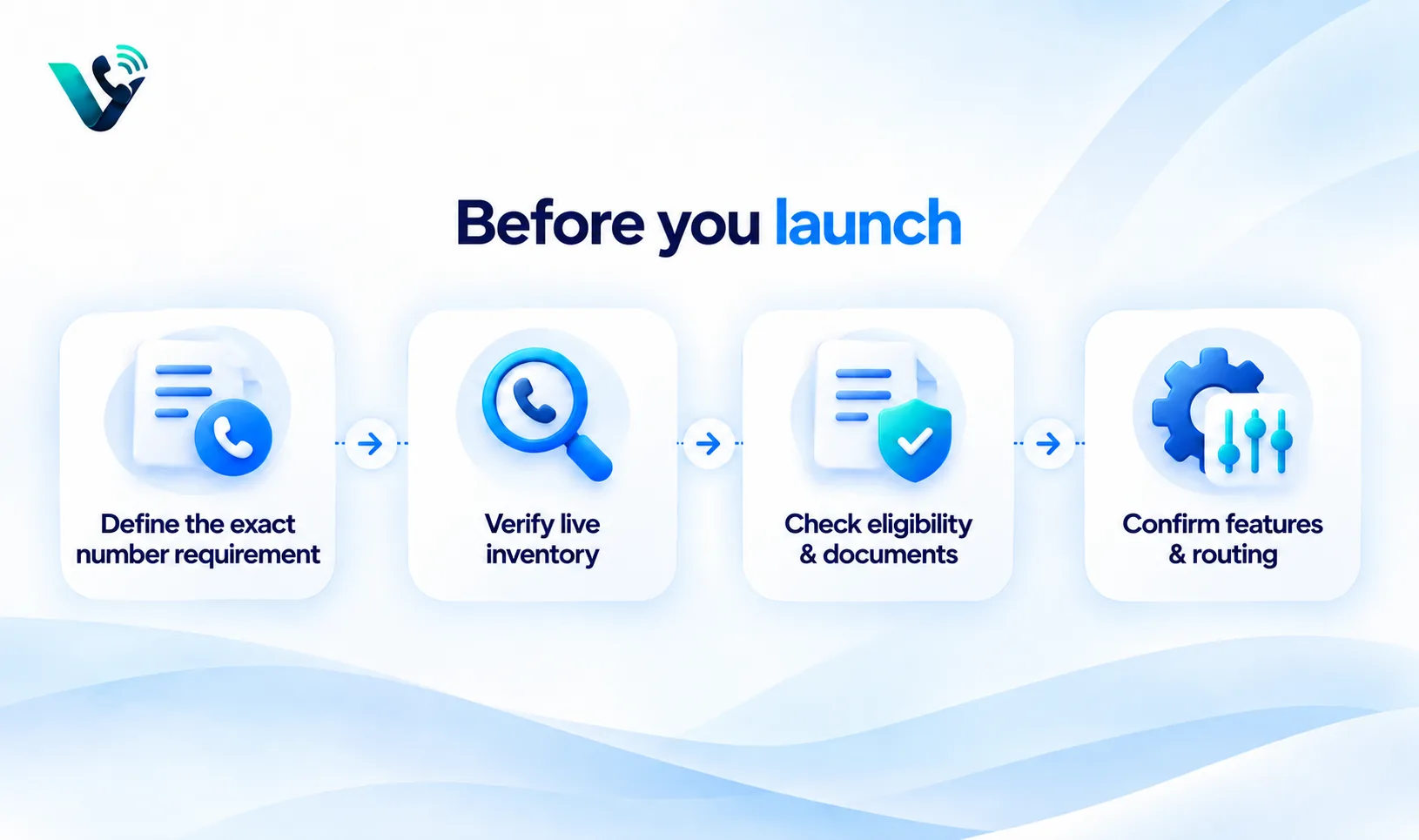
Measure the first 30 days and adjust
After launch, treat phone number availability as an operating channel with measurable outcomes. Track total calls, unique callers, answer rate, missed calls, average speed to answer, abandoned calls, call duration, transfer rate and the business result that matters for the use case. For sales that might be qualified meetings or revenue; for support it may be first-contact resolution, reopen rate or customer satisfaction. Segment performance by number so the team can see whether the chosen market or number type is actually useful.
Review cost at the same time. Include rental, usage, forwarding, recording, contact-centre licences and any carrier surcharges, then compare that total with the value created. If the number receives little traffic, consider whether it still serves a brand or compliance purpose. If demand is high, add channels or more specialised routing before adding more public numbers. Good market expansion / virtual numbers strategy usually comes from improving a small number of well-managed customer entry points rather than accumulating numbers with no clear owner.
Try this on your own numbers
Local numbers in 118 countries, AI call notes and one shared inbox. Live the same day, no contract.
Final operational check before scaling
Before scaling phone number availability, run one final review with sales, support, IT and whoever owns telecom compliance. Confirm who owns the number, where calls route, which hours are covered, what happens during an outage, how recordings or customer data are handled, and how the number will be retired if the market strategy changes. A short cross-functional review catches problems that are easy to miss when procurement, routing and customer experience are handled by separate teams.
Bottom line
Phone number availability should be verified as an operational dependency, not assumed from a provider coverage map. Check inventory, eligibility, features, routing and timing separately. Secure the number before public launch, keep a fallback, and test the exact workflows customers will use.
Frequently asked questions
- How can I check if a business phone number is available?
- Use the provider’s live inventory or ask its provisioning team to confirm the exact country, area and number type.
- Does a provider country page guarantee number availability?
- No. Country coverage can exist even when a specific area code, pattern or number type is temporarily unavailable.
- Why would an available number still require documents?
- National numbering rules and carrier policies can require identity, company or address verification before assignment.
- Should I buy a number before launching ads?
- Yes, when the number is part of the campaign. Provision and test it before publishing paid or permanent materials.
- Can I reserve a vanity number?
- Sometimes. Reservation processes vary by country and provider, and popular patterns may be scarce.
- What is the best fallback if my preferred number is unavailable?
- Consider another local range, a national number, a toll-free number, or a temporary market-level line that can later redirect to the preferred number.