Ring Groups, Hunt Groups and Queues Explained
By Jamila Parker · · 9 min read

Ring groups, hunt groups and queues all distribute calls, but they behave differently. Understand the differences and choose the right call flow.
Key takeaways
- Ring groups are best when several team members share responsibility for answering the same calls.
- Hunt groups work well when calls should follow a defined order or distribution pattern.
- Call queues are suitable when callers may need to wait until an agent becomes available.
- The right option depends on call volume, team size, staffing patterns, and customer expectations.
- Always set clear timeouts, schedules, staff availability rules, and fallback paths.
- Keep the call flow simple and avoid unnecessary routing loops that can lead to missed calls or long waits.
Ring groups, hunt groups and queues all solve the same broad problem: They help a business distribute incoming calls across more than one person. The difference is how they decide who should receive the call and what the caller experiences while the system is looking for an available person.
A ring group is usually the simplest model. A hunt group follows a defined search order or distribution pattern. A queue is designed for situations where callers may need to wait until an agent becomes available. Understanding these differences matters because the wrong setup can create unnecessary ringing, long waits, missed calls, or confusing fallback loops.
The best choice between ring groups hunt groups queues depends on call volume, team size, staffing patterns, customer expectations, and how much visibility the business needs into waiting callers and agent availability.
The short answer
Use a ring group when several people share responsibility and the call should reach one of them quickly. Use a hunt group when there is a preferred sequence or logic for trying members. Use a queue when inbound volume is regular enough that callers may need to wait and the business needs queue behaviour, announcements, or performance data.
These models are not always mutually exclusive. A business can use a ring group for one workflow, a hunt group for an escalation path, and a queue for higher-volume periods. The important part is that every layer has a clear purpose and a clear fallback.
What is a ring group?
A ring group sends an incoming call to a defined set of people. Depending on the configuration, several members may ring at the same time or a short pattern may be used. The goal is simple shared coverage.
Ring groups work well for small teams where several people can handle the same type of call. Reception, a small sales desk, a clinic front office, or a shared support line are common examples of workflows that can benefit from this model.
The main advantage is simplicity. The team does not need a complicated routing strategy when the basic rule is 'any available member can answer'. The limitation is that simultaneous ringing can become noisy, and a basic ring group may provide less visibility into waiting callers than a queue.
When a ring group works best
- A small team shares responsibility for the same line.
- Several people are equally qualified to answer.
- Call volume is manageable without callers regularly waiting.
- The business wants a simple setup with a clear timeout and fallback.
- The caller does not need a formal queue experience.
A ring group becomes less suitable when calls arrive faster than the team can answer them or when a specific order of responsibility matters. At that point, a hunt group or queue can provide more control.
What is a hunt group?
A hunt group searches through a set of extensions or users according to a configured pattern. The source examples include sequential, circular, longest-idle, and weighted patterns. This makes a hunt group useful when the business wants more control over who is tried first and how responsibility moves to the next person.
A simple example is a sales team where one person owns a territory and a backup person should receive the call only if the primary owner does not answer. A hunt group can try the first person, then the second, then a department or fallback destination.
Compared with a basic ring group, the hunt-group model can reduce unnecessary ringing because the system follows a defined search pattern instead of alerting everyone at once.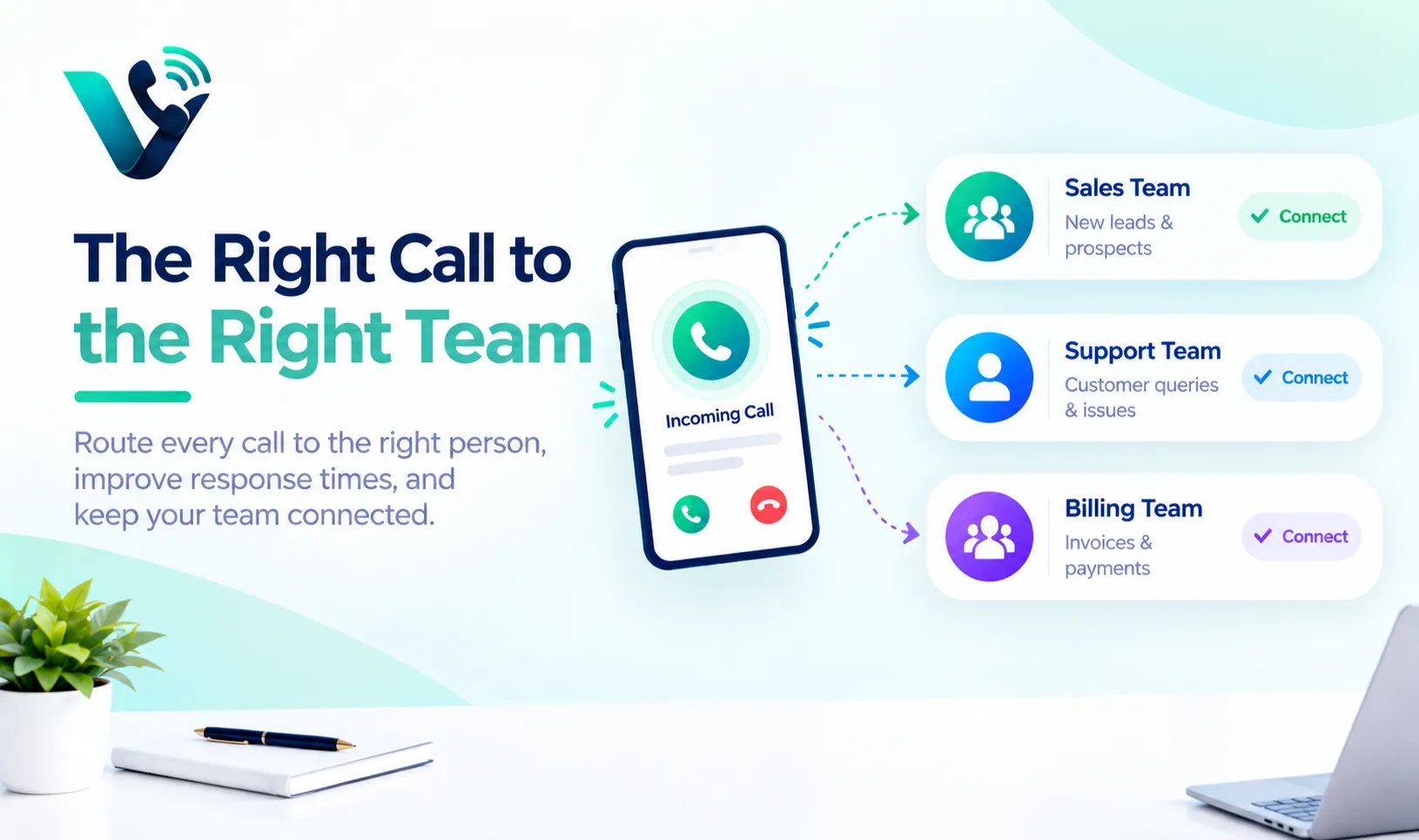
Common hunt-group patterns
- Sequential: Try members in a fixed order.
- Circular: Rotate the starting point so the same person is not always first.
- Longest-idle: Favour the person who has been available the longest.
- Weighted: Distribute more calls to selected members according to the configured weighting.
The exact patterns available depend on the provider. The important decision is to choose a pattern that reflects real staffing. A beautifully configured hunt group still fails if unavailable users remain in the route or if the fallback path sends callers back into the same loop.
What is a call queue?
A call queue is designed for situations where callers may need to wait because all appropriate agents are busy. Instead of simply failing when nobody answers immediately, the system can hold callers with an announcement or music until an agent becomes available.
Queues are useful for higher or more regular inbound volume because they create a more deliberate waiting experience. They can also support metrics such as wait time, service level, abandonment, and agent availability, depending on the provider.
That visibility can help managers understand whether the problem is routing or staffing. If abandoned calls rise at a particular time, the business has evidence that coverage may need to change.
Ring group vs hunt group vs queue
Model |
Best for |
Caller experience |
Main risk |
|
Ring group |
Small shared responsibility |
Call rings one or several team members |
Too much simultaneous ringing or limited waiting visibility |
|
Hunt group |
Preferred order or backup sequence |
System tries members according to a pattern |
Poor sequence design can create long or repetitive routing |
|
Queue |
Regular inbound volume |
Caller waits until an agent becomes available |
Long waits or abandonment if staffing is insufficient |
This is the practical difference behind ring groups hunt groups queues: Ring groups share the call, hunt groups search for the right member, and queues manage the wait.
How to choose the right model
Start with the expected caller journey. If the business wants the first available person in a small team to answer, a ring group may be enough. If the call should try a primary owner and then backups, a hunt group fits better. If callers regularly arrive while all agents are busy, a queue is usually more appropriate.
Also consider team behaviour. A ring group assumes several people can answer interchangeably. A hunt group assumes order or distribution logic matters. A queue assumes the business is comfortable asking customers to wait and has a process for managing that wait.
Do not choose the most advanced feature simply because it is available. Clear rules and testing matter more than complexity. A simple call flow that staff understand is often more reliable than a sophisticated design nobody knows how to maintain.
Use timeouts and fallback paths
Every call flow needs an exit. Set a clear timeout before the call moves to the next destination. If a ring group does not answer, the caller might move to a hunt group, queue, voicemail, or another backup path.
Avoid sending callers around the same loop repeatedly. A caller who has already waited through one route should not be sent back to the beginning without a clear reason. Fallback should simplify the experience, not make it feel endless.
Open-hours and closed-hours schedules should also be separate. A route that works during business hours may be completely wrong after hours when nobody is available.
Staff status and availability matter
A call-distribution feature works only if the system knows who should be receiving calls. Give staff status controls where the provider supports them so unavailable people are not rung unnecessarily.
This is particularly important in hunt groups and queues because the routing logic may otherwise keep trying people who are in meetings, off shift, or temporarily unavailable. The result is a longer caller journey without any improvement in the chance of getting an answer.
Review member lists whenever staffing changes. A call flow should not depend on an extension that no longer belongs to an active user.
How to layer ring groups, hunt groups and queues
The three models can work together. The source gives a clinic example: A ring group can cover reception during normal periods, a hunt group can try the manager when reception does not answer, and a queue can handle appointment-campaign volume.
The same pattern can be applied to other businesses. A sales line might start with a small ring group, move to a hunt-group escalation path, and use a queue during peak campaigns. The design should follow the actual customer journey rather than forcing every call through the same mechanism.
Layering only works when the route remains understandable. Document the order, timeouts, schedules, and final fallback so staff know what callers experience.
What to measure after launch
- Missed calls: Calls that never reached a person.
- Abandoned calls: Callers who left before an agent answered.
- Wait time: How long callers stayed in the queue.
- Service level: Whether calls were answered within the business target, where supported.
- Agent availability: Whether enough people were ready to receive calls.
These measures help the business improve the call flow. If a queue has long waits, changing the greeting will not solve the underlying staffing problem. If a ring group misses calls even when several people are available, the routing or timeout may need review.
Try this on your own numbers
Local numbers in 118 countries, AI call notes and one shared inbox. Live the same day, no contract.
Common configuration mistakes
- Ringing everyone for too long with no fallback.
- Creating hunt-group sequences that keep retrying unavailable users.
- Sending callers through an endless routing loop.
- Using a queue without enough staffing to handle the expected volume.
- Using the same route during open and closed hours.
- Failing to remove inactive users from groups.
- Ignoring missed and abandoned-call data after launch.
- Most mistakes are not caused by choosing the wrong feature name. They are caused by unclear rules, unrealistic staffing assumptions, or failure to test exception paths.
Implementation checklist
- Map the caller journey from the moment the number is dialled.
- Decide whether shared responsibility, ordered hunting, or waiting callers best describes the workflow.
- Choose the simplest suitable model.
- Set members, order, timeouts, and schedules.
- Create a clear fallback for unanswered calls.
- Test normal calls, unavailable users, busy periods, open hours, and closed hours.
- Track missed calls, abandonment, wait time, and other available performance data.
- Review the call flow as staffing and call volume change.
Frequently asked questions
- What is the difference between ring groups, hunt groups and queues?
- A ring group shares a call across a group, a hunt group searches members in a configured order or pattern, and a queue holds callers until an appropriate agent becomes available.
- Which is best for a small team?
- A ring group is often the simplest choice when several people can answer the same call and inbound volume does not regularly create waiting callers.
- When should I use a hunt group?
- Use a hunt group when one member or department should be tried before another, or when the business wants a specific distribution pattern.
- When should I use a call queue?
- Use a queue when callers may need to wait because agents are busy and the business needs a structured waiting experience and queue-related performance data.
- Can I use all three in one call flow?
- Yes. The source example layers a ring group, hunt group, and queue for different parts of the same customer journey.
- What is the biggest mistake to avoid?
- Avoid complex or looping call flows that do not reflect staffing. Always define timeouts, open and closed hours, unavailable-user handling, and a final fallback.