How to Get a UK 020 Number Without a London Office
By Jamila Parker · · 9 min read

Learn what a UK 020 London number means, how virtual routing works, what to ask providers, and how to serve London customers without claiming a physical office that does not exist.
Key takeaways
- A UK 020 number is a London geographic number, so the public wording around it should be accurate and should not imply a physical London office that does not exist.
- A remote business may be able to use virtual routing for a London 020 number, but provider allocation and documentation requirements should be confirmed before purchase.
- Choose a London 020 number because London is genuinely relevant to the customer journey, not simply because the prefix looks familiar or prestigious.
- Configure routing in London time, including business hours, after-hours handling, overflow, missed-call ownership and callback workflows.
- Treat voice, SMS and verification as separate capabilities and confirm what the exact number supports.
- Connect the number to CRM source, ownership and next action so a London phone lead does not become a reporting dead end.
A UK 020 number can give a business a London geographic contact point while calls are handled through virtual telephony rather than a traditional desk phone in a London office. That makes it useful for remote teams, distributed sales organisations and companies that genuinely serve London customers but do not operate from a physical London location.
The key is to understand what the number represents. The supplied source identifies 020 as London's geographic area code and warns against using the number in a way that falsely suggests a physical office. The practical question is therefore not only 'Can I get a UK 020 number?' but also 'Does the provider allow the number for my use case, what documentation is required, how will calls be routed, and how will I describe the business presence accurately?'
This guide expands that framework into a practical setup process covering 020 number meaning, provider checks, remote routing, CRM attribution, voice versus SMS, launch testing, and alternatives when a London geographic number is not the right fit.
What a UK 020 number means
Ofcom identifies 020 as the geographic area code for London. UK geographic numbers begin with 01 or 02 and are associated with specific areas through their area codes. That means an 020 number carries London geographic context rather than acting as a generic UK business number.
For customer-facing communication, that geographic meaning should be handled carefully. If a business serves London customers remotely, it can describe that service accurately. What it should avoid is wording that turns the phone number into evidence of a physical London office when no such office exists.
This distinction is useful for both trust and consistency. A number can support a London-focused sales or support workflow without changing the physical reality of where the team works.
Can a remote business use a virtual 020 number?
A virtual phone system can route calls to browsers, apps, queues or other supported destinations rather than requiring a traditional London desk phone. That technical capability makes remote answering possible, but number allocation is a separate question.
The source notes that whether a provider can allocate a particular 020 number, and what documentation is required, depends on the provider's current rules and the regulatory conditions attached to the number. So the safest process is to confirm eligibility before building a campaign, website or printed material around the number.
For a remote team, the useful model is simple: the 020 number becomes the public contact point, while the internal routing sends calls to the people responsible for London customers. That can work well when the provider supports the number and the business presents the arrangement accurately.
Why businesses choose a London 020 number
A London 020 number can be useful when London is a meaningful target market, when customers expect a conventional geographic UK number, or when a distributed team is specifically responsible for London enquiries.
The number should support a real communication function. Calls need to be answered, transferred when necessary, and followed up. A local-looking number that repeatedly reaches voicemail or has no clear owner can create a worse customer experience than a clearly presented national contact option.
The best reason to choose a UK 020 number is therefore relevance. If London is central to the market strategy, the number can fit the customer journey. If the business serves the whole UK equally, another number category may tell the story more clearly.
What to ask the provider before ordering
Before ordering a UK 020 number, ask the provider for the current allocation and service requirements. The original source recommends confirming whether the number is geographic, what identity or address evidence may be required, and whether overseas teams can use it.
Also ask about porting, SMS availability, emergency-calling arrangements, cancellation and port-out. These details matter because they affect how permanent and flexible the number will be once it appears on the website, directories, ads and customer records.
Number availability and provider processes can change, so an old blog post should not be treated as the final source for current eligibility. The provider should confirm the requirements for the exact number and the intended service.
Set up call routing for a remote team
Once the number is active, configure routing around the customer's day. If the team is outside the UK, use London time for the business-hours schedule rather than the employees local time.
Start with a primary queue or group for London enquiries. Then define what happens when nobody answers: overflow to a backup group, voicemail, a callback task or another fallback path. Missed calls should create a clear ownership workflow rather than remaining as anonymous entries in a call log.
The source specifically highlights UK daylight-saving changes. That is an important operational detail for remote teams because a schedule that looks correct in one time zone can shift relative to London during the year. Review the routing windows whenever daylight-saving changes occur.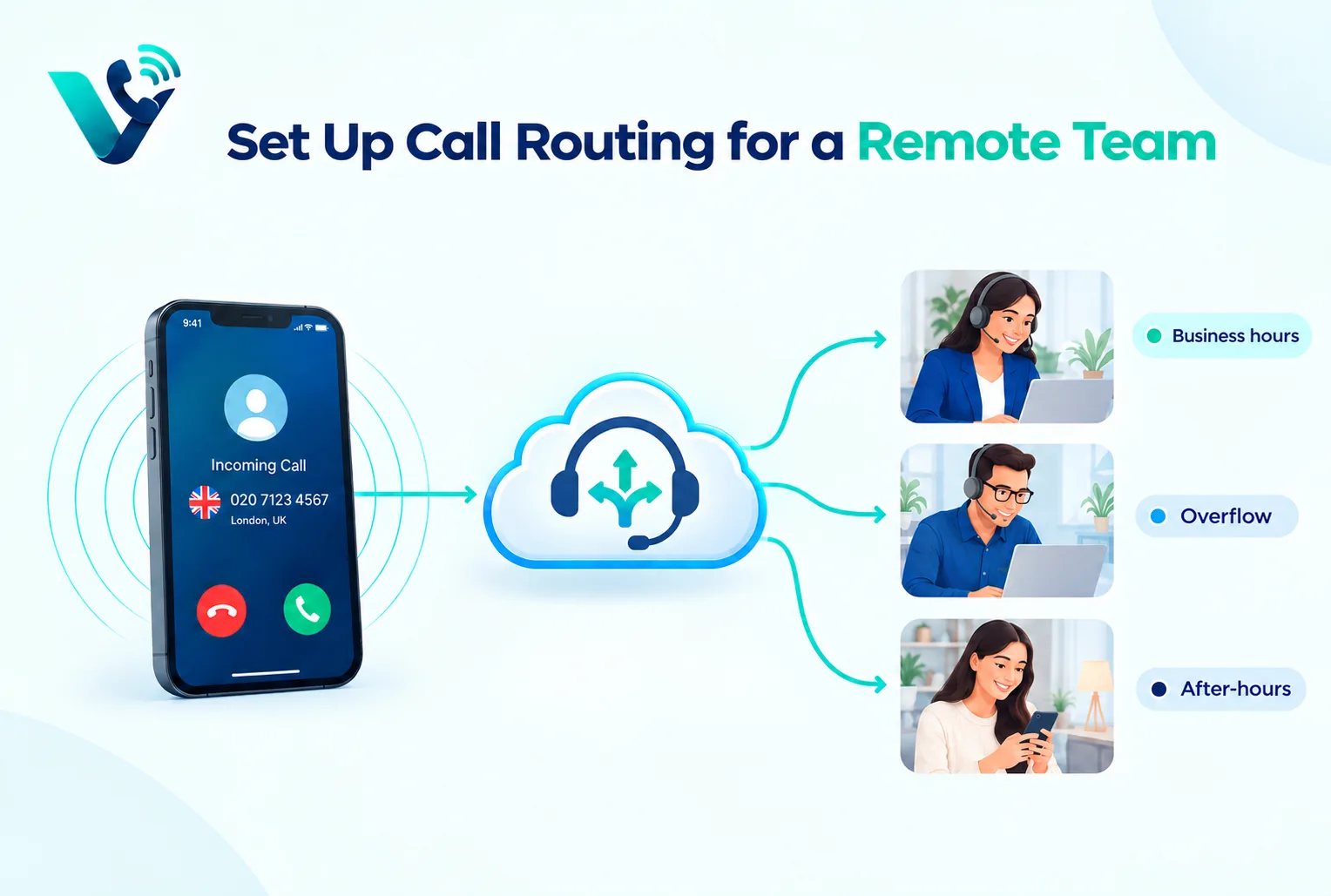
Keep the London story accurate
A geographic number gives location context, but it does not prove a company operates from a physical address in that area. The supplied source recommends transparent wording: a business can say it serves London customers while using a virtual London number, without claiming an office it does not have.
This matters across more than the website. Directory profiles, ads, email signatures, sales documents and customer-facing pages should all tell the same story. Inconsistent location claims can create confusion even when the phone service itself works correctly.
A clean approach is to describe the market being served, not invent a physical presence. The phone number should make it easier for London customers to reach the team, not blur the distinction between service coverage and office location.
Connect the UK 020 number to CRM and attribution
A phone number should not become a reporting dead end. If the 020 number is dedicated to London campaigns, preserve that source in the CRM. If it is the main UK number, use campaign tags or separate tracking mechanisms when more detailed attribution is needed.
Useful CRM fields include source, region, owner, call outcome, status and next action. LeadMino can be used to keep the sales follow-up visible after the call, so the team knows who is responsible and what should happen next.
That connection helps separate marketing performance from operational performance. If London enquiries are arriving but not progressing, the team can examine ownership, response time and follow-up rather than assuming the market itself is weak.
Voice, SMS and verification are different
Do not assume that a UK 020 number that supports voice will automatically support every messaging or verification use case. The source explicitly treats voice and SMS as separate capabilities that should be confirmed with the provider.
If the business plans to send appointment reminders, two-way customer messages or other SMS communication, confirm the exact number capability before publishing it as a messaging channel.
The same caution applies to third-party verification services. A phone number can work perfectly for business calling while still being unsuitable for a separate service that accepts only particular number types. Treat each use case as its own implementation check.
Test the number before launch
Before publishing the number, test calls from a UK mobile and from an external network. Check business-hours routing, voicemail, overflow and any call-recording workflow that the business intends to use.
Verify outbound caller ID so customers see the number the business expects them to recognise. Then test CRM behaviour: the right lead record should be created or updated, the correct owner should receive the enquiry, and the next action should be visible.
Finally, compare the public presentation across the website, directories and advertising. If the same 020 number is intended to be the main London contact, keep it consistent so customers do not see conflicting phone identities.
A practical alternative when 020 is not suitable
If the business serves the whole UK rather than London specifically, a non-geographic option may be a better match. The source notes that Ofcom distinguishes geographic ranges from non-geographic ranges such as 03 and 080.
The choice should follow customer expectations, call costs, coverage and the real service area. A London geographic number is a tool for a London-relevant communication strategy, not a requirement for doing business in the UK.
If the provider's current 020 eligibility rules do not fit the business, use that as a signal to reconsider the number type rather than trying to force the wrong geographic identity into the workflow.
Common mistakes to avoid
- Choosing 020 only because it looks local: Use the number when London is genuinely relevant to the customer journey and market strategy.
- Implying a London office that does not exist: Keep public wording accurate and distinguish service coverage from physical location.
- Buying the number before checking provider requirements: Confirm allocation, documentation, remote-use and porting conditions before launch.
- Using the team's local time for routing: Configure the customer-facing schedule in London time and review daylight-saving changes.
- Assuming voice means SMS will work: Confirm messaging separately for the exact number and intended use.
- Leaving missed calls without ownership: Create overflow, voicemail or callback processes that assign a clear next action.
Try this on your own numbers
Local numbers in 118 countries, AI call notes and one shared inbox. Live the same day, no contract.
Step-by-step UK 020 number setup
- Confirm London is the target market: Decide why a London geographic number is useful to the real customer journey.
- Ask the provider about current eligibility: Confirm number allocation, identity or address requirements, remote use and any service restrictions.
- Choose the exact 020 number: Select from the provider's available London numbers once the business qualifies for the service.
- Assign users or a queue: Make sure the number reaches the people responsible for London enquiries.
- Configure London-time routing: Set business hours, after-hours behaviour, overflow, voicemail and callback ownership.
- Connect the number to the CRM: Store source, owner, outcome and next action so every phone lead enters the same follow-up process.
- Test before publishing: Call from representative networks, check caller ID, fallback paths and CRM behaviour, then verify public listings.
- Practical implementation checklist
Element |
Purpose |
What to check |
|
020 London geographic number |
London contact point |
Confirm current provider eligibility and availability |
|
Provider documents |
Allocation and verification |
Check identity/address evidence for the exact service |
|
Routing |
Remote answering |
Use London-time business hours, overflow and after-hours paths |
|
Transparency |
Customer trust |
Do not imply a physical office that does not exist |
|
Voice |
Calling |
Test inbound and outbound behaviour |
|
SMS |
Messaging |
Confirm separate availability and requirements |
|
CRM |
Lead follow-up |
Capture source, owner, outcome and next action |
|
Public listings |
Consistency |
Keep website, ads and directories aligned |
Frequently asked questions
- What does 020 mean in the UK?
- 020 is the geographic area code for London.
- Can a remote business use a UK 020 number?
- A provider may offer virtual 020 service, but the current allocation and eligibility requirements for the exact number should be confirmed.
- Does a UK 020 number prove a London office exists?
- No. It is a geographic number and should not be presented as proof of a physical office that does not exist.
- Can calls to a London 020 number be answered outside London?
- Virtual routing can allow calls to be answered remotely, subject to the provider's service and allocation conditions.
- Can a UK 020 number receive SMS?
- Do not assume so. Voice and messaging capabilities should be confirmed separately for the exact number.
- What if my business serves the whole UK?
- A non-geographic number may be more appropriate when London is not the specific market being represented.
- Should I route the number using my team's local time?
- Use London time for the customer-facing business-hours schedule, especially when the team is located abroad.
- How should I track London phone leads?
- Store the source, owner, call outcome, status and next action in the CRM so London enquiries enter a measurable follow-up workflow.