Real-Time Translation on Customer Calls: State of the Art in 2026
By Jamila Parker · · 8 min read

Real-time voice translation is moving into production contact centers in 2026. Here is what is ready, what still breaks, and how to pilot translated customer calls safely.
Key takeaways
- Real-time voice translation is production-ready for selected workflows and tested language pairs, but it is not universally reliable.
- Latency, terminology, accent coverage and worst-case delay matter as much as headline language count.
- Cascaded and speech-to-speech architectures trade transparency, control and naturalness differently.
- Regulated or high-stakes calls still need conservative escalation to bilingual experts or interpreters.
- The best rollout starts narrow, measures customer outcomes and keeps a clear human fallback.
Real-time translation on customer calls has crossed an important line in 2026: It is no longer only a conference-demo idea, but it is not yet a universal replacement for bilingual agents or interpreters either. Production systems can now translate live speech quickly enough for many service conversations, while major vendors and telecom operators are shipping or trialing two-way voice translation. The remaining question is where the technology is dependable enough to use without making the customer experience worse.
The state of the art is best understood as a trade-off between latency, language coverage, translation quality, voice naturalness, terminology control, and risk. A system can be fast but flatten meaning. It can be accurate on common language pairs but weak on dialects. It can translate text well but introduce awkward pauses when synthetic speech is added. Customer-call design therefore matters as much as model quality.
Two architectures dominate live call translation
Most real-time translation systems use either a cascade or a more direct speech-to-speech approach. A cascade converts speech to text, translates the text, and optionally converts the translated text back to speech. The advantage is modular control: Each stage can be inspected, improved, or replaced. The disadvantage is accumulated latency and the risk that an error in transcription flows into translation.
End-to-end or tightly integrated speech-to-speech systems aim to preserve more timing, tone, and conversational flow. Research and commercial systems are moving in this direction, but enterprise deployments still often use hybrid pipelines because they provide clearer controls, transcripts, auditability, terminology handling, and integration with contact-centre systems.
Approach |
Strength |
Trade-off |
|
Speech → text → translation → speech |
Transparent, configurable, easier to log and audit |
Each stage adds latency and error propagation |
|
Speech → translated text |
Fast for agent-assist or caption workflows |
Customer still needs the agent to interpret or speak the result |
|
Speech-to-speech |
More natural conversational target |
Harder to inspect and govern; quality varies by language pair |
|
Interpreter + AI assist |
Human judgment with AI speed support |
Higher cost and operational complexity |
Latency is now usable but not invisible
Natural conversation is sensitive to delay. When translation takes too long, both people start talking over the system, repeat themselves, or assume the line has failed. Modern systems have pushed latency down substantially, but end-to-end performance still depends on voice activity detection, network conditions, transcription speed, translation generation, and speech synthesis.
A 2026 ACL demo of bidirectional Korean-English translation over PSTN reported a median of 555 milliseconds in one direction, while the reverse direction was much slower because speech recognition dominated the pipeline. The point is not that every commercial system will match those figures. It is that latency is increasingly low enough for interactive use, yet the slowest stage and worst-case delays still shape the experience.
Major platforms are moving from pilot to product
Zendesk announced AI-powered Real-Time Voice Translation for its contact centre in September 2026, with an early-access program planned for October. The company described two-way live translation designed to let customers and agents speak in their preferred languages without creating separate language queues or adding an interpreter to every call.
Vodafone and Ericsson also demonstrated network-native AI translation in September 2026, showing that translation may increasingly sit inside telecom infrastructure rather than only inside an app. DeepL Voice has taken a pragmatic production path around real-time speech-to-text translation, while other vendors are pursuing fuller speech-to-speech experiences. These developments show momentum, but they also show that the market is still experimenting with where translation should run and how it should be presented.
Language coverage is only the first filter
A list of supported languages does not tell you how well a system handles your customer population. Real-time translation has to survive accents, dialects, code-switching, names, addresses, industry jargon, interruptions, and poor phone audio. Language pairs also differ in difficulty. A translation that performs well between English and Spanish may behave differently between English and a lower-resource language or between two languages with very different syntax.
- Test the exact language pairs your customers use, in both directions.
- Include accents and code-switching, not only standard-language demo audio.
- Test names, numbers, dates, product names and technical terms.
- Measure worst-case latency, not only the average.
- Listen for changes in intent, politeness, negation and urgency not just literal wording.
Glossaries and terminology control are becoming essential
Customer calls are full of terms that generic translation models may not know: Product names, plan names, industry abbreviations, local place names, and account-specific vocabulary. Enterprise systems increasingly use glossaries, prompts, or terminology controls to keep those terms stable. Without that layer, a technically fluent translation can still be operationally wrong.
For support, terminology errors can send a troubleshooting process in the wrong direction. For sales, a mistranslated pricing unit or contract term can create commercial risk. For healthcare, finance, legal, or emergency contexts, the threshold for acceptable error is much higher and human interpretation may still be required.
Where real-time translation is ready first
Use case |
2026 readiness |
Recommended control |
|
General customer service |
High for tested language pairs |
Agent sees transcript/translation and can clarify |
|
Travel, hospitality, logistics |
High to medium |
Glossary for names, locations and booking terms |
|
Sales qualification |
Medium |
Use for discovery support; confirm pricing and commitments explicitly |
|
Technical support |
Medium |
Terminology glossary plus easy escalation to fluent specialist |
|
Regulated or high-stakes advice |
Cautious |
Human interpreter or bilingual expert for critical decisions |
The user experience needs explicit turn-taking
Translation quality can be good while the call still feels bad. The system should tell callers that translation is active, explain whether there will be a short delay, and avoid confusing both speakers about when to talk. Overlapping speech is difficult for humans and machines. A subtle audio cue, translated caption, or agent interface that shows when translation is still processing can reduce interruptions.
Disclosure and consent may also be necessary depending on recording, processing, and jurisdiction. Even when translation itself is legal to use, the underlying call recording or AI processing can trigger separate privacy requirements.
Use translation as a routing layer, not a trap
A customer should always have a path out of the translated experience. If confidence drops, the conversation becomes sensitive, or the caller repeatedly corrects the system, route to a bilingual agent or interpreter. The best automation recognizes its boundary. A rigid system that insists on translating a failing call can be worse than a longer wait for the right human.
How to pilot real-time translation on customer calls
Start with one queue, two or three language pairs, and a limited set of call intents. Measure task completion, transfer rate, repeat explanations, translation corrections, customer satisfaction, agent effort, and latency. Review recordings with bilingual evaluators rather than relying only on generic translation metrics. Pay special attention to names, numbers, negation, and any phrase that creates a commitment.
Compare translated calls with the current alternative: Language-specific routing, callbacks, interpreters, or asking the customer to switch channels. A system does not need perfect translation to create value; it needs to perform better than the workflow it replaces without creating unacceptable risk.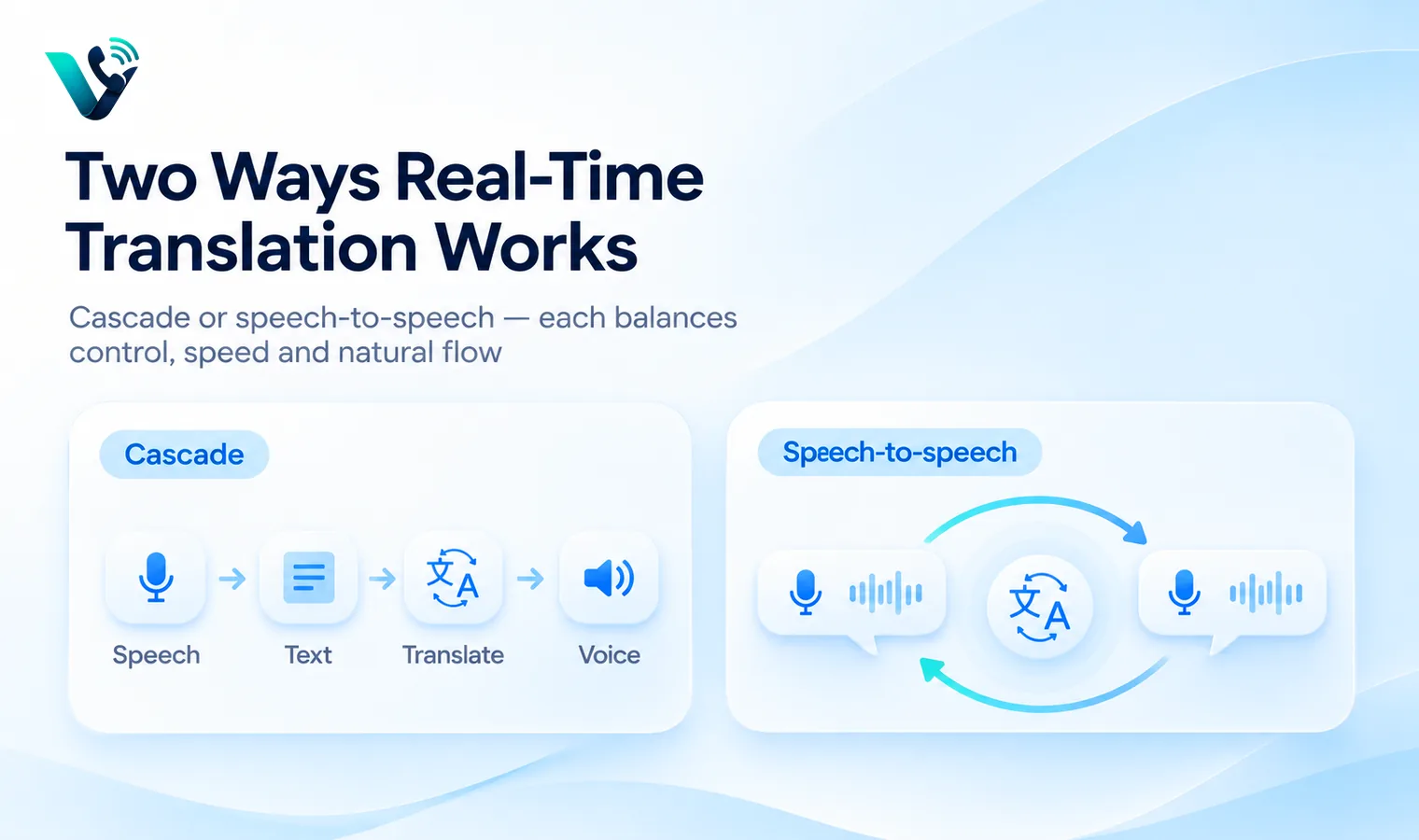
How this connects to Votelly
Votelly is positioned around global business calling, local numbers, live transcription, AI summaries, analytics, and multi-region teams. Real-time translation is therefore a strategically adjacent topic even where a specific translation feature should not be claimed unless it is confirmed on the live product. The article can connect Votelly’s global-number and transcription story with the broader direction of multilingual customer communication.
State of the art: Useful now, universal later
As of October 2026, real-time translation on customer calls is ready for targeted production use, especially in general service workflows with tested language pairs and clear escalation. It is not yet a reason to remove every bilingual specialist or interpreter. The frontier is moving quickly: Latency is falling, language coverage is expanding, and speech-to-speech systems sound more natural. The teams that benefit first will be the ones that treat translation as an operational system with testing, glossaries, disclosure, fallback, and human review not as a button that makes language risk disappear.
Try this on your own numbers
Local numbers in 118 countries, AI call notes and one shared inbox. Live the same day, no contract.
Translation quality should be measured as task success
Traditional translation metrics are useful for model development, but a contact centre ultimately cares whether the customer accomplished the task. A call can contain imperfect phrasing and still resolve the issue correctly. Another call can sound fluent while mistranslating the one number or negation that matters. Build operational evaluation around task success as well as linguistic quality.
- Did the customer and agent reach the same understanding of the problem?
- Were names, dates, prices, addresses and commitments transferred correctly?
- Did either speaker need to repeat or correct the translation?
- Did the call require escalation because translation confidence broke down?
- Was the final outcome comparable with calls handled by fluent agents?
This evaluation approach keeps the technology tied to customer outcomes. The objective is not to produce beautiful translated sentences. It is to let two people who do not share a language complete the conversation safely and efficiently.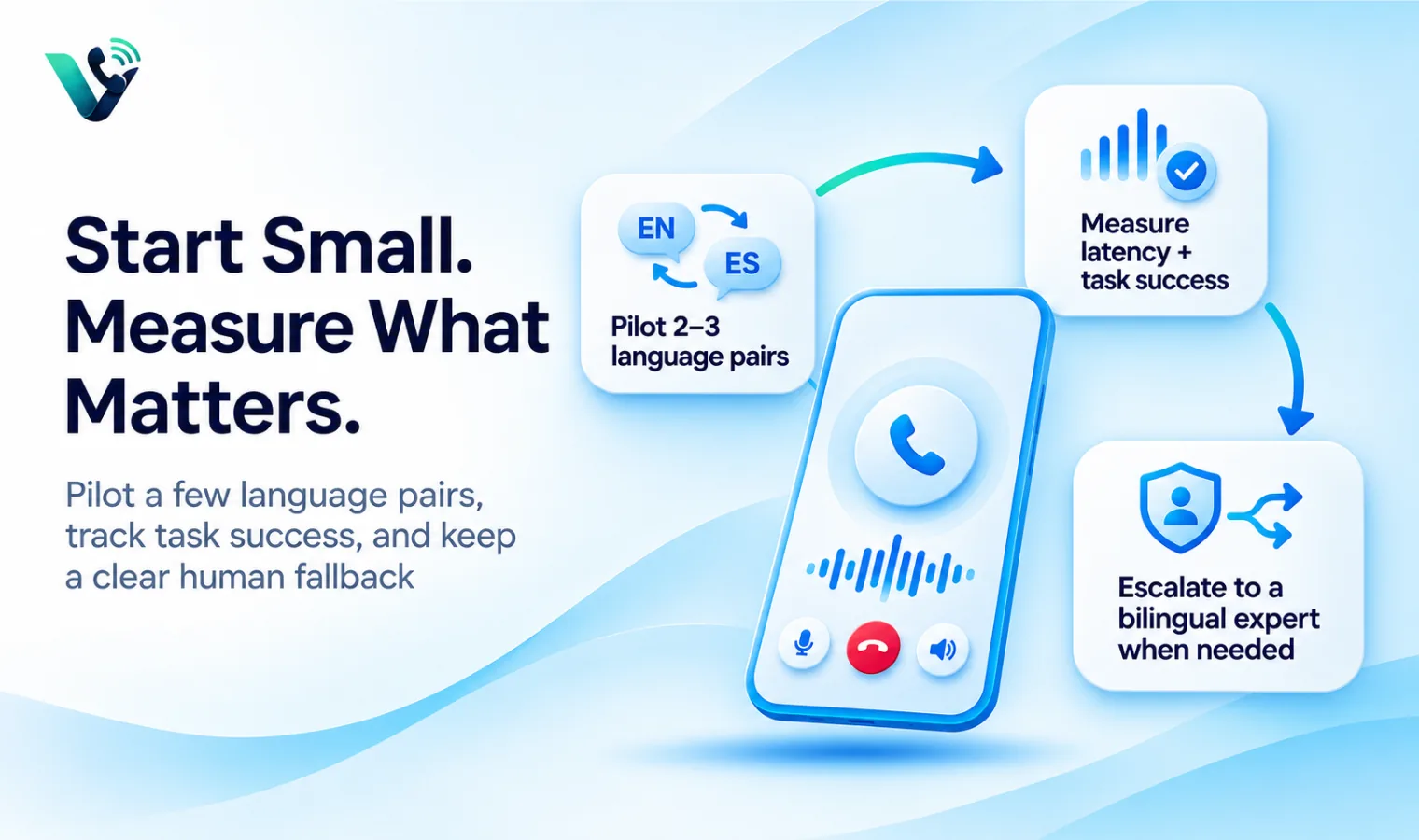
Frequently asked questions
- Is real-time translation on customer calls available in 2026?
- Yes. Several vendors have launched or announced live two-way voice translation, while telecom operators are also trialing network-native approaches.
- How much delay does real-time voice translation add?
- It varies by architecture, language pair, network and speech recognition. Modern systems can be interactive, but worst-case delays can still interrupt conversation flow.
- Is speech-to-speech translation better than translated captions?
- Speech-to-speech can feel more natural, while translated text or cascaded systems can be easier to inspect, control and audit. The best choice depends on the workflow.
- Can real-time translation replace bilingual agents?
- For some routine service calls it can reduce the need for language-specific routing, but complex, sensitive or high-stakes conversations still benefit from fluent human support.
- How should a contact centre test live translation?
- Pilot a few language pairs and intents, use bilingual reviewers, measure task completion, correction rate, latency, transfers and customer satisfaction, and define escalation rules.
- Does Votelly offer real-time translation?
- Votelly publicly markets global calling and live transcription. A specific real-time translation capability should only be claimed if it is confirmed on the live product or by Votelly directly.