Multilingual Transcription: How Well Does It Handle Accents?
By Jamila Parker · · 8 min read

Multilingual transcription is improving fast, but language support does not guarantee equal accuracy across accents, code-switching and phone audio. Here is how to test it properly.
Key takeaways
- Language support and accent accuracy are not the same thing; test the speakers your business actually serves.
- Word error rate alone is not enough names, numbers, dates, negation and product terms may matter more operationally.
- Use real telephony audio, not only clean microphone recordings, when evaluating call transcription.
- Code-switching and domain terminology should be included in the benchmark if they occur in production.
- Segment transcription accuracy by language and accent before using downstream AI scores for performance decisions.
Accent is not an error. A customer can speak perfectly clear English, Spanish, Arabic, Hindi, or French and still sound very different from the audio a transcription model saw most often during training. Multilingual transcription therefore has two separate challenges: Recognizing the language and recognizing the way real people speak that language across regions, accents, code-switching habits, microphones, background noise, and phone networks.
For business calls, the useful question is not 'Does this tool support 50 languages?' The useful question is 'How accurately does it capture the words that matter in our calls, spoken by our customers and agents, under our audio conditions?' That moves evaluation away from a feature checklist and toward representative testing.
Language support and accent robustness are different
A vendor may list English, Spanish, German, Japanese, or dozens of other languages as supported. That does not mean every regional accent, mixed-language conversation, and domain term performs equally. Even within English, accents from India, Scotland, Nigeria, Singapore, Australia, the United States, and many other regions can differ in vowel patterns, rhythm, vocabulary, and code-switching behavior.
The same issue appears inside other languages. A system that performs well on formal broadcast speech can struggle with fast customer-service audio, interrupted turns, names, addresses, product codes, or local vocabulary. Multilingual transcription accuracy is therefore a distribution question: How close is the test audio to the calls the business actually receives?
Do not judge transcription with one headline accuracy number
Word error rate is useful, but it treats every word as equally important. In a contact centre, 'Tuesday' versus 'Thursday,' a missing negative, an incorrect account number, or a misspelled medication can matter more than several minor filler-word mistakes. A practical multilingual transcription benchmark should track both general text accuracy and business-critical entity accuracy.
Test dimension |
What to include |
Why it matters |
|
Accent coverage |
Real speakers from target regions |
Reveals accent-specific recognition gaps |
|
Telephony audio |
Actual narrowband or VoIP call recordings |
Lab microphones can hide real production errors |
|
Code-switching |
Calls that mix languages naturally |
Many multilingual customers switch mid-sentence |
|
Critical entities |
Names, numbers, dates, products, addresses |
These errors can damage CRM records and follow-up |
|
Noise and overlap |
Office noise, mobile calls, interruptions |
Real calls are rarely studio-clean |
|
Domain terminology |
Brand names, acronyms, technical vocabulary |
General models may mishear specialized terms |
Code-switching is a business reality
Multilingual speakers often mix languages inside the same call. A customer might describe the problem in a local language, switch to English for a product name, then return to the first language. Systems that assume one language for the whole recording can produce strange substitutions when this happens.
Current transcription APIs increasingly support language hints or multiple expected languages. OpenAI’s current transcription guidance, for example, recommends testing target languages, accents, and code-switching patterns and allows expected-language hints plus keywords for domain terms. The broader lesson is vendor-neutral: Context helps, but teams should test whether hints improve accuracy without introducing words that were never spoken.
Telephony audio changes the problem
A model that performs well on a clean laptop microphone may behave differently on customer calls. PSTN audio can be narrowband. Mobile networks add compression and dropouts. Speakerphone creates echo. Contact-centre calls include hold music, transfers, cross-talk, and agents using different headsets. Multilingual transcription should be tested on the same audio path the production system will receive.
Amazon Connect Contact Lens expanded conversational analytics to 67 languages by 2025, including multiple English regional variants and many languages used in global contact centres. That kind of coverage is useful, but language availability should still be followed by local validation. A supported language can have different error patterns across accents and business domains.
Build an accent-aware evaluation set
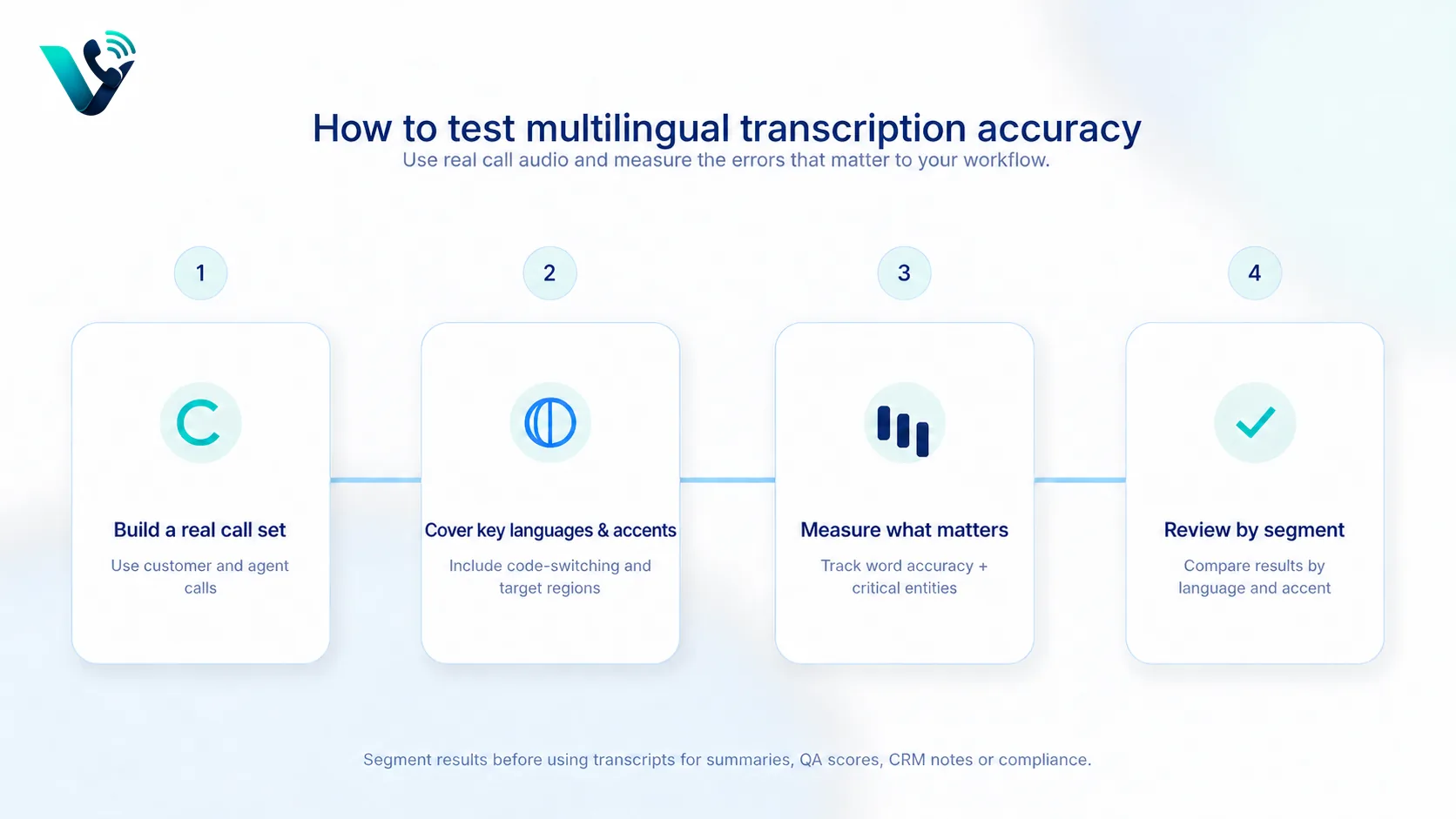
Collect a representative sample with consent and appropriate privacy controls. Do not build the benchmark only from your easiest calls. Include high-volume regions, difficult audio, new speakers, fast speakers, quiet speakers, customers who interrupt, and conversations with names or codes that are important to the workflow.
- Tag each sample with language, region or accent group, audio source, call type and noise condition.
- Create a human reference transcript for a manageable evaluation subset.
- Score general word errors and critical business-field errors separately.
- Measure speaker-label errors if downstream summaries depend on who said what.
- Retest after major model, provider, routing, or microphone changes.
Measure errors that affect the workflow
The right metric depends on what the transcript feeds. For searchable call intelligence, occasional filler-word errors may be tolerable if topic search remains reliable. For automatic CRM notes, names, amounts, dates, and next steps matter more. For compliance review, required phrases and negation may be critical. For real-time agent assist, latency and partial-transcript stability also matter because unstable text can trigger bad suggestions.
Use case |
Most important transcription checks |
|
Searchable call archive |
Topic terms, competitor names, semantic retrieval |
|
CRM write-back |
Names, dates, amounts, actions, products |
|
QA and compliance |
Required phrases, negation, speaker attribution |
|
Live agent assist |
Low latency, stable partial text, intent-critical phrases |
|
Customer analytics |
Consistent topic and sentiment inputs across language groups |
Keywords and context can help domain accuracy
Product names and internal terminology are common failure points. If the transcription system supports contextual prompts, keywords, glossaries, or expected-language hints, use them narrowly. A long list of irrelevant keywords can bias recognition. The best approach is to start with terms that repeatedly fail in real transcripts brand names, model numbers, technical acronyms, city names, or customer-specific vocabulary and measure whether the hint reduces those errors.
Accents can also create fairness problems in analytics
Transcription error is not only a readability issue. If one accent is transcribed less accurately, downstream sentiment, QA scoring, search, and summaries may also become less reliable for that group. A company that compares agent performance across regions should check whether model errors are unevenly distributed before trusting the analytics as a fair measure.
This is particularly important when AI scores affect coaching, escalation, or performance decisions. Segment accuracy tests by language and accent instead of averaging everything into one number that hides weak groups.
How this connects to Votelly
Votelly currently markets live transcription, searchable transcripts, AI summaries, sentiment, CRM integration, and global calling. For a multilingual customer base, those features become more valuable when transcript accuracy is tested against the accents and languages the business actually serves. Votelly’s public site also emphasizes international numbers and multi-region use cases, making accent-aware transcription a natural educational topic for its audience.
The right answer is “test your audio”
How well does multilingual transcription handle accents? In 2026, leading systems are substantially more capable across languages and code-switching than older generations, but performance is not uniform. The safest answer is not a vendor language count or one benchmark percentage. Build a representative test set, measure errors that matter to your workflow, compare performance by accent and audio condition, and keep humans in the loop where a transcription mistake would change a decision.
Do not average away weak language groups
A global transcription score can hide the exact population that needs attention. Suppose English calls are the majority and perform strongly while a smaller language or accent group performs poorly. The overall metric may still look excellent even though the weaker group experiences broken search, inaccurate summaries, or unfair QA results. Report performance by language and by the most important regional speaker groups where sample size allows.
Also compare error categories, not only total error. One accent group may have similar overall word accuracy but more mistakes on names or numbers. Another may have more speaker-attribution failures because conversational overlap is common. These differences determine which downstream workflows are safe to automate.
- Set minimum acceptable thresholds for critical entities by language group.
- Route low-confidence transcripts to human review when the workflow is high stakes.
- Re-test when expanding into a new country instead of assuming nearby language support will transfer.
The practical test is whether the workflow changes a decision, reduces manual review, improves customer understanding, or creates more reliable data. Teams should keep measuring the operational outcome rather than assuming that a sophisticated AI feature automatically produces business value.
Try this on your own numbers
Local numbers in 118 countries, AI call notes and one shared inbox. Live the same day, no contract.
Accent testing should include the downstream AI, not just the transcript
A transcription benchmark can look acceptable while the next AI layer still fails. Summaries may omit a customer commitment because one phrase was misheard. Sentiment models may overreact to transcription artifacts. Search may miss a competitor name that is consistently misspelled. Quality scoring may mark a disclosure absent when the transcript dropped one important word. For that reason, evaluate the complete workflow on representative accent groups.
Create a small end-to-end test where each recording produces a transcript, summary, searchable topics, and any QA or CRM fields your production system uses. Compare the final outputs with human-reviewed ground truth. This reveals whether a modest transcription error is harmless or whether it cascades into a bad business decision.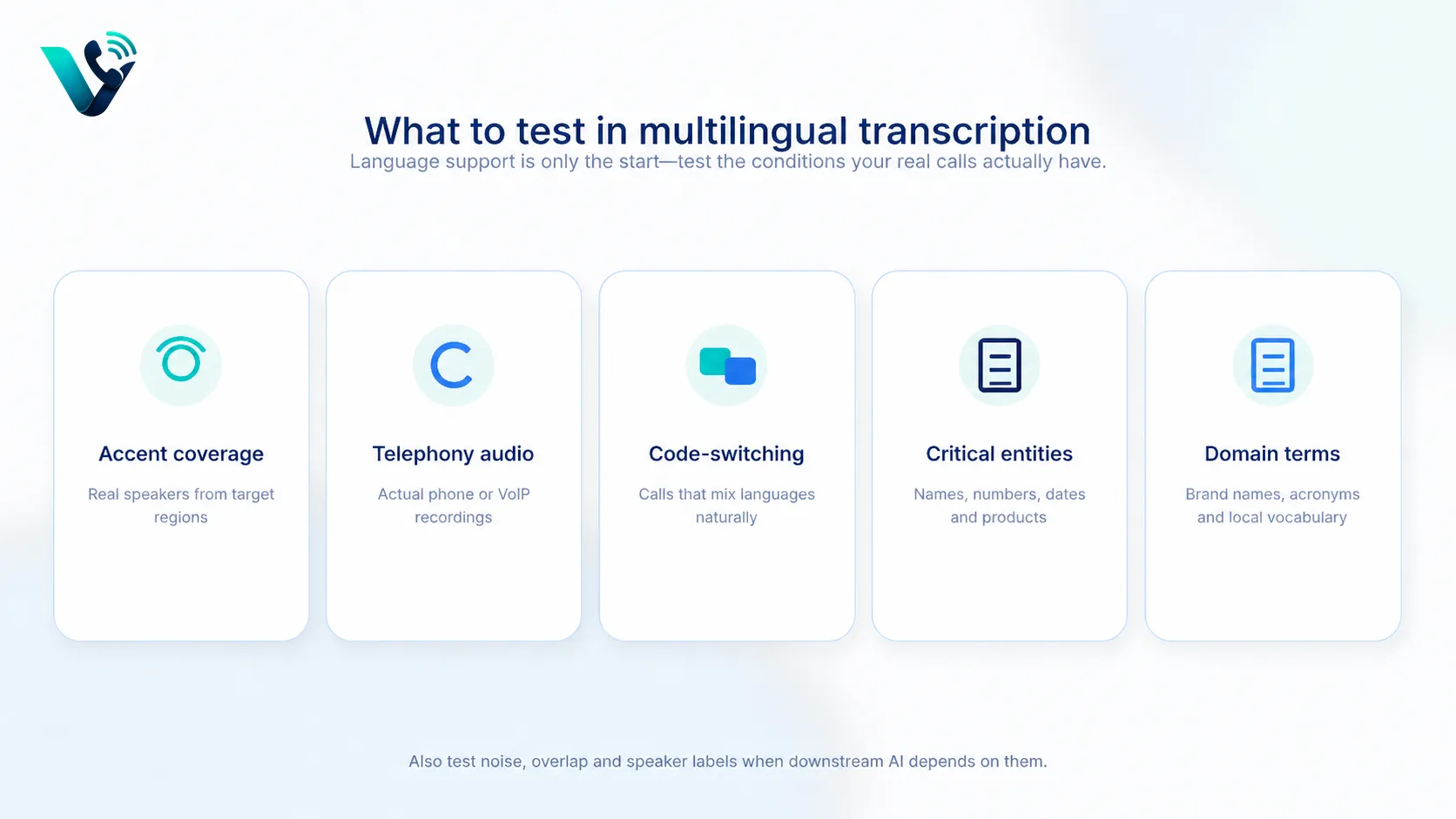
A practical acceptance rule
Define separate thresholds for low-risk and high-risk automation. Search and coaching can tolerate more transcription noise than compliance, billing, identity verification, or medical information. When a critical field falls below the required confidence, route it for confirmation instead of pretending all supported accents have identical reliability.
Frequently asked questions
- Does multilingual transcription work with different accents?
- Yes, modern systems can handle many accents, but accuracy varies by language, region, audio quality and model. Representative testing is still necessary.
- What is multilingual transcription accuracy?
- It is how reliably a system converts speech from multiple languages and speaker varieties into correct text under the conditions your application uses.
- Is word error rate enough to compare transcription tools?
- No. Business teams should also measure critical entities such as names, account numbers, dates, amounts, products, negation and speaker attribution.
- How should I test accent accuracy?
- Use real speakers, real phone audio, relevant regions, code-switching, noise and domain vocabulary, then compare output with human reference transcripts.
- Can language hints improve transcription?
- They can. Some modern APIs support expected-language hints, prompts, keywords or glossaries, but teams should validate that hints improve real accuracy without introducing false terms.
- How does Votelly relate to multilingual transcription?
- Votelly markets live transcription, searchable transcripts, AI summaries and global calling, making transcription quality across international customer calls an important evaluation area.