AI receptionist vs IVR vs a human answering service
By Jamila Parker · · 8 min read

Compare AI receptionists, IVR and human answering services by call type, judgement, coverage, handoff and cost per completed outcome.
Key takeaways
- Choose by the calls you receive, not by which technology sounds newest.
- IVR is excellent for predictable routing and structured self-service.
- AI receptionists fit repeatable conversations and bounded actions when handoff is strong.
- Human answering services remain strongest where empathy and judgement are central.
- Hybrid designs often work best, but callers should explain their need only once.
A receptionist decision usually starts with a missed-call problem, not an AI strategy. The business wants every caller answered, routed correctly, and moved to a useful next step. Three common options solve that problem in very different ways: an AI receptionist holds a natural-language conversation, an IVR follows predefined choices and routing logic, and a human answering service puts a trained person on the line. The best choice depends on the shape of your calls, not on which option sounds most modern.
A simple sales line with four destinations may need nothing more than an IVR. A clinic or service business that receives repetitive appointment questions after hours may benefit from an AI receptionist with strict booking rules. A legal intake line, bereavement service, or complex complaint queue may still need a person because judgement and empathy are the work. Many businesses eventually run a hybrid: Deterministic routing for the obvious path, AI for routine conversation, and people for exceptions.
Start with the job each option is designed to do
Option |
Best at |
Weakest at |
Typical operating model |
|
AI receptionist |
Natural-language FAQs, structured intake, bookings, routine updates, after-hours coverage. |
Unusual situations, ungrounded questions, sensitive judgement, poorly designed handoffs. |
Software follows approved knowledge, tools and escalation rules. |
|
IVR |
Fast routing, keypad input, business-hours logic, predictable self-service steps. |
Open-ended questions and callers who do not fit the menu. |
Deterministic menu or speech choices send calls to a destination or workflow. |
|
Human answering service |
Empathy, discretion, improvisation, ambiguous requests and unusual situations. |
High concurrency, consistency across agents, minute-based cost at scale. |
Trained people answer from scripts and business instructions. |
AI receptionist: Choose it for repeatable conversations
An AI receptionist makes sense when callers tend to ask the same families of questions or complete the same small set of actions. It can ask what the caller needs, answer from approved knowledge, capture contact details, qualify an enquiry, book an allowed appointment, create a message, and transfer when a rule is triggered. Its biggest advantage over IVR is that the caller can speak naturally instead of mapping their problem to a menu option.
The risk is that natural conversation can create false confidence. A fluent answer is not necessarily a correct answer. The system needs scoped knowledge, tool permissions, identity checks where customer data is involved, and an obvious path to a person. If a vendor demo focuses entirely on voice quality but cannot explain what happens when the calendar API fails or the caller asks an unsupported question, the workflow is not ready.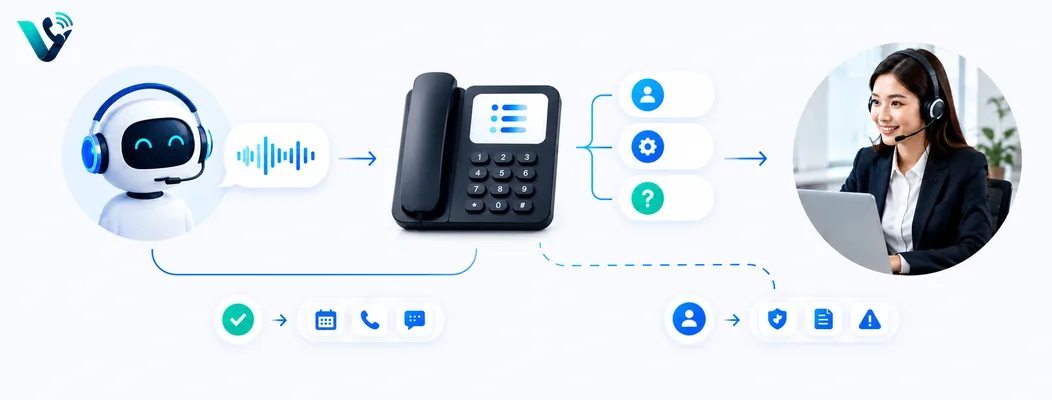
IVR: Boring can be excellent
IVR remains the right answer for many routing jobs because deterministic behaviour is a feature, not a limitation. If callers simply need sales, support, billing, existing reservations, or a directory, a short menu is easy to understand and easy to audit. Keypad collection is also useful for structured inputs that should not be interpreted creatively.
- Keep the first menu short and use plain language rather than internal department names.
- Offer a clear route to a person when the caller cannot find the right choice.
- Use business-hours and overflow logic so a menu option never sends callers to an empty queue.
- Avoid deep trees; a caller should not need to remember six layers of choices.
- Test the IVR from a real external phone after every major routing change.
IVR becomes frustrating when the menu is asked to solve a conversation problem. A customer saying 'I was charged twice but I already cancelled' does not want to choose between billing, cancellations and support. That is where a conversational front door or a human can reduce effort.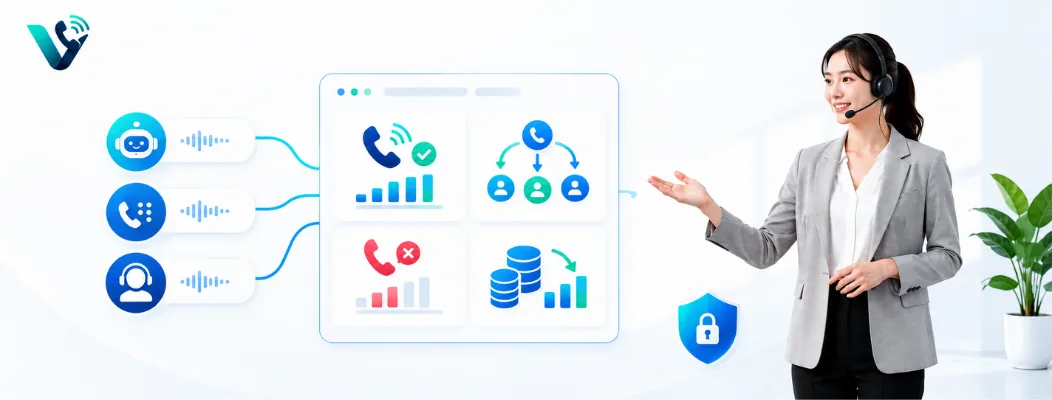
Human answering service: Judgement is the feature
A human answering service is strongest when the caller's situation cannot be reduced to a predictable flow. People can hear hesitation, ask an unplanned clarifying question, decide that a request is urgent even when the caller did not use the expected phrase, and adapt to emotional or sensitive situations. The quality depends on training, staffing, access to the right systems, and how well the external team understands the business.
Human services also have constraints. Availability may depend on contracted coverage, busy periods can create queues, notes can vary by operator, and the cost model often grows with minutes or calls. The evaluation should therefore compare total workflow cost and quality, not assume that human automatically means premium or that AI automatically means cheap.
Decision matrix: Which caller should meet which front door?
Call pattern |
Recommended first choice |
Why |
|
Simple department routing |
IVR |
Predictable, fast and easy to audit. |
|
After-hours FAQs and appointment intake |
AI receptionist |
Can converse, collect details and use approved tools. |
|
Distressed, sensitive or unusual calls |
Human answering service |
Judgement and empathy matter more than automation. |
|
High-volume routine enquiries with exceptions |
Hybrid AI + human |
AI absorbs repeatable work; people handle edge cases. |
|
Secure structured self-service |
IVR or tightly bounded AI |
Deterministic verification and action rules are critical. |
|
Small business with very low call volume |
Human owner/voicemail/short IVR |
The simplest workflow may be more economical than a new layer of automation. |
Compare cost by completed outcome, not monthly price
The wrong comparison is subscription versus subscription. The useful comparison is cost per completed outcome. For an IVR, include the staff time required after the route. For an AI receptionist, include telephony, AI usage, integration work, monitoring, and human exceptions. For an answering service, include the plan, minute or call charges, after-hours premiums, and internal rework when the message lacks context.
Then compare what percentage of calls are actually completed without another step. An inexpensive IVR that sends 40% of callers to voicemail may be more costly than a conversational layer that books the appointment on the first call. An AI receptionist that creates inaccurate bookings can be more expensive than a human service once corrections are counted. The metric should follow the customer to the finished task.
Five tests to run before choosing
- Give each option ten real call scenarios, including awkward and ambiguous ones, not just the happy path.
- Test after-hours, no-answer, failed transfer and unavailable-calendar behaviour.
- Check whether the final record contains the caller's intent, contact details, action taken and next owner.
- Measure time to useful outcome, transfer rate, repeat contact and customer effort.
- Ask who owns updates to scripts, knowledge, routing and escalation rules after launch.
A hybrid architecture is often the mature answer
The three models are not mutually exclusive. A business can use a short IVR to separate urgent from routine calls, let an AI receptionist handle predictable intake, and transfer unusual situations to an internal team or human answering service. The key is to avoid making the customer navigate all three layers. The orchestration should be invisible: The caller explains what they need once, and the system moves the conversation to the right level of judgement.
Practical note: Design the escalation route before the automation route. A reliable escape path makes every automated layer safer.
Where Votelly fits in the decision
Votelly publicly provides the telephony foundation around this decision: Cloud phone system features, IVR, visual call flows, business-hours routing, queues, shared inbox, voicemail, analytics, recordings, AI call summaries, and integrations. Those capabilities let a business build a strong deterministic front door today and connect messages, calls, and CRM context across the team.
When writing about AI receptionist options, avoid implying that a specific autonomous receptionist is included unless the live Votelly product confirms it. Position Votelly accurately as the calling and workflow layer, then explain how an AI or human answering model can sit around the phone system depending on the business's call types and escalation needs.
Try this on your own numbers
Local numbers in 118 countries, AI call notes and one shared inbox. Live the same day, no contract.
Ownership after launch matters as much as the buying decision
Whichever model you choose, assign an operator for the workflow after launch. IVR menus need someone to maintain routing and business-hours changes. AI receptionists need knowledge, tool permissions, escalation rules, and quality review. Human answering services need updated scripts, access instructions, and a process for correcting poor notes or missed escalations. Without ownership, every option decays: Old menus route to former employees, AI answers from outdated policies, and external agents follow scripts that no longer match the business. Put a monthly review on the calendar and sample real calls, failed transfers, abandoned calls, and customer complaints. The best front door is not the one that performed well in a demo; it is the one that stays accurate when products, staffing, opening hours, and customer behaviour change.
Choose by exception rate
A useful final rule is to look at exception rate. If almost every caller fits one of a few routes, IVR may be all you need. If most calls are routine but require conversation and action, AI can add coverage and consistency. If a large share of calls are unique, emotional, high-stakes, or difficult to script, humans should stay near the front. As the exception rate changes, the architecture can change with it. The best receptionist is the one that completes the customer's job with the least friction and the safest fallback.
Frequently asked questions
- What is the difference between an AI receptionist and IVR?
- An IVR follows predefined menus or structured choices. An AI receptionist interprets natural language and can answer questions or invoke approved actions within configured rules.
- When is a human answering service better than AI?
- Human services are better when calls are sensitive, unusual, emotional or require discretion and judgement that is difficult to encode safely.
- Is IVR outdated in 2026?
- No. IVR remains efficient for predictable routing, keypad input and deterministic self-service. The problem is using a menu where the caller really needs a conversation.
- Can a business use AI, IVR and humans together?
- Yes. A hybrid workflow can use deterministic routing, AI for routine intake and people for exceptions, as long as context passes cleanly between layers.
- How should I compare the cost of these options?
- Compare cost per completed customer outcome, including software, minutes, integrations, monitoring, human exceptions and rework not only the advertised monthly fee.
- What Votelly pages are relevant to this decision?
- Votelly publishes cloud phone, IVR/routing, shared inbox, analytics, AI call summaries and integration features. Verify any specific autonomous receptionist capability on the live product before making a claim.