Sales call activity metrics: what to track beyond call volume
By Jamila Parker · · 12 min read

Call volume alone rewards activity, not quality. These sales call activity metrics show whether calls create conversations, meetings and pipeline.
Key takeaways
- Sales call activity metrics should connect effort to outcomes: Dials matter, but connect rate, meaningful conversations, meetings booked and pipeline created show whether the activity is productive.
- Track the full sales call funnel from dial to answer, conversation, positive disposition, meeting, held meeting and opportunity so managers can see exactly where performance drops.
- Use sales call KPIs such as callback speed, follow-up completion and next-step adherence to measure execution quality after the conversation, not only what happens during the call.
- Segment outbound call metrics by list source, campaign, persona, geography, rep and time of day because blended averages can hide weak data or strong-performing segments.
- A useful manager scorecard should stay focused on a small group of sales call activity metrics that can change coaching, targeting or follow-up decisions.
Sales call activity metrics help managers understand whether phone activity is creating real sales momentum or simply producing a large number of dials. Call volume is easy to measure, which is why it often becomes the headline KPI. But a rep can make 100 calls and create no meaningful conversations, while another can make 50 calls and generate several qualified meetings. The raw number does not explain the difference.
A better sales call reporting model follows the entire journey from activity to outcome. That means tracking dials, answer rate, connect rate, meaningful conversations, positive call dispositions, meetings booked, meetings held, opportunities created and follow-up completion. For inbound teams, speed-to-lead and callback time may be equally important. For outbound teams, list quality, conversation rate and meeting conversion often reveal more than total activity.
The goal is not to create a dashboard with dozens of sales call KPIs. It is to choose a small set of sales call activity metrics that help the team answer practical questions: Are we reaching the right people? Are conversations turning into next steps? Are reps following up when they promise to? Which lists and campaigns create pipeline? Where should coaching focus?
This guide explains what to track beyond call volume, how to calculate the most useful sales call metrics, how to segment the data, and how to build a manager scorecard that supports better decisions without turning every call into a spreadsheet exercise.
Why call volume is incomplete
Call volume measures effort, not effectiveness. A high dial count may indicate strong activity, but it may also reflect poor data, repeated attempts to unreachable contacts, short calls, weak targeting or a workflow that rewards quantity over useful conversations. That is why call volume should be treated as the top of the funnel rather than the final measure of sales performance.
The first comparison should be between dials and answers. From there, separate answered calls from meaningful conversations. A person answering the phone and immediately declining is different from a two-minute conversation with a relevant buyer. When sales call activity metrics distinguish those stages, managers can see whether the main problem is list quality, pickup rate, messaging or conversion.
Call volume can still be useful for capacity planning and activity consistency. If one rep makes dramatically fewer attempts than peers with the same role and schedule, that may require investigation. But activity targets should be paired with outcome metrics so reps are not encouraged to chase dials that add no pipeline.
A useful principle is simple: Every volume metric should have a quality or outcome metric beside it. Dials pair with connect rate. Conversations pair with positive disposition rate. Meetings booked pair with meetings held. Follow-ups promised pair with follow-ups completed. This keeps the dashboard focused on what the activity actually produced.
Core funnel metrics
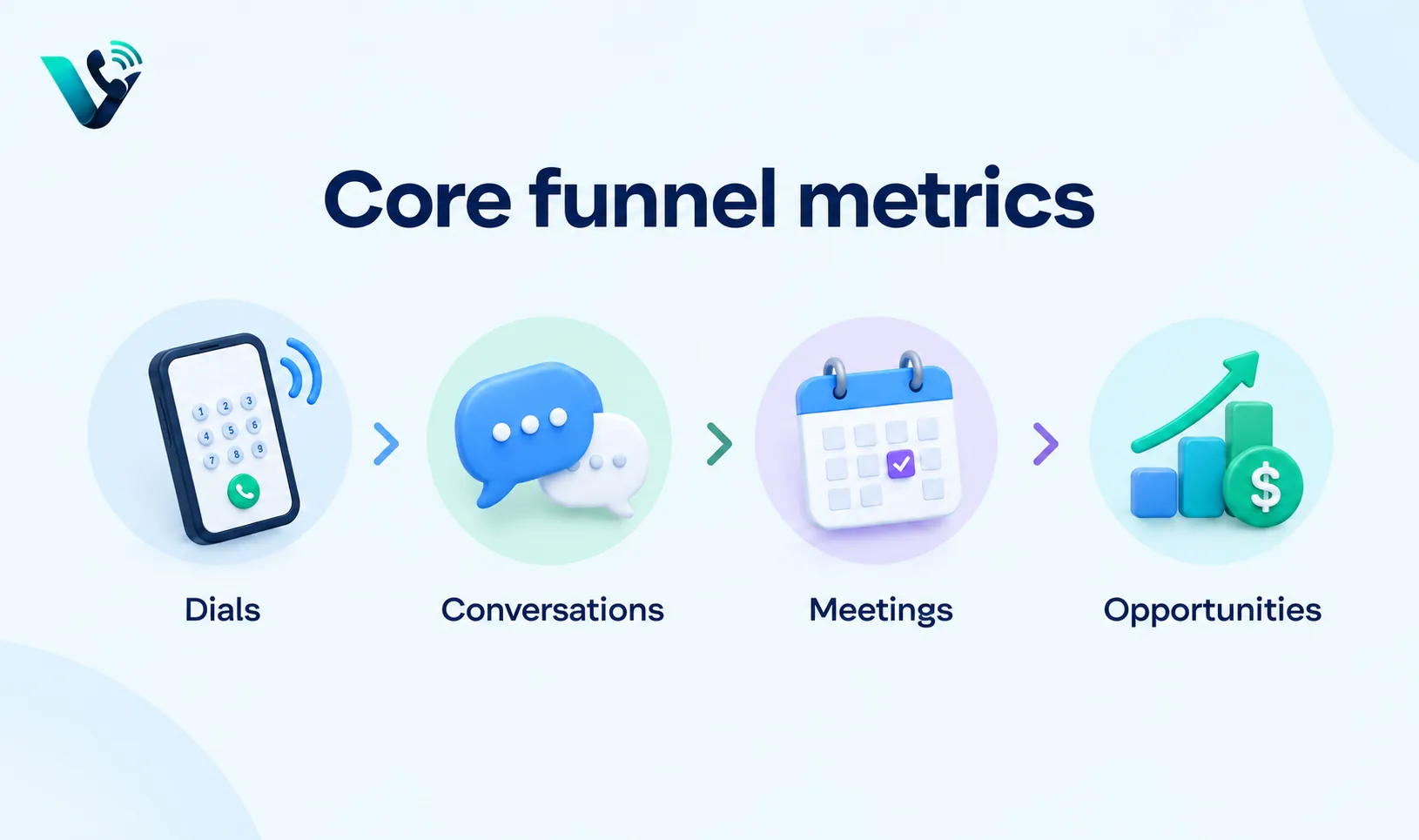
The strongest sales call activity metrics form a funnel. Each stage should show how many interactions moved forward and where the biggest drop-offs occur. A practical funnel for outbound sales can include total dials, answered calls, meaningful conversations, positive dispositions, meetings booked, meetings held and opportunities created.
Start with connect rate: Answered or connected calls divided by total dials. Then measure conversation rate: Meaningful conversations divided by connected calls. From there, track meeting-booking rate, usually meetings booked divided by meaningful conversations, and held-meeting rate, meetings attended divided by meetings booked. Finally, track opportunity creation from held meetings or qualified conversations.
These sales call conversion metrics make diagnosis easier. A low connect rate may point to bad phone data, poor calling times or number reputation. A healthy connect rate but weak conversation rate may indicate targeting or opening-message problems. Strong conversations with few meetings suggest a discovery or value-proposition issue. High meeting bookings with low attendance may point to confirmation and follow-up problems.
For teams that sell through longer cycles, add pipeline value created from calls rather than judging success only by meetings. Two campaigns may book the same number of meetings while one produces much larger or better-qualified opportunities. Tracking pipeline created per 100 calls or per rep-hour can make this visible.
Do not force every team into the same funnel. An account-management team may care more about customer conversations, renewal actions and expansion opportunities, while a prospecting team focuses on connects, meetings and qualified pipeline. The structure should follow the job the calls are supposed to do.
How to calculate useful sales call metrics
A metric becomes more useful when everyone calculates it the same way. Define each sales call KPI in plain language and keep the formula visible in the reporting documentation. For example: Connect rate = connected calls / total dials; conversation rate = meaningful conversations / connected calls; meeting-booking rate = meetings booked / meaningful conversations; and opportunity rate = opportunities created / meetings held or qualified conversations, depending on your process.
The definition of a “meaningful conversation” matters. A ten-second wrong-number call should not count the same as speaking with a relevant contact. Agree on a minimum standard, such as reaching the intended persona and exchanging enough information to classify the outcome. That keeps conversation metrics comparable between reps.
Use percentages alongside absolute numbers. A rep who books six meetings from 30 conversations has a 20% meeting rate; another who books eight from 80 conversations has 10%. Both pieces of information matter. The first may be more efficient, while the second may still create more total pipeline because of higher volume.
Where possible, also track metrics per rep-hour. Calls, conversations, meetings and opportunities per hour help separate productivity from simple time spent online. This is particularly useful when comparing manual dialing with a sales dialer or when different reps work different schedules.
Quality metrics
Not every important sales call metric is a conversion percentage. Quality indicators explain how the conversation was handled and are especially useful for coaching. Examples include next-step clarity, question quality, talk-to-listen balance, objection handling, call disposition accuracy and whether the rep captured useful notes in the CRM.
Quality metrics should not become a rigid script score. Use them to spot patterns across several calls. If a rep regularly talks for most of the conversation, skips discovery questions or ends calls without a specific next step, the coaching opportunity is clearer than a generic instruction to “make better calls.”
Call dispositions are another valuable quality signal. Codes such as callback requested, meeting booked, no fit, nurture, wrong number and do not contact show what happened after the connection. When those codes are applied consistently, managers can compare outcome patterns by rep, campaign and list source.
If call recordings or transcripts are available and lawful to use, sample them rather than reviewing every call. A small weekly sample linked to the sales call activity metrics can explain why the numbers moved and make coaching more specific.
Speed and follow-up
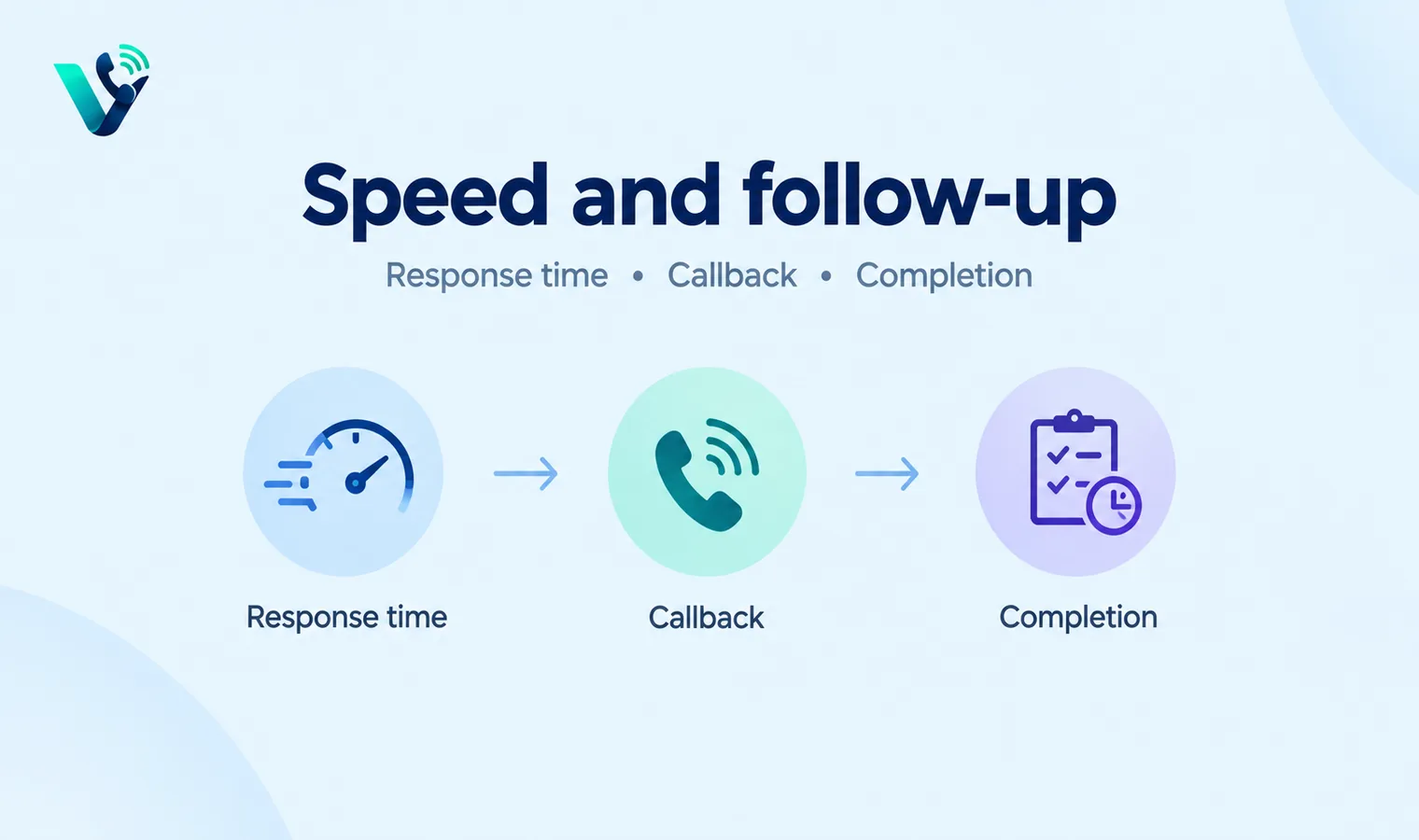
Speed matters most when buyer intent is already high. For inbound sales leads, measure the time from enquiry to first call attempt. For missed calls, track callback time. For scheduled follow-ups, compare the promised time with the actual contact attempt. These sales call activity metrics show whether the team executes reliably after interest appears.
Follow-up completion is often more valuable than another block of low-quality dials. A rep who creates ten strong next steps but completes only half of them is leaking more pipeline than a rep who makes fewer calls but follows through consistently. Track tasks completed on time, callbacks completed, post-call emails sent and meetings confirmed where those actions are part of the process.
For inbound teams, look at median speed-to-lead rather than only the average. A few extremely slow responses can distort the mean, while the median shows what a typical buyer experiences. Also review the percentage of leads contacted within your target window.
For outbound teams, speed is less about calling immediately and more about maintaining cadence discipline. Measure whether follow-up attempts happen on the intended day, whether promised callbacks are honoured and whether high-intent replies move quickly into a live conversation.
Segment the data
Blended sales call activity metrics can hide the real story. Break the data down by list source, persona, geography, rep, campaign, product, time of day and, where useful, company size or industry. The purpose is not to create endless reports; it is to identify which segments behave differently enough to change a decision.
For example, a team may have a 12% connect rate overall, but one data source connects at 20% while another connects at 5%. The problem is no longer “reps need to dial more.” It is that one list is weak. Likewise, one persona may answer less often but convert to meetings at twice the rate once reached.
Time-of-day analysis can be useful when the team calls across regions. Compare connect rate and conversation rate by local customer time rather than only the rep’s time zone. This can reveal better calling windows without increasing daily call volume.
Segmenting also protects reps from unfair comparisons. A salesperson working a mature inbound list should not automatically be compared with someone prospecting cold accounts in a new market. Evaluate performance within similar conditions before drawing conclusions about individual skill.
Sales call metrics that can mislead
Some sales call KPIs look useful but can create the wrong behaviour when viewed alone. Average call duration is a good example. Longer calls are not automatically better, and shorter calls are not automatically more efficient. The right duration depends on the purpose of the conversation.
Talk time can also be misleading without outcomes. A rep may have high talk time because they reach more buyers, or because conversations lack structure. Likewise, a high number of follow-up tasks can signal strong engagement or poor qualification that keeps weak opportunities alive.
Avoid ranking reps only by dials, total talk time or meetings booked. Use a balanced view that combines activity, conversion, follow-up and pipeline quality. Leaderboards built on one metric often encourage people to optimise the metric rather than the sales result.
Whenever a metric becomes a target, ask how someone could “win” the metric without improving revenue or customer experience. If the answer is easy, pair it with another measure or change the target.
Manager scorecard
A manager scorecard should be small enough to review every week. A practical version can include connect rate, meaningful conversation rate, positive-disposition rate, meetings booked per conversation, held-meeting rate, opportunities created and follow-up completion. Add speed-to-lead or callback time if inbound activity is important.
Review trends rather than reacting to one day. Weekly data is usually more useful than minute-by-minute comparisons for sales coaching because call outcomes can be noisy. Look for movement across several weeks and then open the underlying calls, dispositions or CRM notes to understand why the metric changed.
A good scorecard should lead to a decision. If connect rate falls, investigate data source, number quality and calling windows. If conversations are strong but meetings are weak, review discovery and value messaging. If meetings are booked but not held, improve confirmation and reminder workflows. If opportunities are created but pipeline quality is low, revisit qualification.
For individual coaching, choose one or two metrics that match the rep’s current bottleneck rather than asking everyone to improve everything at once. A new rep may need conversation quality and next-step coaching, while an experienced rep may benefit more from list segmentation or opportunity conversion analysis.
At team level, combine the scorecard with business outcomes such as pipeline created, revenue influenced or opportunities won. Sales call activity metrics are leading indicators; they matter because they help explain and improve the results that follow.
Try this on your own numbers
Local numbers in 118 countries, AI call notes and one shared inbox. Live the same day, no contract.
A 30-day sales call metrics rollout
During the first week, define the funnel and metric formulas. Decide exactly what counts as a dial, connection, meaningful conversation, positive disposition, meeting and opportunity. Clean up call disposition codes so the same outcome is not recorded under several labels.
In week two, build the baseline. Measure the current connect rate, conversation rate, meeting conversion, held-meeting rate and follow-up completion without changing rep behaviour. Segment the results by at least campaign, list source and rep.
In week three, choose one bottleneck to improve. If connect rate is weak, test calling windows or list quality. If meeting conversion is weak, focus on discovery and messaging. If follow-up is inconsistent, tighten task ownership and callback rules. Change one major variable at a time so the result can be interpreted.
In week four, compare the new results with the baseline and review a small sample of calls or notes. Keep the metrics that actually helped the team diagnose and improve performance. Remove dashboard fields that nobody used. A smaller scorecard that changes decisions is more valuable than a large report that everyone ignores.
How to connect this topic to Votelly
For Votelly, this topic connects naturally to the business-calling layer of the sales workflow. A cloud calling platform can provide reliable call activity around business numbers, while the CRM and sales process add dispositions, follow-up tasks, meetings and opportunity outcomes. The primary website destination is www.votelly.com.
Keep detailed product claims tied to confirmed live Votelly capabilities. The educational value of the article is the measurement framework itself: Capture sales calling activity consistently, connect it to customer and CRM outcomes, then use the data to improve targeting, coaching and follow-up rather than simply rewarding more dials.
This article can also link naturally to Votelly guides on call disposition codes, power dialers, missed call recovery, call recording for coaching and call queue best practices. Those topics provide the operational detail behind many of the sales call activity metrics described here.
Frequently asked questions
- What is sales call activity metrics?
- Sales call activity metrics are measurements used to evaluate what happens before, during and after sales calls. Common examples include dials, connect rate, meaningful conversations, meetings booked, held-meeting rate, opportunities created, callback speed and follow-up completion.
- How should a small team start with sales call activity metrics?
- Start with a simple funnel: dials, connections, meaningful conversations, meetings booked, meetings held and opportunities created. Add follow-up completion and speed-to-lead only when they are relevant to the team. Keep the scorecard small enough to review weekly.
- What should be measured?
- Measure activity, conversion and execution together. Useful sales call KPIs include connect rate, conversation rate, positive dispositions, meetings per conversation, held-meeting rate, opportunities created, callback time and follow-up completion.
- How often should the setup be reviewed?
- Review the main sales call activity metrics weekly for coaching and monthly for broader trends. Revisit definitions and dashboard fields whenever the sales process, lead sources, campaigns or team structure changes.
- Can automation replace human ownership?
- No. Automation can capture call activity, create tasks, trigger follow-up and update records, but managers still need to interpret the sales call metrics and reps still need to own the quality of the conversation and the next step.
- How can Votelly fit into the workflow?
- Votelly can be positioned as part of the cloud business-calling layer where live product capabilities support the required calling workflow. Use www.votelly.com as the primary brand destination and connect call activity with CRM outcomes for more useful sales reporting.