Timezone Routing: Covering 118 Countries With 12 People
By Jamila Parker · · 8 min read

Learn how timezone routing helps a 12-person team cover global enquiries, reduce missed calls and route customers to the right team at the right time.
Key takeaways
- Choose the number type and routing model around the customer journey, not just the country name.
- Capture source, ownership and next action as soon as a lead arrives.
- Check current numbering and compliance requirements before publishing a local or geographic number.
- Use reporting to compare qualified outcomes, not only call volume.
- Test voice, routing, fallback and CRM behaviour before launch.
Timezone Routing: Covering 118 Countries With 12 People is primarily a question of matching phone infrastructure to a real customer and sales workflow. For businesses using timezone routing, the practical priorities are eligibility, clear routing, accurate customer-facing information, fast follow-up and measurable attribution. The sections below explain the implementation in a way that can be used as a publishing and operations checklist.
Why global coverage is a routing problem
A company can advertise in dozens of countries without having dozens of offices. The harder problem is making sure a customer enquiry reaches a person when that customer expects an answer. A team of 12 can cover a wide footprint if calls are routed by business hours, region, language, skill and availability. The objective is not to keep every employee online around the clock; it is to make the path from customer to available owner predictable.
A useful implementation principle is to keep the customer-facing experience simple while making the internal workflow measurable. The phone number, routing rule and CRM record should describe the same journey. If one part changes, test the full path again: from the first impression and incoming call through ownership, follow-up and reporting. This avoids a common failure mode in which the telephony system works technically but the sales process still loses enquiries between systems.
Map the 118-country footprint first
Country count alone does not tell you how the team should be organised. Group countries into practical time-zone and language clusters. Note the preferred working hours of each market, public holiday differences and any service-level commitments. Some countries may share a time zone but require different languages or regulatory handling. The routing map should therefore contain at least country, time zone, language, working window and responsible queue.
A useful implementation principle is to keep the customer-facing experience simple while making the internal workflow measurable. The phone number, routing rule and CRM record should describe the same journey. If one part changes, test the full path again: from the first impression and incoming call through ownership, follow-up and reporting. This avoids a common failure mode in which the telephony system works technically but the sales process still loses enquiries between systems.
Use business hours as the first routing layer
Business-hours routing is the simplest layer. During the team's local coverage window, calls go to the assigned group. Outside that window, they can move to an on-call queue, voicemail, callback request or self-service booking option. This prevents calls from being sent repeatedly to unavailable employees. A customer should receive a clear next step rather than silence.
A useful implementation principle is to keep the customer-facing experience simple while making the internal workflow measurable. The phone number, routing rule and CRM record should describe the same journey. If one part changes, test the full path again: from the first impression and incoming call through ownership, follow-up and reporting. This avoids a common failure mode in which the telephony system works technically but the sales process still loses enquiries between systems.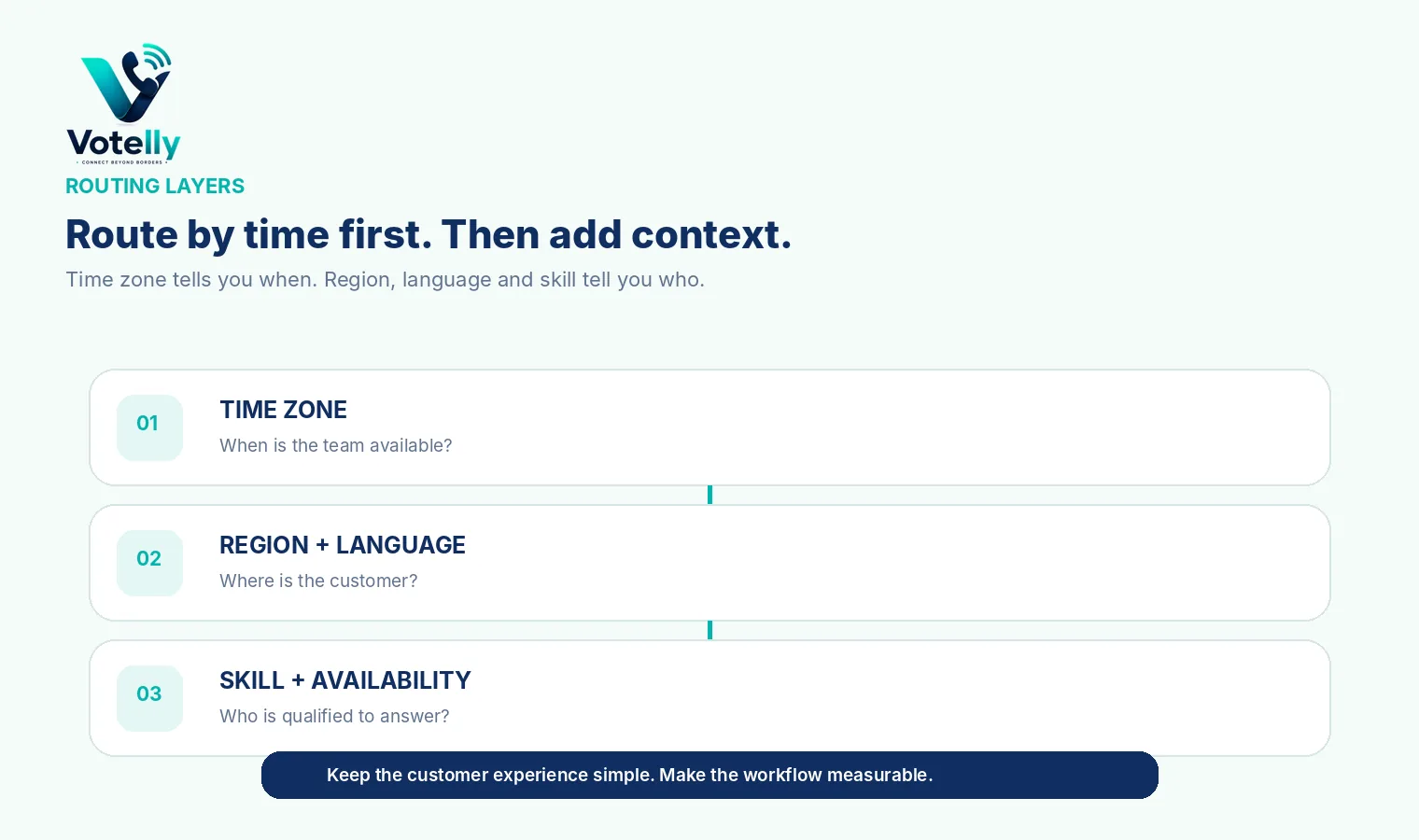
Add region and skill after time zone
Time zone tells you when someone is available; it does not tell you who is qualified to answer. After the time filter, add region, language and product skill. A French-speaking customer in Canada may need a different queue from an English-speaking customer in the same time zone. Similarly, an enterprise sales enquiry may require a specialist even if another representative is available.
A useful implementation principle is to keep the customer-facing experience simple while making the internal workflow measurable. The phone number, routing rule and CRM record should describe the same journey. If one part changes, test the full path again: from the first impression and incoming call through ownership, follow-up and reporting. This avoids a common failure mode in which the telephony system works technically but the sales process still loses enquiries between systems.
Design a 12-person coverage model
A practical model can divide the 12 people into overlapping regional coverage rather than rigid country ownership. For example, a morning-oriented group can cover Asia-Pacific, a middle group can cover Europe and adjacent markets, and a later group can cover North America. The exact allocation should follow actual enquiry volume. Overlap is valuable because it provides handoff capacity and reduces the risk of a single employee becoming a bottleneck.
A useful implementation principle is to keep the customer-facing experience simple while making the internal workflow measurable. The phone number, routing rule and CRM record should describe the same journey. If one part changes, test the full path again: from the first impression and incoming call through ownership, follow-up and reporting. This avoids a common failure mode in which the telephony system works technically but the sales process still loses enquiries between systems.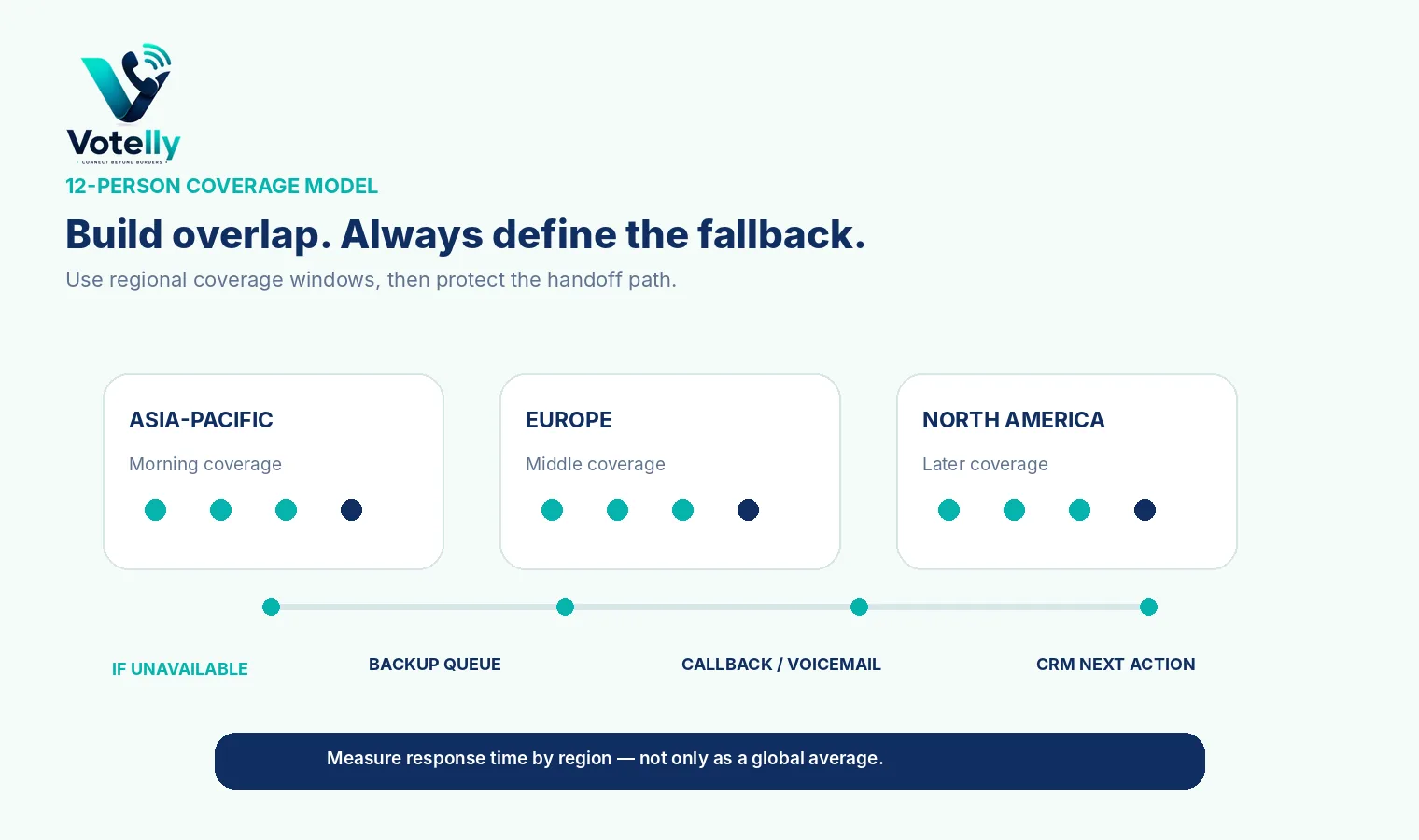
Create overflow and escalation rules
Every route needs a failure path. If nobody answers after a defined number of rings, send the call to a backup group. If the backup is unavailable, create a callback task or voicemail record. Escalate high-value enquiries differently from low-priority calls. A routing tree that assumes everyone is always available will fail precisely when demand spikes, which is when the business needs it most.
A useful implementation principle is to keep the customer-facing experience simple while making the internal workflow measurable. The phone number, routing rule and CRM record should describe the same journey. If one part changes, test the full path again: from the first impression and incoming call through ownership, follow-up and reporting. This avoids a common failure mode in which the telephony system works technically but the sales process still loses enquiries between systems.
Connect routing to the CRM
The call should not end the workflow. Once the enquiry becomes a lead, store the source, country, owner, status and next action. LeadMino's published workflow guidance emphasises fast ownership and source capture for inbound leads. For global teams, those fields can be extended with region and local business hours so that follow-up remains visible after the original call ends.
A useful implementation principle is to keep the customer-facing experience simple while making the internal workflow measurable. The phone number, routing rule and CRM record should describe the same journey. If one part changes, test the full path again: from the first impression and incoming call through ownership, follow-up and reporting. This avoids a common failure mode in which the telephony system works technically but the sales process still loses enquiries between systems.
Measure response time by region
Global averages can hide regional failures. Measure median response time by country or cluster, missed-call rate, after-hours enquiries and lead-to-conversation rate. A 10-minute global average can still conceal a two-hour delay in one market. The data should show where the routing design works and where additional overlap or automation is needed.
A useful implementation principle is to keep the customer-facing experience simple while making the internal workflow measurable. The phone number, routing rule and CRM record should describe the same journey. If one part changes, test the full path again: from the first impression and incoming call through ownership, follow-up and reporting. This avoids a common failure mode in which the telephony system works technically but the sales process still loses enquiries between systems.
Avoid the always-on trap
A team covering 118 countries can easily become a team that feels permanently on call. The solution is not simply to add more notifications. Define service windows, escalation policies and customer expectations. Use voicemail, callback scheduling and automated acknowledgements when a human is unavailable. A sustainable system is one where customers know when they will receive a response and employees know when they are expected to respond.
A useful implementation principle is to keep the customer-facing experience simple while making the internal workflow measurable. The phone number, routing rule and CRM record should describe the same journey. If one part changes, test the full path again: from the first impression and incoming call through ownership, follow-up and reporting. This avoids a common failure mode in which the telephony system works technically but the sales process still loses enquiries between systems.
Try this on your own numbers
Local numbers in 118 countries, AI call notes and one shared inbox. Live the same day, no contract.
A global routing checklist
Before launch, confirm the number format, country mapping, time zone database, holiday rules, language queues, business hours, overflow destinations, CRM ownership and reporting. Test calls from representative countries at different local times. Test weekends, holidays, simultaneous calls and an unavailable agent. Routing is infrastructure: it should be tested like infrastructure, not assumed to work because a single call reached a person.
A useful implementation principle is to keep the customer-facing experience simple while making the internal workflow measurable. The phone number, routing rule and CRM record should describe the same journey. If one part changes, test the full path again: from the first impression and incoming call through ownership, follow-up and reporting. This avoids a common failure mode in which the telephony system works technically but the sales process still loses enquiries between systems.
Practical implementation checklist
Element |
Purpose |
What to check |
Time zone |
When to route |
Use customer-market local time |
Language |
Who to route |
Add language after time-zone filtering |
Skill |
What can be handled |
Route specialist enquiries to qualified teams |
Overflow |
What happens if unavailable |
Create backup and callback paths |
Frequently asked questions
- What is timezone routing?
- It is routing calls according to the caller's or market's local time so the appropriate team is available.
- Can 12 people really cover many countries?
- Yes, with overlapping shifts, queues, clear escalation rules and realistic service windows.
- Should routing use only time zones?
- No. Add language, region, skill and availability after the time filter.
- What happens after hours?
- Use voicemail, callback requests, booking links or an on-call queue depending on service requirements.
- How should global response time be measured?
- Measure it by region or country as well as globally so local delays are not hidden by averages.
- How does a CRM help?
- It keeps ownership and next actions visible after the call and supports reporting across regions.