Toll-Free Numbers for Global Support Teams: When They Are Worth It
By Jamila Parker · · 8 min read

Learn when toll-free numbers make sense for global customer support, how country-specific freephone services differ, and when local or national numbers may be better.
Key takeaways
- Toll-free is a caller-pricing model, not one universal global number. Most businesses need country-specific freephone numbers for the markets they serve.
- Toll-free is most valuable when support calls are frequent, urgent, long, or high value and the business wants to remove caller cost as a barrier.
- Local or national numbers can be better for low-volume markets, outbound sales, SMS-heavy workflows or situations where toll-free access is inconsistent.
- Model the full cost: number rental, inbound usage, international routing, contact-centre seats and peak concurrency.
Quick answer: When are toll-free numbers worth it?
Toll-free numbers are worth considering when customer support is important enough that the business wants to remove calling cost as a reason not to contact it. They are especially useful for technical support, travel, financial services, healthcare administration, logistics and other situations where calls can be urgent or lengthy.
They are not automatically the best number type in every country. A global support operation usually needs separate country-specific toll-free numbers, each governed by local numbering rules and accessibility conditions. The decision should be based on caller behaviour, support volume, channel mix and total cost rather than on the assumption that “freephone” always looks more professional.
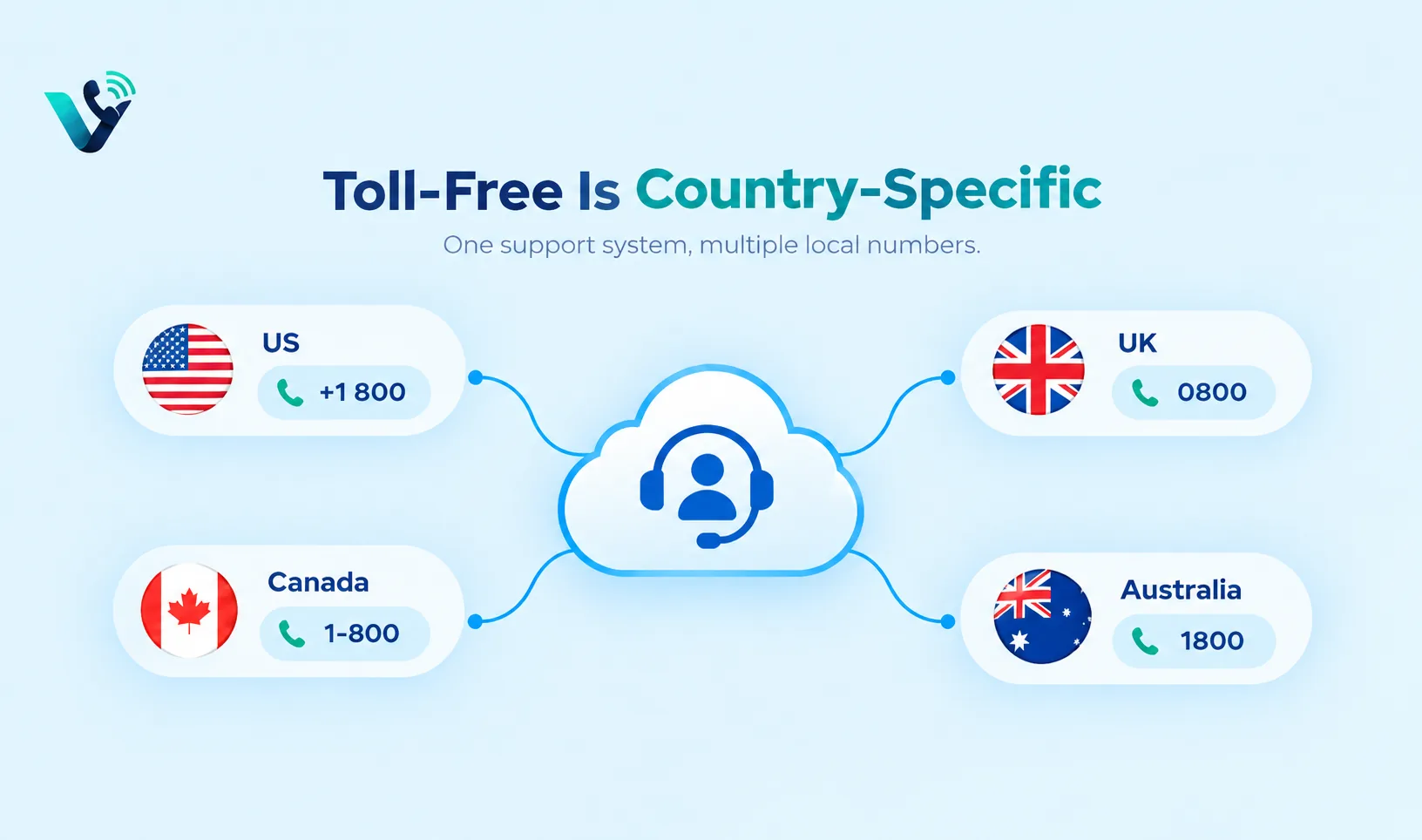
Toll-free is local to a country, not truly global
There is no single ordinary toll-free number that every customer worldwide can dial for free. Countries use their own service codes and rules: Examples include 800-style, 0800-style, 1800-style and other ranges. A number that is free from a domestic fixed or mobile network may not be reachable from abroad, roaming phones or every carrier.
That means a global company often publishes one toll-free number per priority market and routes all of them into the same cloud contact centre. The customer sees a familiar national support channel while the company keeps one operational queue behind the scenes.
The business case for toll-free support
The benefit is strongest when the expected value of a resolved call is high. If a customer is trying to recover an account, report a service failure or change an expensive order, removing call cost can reduce hesitation. Toll-free can also work well for older customer segments or markets where voice support remains an important trust signal.
However, the business should measure whether customers actually call. If most support is handled through chat, in-app messaging or email, paying for freephone coverage in ten countries may not improve service. Start with the markets where voice demand already exists.
When local or national numbers may be better
A local number can be more suitable for a sales team that wants a city or regional identity. A national number can provide one consistent business contact without implying a specific city. Mobile-capable numbers can be useful when two-way SMS or messaging is a core requirement. Toll-free works best when inbound voice accessibility is the priority.
For small markets with only a handful of calls each month, a local number may be cheaper and operationally simpler. The key is to match the number type to customer behaviour, not to buy every available range because the platform supports it.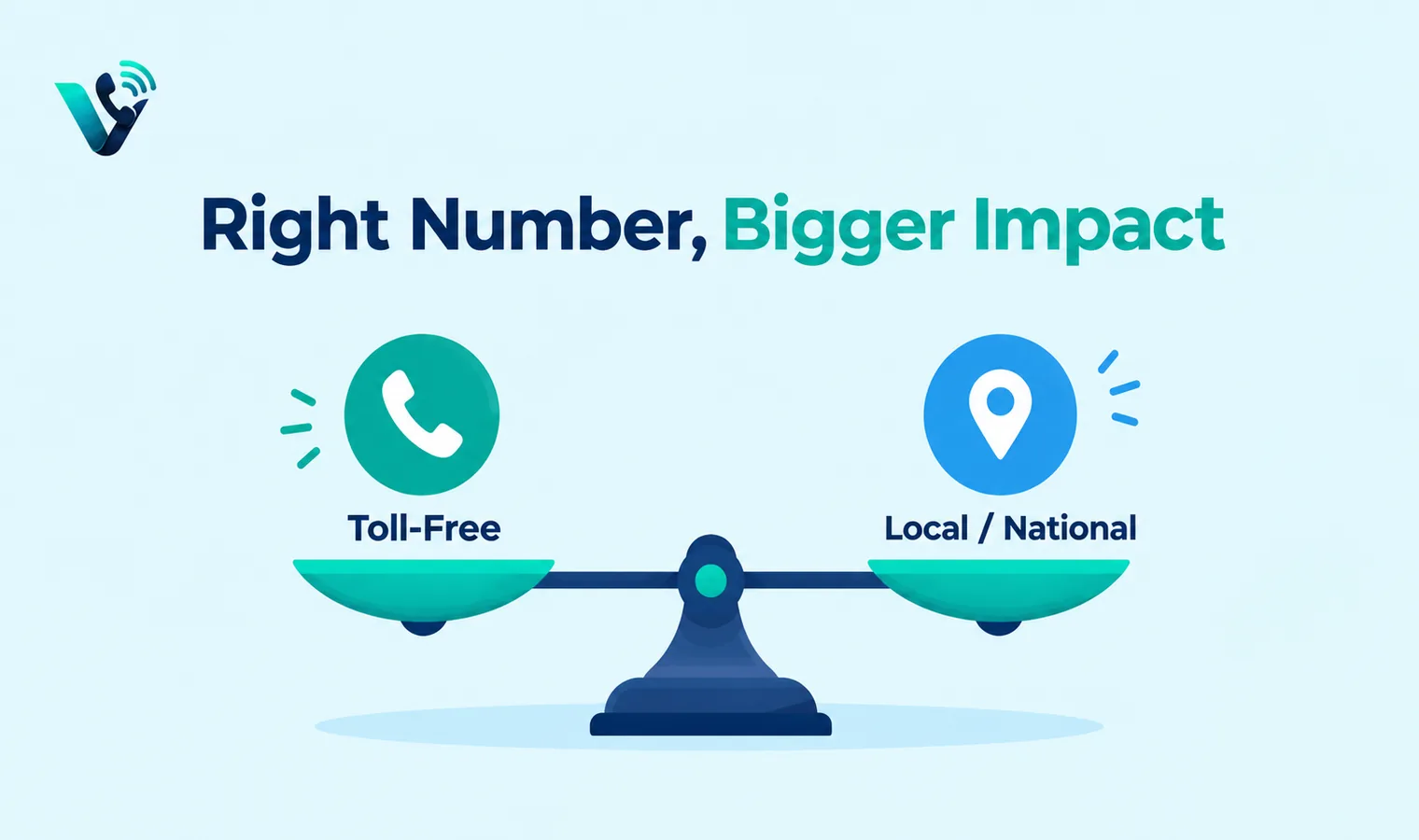
Architecture for a multi-country toll-free setup
A scalable design maps multiple country numbers into common queues. Each number can carry market context into the contact centre so the agent sees the caller’s country and preferred language before answering. Routing can then use business hours, language skills, customer tier and product line.
Add failover at two levels: Carrier or number-level failover if one route has a problem, and queue-level overflow if agents are unavailable. Avoid forwarding all toll-free calls to a single ordinary international mobile, because that can create unpredictable cost, poor quality and a single point of failure.
Costs that teams often underestimate
Toll-free service shifts some or all of the calling cost away from the caller, so inbound usage can be more expensive than a normal local number. International or mobile-originated calls may have different rates. Providers may also charge for number rental, channels, forwarding, IVR, recording and contact-centre seats.
Use a traffic model. Estimate monthly calls, average duration, peak simultaneous calls and origin mix. Then calculate cost per resolved case rather than cost per number. A more expensive toll-free setup can still be efficient if it reduces abandoned support or protects high-value customer relationships.
Availability and compliance differ by market
Each country controls its own numbering resources. Some toll-free ranges can be ordered quickly; others require business documentation, a local address, registration or carrier review. Some are reachable from both mobile and fixed networks, while others have limitations. Confirm these details before publishing a “global support” directory.
Also remember that toll-free status does not remove marketing or privacy obligations. If the same platform is used for outbound campaigns, consent and caller-identification requirements still apply.
A decision framework for support leaders
Prioritise countries using four signals: Voice-support volume, Customer value, Average call length and Customer friction. Add toll-free where these signals are high. Use local or national numbers where voice is useful but call cost is not a major barrier. Keep digital channels primary where customers already prefer them.
Review the portfolio quarterly. A market that had ten calls a month at launch may have a thousand after expansion, while another may move almost entirely to chat. Number strategy should change with customer behaviour.
Toll-free and digital support should complement each other
Freephone is most powerful when customers can choose the channel that matches the problem. A simple billing question may be faster in chat, while a complex service outage may justify a voice call. Publish consistent case numbers across channels so customers do not have to repeat the entire story after switching from chat to phone.
Use IVR to reduce effort, not to deflect callers. Short self-service options can help with common tasks, but forcing a customer through too many menu layers undermines the purpose of offering a convenient toll-free channel.
Procurement questions to ask before committing
When evaluating toll-free numbers for global support teams, ask the provider to answer the commercial and technical questions in writing. Confirm the exact number type, current inventory, monthly rental, inbound and outbound call rates, included channels, overage pricing, minimum term, cancellation process and whether the number can be ported later. Then ask which capabilities are tied to the exact number rather than to the platform in general. This distinction matters because a dashboard may support SMS, recording or outbound caller ID even when a particular country range does not.
Compliance questions deserve the same treatment. Ask which carrier or licensed operator supplies the number, what KYC or business documents are required, whether a local address or entity is needed, and whether any intended-use restriction applies. Toll-free is a caller-pricing model, not one universal global number. Most businesses need country-specific freephone numbers for the markets they serve. A provider that can explain these dependencies clearly is usually easier to work with than one that promises universal instant activation without qualifying the number type or market.
Test the complete customer journey before launch
A successful toll-free numbers for global support teams deployment should be tested from the customer side, not only from the admin portal. Place calls from the networks your customers are likely to use, listen for post-dial delay, confirm two-way audio, press IVR keys, transfer between agents, leave voicemail and trigger after-hours routing. If the workflow includes outbound calling, verify that the intended caller ID is presented correctly and that callbacks return to a monitored destination. If SMS is important, test sending and receiving with the real number instead of assuming support from a feature list.
Also test failure conditions. Temporarily make the primary queue unavailable and confirm that overflow or failover works. Check what happens when all agents are busy, when a call arrives outside business hours and when the destination system is offline. Toll-free is most valuable when support calls are frequent, urgent, long, or high value and the business wants to remove caller cost as a barrier. These tests are inexpensive compared with discovering a broken route after the number has been printed on a campaign, customer portal or product packaging.
Try this on your own numbers
Local numbers in 118 countries, AI call notes and one shared inbox. Live the same day, no contract.
Measure the first 30 days and adjust
After launch, treat toll-free numbers for global support teams as an operating channel with measurable outcomes. Track total calls, unique callers, answer rate, missed calls, average speed to answer, abandoned calls, call duration, transfer rate and the business result that matters for the use case. For sales that might be qualified meetings or revenue; for support it may be first-contact resolution, reopen rate or customer satisfaction. Segment performance by number so the team can see whether the chosen market or number type is actually useful.
Review cost at the same time. Include rental, usage, forwarding, recording, contact-centre licences and any carrier surcharges, then compare that total with the value created. If the number receives little traffic, consider whether it still serves a brand or compliance purpose. If demand is high, add channels or more specialised routing before adding more public numbers. Good business phone strategy / toll-free strategy usually comes from improving a small number of well-managed customer entry points rather than accumulating numbers with no clear owner.
Bottom line
Toll-free numbers for global support teams are valuable when they remove meaningful customer friction and feed into a well-designed contact-centre operation. They are not a badge to collect in every country. Start with high-value markets, confirm local reachability and regulations, model the true inbound cost, and route the numbers into one measurable support system.
Frequently asked questions
- Is one toll-free number free to call from every country?
- Usually no. Toll-free services are generally country-specific, and reachability from overseas or roaming networks can be limited.
- Are toll-free numbers good for customer support?
- They can be excellent when voice support is frequent, important or lengthy and the business wants to reduce caller cost.
- Are toll-free numbers more expensive for the business?
- Often they have higher inbound usage costs than ordinary local numbers because the called business absorbs the calling charge.
- Can multiple toll-free numbers route to one support team?
- Yes. Cloud contact centres can map country-specific numbers into shared queues while preserving market context.
- Should a startup buy toll-free numbers in every market?
- Usually not. Start where voice demand and customer value justify the cost, then expand based on usage.
- What should I check before buying an international toll-free number?
- Check domestic reachability, mobile access, documentation, activation time, inbound rates, concurrent calls, routing options, portability and emergency limitations.