International Virtual Numbers: The Complete Buyer Guide
By Jamila Parker · · 7 min read

A complete buyer guide to international virtual numbers covering number types, country availability, compliance, voice, SMS, portability, routing and CRM integration.
Key takeaways
- Start with countries and customer use cases, then evaluate providers.
- Check exact number type, eligibility and documentation for each country.
- Voice and SMS are separate capabilities and may have different compliance rules.
- Portability and caller ID should be checked before migration.
- Use a CRM to make international calls measurable and actionable.
International virtual numbers are best purchased as part of a communications architecture, not as a list of country codes. A serious buyer needs to compare the exact number type available in each market, the documentation required, voice and SMS capability, portability, caller ID, routing and how phone activity enters the CRM. Country coverage alone is not enough.
What to buy: A number or a communication system?
International virtual numbers are often sold as individual phone numbers, but the real purchase is a communication layer. The business needs to know where calls originate, where they terminate, how customers see caller ID, how messages are handled and how leads enter the CRM. A number without routing and ownership is just an endpoint. A useful international setup combines the number, call flow, compliance process and reporting workflow.
The number is only the customer-facing endpoint. Behind it, the business needs users, queues, schedules, fallback paths, caller identity, message handling and reporting. When comparing international virtual numbers, map the complete customer journey from dialled number to final owner. This exposes hidden differences between providers that are not visible in a simple country-coverage table.
Number types to compare
Common categories include geographic local numbers, national numbers, toll-free services, mobile numbers and IP or nomadic ranges. The names and rules differ by country. A geographic number can support regional positioning, while a national or toll-free number can support broader coverage. Mobile numbers may be useful for messaging but can have different verification rules. Always identify the local category before comparing providers internationally.
Create a common vocabulary for geographic, national, toll-free, mobile and IP or nomadic ranges, then map the local category in each country to that framework. A local virtual number may help regional positioning, while an international toll-free number may support broader access. Compare the customer purpose first, because similar-sounding number types can carry different rules across markets.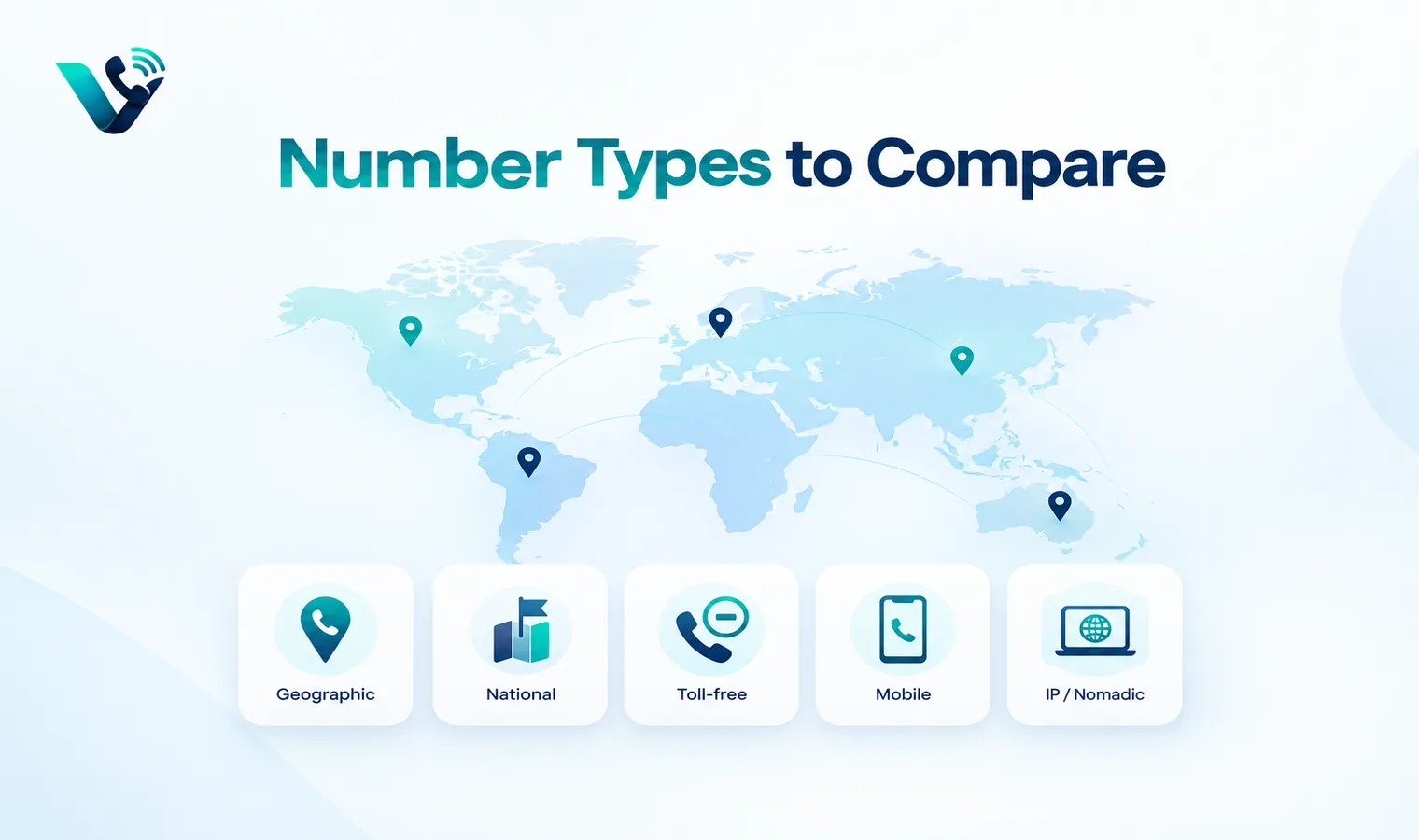
Country availability is not enough
A provider can advertise coverage in dozens of countries while offering only selected number types in each market. One country may provide inbound local voice, another may require local documentation, and another may support only specific business ranges. Compare capabilities country by country. Create a matrix with country, number type, local presence requirement, inbound voice, outbound voice, SMS, porting and emergency calling where relevant.
A provider that lists many countries may still offer only limited number types or directions in each one. Build a country matrix with number type, local-presence requirement, inbound voice, outbound voice, SMS, porting, caller ID and emergency capability where relevant. This turns “coverage” into a deployable comparison instead of a marketing count.
Compliance and documentation
Number allocation is regulated in many markets. Saudi CST, for example, manages national numbering resources and explicitly regulates virtual voice services. Singapore IMDA manages its National Numbering Plan, and Hong Kong OFCA publishes its numbering and IP telephony frameworks. These examples illustrate a global rule: the provider must map its service to the local numbering framework. Documentation can include business identity, address, authorised user and proof of service relationship.
Make documentation part of the buying score. Ask which legal entity can hold the number, what address or authorised-user evidence is required and whether the service can be used by a remote team. Store the provider's current checklist with the project because requirements can differ by country and may change over time.
Voice capabilities
Check inbound and outbound voice separately. Some numbers are inbound-only, some support outbound caller ID, and some require specific permissions for international calling. Confirm whether calls can be forwarded to the countries where your team works and whether the provider preserves caller ID. Test actual calls before launch. Marketing pages often describe platform-level capabilities, while the exact number can have narrower capabilities.
Test inbound and outbound voice separately. Confirm forwarding destinations, outbound caller ID, international calling permissions and any restrictions on the exact number. Do not assume a platform-level feature applies to every international business phone number in the catalogue. Run representative calls before publishing the number to customers.
SMS capabilities
SMS is one of the most common sources of misunderstanding. Twilio's current number documentation distinguishes SMS inbound and outbound connectivity and provides number-level capability information. A virtual number is not automatically an SMS number. Even when SMS is technically enabled, local carrier rules, sender registration and international delivery can affect the workflow. Treat messaging as a separate purchase decision within the same communications architecture.
Treat messaging as a separate capability and compliance track. An international virtual number may be voice-only, SMS-enabled domestically or subject to sender registration and carrier filtering. If two-way texting, reminders or OTP-related workflows matter, validate the exact number and intended countries before procurement is final.
Portability and number ownership
If you already have a number, ask about porting before buying a replacement. Verify that the provider supports the number type and country, then complete ownership and authorisation requirements. Never cancel the old provider before the port is confirmed. If portability is unavailable, decide whether a new number can be published without disrupting customers or whether a transition period is required.
Existing numbers should be checked for portability before they are replaced. Confirm supported country and number type, gather ownership documents and keep the old provider active until the port completes. If portability is unavailable, plan a transition period and customer communication instead of changing the public number abruptly.
Routing and global business hours
International numbers should route according to customer-market hours. A company with teams in several time zones can create overlapping queues, regional groups and an after-hours callback path. Routing should also consider language and product skill. The aim is to reduce missed calls while avoiding an always-on work culture. A clear service window and callback expectation can be better than pretending that someone is available 24/7.
Global call routing should follow customer-market hours and the real capacity of the team. Use regional queues, overlap where useful, language or skill routing and an after-hours callback path. A clear service window is usually better than an unrealistic promise of 24/7 coverage from a small team.
CRM and analytics
A global number strategy should produce global reporting. Capture country, number, source, owner, call outcome, lead status and revenue stage. LeadMino can provide the central CRM workflow so phone enquiries from different countries are handled consistently. Marketing can then compare qualified opportunities across markets without maintaining a separate spreadsheet for every provider.
Standardise CRM fields across countries: market, number dialled, source, owner, call outcome, lead status and revenue stage. This lets marketing compare qualified opportunities and lets sales operate one process even when several phone providers or country numbers are involved.
Try this on your own numbers
Local numbers in 118 countries, AI call notes and one shared inbox. Live the same day, no contract.
International buyer checklist
Before purchasing, compare coverage, number type, eligibility, documents, voice, SMS, caller ID, porting, routing, recording, emergency features, data handling, support and CRM integration. Ask for a country-specific capability sheet and test the exact number. The best international virtual-number setup is not the provider with the longest country list; it is the one that can reliably support the number types and workflows your target markets require.
Before signing, compare country availability, exact number types, documentation, voice, SMS, caller ID, portability, routing, pricing, support and CRM integration. Then test representative numbers in the highest-priority markets before committing to a large rollout. International virtual numbers should be expanded in phases as operational confidence grows.
Common mistakes to avoid
- Buying from a country-count headline: Compare the exact number type and capability available in each target market.
- Assuming platform features apply to every number: Validate voice, SMS, caller ID and porting at number level.
- Ignoring documentation until after purchase: Put eligibility and local-presence requirements in the buying matrix.
- Overbuilding country coverage too early: Start with priority markets and add numbers when the customer or measurement need is clear.
- Separating phone analytics from CRM outcomes: Connect calls to qualified opportunities and revenue stages where possible.
Practical implementation checklist
Area |
Purpose |
Check |
|
Coverage |
Countries/ranges |
Compare country by country |
|
Capabilities |
Voice/SMS/porting |
Check exact number |
|
Compliance |
Documents/rules |
Verify with provider/regulator |
Frequently asked questions
- What is the main thing to check about international virtual numbers?
- Check the exact number type, provider eligibility, required documentation and the communication features you actually need.
- Can a remote team use the number?
- Often yes, if the provider supports the routing and the number is eligible for the intended service.
- Does a virtual number automatically support SMS?
- No. SMS capability is separate and should be verified for the exact number.
- Do I need a local office?
- Not necessarily, but some number types or markets can require local presence or address evidence.
- Can I connect the number to a CRM?
- Yes. Connecting calls and messages to a CRM helps preserve ownership, source, status and next action.
- What should I test before publishing it?
- Test inbound and outbound calling, caller ID, business hours, overflow, SMS if needed, and the CRM workflow.
- How many countries should a business launch at once?
- Start with the markets that have a clear customer and operational case. Expanding in phases makes documentation, routing and reporting easier to validate.
- What should a provider comparison matrix include?
- Country, number type, eligibility, documents, inbound/outbound voice, SMS, caller ID, portability, routing, pricing and support.