Discovery Call Framework With a Question Bank You Can Steal
By Jamila Parker · · 7 min read

A practical discovery call framework with reusable questions for situation, impact, process, stakeholders, timing, alternatives and next steps.
Key takeaways
- Discovery should diagnose the buying situation, not perform the demo early.
- Ask fewer, better questions and follow the answer before moving on.
- Capture impact, decision process and timeline while the information is fresh.
- Questions should adapt to what the prospect says, not follow a rigid interrogation.
- End with a mutually understood next step or a clean reason not to proceed.
What a discovery call framework is for
A discovery call framework gives sales reps a repeatable way to understand whether there is a real problem, whether it matters enough to act on, how the buyer will decide and what should happen next. It prevents discovery from becoming either a product demo with a few questions attached or an unstructured chat that produces no usable deal information.
The framework should create consistency without turning the call into an interview. The rep needs a set of areas to cover, but the order should follow the conversation. If the prospect gives the timeline while explaining the problem, there is no reason to ask the same timeline question again fifteen minutes later.
A good discovery call framework also improves CRM quality because the information the team cares about has a natural place: Situation, impact, stakeholders, process, timing, alternatives and next step.
Start with the situation, not the product
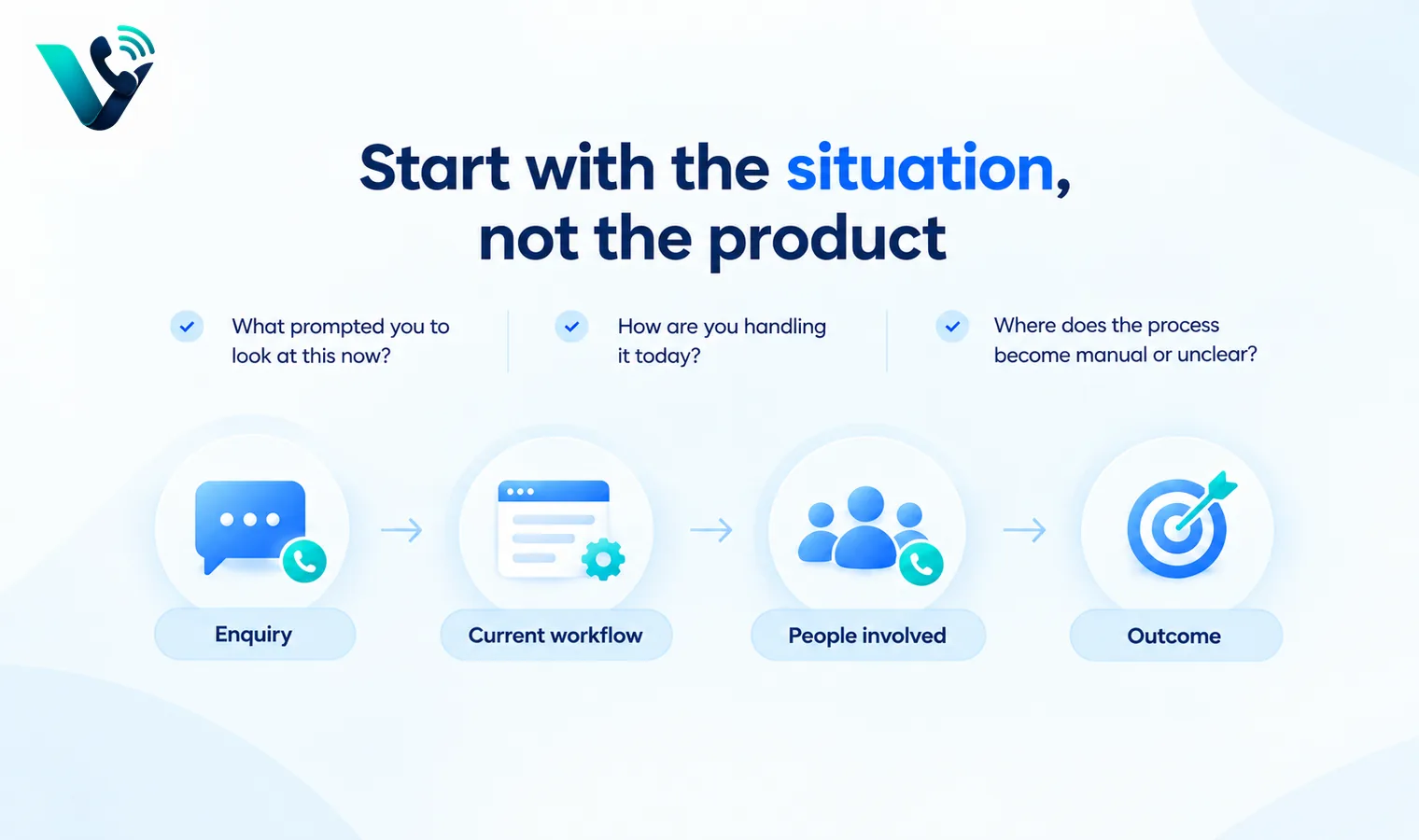
The first objective is to understand what is happening now. Ask questions that reveal the current workflow, who is involved and why the topic has become important enough for a conversation.
- What prompted you to look at this now?
- How are you handling it today?
- Who touches the process from first enquiry to final outcome?
- What is working well in the current setup?
- Where does the process become manual or unclear?
These questions let the prospect describe the environment in their own language. Resist the urge to map every answer immediately to a feature. Discovery becomes more useful when the rep first understands the workflow before positioning a solution.
Move from problem to impact
A problem only becomes commercially meaningful when the team understands its effect. “We miss calls” is a problem statement. The next questions should explore frequency, consequence and who feels the pain.
- How often does that happen?
- What usually happens to the lead when it does?
- Who spends time fixing it afterwards?
- Does it affect revenue, response time, customer experience or reporting?
- What happens if nothing changes over the next six months?
Do not force a financial number when the prospect does not have one. Impact can be operational, reputational or strategic. The goal is to understand why change matters, not to manufacture ROI during the call.
Understand the decision process early enough to matter
Many deals stall because the rep discovers the buying process only after the proposal. A stronger discovery call framework surfaces the process while the problem is still being understood.
- How do purchases like this normally get approved?
- Who else needs to be comfortable with the change?
- Is there a technical, security or procurement review?
- Who will use the system day to day?
- Who can stop the project even if the main sponsor wants it?
Clarify timing without creating fake urgency
Timing questions should identify real events. Ask what is driving the date rather than asking only “When do you want to buy?”
- Is there a date this needs to be working by?
- What happens on that date?
- Is the timeline tied to hiring, renewal, launch, budget or another event?
- What needs to happen before you can make a decision?
- If the project slips a quarter, what changes?
A real timeline has a cause. If the prospect has no event and no consequence, the deal may still be early. That is useful information; the rep can set the next step accordingly instead of pretending the opportunity is urgent.
Ask about alternatives and the status quo
The biggest competitor is often keep doing what we do now. Discovery should understand why the current process has survived and what alternatives the buyer is considering.
- What have you tried already?
- What would make you keep the current setup?
- Are you comparing other providers or mainly deciding whether to change at all?
- What would a new option need to do better than today?
- Is there anything about switching that feels risky?
This reveals the standard the solution must beat. It also gives the rep a fairer view of the opportunity than assuming every discovery call is an active vendor comparison.
Use a question bank, not a checklist
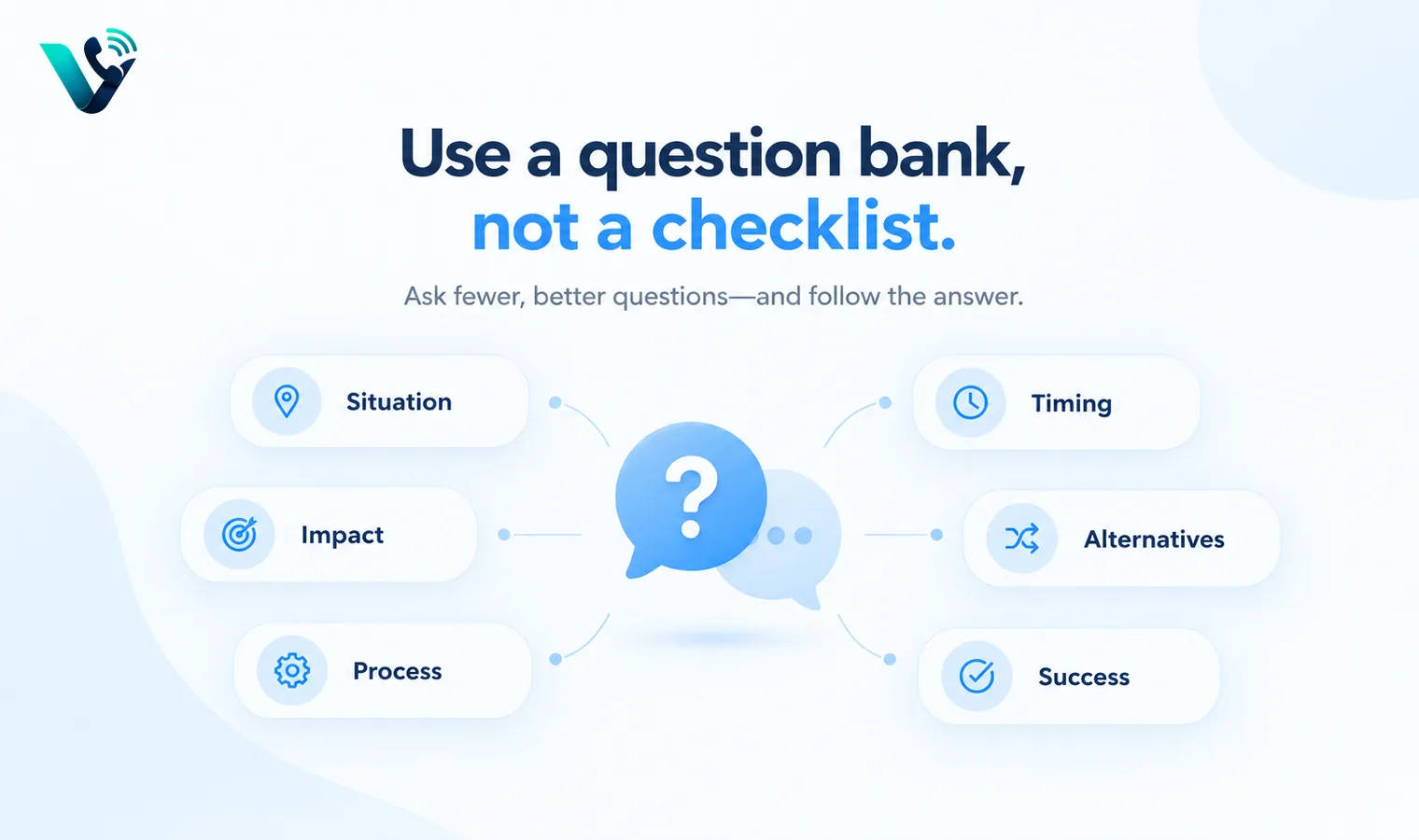
A question bank gives reps choices under each discovery area. A checklist can make them feel they must ask every question regardless of what the prospect has already explained.
Area |
Question to start |
Useful follow-up |
|
Situation |
What prompted this now? |
How are you handling it today? |
|
Impact |
What happens when the problem occurs? |
Who feels that most? |
|
Process |
How does a decision like this get made? |
Who else needs to agree? |
|
Timing |
Is there a date driving this? |
What happens on that date? |
|
Alternatives |
What else are you considering? |
What would make you stay with the status quo? |
|
Success |
What would good look like six months after launch? |
How would you know it worked? |
The rep should listen for answers that cover several areas at once and then go deeper where the deal is still unclear.
Capture success criteria before the demo
Success criteria turn discovery into a useful demo or proposal. Ask what the buyer needs to be able to do, what result they expect and which limitations would disqualify a solution.
Examples: “What does your team need to see in reporting?” “How quickly should a new inbound lead be assigned?” “What integrations are non-negotiable?” “What would make users reject the new workflow?”
This allows the next conversation to demonstrate the relevant parts of the solution rather than walking through every feature. It also creates a basis for later evaluation: The team can compare the proposal against the criteria the buyer gave in discovery.
Know when not to advance the opportunity
Discovery sometimes reveals that there is no meaningful problem, no timing, no ownership or no fit. That is not a failed call. It is a useful qualification result.
The rep can agree on a future trigger, send one resource or close the opportunity cleanly. Keeping every conversation in the active pipeline creates false forecast confidence and more follow-up work.
A strong discovery call framework therefore includes an exit path. The purpose is not to force every lead forward; it is to understand what is true.
End with a mutual next step
The last minutes of discovery should convert the conversation into a clear action. Summarise what you heard, check that the summary is accurate and propose the next step only if it matches the situation.
Example: “You are replacing the current routing setup before the November hiring wave, operations and IT both need to review it, and the main concern is missed follow-up. I suggest the next call is a 30-minute workflow demo with you and IT. Does that match what you need?”
If there is no agreed next step, record that honestly. “Send information” with no owner or date should not be treated as a committed opportunity.
Turn discovery into CRM fields that help the team
Do not create fifty mandatory fields. Capture the few pieces of information that change forecasting, follow-up or solution design: Problem, impact, decision process, stakeholders, timing, success criteria and next action.
Notes can hold nuance, while structured fields make reporting possible. The discovery call framework should therefore mirror the information the sales team actually uses later.
Review stalled deals against these fields. Missing impact, unclear decision process and no real timeline are common signals that the deal was advanced before discovery was complete.
Try this on your own numbers
Local numbers in 118 countries, AI call notes and one shared inbox. Live the same day, no contract.
A simple 30-minute discovery agenda
For teams that want more consistency, use a light agenda rather than a rigid script. Spend the first few minutes confirming why the meeting was booked and what the prospect wants to get from it. Use the middle of the call for situation, impact, process and timing. Reserve the final five minutes for summary and next step.
The agenda should flex when the conversation deserves it. A major issue may need ten minutes of follow-up questions, while another area can be covered in one answer. Reps should know the categories that matter without watching the clock mechanically.
After the call, update the CRM while the context is fresh. Discovery quality usually drops when reps wait until the end of the day and try to reconstruct the conversation from memory.
Frequently asked questions
- What is a discovery call framework?
- It is a repeatable structure for understanding the prospect’s situation, problem, impact, buying process, timing, alternatives, success criteria and next step.
- How many questions should I ask on a discovery call?
- Ask only the questions needed to understand the deal. Use a question bank rather than forcing every prospect through a fixed checklist.
- What should I ask first?
- Start with why the conversation is happening now and how the prospect handles the process today.
- When should I ask about budget?
- Budget can be discussed when it helps determine fit, but first understand the problem, scope and buying process so the number has context.
- How should discovery notes be stored?
- Keep concise notes for nuance and a small set of structured CRM fields for information that affects follow-up, forecasting or solution design.
- What is a good discovery call outcome?
- A clear understanding of the situation and a mutually agreed next step, or a clear reason not to advance the opportunity.