Call coaching running a scorecard review in 20 minutes
By Jamila Parker · · 8 min read

A call coaching session does not need an hour. Use a focused 20-minute scorecard review to find one behaviour, coach it with evidence and create a measurable next step.
Key takeaways
- A useful call coaching scorecard evaluates observable behaviours, not personality or vague impressions.
- The 20-minute review works because it limits the session to one call, a small rubric and one behaviour to practise next.
- Scorecard evidence should point to exact call moments so the rep can hear what worked and what needs to change.
- Managers should calibrate scoring across reviewers so the same behaviour receives roughly the same judgement.
- The coaching loop is not complete until a later call is reviewed for evidence that the behaviour improved
A call coaching scorecard gives managers a repeatable way to turn recorded conversations into practical sales coaching. The score itself is not the objective. The objective is to identify one behaviour that matters, show the rep clear evidence from the call, agree on a better behaviour and check whether that change appears in future conversations. That is why a focused 20-minute review can be more useful than an hour-long session that tries to discuss every weakness at once. Gong’s current scorecard guidance describes scorecards as structured feedback that helps teams learn consistently, and that principle matters even if your team uses a different conversation platform.
Why a 20-minute call coaching review works
Managers often avoid call reviews because the process feels expensive. A 40-minute discovery call can take another 40 minutes to replay, annotate and discuss. That does not scale across ten or twenty reps. A 20-minute call coaching scorecard review changes the unit of work. The manager does not need to replay the entire conversation live. They prepare a small amount of evidence first, then use the coaching meeting for diagnosis, reflection and practice.
The time limit also improves focus. A rep can realistically practise one or two changes on the next set of calls. If the manager gives twelve pieces of feedback, the rep leaves with a list rather than a coaching target. The best short review therefore prioritises the behaviour with the highest expected impact: Weak discovery, unclear next steps, excessive pitching, poor objection handling, missed qualification, or another observable skill.
Build a scorecard that can actually be coached
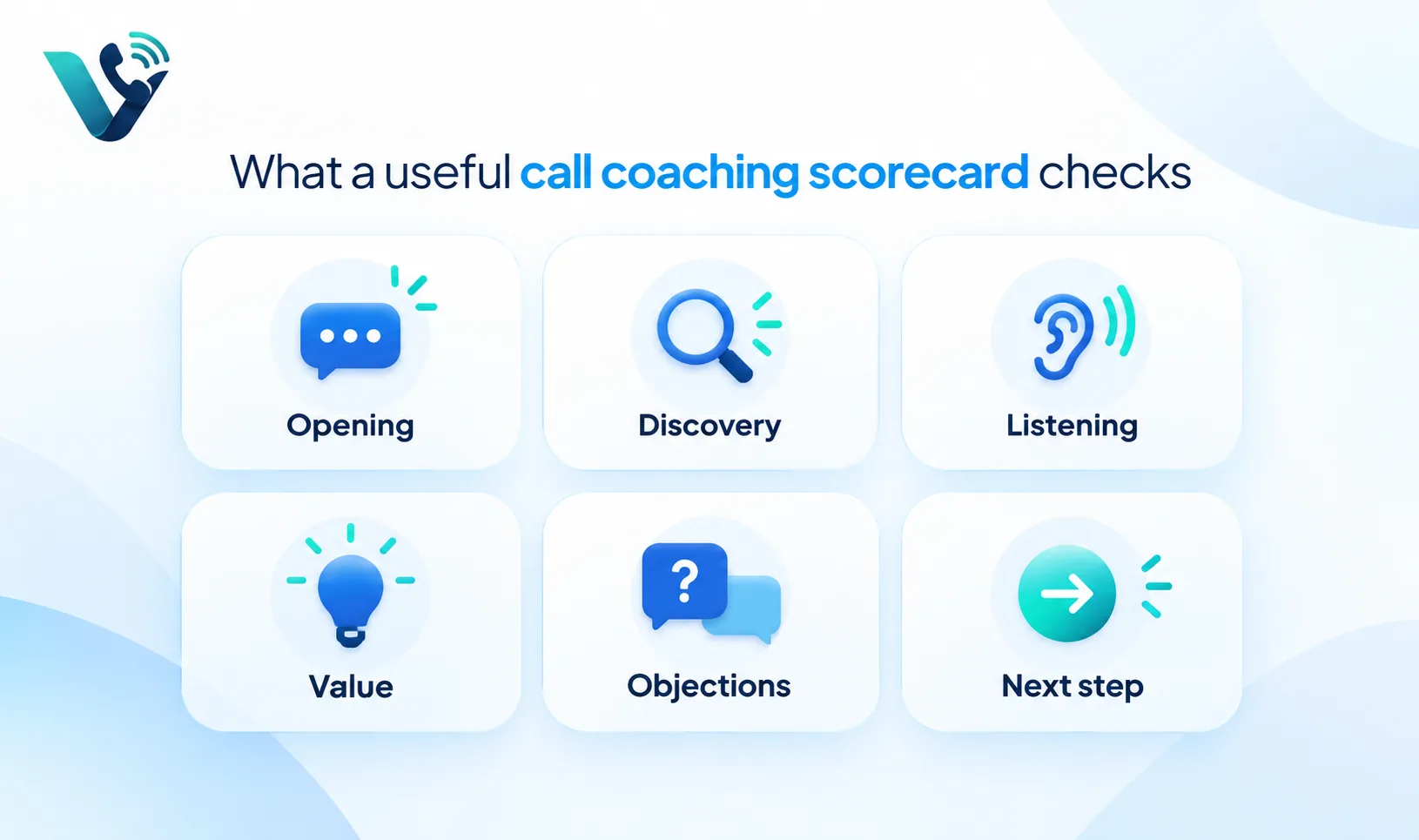
A sales coaching scorecard should be short enough that two managers can use it without inventing their own interpretation. Five to seven criteria are usually more practical than a twenty-line inspection sheet for a weekly coaching rhythm. Each criterion should describe something you can hear in the call. “Asked a relevant follow-up question after the buyer described a problem” is coachable. “Showed confidence” is much harder to score consistently.
Scorecard area |
What to listen for |
Simple evidence |
|
Opening |
Purpose, relevance, permission or agenda |
Rep creates a clear reason to continue |
|
Discovery |
Questions linked to business context |
Buyer explains problem, impact or priority |
|
Listening |
Rep responds to the buyer instead of returning to a script |
Follow-up question uses buyer language |
|
Value |
Message connects product value to stated need |
Benefit is tied to the buyer’s situation |
|
Objections |
Rep clarifies before answering |
Objection is explored, not instantly rebutted |
|
Next step |
Specific action, owner and timing |
Calendar step or agreed follow-up is explicit |
Keep scoring simple: Yes/No/Not applicable, or a small three-point scale such as missed, partial and strong. If a five-point scale produces debates about whether something was a three or a four, the scorecard is consuming coaching time rather than improving it. Add a short evidence field beside every scored item. The evidence should contain a timestamp, a brief note or a transcript snippet that explains the judgement.
The 20-minute call coaching scorecard agenda
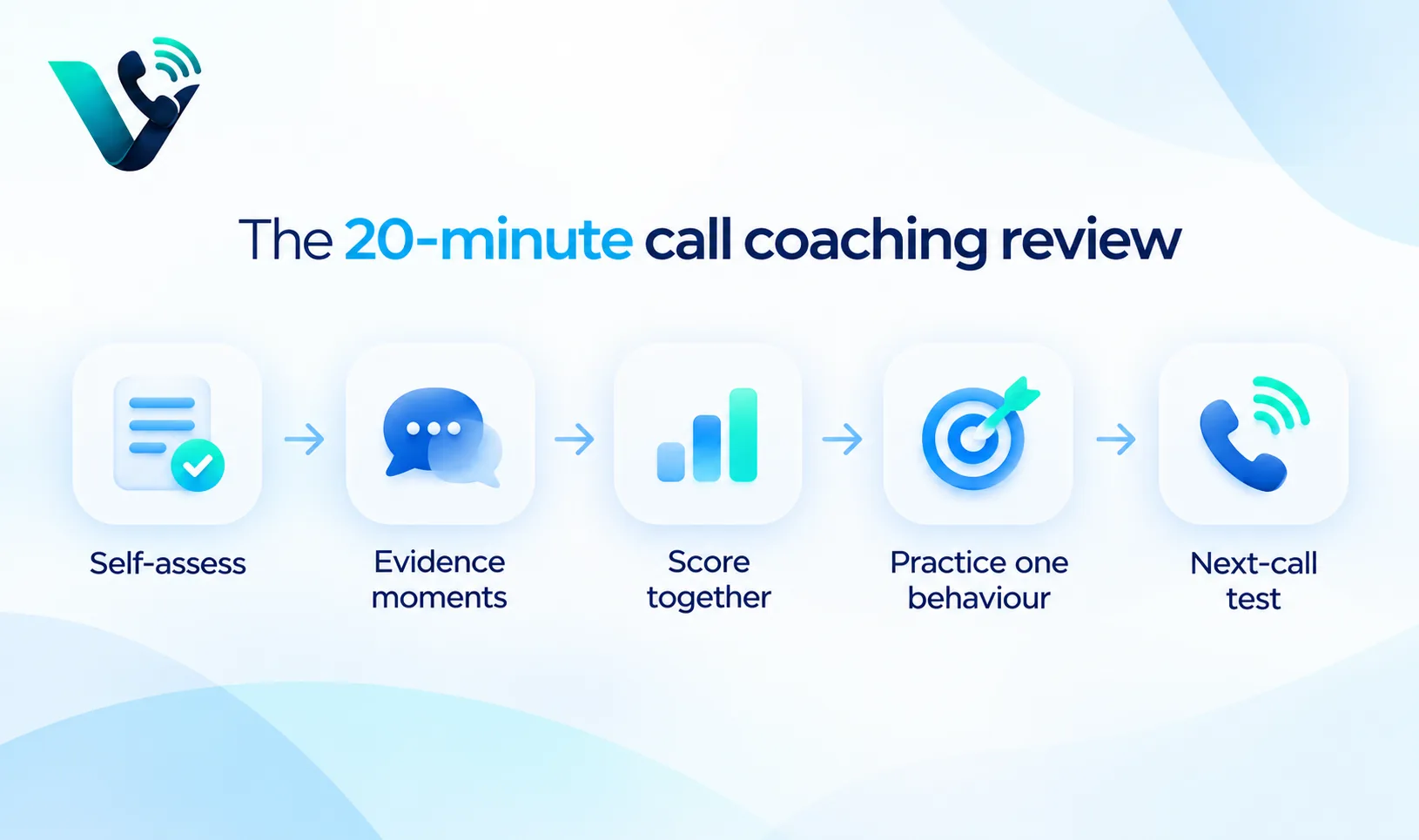
Minutes 0-3: Let the rep diagnose first
Start with the rep’s view of the call. Ask what they were trying to achieve, what felt strong and where they would change the conversation if they could replay it. This prevents the meeting from becoming a manager verdict. It also reveals whether the rep can self-diagnose. A rep who already notices the same issue may need practice, while a rep who does not notice it may need more evidence and explanation.
Minutes 3-8: Review two or three evidence moments
Do not play ten minutes of uninterrupted audio. Jump to the moments that explain the scorecard. One moment might show a strong discovery follow-up. Another might show the rep answering an objection before understanding it. A third might show an unclear close. Let the rep hear enough context to understand the interaction, then ask what they notice before giving your interpretation.
Minutes 8-12: Score the call together
Now complete the relevant scorecard items. The discussion matters more than perfect numerical agreement. If the manager scores discovery as weak and the rep scores it as strong, compare the evidence and definition. That conversation calibrates expectations. Over time, the rep should be able to predict how the team defines a strong opening, useful discovery or concrete next step without waiting for a manager to explain it again.
Minutes 12-17: Choose one replacement behaviour and practise it
Turn the biggest coaching opportunity into a specific replacement behaviour. Do not write “listen more.” Write “after the buyer describes a problem, ask one follow-up about impact before presenting a solution.” Do not write “close harder.” Write “end every qualified conversation by naming the next action and proposing a date.” Then role-play the exact call moment for two or three minutes. Practice is where feedback becomes behaviour.
Minutes 17-20: Define the next-call test
Finish with a measurable test for the next five to ten calls. The rep should know what they are trying, and the manager should know what evidence will confirm improvement. For example: In the next ten discovery calls, the rep will ask a second-layer impact question before explaining the product. The manager will review two calls next week and look only for that behaviour. This makes call coaching cumulative rather than repetitive.
Use scorecards for consistency, not surveillance
A call review scorecard becomes harmful when it is treated as a hidden performance trap. Tell reps what is being scored, why the criteria matter and how recordings are selected. Use the same rubric across similar call types. Discovery, demo, renewal and cold prospecting calls should not necessarily share one scorecard because the expected behaviours differ. Gong’s documentation makes the same practical distinction by offering different scorecard templates for discovery, outbound, demos and other conversation types.
Managers should also calibrate with each other. Once a month, have two reviewers score the same call independently, then compare. If one manager regularly gives high marks for behaviours another manager considers weak, reps are receiving inconsistent coaching. Calibration does not require perfect agreement; it requires shared definitions and evidence standards.
What to measure after a call coaching scorecard review
Do not measure coaching success by the number of calls reviewed. Measure whether target behaviours change. A team can complete hundreds of scorecards without improving if every review ends as documentation instead of practice. Track the selected behaviour across later calls, then connect the behaviour to downstream outcomes carefully. For example, clearer next steps may improve meeting progression, while better discovery may improve qualification quality. Avoid claiming that one scorecard point directly caused a closed deal; sales outcomes have many influences.
Useful coaching metrics include the percentage of reviewed calls with a dated next step, recurrence of the same coaching issue, time between feedback and re-review, and manager calibration agreement. Team-level scorecard trends can also reveal enablement problems. If most reps score poorly on the same criterion, the issue may be the sales process, onboarding or messaging rather than individual effort.
How to apply the workflow with Votelly
Votelly’s call-centre and sales-team pages describe live coaching, call scoring, analytics, recordings and CRM-connected call activity as part of its business-calling workflow. That makes a practical internal link from this article: Readers can learn the coaching method here, then explore the Votelly call-centre, sales-team and call-analytics pages for the platform layer. Votelly also publishes a guide to call monitor, whisper and barge, which fits naturally beside a scorecard article because live supervisor tools and post-call review solve different coaching moments.
Try this on your own numbers
Local numbers in 118 countries, AI call notes and one shared inbox. Live the same day, no contract.
A manager checklist for the next review
- Choose one call that represents the current coaching theme, not only the best or worst call of the week.
- Prepare two or three timestamped evidence moments before the meeting.
- Use a short call coaching scorecard with observable criteria and clear definitions.
- Ask the rep to self-assess before showing the manager score.
- Coach one replacement behaviour and practise it during the session.
- Schedule a re-review so the coaching loop ends with evidence of change.
Before the session, define what the scorecard is not allowed to do. It should not become a personality rating, a compensation shortcut or a substitute for pipeline review. Keep mandatory compliance checks separate from developmental coaching when possible, because a rep needs to know whether the conversation is about risk, process adherence or skill growth. This separation makes feedback easier to trust. It also helps managers compare like with like: Discovery skill against discovery skill, rather than mixing policy, product knowledge and sales technique into one score that nobody can interpret.
A simple rule helps: Every score must point to evidence, and every coaching action must describe a behaviour the rep can repeat on the next call.
The practical advantage of a 20-minute call coaching scorecard review is discipline. The rep knows what good looks like, the manager has evidence instead of impressions, and both leave with one concrete action. When the same process repeats every week, coaching becomes part of the operating system of the sales team rather than an occasional reaction after a lost deal.
Frequently asked questions
- What is a call coaching scorecard?
- A call coaching scorecard is a structured rubric used to evaluate observable behaviours in a sales conversation, such as discovery, listening, value communication, objection handling and next-step clarity.
- Can a useful call review really take 20 minutes?
- Yes, if the manager prepares evidence before the meeting and limits the session to one call, a short scorecard and one coaching action. The 20 minutes are for diagnosis and practice, not for replaying the entire recording.
- How many criteria should a sales coaching scorecard include?
- For frequent manager coaching, five to seven clear criteria are usually easier to use consistently than a very long checklist. Different call types may need different scorecards.
- Should reps score their own calls?
- Self-scoring can be useful because it builds self-diagnosis. Managers can compare the rep score with their own evidence and use disagreements to clarify expectations.
- How often should call coaching happen?
- A weekly or fortnightly rhythm works well for many active sales teams. The key is to review later calls so each session checks whether the previous behaviour changed.
- How can Votelly support a call coaching workflow?
- Votelly publishes call-centre, sales-team and analytics workflows that include call scoring and coaching-related capabilities. Check the current Votelly product pages for the exact features available to your plan.