Call Transcription Accuracy: What 95% Means
By Jamila Parker · · 10 min read

Learn how call transcription accuracy works in real business workflows, where it fails, what to measure, and how to choose a practical setup without needless complexity.
Key takeaways
- Call transcription accuracy should be judged by business outcomes and validated with real calls.
- Pilot word error rate and accents and overlapping speech with documented edge cases.
- Track word error rate and critical-term accuracy alongside qualitative reviews.
- Restrict audio and transcript access; capture consent and retention requirements for the jurisdictions involved.
- Corrected transcripts can inform search and notes if changes remain traceable to the source audio.
What is call transcription accuracy? The practical answer
In practical terms, call transcription accuracy is ultimately a question about business outcomes, not whether a dashboard includes the newest feature. For contact centre managers, compliance teams, sales operations, the practical goal is to make customer conversations more accurate, easier to manage and more useful after the call ends. A solution deserves investment when it solves an identifiable workflow problem and allows people to check the result. It should not be purchased only because a demonstration looks effortless.
A common problem is high headline accuracy hiding crucial mistakes. That failure is rarely caused by one missing button. It reflects unclear ownership, inconsistent inputs, weak quality checks or a handoff between calling software and the systems where customer work actually happens. Start with a narrow use case and document what a successful call, an acceptable exception and a safe escalation look like. The underlying operating principle should be a reference transcript from representative real calls.
Consider a customer who spells a product name over traffic noise. A tool might correctly identify the topic yet miss the detail that changes the appropriate next step. A useful process therefore combines the convenience of automation with source context, structured decisions and the option for a person to correct the record. This is particularly important when a call involves commitments, personal information, eligibility, pricing or a dissatisfied customer.
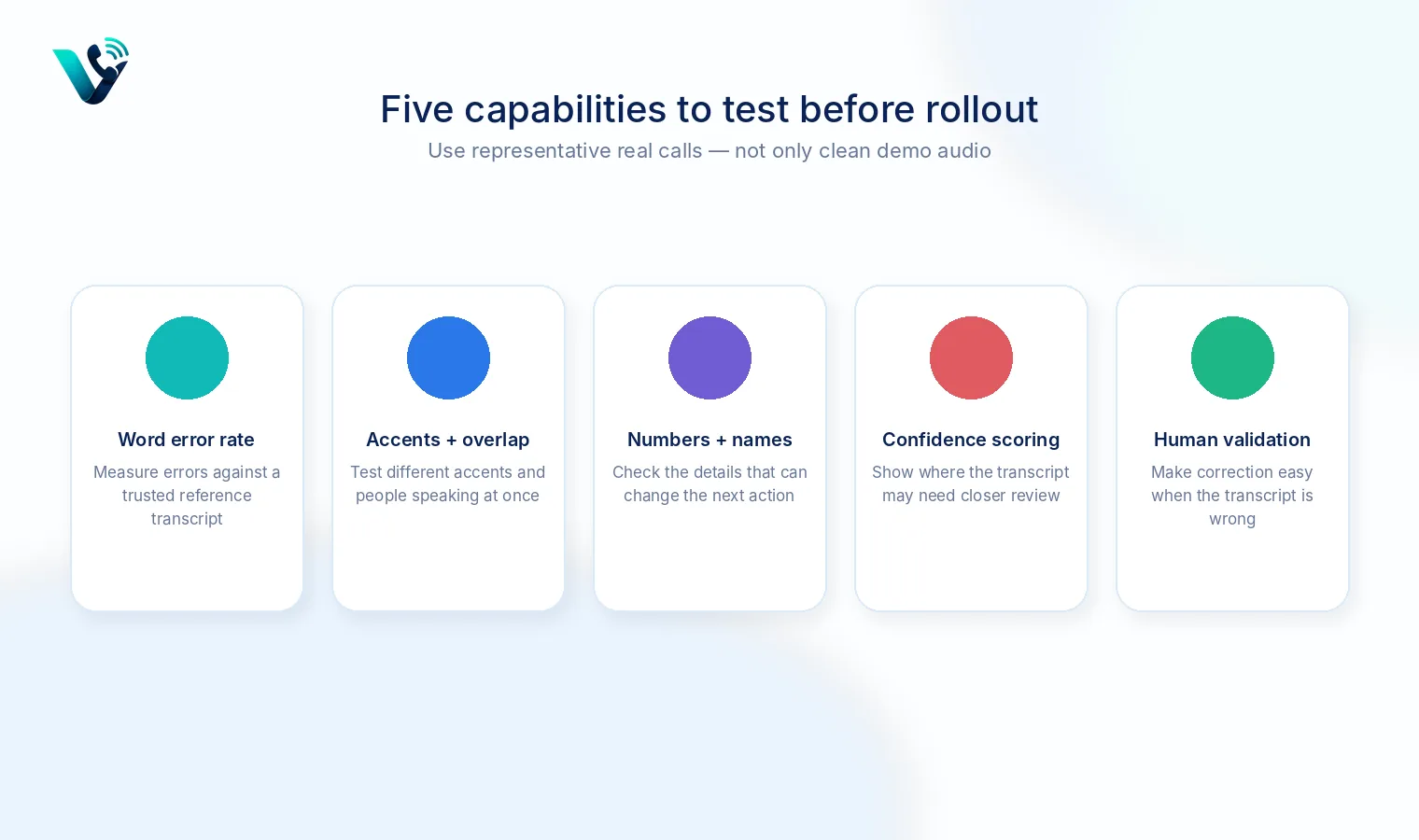
Five capabilities to evaluate before committing
-
Word error rate
When evaluating call transcription accuracy, word error rate should be judged using a realistic call, not a glossy feature list. Consider this situation: Two people speak over each other during a noisy support call. Inspect whether the workflow preserves the caller’s actual meaning and keeps a clear trail back to the source. The most useful controls are speaker separation, domain vocabulary and audio-quality flags. Ask reviewers to log every exception, including cases that looked successful in a dashboard but produced the wrong follow-up. An individual error here can change the customer experience even when the overall completion percentage looks respectable.
-
Accents and overlapping speech
Handling accents and overlapping speech becomes valuable only when colleagues can act on the result. In the example where two people speak over each other during a noisy support call, a manager needs to know who spoke, which statement was verified, and what remains uncertain. A score without linked evidence can create more work than it saves. Record proper nouns, amounts and negations separately so a team can distinguish a missing input from a faulty interpretation. For procurement, request an exportable sample showing both good outcomes and missed cases, and have the people who will use the system judge its clarity.
-
Numbers and names
Testing numbers and names properly requires negative examples. One failure to plant deliberately is this: A transcript renders “do not cancel” as “cancel”. See whether the tool detects the risk, flags uncertainty or confidently writes an incorrect result. Compare at least two kinds of calls: A clean scripted example and a difficult authentic interaction. The scorecard should record the business consequence of each mistake, not just a binary pass or fail. Where the output affects a decision or a customer promise, require a human confirmation path.
-
Confidence scoring
With confidence scoring, transparency beats a striking single-number claim. A practical review asks what evidence generated the recommendation and what would make it invalid. The issue is especially relevant to speech recognition under poor audio. Build a small challenge set with changed names, unexpected interruptions and conflicting instructions. Reviewers should be able to explain a wrong recommendation without assuming the machine’s confidence score is proof. Keep the correct response for each test documented so the next version can be evaluated fairly.
-
Human validation
Human validation works best when the handoff is agreed before deployment across the organisation. The desired outcome is straightforward: A reviewer can replay questionable timestamps rather than trust a global accuracy percentage. Give quality analysts and support supervisors responsibility for fixing errors and deciding when the answer should be withheld. Measure whether the feature changes completed customer tasks instead of counting how frequently staff click it. Test a fresh set of calls after any prompt, model or integration change; improvements observed on training examples may disappear on real conversations.
Practical comparison: Noisy transcription
Evaluation area |
Minimum practical test |
Risk if ignored |
Word Error Rate |
Use several real-world examples and inspect results |
Demonstration success does not transfer |
Accents And Overlapping Speech |
Document edge cases and expected exceptions |
Important context is lost |
Numbers And Names |
Review sample outputs against source evidence |
Errors become accepted as facts |
Confidence Scoring |
Check role permissions and data handling |
Sensitive information reaches wrong users |
Human Validation |
Monitor trends after launch, not just pilot |
Quality declines unnoticed |
Testing transcription when the line is noisy
-
Choose one workflow owned by a named team; write down why call transcription accuracy matters for its customers.
-
Gather paired clean and noisy recordings, including speaker overlap, hold music and low-bitrate mobile audio.
-
Define success using word error rate and critical-term accuracy, rather than relying only on vendor demonstrations.
-
Benchmark a representative noisy-call set: Mobile dropouts, accents, cross-talk and industry jargon, with a manually checked transcript.
-
Show reviewers how to flag uncertain words, preserve original audio and correct product names without silently altering the record.
-
Track errors separately for prices, names, numbers and consent statements; expand only after critical-term accuracy meets the defined target.
A useful pilot for call transcription accuracy begins with a carefully labelled sample representing speech recognition under poor audio. Include the situation where two people speak over each other during a noisy support call; then contrast it with ordinary, uneventful conversations. Capture baseline performance before enabling automation. Have two reviewers independently identify the correct outcome, reconcile disagreements, and document an acceptance threshold. Use word error rate, critical-term errors and human correction time for the scorecard. Keep an exception register with call identifiers, severity, owner and corrective action; this lets leaders see if recurring defects are being addressed rather than merely counted.
Even a correct-looking screen is not enough if it does not lead to a correct business action. In particular, test what happens when a transcript renders “do not cancel” as “cancel”. Follow the event from caller intent through routing or interpretation, downstream record and human follow-up. Require a reviewer can replay questionable timestamps rather than trust a global accuracy percentage. During the trial, pause automation on failure categories with serious customer consequences. Teams should decide in advance who receives each exception, how quickly it must be handled and when the pilot can safely resume.
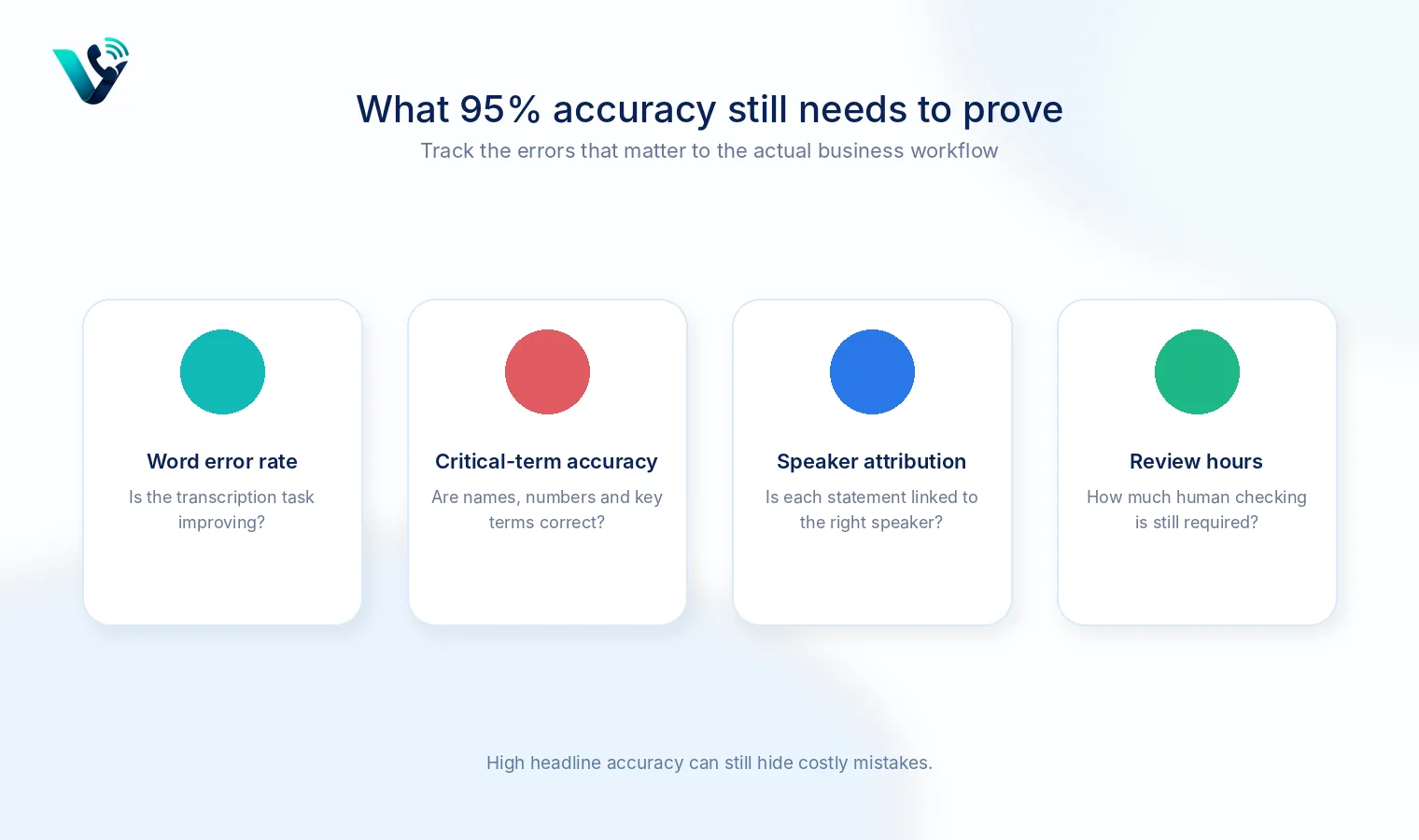
Metrics that distinguish productivity from actual value
Metric |
Question it should answer |
Word Error Rate |
Is the primary task improving? |
Critical-Term Accuracy |
Can we trust the output or decision? |
Speaker Attribution |
Are people and customers experiencing less friction? |
Review Hours |
Is the downstream business outcome improving? |
Measurement should map directly to call transcription accuracy. The starting set is word error rate, critical-term errors and human correction time; define the numerator, denominator, sample period and reviewer method for each. Slice results by call duration, quality, language, client segment and interaction complexity where lawful and relevant. A change in customer mix can make a system appear better without any real improvement. Report both typical results and costly edge cases, and document whether human review or hidden rework was required to achieve the result.
Quantitative results need a qualitative companion. Ask quality analysts and support supervisors to examine a handful of successful examples and every high-impact defect each week. In a review session, replay the source evidence and record which particular phrase, timestamp or policy caused the outcome. Use the recurring speech recognition under poor audio scenarios as coaching material. If staff bypass the feature or create parallel spreadsheets, investigate whether output quality, interface friction or lack of trust is responsible before setting adoption targets.
Security, consent and responsible data handling
Responsible data handling for call transcription accuracy requires specific controls, not a vague assurance that the service is secure. Review sensitive words in recordings and jurisdictional consent. Define who can listen to audio, open transcripts, export results, correct records and manage integrations. Explain the purpose and legal basis for processing as appropriate to each jurisdiction. In deployments involving more than one customer or client, verify tenant isolation and log privileged access. A recording, transcript, summary and structured CRM field may have different retention needs.
Privacy scenarios should be part of acceptance testing. A user may request a correction, deletion where legally applicable or access to the original conversation. Ensure quality analysts and support supervisors can trace what was generated from the audio and where it was stored. Remove unnecessary personal identifiers from reports and development datasets. Check the system response when an integration token expires, a retention period ends or a team member changes roles. The goal is not unlimited storage but dependable access to the minimum evidence needed.
How this fits into a connected business phone stack
A connected business phone stack works best when each component supports a clear next action. For call transcription accuracy, map call entry or origination, routing, recording where enabled, interpretation, staff review and CRM or ticket updates as separate stages. Votelly publishes information on business calling and related capabilities, but individual feature availability depends on the chosen plan and current configuration. Verify the relevant Votelly product documentation and test the full path with your own account rather than assuming every feature or connection is present by default.
Votelly’s pricing and integration resources are useful starting points, and they are linked in the source list below. Read them alongside the operational checklist for call transcription accuracy. Confirm exactly which speaker separation, domain vocabulary and audio-quality flags capabilities are included, who can administer them, and what happens when a call or API operation fails. For independent guidance, use the additional links in this document to check relevant search, speech or privacy principles rather than treating marketing copy as technical proof.
Common mistakes and how to avoid them
One of the most damaging mistakes is treating call transcription accuracy as a feature with no process owner. In practice, a transcript renders “do not cancel” as “cancel” can turn a time-saving system into a customer-risk multiplier. A second mistake is measuring only adoption or speed and ignoring word error rate, critical-term errors and human correction time. A third is designing exclusively around perfect demo audio. Introduce realistic interruptions, wrong numbers, ambiguous phrasing and downstream service failures before launch. Finally, make it easy for staff to challenge an output without being penalised for overriding the technology.
Try this on your own numbers
Local numbers in 118 countries, AI call notes and one shared inbox. Live the same day, no contract.
A decision framework for choosing the next step
A staged decision works best. Start with manual review when the organisation has limited call examples or unresolved sensitive words in recordings and jurisdictional consent concerns. Use a supervised pilot when quality analysts and support supervisors can check results and investigate exceptions. Broader rollout is justified only when a reviewer can replay questionable timestamps rather than trust a global accuracy percentage holds across a representative sample, including difficult conditions. Document an explicit stop condition for severe failures. The threshold should be stricter for outcomes that affect money, legal commitments, personal information or customer safety.
As an immediate next step, write a one-page implementation brief for call transcription accuracy. Describe the target customer journey, the baseline issue of speech recognition under poor audio, the required speaker separation, domain vocabulary and audio-quality flags, and the measures word error rate, critical-term errors and human correction time. Attach examples of both correct and incorrect outcomes. Assign a reviewer for every decision that automation may influence. This keeps vendor evaluation focused on whether the workflow reliably serves customers, not simply on whether the interface showcases a fashionable AI capability.
Frequently asked questions
- What does call transcription accuracy mean?
- In practice, call transcription converts recorded speech into text, and reliability must be assessed on the actual audio conditions and vocabulary.
- Who benefits most from call transcription accuracy?
- Contact centre managers, compliance teams and sales operations teams benefit when call volume, process ownership and review capacity make the use case worthwhile.
- How accurate or reliable is call transcription accuracy?
- Word error rate is a common way to express accuracy, but a single percentage says little about errors in critical business terms.
- What are the main risks?
- Key risks include high headline accuracy hiding crucial mistakes, missing context, unsuitable automation and weak access controls. Include clear escalation and review.
- How should a business measure success?
- A practical measurement set starts with word error rate, critical-term accuracy, speaker attribution and review hours, while also checking the underlying call outcomes rather than just dashboard activity.
- Can Votelly support a related workflow?
- For a related workflow, Votelly offers business phone and communication resources. For noisy transcription, check the currently published plan, integrations and availability before promising any workflow to customers.