Search a Year of Calls With Conversation Intelligence
By Jamila Parker · · 8 min read

Learn how conversation intelligence search works in real business workflows, where it fails, what to measure, and how to choose a practical setup without needless complexity.
Key takeaways
- Conversation intelligence search should be judged by business outcomes and validated with real calls.
- Pilot transcript indexing and semantic search with documented edge cases.
- Track search precision and time to evidence alongside qualitative reviews.
- Keep human review, data permissions and escalation clearly defined.
- Connect call insights with accountable CRM or helpdesk follow-up.
What is conversation intelligence search? The practical answer
Search a Year of Calls With Conversation Intelligence is ultimately a question about business outcomes, not whether a dashboard includes the newest feature. For sales leaders, product teams, research analysts, the practical goal is to make customer conversations more accurate, easier to manage and more useful after the call ends. A solution deserves investment when it solves an identifiable workflow problem and allows people to check the result. It should not be purchased only because a demonstration looks effortless.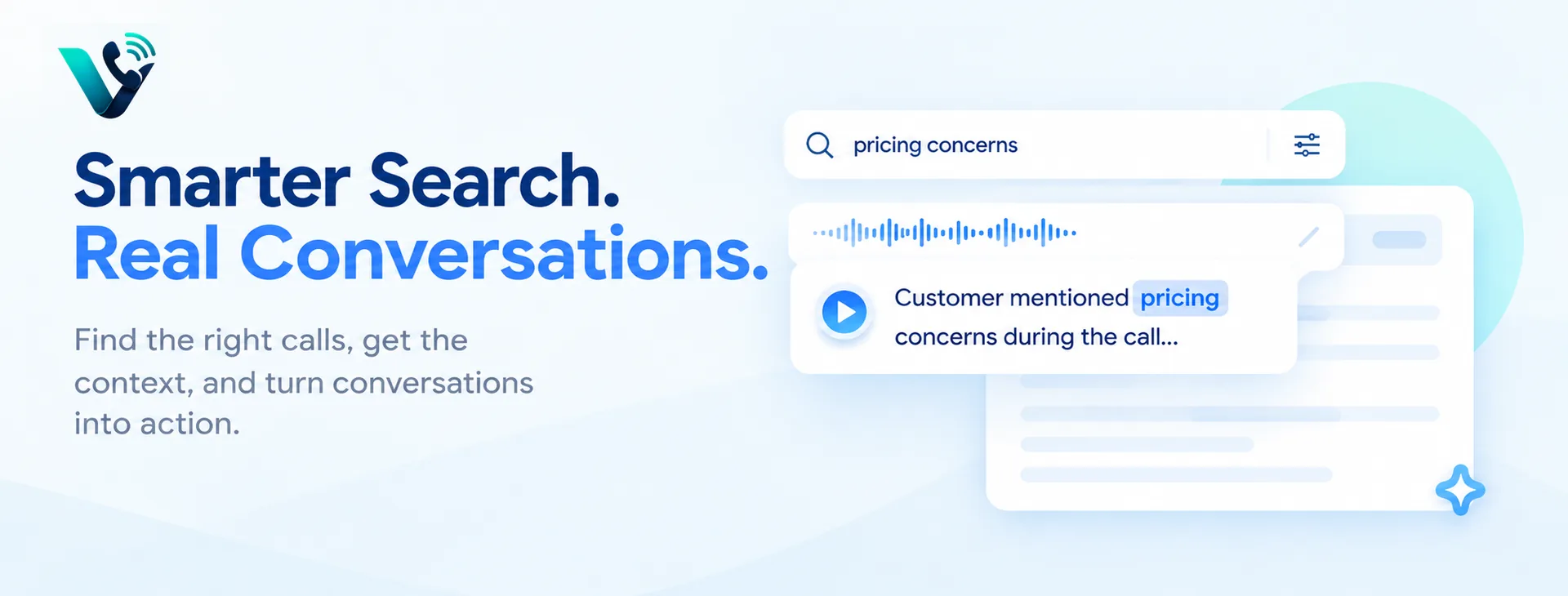
The recurring problem is thousands of recordings nobody can practically review. That failure is rarely caused by one missing button. It reflects unclear ownership, inconsistent inputs, weak quality checks or a handoff between calling software and the systems where customer work actually happens. Start with a narrow use case and document what a successful call, an acceptable exception and a safe escalation look like. The underlying operating principle should be permission-scoped search with linked source evidence.
For example, imagine a product manager looks for recurring integration objections. A tool might correctly identify the topic yet miss the detail that changes the appropriate next step. A useful process therefore combines the convenience of automation with source context, structured decisions and the option for a person to correct the record. This is particularly important when a call involves commitments, personal information, eligibility, pricing or a dissatisfied customer.
Five capabilities to evaluate before committing
Transcript indexing
First examine transcript indexing against an actual customer interaction rather than a scripted demo. Define what the system is expected to notice, what information it may safely use, and what output a teammate should receive. Test both a straightforward example and a counterexample that is likely to expose limitations. Accuracy on routine calls is useful, but the cases that fail tend to create disproportionate follow-up work and customer frustration.
Semantic search
First examine semantic search against an actual customer interaction rather than a scripted demo. Define what the system is expected to notice, what information it may safely use, and what output a teammate should receive. Test both a straightforward example and a counterexample that is likely to expose limitations. Accuracy on routine calls is useful, but the cases that fail tend to create disproportionate follow-up work and customer frustration.
Privacy and permissions
First examine privacy and permissions against an actual customer interaction rather than a scripted demo. Define what the system is expected to notice, what information it may safely use, and what output a teammate should receive. Test both a straightforward example and a counterexample that is likely to expose limitations. Accuracy on routine calls is useful, but the cases that fail tend to create disproportionate follow-up work and customer frustration.
Trend analysis
First examine trend analysis against an actual customer interaction rather than a scripted demo. Define what the system is expected to notice, what information it may safely use, and what output a teammate should receive. Test both a straightforward example and a counterexample that is likely to expose limitations. Accuracy on routine calls is useful, but the cases that fail tend to create disproportionate follow-up work and customer frustration.
Retrieval validation
First examine retrieval validation against an actual customer interaction rather than a scripted demo. Define what the system is expected to notice, what information it may safely use, and what output a teammate should receive. Test both a straightforward example and a counterexample that is likely to expose limitations. Accuracy on routine calls is useful, but the cases that fail tend to create disproportionate follow-up work and customer frustration.
Comparison table: what good implementation looks like
Evaluation area |
Minimum practical test |
Risk if ignored |
Transcript Indexing |
Use several real-world examples and inspect results |
Demonstration success does not transfer |
Semantic Search |
Document edge cases and expected exceptions |
Important context is lost |
Privacy And Permissions |
Review sample outputs against source evidence |
Errors become accepted as facts |
Trend Analysis |
Check role permissions and data handling |
Sensitive information reaches wrong users |
Retrieval Validation |
Monitor trends after launch, not just pilot |
Quality declines unnoticed |
A step-by-step rollout that teams can repeat
- Choose one workflow owned by a named team; write down why conversation intelligence search matters for its customers.
- Collect representative calls lawfully, including typical audio, unusual requests and difficult edge cases.
- Define success using search precision and time to evidence, rather than relying only on vendor demonstrations.
- Pilot with a small group, retain source context, and compare output to a human-reviewed baseline.
- Train staff on corrections, escalation and the precise decisions automation is not allowed to make.
- Review weekly failure samples; expand only when quality, privacy and operational metrics are acceptable.
A good pilot is deliberately unglamorous. Start with a clear written test set, include calls of different lengths, and record which cases the system completed without intervention. Compare outputs produced under the same conditions so that improvements are attributable to the workflow change rather than to a different customer mix. Include agents who will use the process daily; they often notice missing context faster than a procurement committee.
Do not equate task completion with customer success. A call can be marked resolved while the next promised action remains open. Review the complete journey: caller expectation, response quality, record creation, follow-up ownership and eventual outcome. If an automation hands off to a person, the recipient should see what happened and should not ask the customer to repeat information unnecessarily.
Metrics that distinguish productivity from actual value
Metric |
Question it should answer |
Search Precision |
Is the primary task improving? |
Time To Evidence |
Can we trust the output or decision? |
Theme Frequency |
Are people and customers experiencing less friction? |
Decision Impact |
Is the downstream business outcome improving? |
Use search precision, time to evidence, theme frequency, decision impact as a starting scorecard, but define each metric precisely before collecting data. A numerical improvement is not meaningful if the denominator or customer mix changes. Report volume alongside rates and segment results by team, call type, language and channel when there is enough data to avoid misleading comparisons. Review both average performance and severe exceptions, because a rare but costly failure can outweigh small productivity gains.
Qualitative review remains essential. Listen to a sample of calls that scored well and poorly, compare customer intent with the documented result, and invite agents to explain where the workflow helped or hindered them. These reviews can reveal a measurement problem: for example, shorter calls may indicate better routing, but they might also indicate rushed conversations or customers abandoning a complicated process.
Security, consent and responsible data handling
Before rollout, document retention limits, redaction policies, recording provenance. Restrict access to people who need the information for their work. Decide whether recordings, transcripts, notes and analytics require different retention rules. Where laws require notice or consent to record or analyze calls, implement those requirements before collecting the material. Requirements differ by jurisdiction and use case, so the operational owner should obtain appropriate legal guidance.
Test what happens when a customer requests correction, deletion where applicable, or a human contact. Avoid placing sensitive details into broad dashboards by default. Mask or minimise information where feasible, especially when conversations contain payment, identity or health-related content. An audit trail should show who accessed or changed important records and why the change occurred. Security is part of usefulness: teams cannot responsibly rely on information they cannot govern.
How this fits into a connected business phone stack
A calling platform is more valuable when the conversation connects to the next step. On Votelly, the published feature and pricing pages describe business numbers, routing, dialling, AI call summaries and transcripts, CRM integrations and analytics, with specific capabilities varying by plan. The integration page describes CRM and helpdesk connections plus API and webhook options. Buyers should verify their exact plan, region and workflow in a hands-on trial rather than assume every feature is available in every configuration.
For related platform guidance, explore Votelly pricing, CRM integrations and API, and what VoIP is and how it works. These links lead to existing Votelly pages that provide useful product context.
Try this on your own numbers
Local numbers in 118 countries, AI call notes and one shared inbox. Live the same day, no contract.
Common mistakes and how to avoid them
The first mistake is treating conversation intelligence search as a standalone purchase while leaving the surrounding process unchanged. If ownership is unclear, useful signals still fail to become completed work. The second is defining success exclusively as a speed improvement. Faster calls or quicker records are not valuable if they introduce errors, missed commitments or needless transfers. The third is testing only clean, familiar examples and concluding that the system performs equally well for every customer.
A decision framework for choosing the next step
Choose a focused pilot when the business already has enough relevant calls and a clear owner for transcript indexing. Postpone a wider rollout when records are fragmented, the call journey is poorly defined or no one can audit mistakes. A human-led workflow remains preferable when the interaction is unusually sensitive, the customer needs judgment or the consequences of a wrong answer are high. The best solution is often a hybrid: automate repeatable preparation and documentation while leaving nuanced decisions with qualified people.
For sales leaders, product teams, research analysts, the most defensible next move is to evaluate conversation intelligence search with a representative set of calls and an agreed scorecard. Capture what changed, what still fails, and how staff will detect errors. When the pilot demonstrates reliable improvements, expand one workflow at a time. When it does not, the test still creates value: it clarifies customer demand, exposes broken processes and prevents a costly rollout built around assumptions.
Frequently asked questions
- What does conversation intelligence search mean?
- It means applying the approach to real business conversations and associated workflows. Evaluate it by specific customer tasks, not by a marketing claim.
- Who benefits most from conversation intelligence search?
- Teams such as sales leaders, product teams, research analysts benefit when call volume, process ownership and review capacity make the use case worthwhile.
- How accurate or reliable is conversation intelligence search?
- Results depend on the audio, task, language, settings and process. Test against representative source calls before relying on an accuracy claim.
- What are the main risks?
- Watch for thousands of recordings nobody can practically review, missing context, unsuitable automation and weak access controls. Include clear escalation and review.
- How should a business measure success?
- Start with search precision, time to evidence, theme frequency, decision impact and check the underlying call outcomes, not just dashboard activity.
- Can Votelly support a related workflow?
- Votelly publicly describes calling, routing, AI notes and transcripts, analytics, integrations and API options. Verify feature availability and plan limits for the exact use case.