Using Call Transcripts to Find Your Best-Converting Talk Track
By Jamila Parker · · 8 min read

Mine real call transcripts to find the language patterns, discovery sequences and next-step phrasing that correlate with better sales conversion.
Key takeaways
- Define the conversion event before comparing transcripts; booked meeting, held meeting and opportunity creation are not the same.
- Compare similar call groups so lead quality does not masquerade as talk-track quality.
- Winning talk tracks are usually sequences of conversational moves, not one magic phrase.
- Segment findings by persona, source, geography and company size before standardizing a playbook.
- Validate transcript findings on new calls before treating correlation as a proven sales technique.
Winning talk tracks rarely reveal themselves in a script document. They show up in the messy middle of real conversations: The way a top rep frames a problem, the order of discovery questions, the sentence that makes a skeptical buyer stay engaged, or the transition that turns interest into a calendar commitment. Call transcripts make those moments comparable. Instead of asking the best rep to explain what they think they do, a sales team can inspect what was actually said across calls that converted.
The goal is not to copy one rep word for word. It is to identify repeatable language patterns that correlate with a useful outcome, then test whether those patterns still work when different reps, segments, and call types use them. That makes transcript analysis a sales-research process, not a hunt for a magic sentence.
Start by defining “best-converting”
A talk track cannot be called high converting until the team defines the conversion event. For a cold call, the event might be a booked meeting. For discovery, it might be an agreed next step with a date. For an inbound consultation, it may be qualification into an opportunity. Mixing those outcomes makes transcript analysis noisy because the same language can be appropriate in one stage and weak in another.
- Choose one call type: Cold call, discovery, demo follow-up, renewal, or another clearly defined motion.
- Choose one outcome: Meeting booked, next step agreed, opportunity created, renewal saved, or another measurable result.
- Separate held meetings from merely booked meetings when no-shows are common.
- Keep the comparison window long enough to include normal variation in reps, lists, and buyer types.
- Build two transcript groups before reading anything
Create a converted group and a comparison group. The converted group contains calls that produced the target outcome. The comparison group should contain calls with a similar starting condition that did not. If the successful group contains warm inbound buyers while the comparison group contains cold outbound calls, the transcript differences will mostly reflect lead quality rather than talk-track quality.
Match the groups as closely as practical by market, persona, product, rep tenure, lead source, and call stage. Perfect experimental control is unrealistic in sales, but thoughtful grouping prevents obvious false conclusions.
Signal to compare |
Why it matters |
Common trap |
|
Opening language |
Shows how quickly the rep creates relevance |
Confusing a famous rep’s brand recognition with a better opener |
|
Question sequence |
Reveals how discovery develops |
Counting questions without judging whether they changed the conversation |
|
Objection response |
Shows language used under resistance |
Studying only successful saves and ignoring easy buyers |
|
Proof and examples |
Shows when evidence enters the call |
Assuming more proof always improves conversion |
|
Next-step wording |
Shows how commitment is requested |
Counting meetings that were booked but never held |
Look for sequences, not isolated phrases
The biggest mistake in transcript mining is finding a phrase that appears often in successful calls and declaring it the winning line. Conversation is sequential. The phrase may work because it follows a specific discovery question, because the customer already admitted a problem, or because the rep waited until the right moment to introduce it. A talk track is closer to a pattern of moves than a collection of quotes.
For example, successful discovery calls may show a pattern: Clarify the current process, quantify the friction, ask what happens if nothing changes, then introduce a relevant example. The exact wording can vary while the structure stays stable. That structure is more transferable across reps than a memorized sentence.
Use transcript search to find the moment before the outcome
Work backwards from conversion. In calls where a meeting was booked, inspect the two or three minutes before the booking. In calls where an opportunity was created, inspect the point where the buyer agreed the problem was worth solving. Search for repeated transitions: 'what happens today,' 'how are you handling,' 'who else is involved,' 'what would make this worth changing,' or other phrases that appear near the decision moment.
Then compare the same stage in non-converting calls. Did the rep skip the question? Ask it too early? Answer their own question? Move into a pitch before the customer described impact? Transcript comparison becomes powerful when it shows not just what top calls contain, but what weaker calls are missing.
Measure talk-track performance by segment
A talk track that converts founders may fail with enterprise operations leaders. A pricing frame that works in the UK may land differently in the US or Australia. Industry vocabulary changes too. Segment the analysis before turning transcript findings into a universal playbook.
- Persona: Founder, sales leader, operations, finance, IT, support, procurement.
- Company size: SMB, mid-market, enterprise.
- Lead source: Outbound, inbound, referral, reactivation.
- Market or geography: Especially where terminology and buying process differ.
- Rep tenure: New reps may benefit from more structure than experienced sellers.
Turn patterns into a flexible talk-track map
The output should not be a rigid script. Build a map with objectives, example language, and branching options. For an opener, the objective may be relevance. For discovery, the objective may be to understand the current process and cost of the problem. For objection handling, the objective may be to clarify whether the objection is about priority, risk, money, or fit before responding.
Stage |
Objective |
Example prompt |
|
Opening |
Earn another 30 seconds |
“I’m calling because teams using X often run into Y is that even relevant on your side?” |
|
Discovery |
Expose current process |
“Walk me through what happens after a customer calls today.” |
|
Impact |
Make the problem concrete |
“When that breaks, what does it create for the team?” |
|
Proof |
Connect evidence to the stated problem |
Use a relevant customer example after the buyer names the pain |
|
Next step |
Create a specific commitment |
Ask for a date, owner and purpose not a vague “circle back.” |
Validate with new calls before declaring a winner
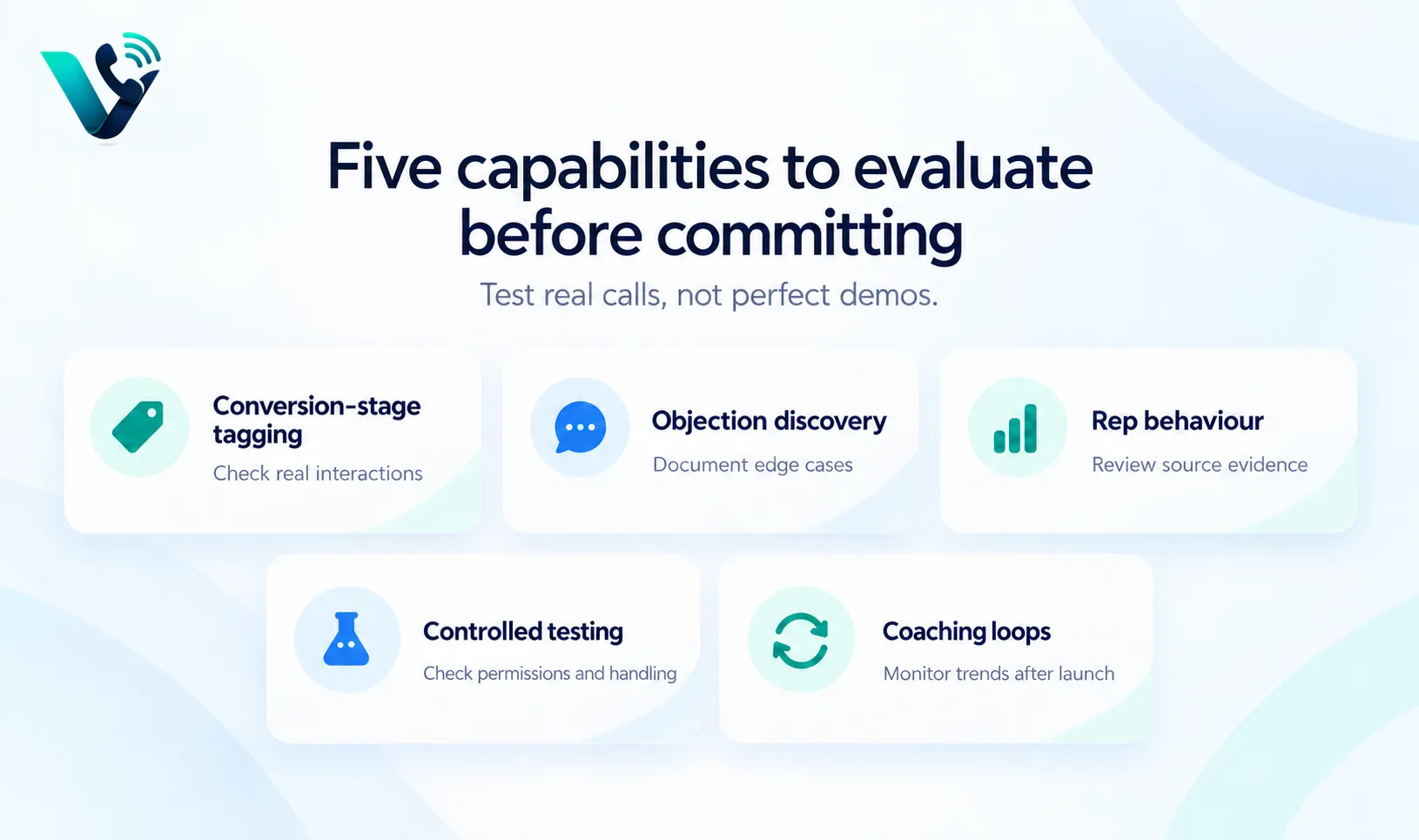
Historical transcript analysis generates a hypothesis. It does not prove causation. Once a promising pattern is found, test it prospectively. Give a group of reps the revised talk-track structure, keep the target segment stable, and compare outcomes over a defined period. Review whether meeting quality, held rate, opportunity creation, or conversion improves not just whether reps use the new words.
A good experiment changes one meaningful part of the conversation at a time. If the opener, discovery sequence, proof point, and closing language all change together, the team cannot tell which change mattered.
Use top-rep transcripts carefully
Top reps are useful sources of examples, but their success can come from skills that are hard to capture in text: Timing, tone, pacing, credibility, confidence, account selection, or the ability to respond to subtle cues. A transcript shows the language but not the full performance. Use recordings alongside transcripts when turning examples into coaching material.
How Votelly fits the workflow
Votelly advertises searchable transcripts, call summaries, sentiment, scorecards, call recording, and CRM integrations. That combination is useful for this workflow because the transcript can remain attached to the sales record and outcome. Teams can use the calling platform for the conversation, the CRM for the conversion label, and transcript search for the pattern analysis instead of exporting everything into disconnected tools.
The best talk track is a tested pattern, not a script
Using call transcripts to find your best-converting talk track is valuable because it replaces opinion with evidence. The output should still leave room for judgment. Buyers do not want to hear a team recite the same paragraph. The strongest playbook captures the sequence and intent behind winning conversations, gives reps examples of effective language, and keeps testing whether those patterns continue to create better outcomes.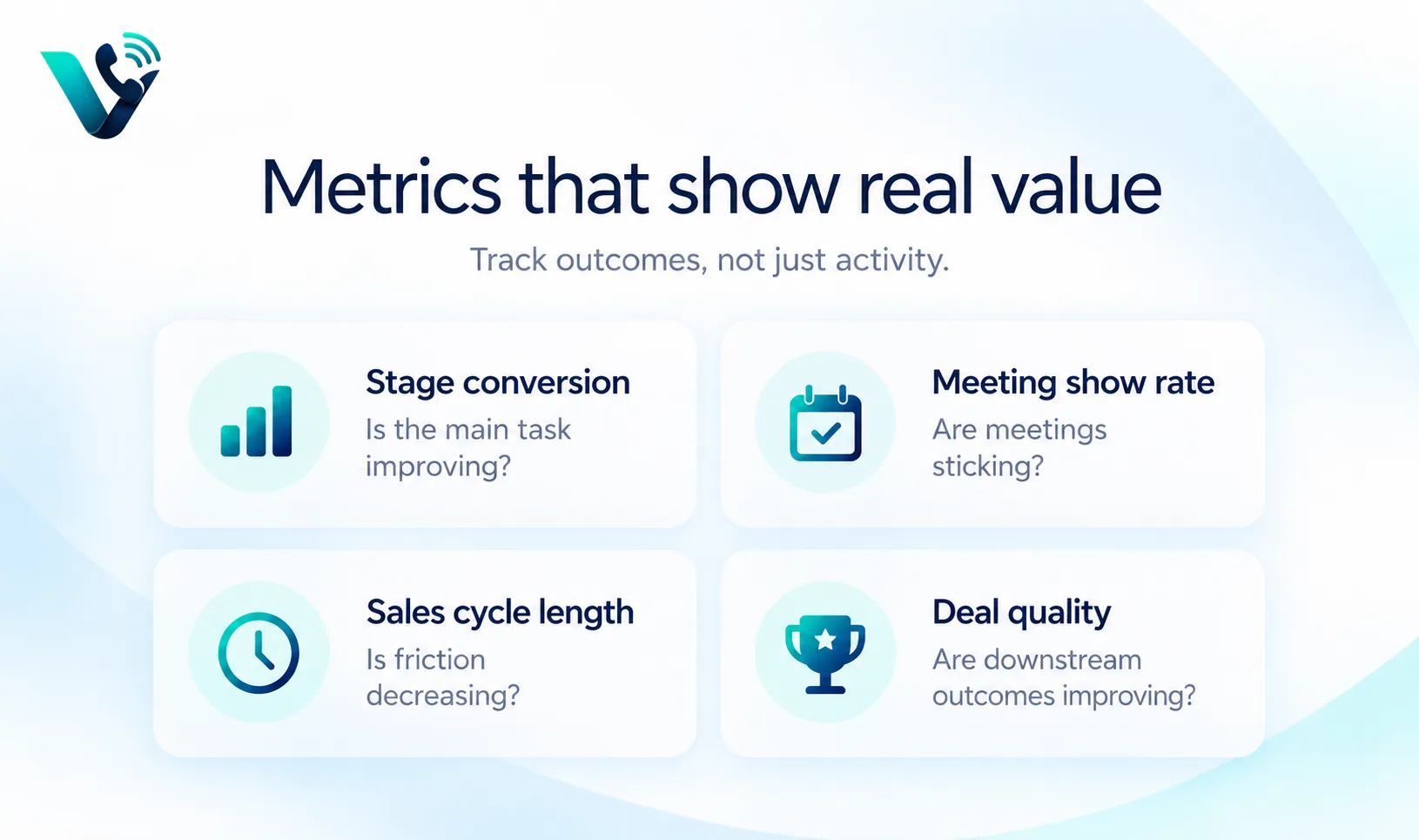
Use losing calls to improve the talk track too
Successful calls show what can work; losing calls show where the structure breaks. Build a small library of calls that reached the right buyer but failed to create the target outcome. Label the point of failure: Weak relevance, shallow discovery, premature pitching, objection not explored, proof not connected to the stated problem, or vague next step. Compare those failure points with matched successful calls.
This prevents survivorship bias. If the analysis studies only meetings that booked, it may overvalue language that also appears in many failed calls. The best-converting talk track is defined by contrast: A pattern should be more common, better timed, or better executed in successful conversations than in comparable unsuccessful ones.
- Create one coaching example that shows the strong version of each critical stage.
- Pair it with a contrasting call where the same stage broke down.
- Ask reps to identify the difference before giving the manager interpretation.
- That contrast turns transcripts into a training asset. Reps learn the decision behind the language instead of memorizing a line with no context.
Try this on your own numbers
Local numbers in 118 countries, AI call notes and one shared inbox. Live the same day, no contract.
Keep the playbook measurable after rollout
Once the revised talk track is live, add a small set of metrics to the coaching dashboard. Track conversion from meaningful conversations to booked meetings, held-meeting rate, opportunity creation, and the frequency of the specific conversational behavior being tested. This separates adoption from impact: A rep may use the new discovery sequence perfectly while the underlying segment still converts poorly for another reason.
Review the playbook when positioning, pricing, competition, or buyer objections change. Transcript evidence can go stale, so the talk track should behave like a living operating asset rather than a permanent script.
Frequently asked questions
- Can call transcripts show which sales talk track converts best?
- They can reveal language and sequence patterns associated with better outcomes, but teams should validate those patterns prospectively before treating them as causal.
- What is a best-converting talk track?
- It is a repeatable conversation structure and set of language patterns that produces stronger target outcomes for a defined call type and buyer segment.
- Should I copy my top rep’s exact wording?
- No. Use top-rep calls as evidence, but extract the intent and sequence behind the language rather than forcing every rep to sound identical.
- Which transcript moments should I analyze first?
- Start with openings, discovery transitions, objection responses, proof moments and the two to three minutes before a successful next step.
- How many calls do I need?
- Enough to compare meaningful groups across the same call type and segment. The right sample depends on call volume and how variable the motion is.
- How can Votelly support this process?
- Votelly advertises searchable transcripts, call recordings, AI summaries, scorecards and CRM integrations that can help connect conversation evidence with sales outcomes.