Canada Virtual Phone Number: Local Presence Without a Canadian Office
By Jamila Parker · · 9 min read

A Canada virtual phone number can give customers a Canadian contact point while calls route to a team elsewhere. Learn local-number strategy, portability, caller ID and telemarketing basics.
Key takeaways
- A Canadian virtual number can route calls to an international team, but it should be presented as a contact channel rather than proof of a physical office.
- Local area-code selection can support regional customer experience; portability allows many customers to keep numbers when changing providers.
- Canada uses caller-authentication and anti-spoofing measures, but caller reputation and telemarketing compliance remain separate concerns.
- Businesses making telemarketing calls into Canada should review the National DNCL and Unsolicited Telecommunications Rules that apply to their campaign.
A Canada virtual phone number can help an international business serve Canadian customers without operating a traditional phone system in Canada. Customers dial a Canadian number, while the call is routed through a cloud platform to a sales, support or service team located wherever the company operates.
This is useful for market entry, remote teams and companies that want separate contact points for Canadian customers. It can also reduce friction compared with asking a customer to place an international call.
The technology is straightforward, but the business context matters. Area-code strategy, number portability, caller ID, telemarketing rules and the distinction between a local contact number and a physical office should all be considered before launch.
What is a Canadian virtual phone number?
A virtual number is a telephone number whose destination is controlled through software rather than a single fixed line. Calls can route to an IVR, desk phone, browser, mobile app, SIP endpoint or call queue.
An international company can therefore operate one Canadian number for general enquiries and route it to a global support team. It can also use several regional numbers when it has genuine customer activity in different provinces or metro areas.
The number remains a real telecommunications resource assigned through a provider. "Virtual" describes the routing model, not whether the number is legitimate.
Local presence without a physical Canadian office
A Canadian area code can give customers a familiar domestic contact point. That can make calling simpler, especially for a business whose main corporate number is overseas.
However, a Canadian phone number should not be used to falsely imply a physical office. A website can accurately publish a Canadian sales or support number while listing the company's actual legal and mailing addresses separately.
This distinction also matters for local search, licensing and tax matters. A telephone number does not establish a legal place of business on its own.
Choosing the right Canadian number
Local geographic-style numbers
Canada participates in the North American Numbering Plan, so standard Canadian numbers use familiar area-code formats. Many regions now have multiple overlapping area codes because number demand has grown.
If a significant share of customers are in one metro area, a local number can create a convenient regional contact route. But do not overinterpret the area code: people can keep numbers when they move, and overlays mean several area codes can represent the same region.
Toll-free numbers
Canada also shares North American toll-free numbering ranges. A toll-free number can be useful for a company that wants one identity across provinces rather than separate local numbers.
For national customer support or reservations, toll-free may be easier to manage. For regional sales, local numbers may feel more specific. Many businesses use both and route all calls into one platform.
How virtual call routing works
When a Canadian customer dials the number, the provider receives the call and applies your routing rules. Those rules can consider time, day, department, language, agent availability and failover conditions.
A bilingual business, for example, could offer English and French menu options. A national support number could route callers based on input rather than forcing them to find a province-specific line. A sales number could ring the Canadian-market team first and overflow to another region if no one answers.
Cloud routing also helps international teams cover Canadian time zones. Make sure the PBX is configured around the customer's local service promise rather than the administrator's office time zone.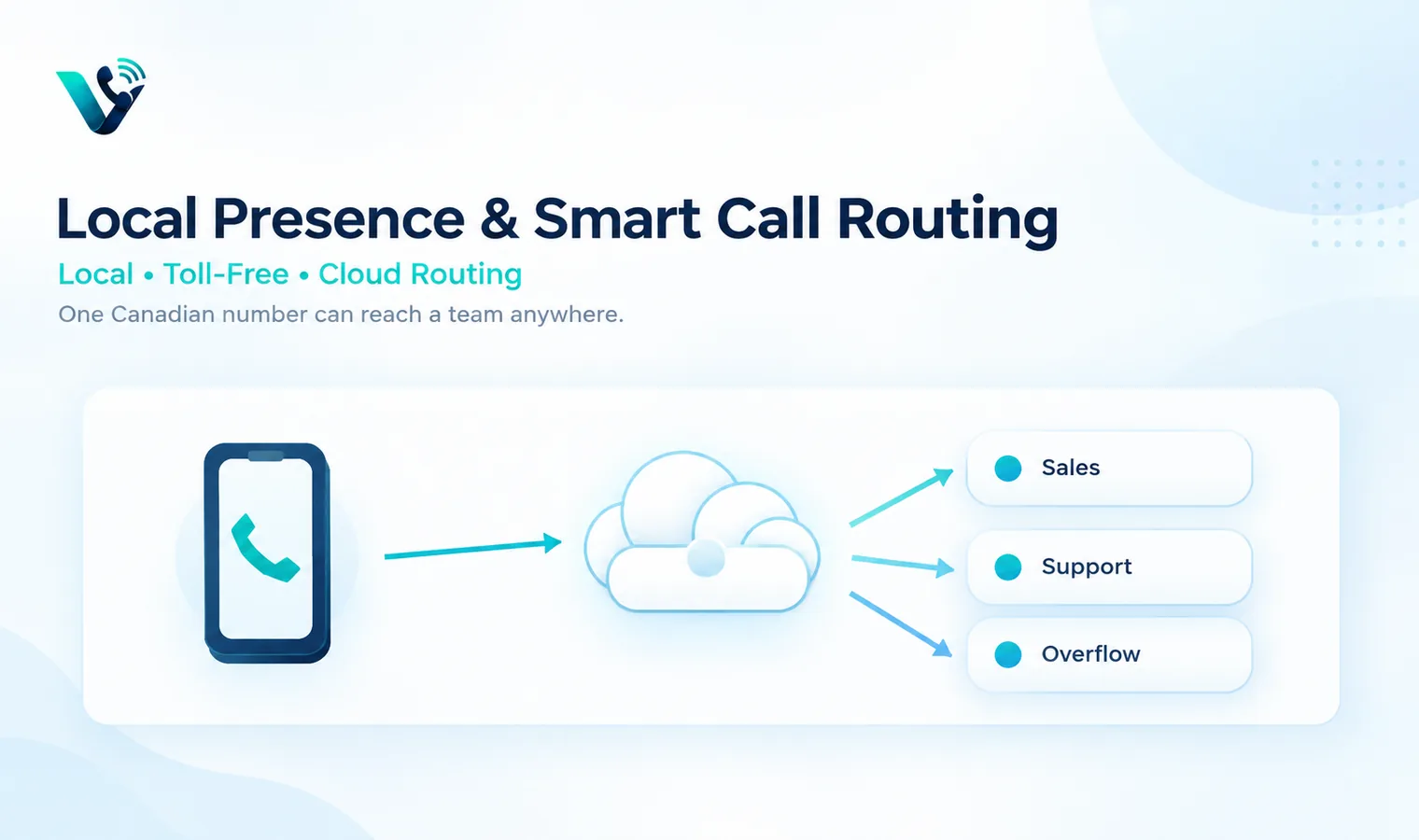
Number portability in Canada
The CRTC provides information for consumers who want to keep an existing telephone number when changing providers. In many situations, a number can be transferred when switching service, subject to eligibility and the providers involved.
For a business, portability matters because the number becomes part of marketing and customer records. Before promoting a new number heavily, ask the provider whether you can later port it out, what account information will be required, and whether any restrictions apply to the selected number type.
If you are moving an existing Canadian number into VoIP, keep the old service active until the port is complete. Mismatched account information can delay the process, so use the exact legal name, service address, account number and authorisation details held by the losing carrier.
Caller ID spoofing and STIR/SHAKEN in Canada
The CRTC has implemented measures addressing caller-ID spoofing, including STIR/SHAKEN authentication for IP voice networks. The framework helps providers assess whether the caller is authorised to use the displayed number.
As in the US, authentication should not be confused with reputation. A properly authenticated business number can still be reported as unwanted or receive a spam label based on recipient feedback and calling behaviour.
International businesses should ask their provider how Canadian caller ID is presented when agents are outside Canada and how authentication is handled across the call path.
Caller ID reputation for Canadian campaigns
A stable Canadian number is more useful when customers can recognise it and call it back. Avoid frequently rotating through disposable numbers. Keep business identification consistent and monitor complaint trends.
If answer rates suddenly decline, test the number across multiple Canadian mobile networks and ask customers what they see on screen. A label may be network-specific.
Separate high-volume prospecting from critical customer-service identities where practical. A support number published on invoices and account pages is worth protecting from the reputation risk of unrelated campaigns.
Canadian telemarketing rules and the National DNCL
Businesses making telemarketing calls to Canadians should review the CRTC's Unsolicited Telecommunications Rules and the National Do Not Call List requirements that apply to their activity.
The rules cover matters such as identification, calling hours, internal do-not-call requests and, for applicable telemarketing, National DNCL obligations. There are exemptions and distinctions for example, certain business-to-business calls are treated differently under the National DNCL provisions but other telemarketing requirements may still apply.
Do not turn that nuance into a shortcut. Before launching a campaign, classify the audience and call purpose correctly and document which rules apply.
Calling hours and identification
CRTC telemarketing guidance specifies permitted calling windows and requires callers to identify themselves and the organisation on whose behalf the call is made. Current guidance should be reviewed before launch because details and enforcement can change.
A compliant process also makes good reputation sense. People are less likely to complain when the caller is clear about who they are, why they are calling and how to opt out.
Business-to-business calls are not "no rules"
One common misunderstanding is that a B2B list means Canadian telemarketing rules can be ignored. The CRTC notes that certain calls to businesses are exempt from the National DNCL Rules in Part II, but telemarketers still need to consider other applicable Unsolicited Telecommunications Rules.
If your international company calls Canadian businesses, build an internal suppression process anyway. Continuing to call a company that has asked you to stop is bad for both customer trust and caller reputation.
SMS and messaging capability
Confirm SMS separately from voice. Not every virtual number or provider offers the same messaging functionality, and carrier rules can differ by traffic type.
If the number will send appointment reminders, support messages or marketing texts, ask the provider about registration, consent, throughput and content restrictions. Also review Canada's anti-spam requirements where electronic messages are involved. Voice telemarketing rules and commercial electronic messaging rules are not interchangeable.
Choosing a Canada virtual-number provider
Look beyond the headline monthly fee. Ask about:
- Canadian local and toll-free inventory;
- Proof or documentation required for assignment;
- Inbound and outbound call rates;
- International SIP or forwarding routes;
- Number portability in and out;
- Caller-ID authentication support;
- Spam-label remediation processes;
- SMS capability and registration;
- Bilingual IVR and queue features;
- Call recording and data location options;
- Support hours and incident response.
For international operations, support quality matters. A cheap number is not useful if a routing fault during Canadian business hours takes a day to reach the right technical team.
A practical architecture for Canadian customers
A growing company might use one toll-free number for national support and local numbers for priority markets. All numbers route to the same cloud PBX. The customer chooses English or French, then the system sends the call to the appropriate skill group.
During Eastern Time business hours, a Toronto-market team may receive the first ring. Later, an authorised global team can handle overflow. The public numbers do not need to change when staffing changes.
For outbound callbacks, present a number the customer recognises and can call back. If someone contacted the business through a Canadian number, an unrelated international callback number may create unnecessary distrust.
Try this on your own numbers
Local numbers in 118 countries, AI call notes and one shared inbox. Live the same day, no contract.
Launch checklist
- Choose local, toll-free or a combination based on market coverage.
- Confirm assignment and documentation requirements.
- Set Canadian service hours and time-zone routing.
- Configure IVR, queues, voicemail and failover.
- Confirm caller-ID presentation and authentication support.
- Confirm portability before investing in the number as a brand asset.
- Review National DNCL and telemarketing rules for outbound campaigns.
- Confirm SMS separately if messaging is required.
- Test inbound and outbound calls on multiple Canadian networks.
- Monitor spam labels, complaints and opt-out handling.
Note: CRTC requirements and carrier practices can evolve. Use the current CRTC guidance and provider documentation for your exact campaign and number type.
Final takeaway
A Canada virtual phone number is a practical way to make an international business easier to reach for Canadian customers. It can support regional sales, national support and distributed teams without tying the phone identity to one physical desk.
Use the number as a transparent customer contact channel. Combine it with good routing, clear caller identity, portability planning and a disciplined compliance process. That is what turns "local presence" from a cosmetic area code into a reliable Canadian customer experience.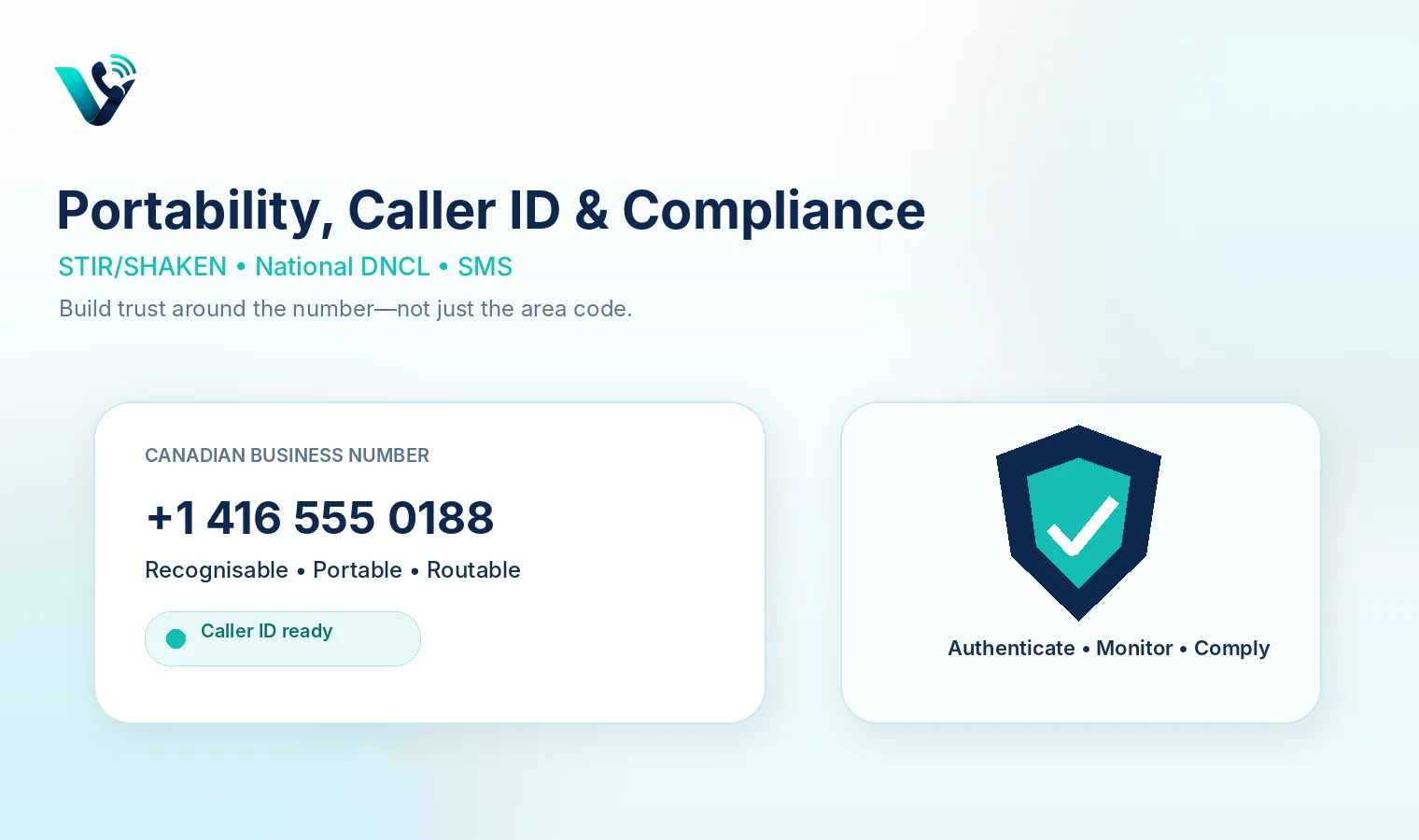
Canada virtual-number strategy
Option |
Useful for |
Watch for |
|
Local Canadian number |
Regional sales or customer contact |
Area code familiarity does not equal physical-office proof |
|
Canadian toll-free |
National support or sales |
Provider pricing, routing and portability |
|
Local + toll-free |
Multi-market growth |
Keep routing and caller identity consistent across numbers |
Frequently asked questions
- Can I get a Canada virtual phone number without a Canadian office?
- Often yes, depending on the provider and number type. Use it as a contact channel and do not falsely represent a physical office that does not exist.
- Can a Canadian virtual number route overseas?
- Yes, when the provider supports international or VoIP routing. Test call quality, time-zone rules and failover before publishing the number.
- Can I port a Canadian business number?
- Many numbers can be kept when changing providers, subject to eligibility and provider processes. Confirm the exact porting requirements for your number.
- Does Canada use STIR/SHAKEN?
- Yes. The CRTC has implemented caller-ID authentication measures for IP voice services, although authentication does not guarantee a positive spam reputation.
- Do Canadian telemarketing rules apply to international callers?
- If you are making telemarketing calls to people or businesses in Canada, review the CRTC rules that apply to your campaign and audience, including any National DNCL obligations or exemptions.
- Are B2B calls exempt from all Canadian telemarketing rules?
- No. Certain business-to-business calls may be exempt from National DNCL provisions, but other Unsolicited Telecommunications Rules can still apply.