Cold Call Opening Lines That Survive the First Eight Seconds
By Jamila Parker · · 8 min read

Cold call opening lines for B2B sales that earn a few more seconds of attention by being clear, relevant and easy to respond to without sounding scripted.
Key takeaways
- The opening should earn permission to continue, not deliver the whole pitch.
- Specific context beats generic enthusiasm.
- A short reason for calling is stronger than a long company introduction.
- Use plain language and a question that is easy to answer.
- Test patterns by qualified conversations, not by how clever the line sounds.
What The First Eight Seconds Are Really For
The first eight seconds of a cold call are not enough to explain your product, prove ROI and book a meeting. They are enough to answer the prospect’s immediate questions: Who is this, why are they calling me, and do I want to keep listening? The best cold call opening lines are designed around that smaller job.
When a rep tries to cram a pitch into the opening, the call sounds like a script before the prospect has any reason to care. When the rep starts with vague friendliness, the prospect still does not know why the call exists. A better opening is brief, specific and comfortable enough that the other person can respond naturally.
The goal is not to trick someone into staying on the line. It is to create a clear reason for the conversation and give the prospect an easy choice to continue.
A Simple Structure For Cold Call Opening Lines
A practical B2B opening can follow four parts: Identity, relevance, reason and a low-friction question. Identity tells the person who is calling. Relevance connects the call to something about their role, company or situation. Reason names the problem or change worth discussing. The question invites a response without demanding a meeting immediately.
Example pattern: “Hi Maya, David from Votelly. I’m calling because you’re expanding the support team across two regions. Teams at that stage often struggle with missed calls between shifts. Is that already sorted, or still a bit messy?”
That opening does not make a dramatic claim. It simply gives the prospect enough context to decide whether the topic belongs in their world.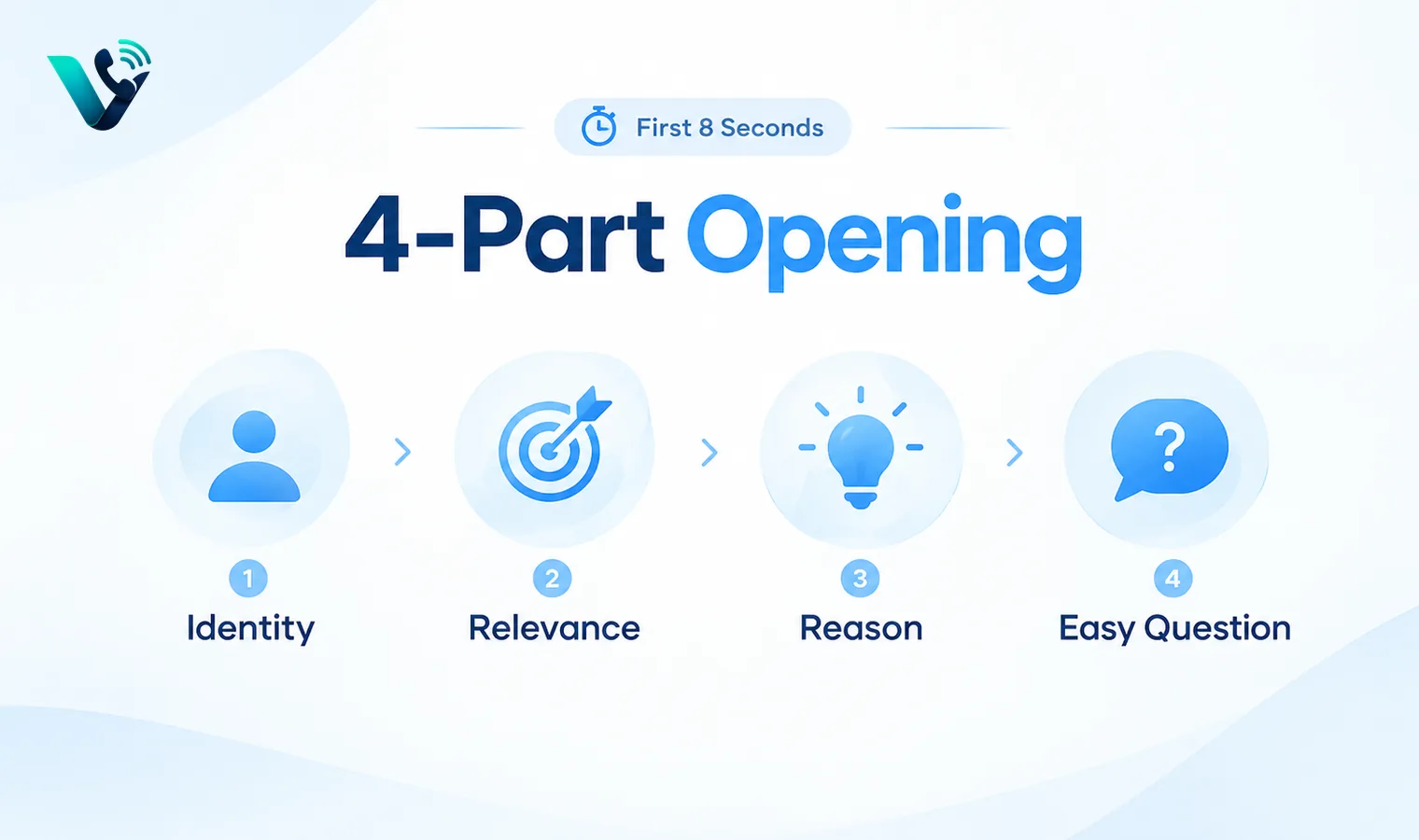
Opening Line Pattern 1: The Observable Trigger
Trigger-based cold call opening lines work when the rep can point to a real, recent change. The trigger might be hiring, a new location, a funding round, a product launch, a new market, a large contract win or another public signal that changes the prospect’s workload.
Pattern: “Hi Sam, David from Votelly. I saw you’ve opened the Manchester office. When teams add a location, business calling usually gets split across mobiles and forwarding pretty quickly. How are you handling that today?”
The trigger matters because it explains why the call is happening now. Do not invent one. A fake observation such as “I was looking at your website” adds no value and can make the call feel less trustworthy.
Opening Line Pattern 2: Role-Specific Problem
If there is no timely trigger, use a problem tied to the person’s role. The strongest version names an operational situation rather than a broad benefit.
Pattern: “Hi Jordan, David from Votelly. Quick reason for the call: Sales ops teams often tell us missed inbound calls are easy to see but hard to assign. Are callbacks owned by the rep today, or by a shared team?”
This gives the prospect a concrete question. Even a short answer tells the rep something useful and makes the conversation more natural than “I wanted to introduce our platform.”
Opening Line Pattern 3: Permission With Substance
Permission-based openings can work when the permission question contains an actual reason for the call. “Did I catch you at a bad time?” is easy to dismiss because it gives no context. A better permission line makes the topic visible first.
Pattern: “Hi Priya, David from Votelly. I’m calling about how your inbound sales calls are routed. Can I take twenty seconds to explain why I thought it was relevant?”
The prospect can say no, which is important. But if they say yes, the rep has earned a short window to continue. Keep the next sentence just as disciplined; permission is not a licence for a two-minute monologue.
Opening Line Pattern 4: The Direct Problem Check
Direct problem checks are useful when the team has a narrow ideal customer profile and a problem that is easy to recognise.
Pattern: “Hi Alex, David from Votelly. Do missed calls ever sit without a clear owner on your sales team?”
The risk is being too generic. “Do you want more sales?” is technically a problem check but it applies to almost everyone and signals a generic pitch. The question should be specific enough that the answer teaches the rep something about the workflow.
Opening Line Pattern 5: Referral Or Internal Context
When there is a legitimate referral, use it early. “Jamie in customer success suggested I speak with you about the new phone routing setup” is stronger than hiding the referral until later.
Internal context also matters for multi-threaded accounts. If another stakeholder has already discussed the topic, say so accurately: “I spoke with Mia on your operations team about after-hours coverage, and she said you own the sales side.”
Do not imply endorsement the other person did not give. Referrals work because they reduce uncertainty, so overstating them defeats the purpose.
What Not To Say In The First Eight Seconds
Opening |
Why it fails |
Better direction |
|
“How are you today?” |
Feels scripted when no relationship exists |
Move quickly to who you are and why you called |
|
“I wanted to introduce our company…” |
Makes the call about the seller |
Lead with the prospect’s situation |
|
“We are the leading provider…” |
Unverified self-praise before relevance |
Use one concrete reason for calling |
|
“Do you have 15 minutes?” |
Asks for too much too early |
Ask a one-sentence question first |
|
“I was just checking your website…” |
Often sounds generic or automated |
Use a real trigger or be plainly direct |
Cold call opening lines fail when they consume attention without giving the prospect useful information. Every word in the first few seconds should reduce uncertainty or create relevance.
How To Sound Natural Without Improvising Everything
A script should give the rep a structure, not a performance. Write several approved opening patterns and let the rep choose the one that fits the account. This creates consistency without forcing every call into identical wording.
Reps should practise the opening until the delivery is relaxed. Read it aloud. Remove phrases that are hard to say. Replace marketing language with words the prospect would use. If the line only sounds good on a slide, it is not ready for a real call.
The first sentence should also work when interrupted. Prospects often respond before the rep finishes the planned opening. A good structure allows the conversation to branch rather than requiring the rep to “get through the script.”
The Second Question Matters More Than The Clever Opener
Even a strong opening only buys a few more seconds. The next question determines whether the call becomes discovery or returns to a pitch. Use what the prospect says and ask one level deeper.
If they say callbacks are handled manually, ask who owns them. If they say routing is fine, ask what happens after hours. If they say they already have a provider, ask what they would change if they could. The objective is to understand the current state, not to defeat the first objection immediately.
This is why cold call opening lines should be evaluated as part of a conversation path. An opener that produces lots of “sure, go ahead” responses but no meaningful dialogue may still be weak.
Try this on your own numbers
Local numbers in 118 countries, AI call notes and one shared inbox. Live the same day, no contract.
How To Test Cold Call Opening Lines
Test a small number of patterns across comparable lists and calling windows. Track live connects, conversations that reach a meaningful second question, qualified outcomes and meetings. Do not judge an opener by one memorable call.
- Live connects that continue beyond the opening.
- Prospects who answer the first problem question.
- Qualified conversations per hundred connects.
- Meetings or next actions created.
- Immediate objections by opening pattern.
Keep the sample large enough that one rep or one unusual day does not decide the result. The best opening line is the one that repeatedly creates useful conversations with the right prospects.
Create Versions For Different Call Contexts
One universal opener is rarely enough. Build separate cold call opening lines for brand-new prospects, missed inbound leads, event follow-up, referrals and existing accounts. The identity of the caller may be the same, but the reason for the call is different.
A missed inbound lead deserves an opening that references the enquiry. A referral should name the source accurately. An existing account should use known context rather than pretending the relationship is cold. Relevance improves when the script matches the call type.
Keep each version short and train reps on when to use it. The goal is not a library of fifty scripts; it is a small set of clear patterns that make the first seconds feel appropriate to the situation.
Frequently asked questions
- What is a good cold call opening line?
- A good opening quickly identifies the caller, gives a relevant reason for the call and asks a simple question that lets the prospect respond naturally. Should I ask “Did I catch you at a bad time?” It can be easy to dismiss because it provides no context. Permission works better when the topic is visible first.
- How long should a cold call opening be?
- Keep it short enough to say comfortably in one breath or two. The goal is to earn the next exchange, not deliver the full pitch.
- Should cold call openings be scripted?
- Use a few tested structures rather than a word-for-word performance. Reps should adapt to the account and the prospect’s response.
- What makes an opening relevant?
- A real trigger, a role-specific operational problem, a legitimate referral or another reason that explains why this person is being called.
- How do I measure an opening line?
- Measure meaningful conversations, qualified outcomes and meetings from live connects rather than relying only on total call duration.