Local vs National vs Mobile Virtual Numbers: Which Type Should You Buy?
By Jamila Parker · · 8 min read

Compare local, national and mobile virtual numbers by customer perception, routing, SMS capability, geographic identity, cost and compliance before choosing a business number.
Key takeaways
- Local numbers signal a geographic area; national numbers create a country-wide business identity; mobile numbers may support mobile-style calling or messaging depending on the market.
- The label “virtual” describes how the number is delivered, not a universal feature set.
- Choose based on the customer journey and required capabilities: inbound voice, outbound caller ID, SMS, WhatsApp, portability, emergency service and compliance.
- For multi-market teams, one number type does not have to serve every workflow.
Quick comparison
Local vs national vs mobile virtual numbers is really a question of identity and capability. A local number is associated with a geographic area where the national numbering plan uses area codes. A national or non-geographic business number is designed for country-wide reach without the same city identity. A mobile number belongs to a mobile numbering range and may support features such as SMS, although virtual delivery does not guarantee messaging.
The best option is the one that matches how customers contact the business. A local sales office, nationwide support desk and two-way messaging team can legitimately need three different number types.
Number type |
Best fit |
Main trade-off |
Local / geographic |
Regional sales, branches, local support |
Can imply a physical/local presence and may have address rules |
National / non-geographic |
Country-wide brand, central support |
Less local identity; availability varies by country |
Mobile |
Two-way mobile-style communications where supported |
Messaging, verification and outbound rules vary widely |
Local virtual numbers
Local numbers use geographic numbering where the country’s plan assigns areas or cities. They can make sense for a branch, regional campaign or business that genuinely serves customers in a defined area. Customers often recognise the area code, which can make the number easier to understand on a local landing page or directory listing.
But do not use “local” as a synonym for “available to anyone.” Some countries require an address or business connection to the area. Others make geographic numbers easy to provision through carriers. The provider should state the eligibility rules for the exact locality.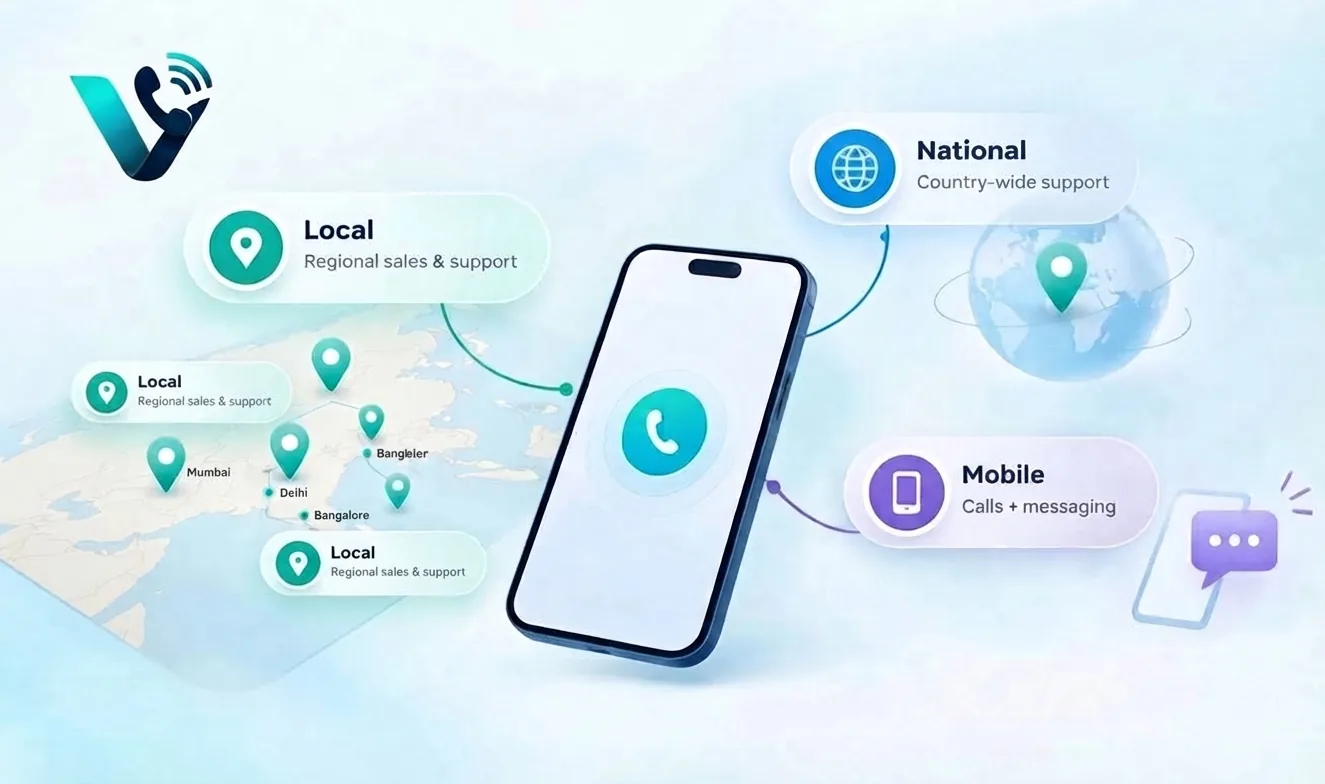
National and non-geographic numbers
National numbers are useful when a company wants one country-wide contact identity without tying the number to one city. Depending on the country, the relevant range may be called national, non-geographic, shared-cost, business or another service category. Toll-free numbers are also non-geographic in many numbering plans, although their charging model is different.
These numbers can work well for centralised customer service because the same contact point can be advertised nationwide. The trade-off is that they may not provide the regional familiarity of a city code, and some ranges have special pricing or reachability rules.
Mobile virtual numbers
A mobile-range number can be attractive when customers expect to text as well as call. However, a virtual mobile number is not automatically equivalent to a physical SIM. SMS, MMS, WhatsApp registration, two-factor authentication and emergency-service support depend on the carrier, number range and destination platform.
If messaging is essential, test it before choosing the number for the brand. Many verification systems reject some VoIP or hosted ranges, and some countries restrict how mobile resources are assigned. Buy for the actual workflow, not for the word “mobile” on a product page.
How customer perception should influence the choice
Use a local number when the geographic relationship is meaningful and accurate. Use a national number when customers are spread across a country and the company wants one central identity. Use a mobile number when customers commonly communicate through mobile channels and the provider can support the required features.
Avoid treating number type as a persuasion trick. A misleading local identity can damage trust if customers discover that the company has no connection to the area. The stronger strategy is transparent business identity plus reliable service.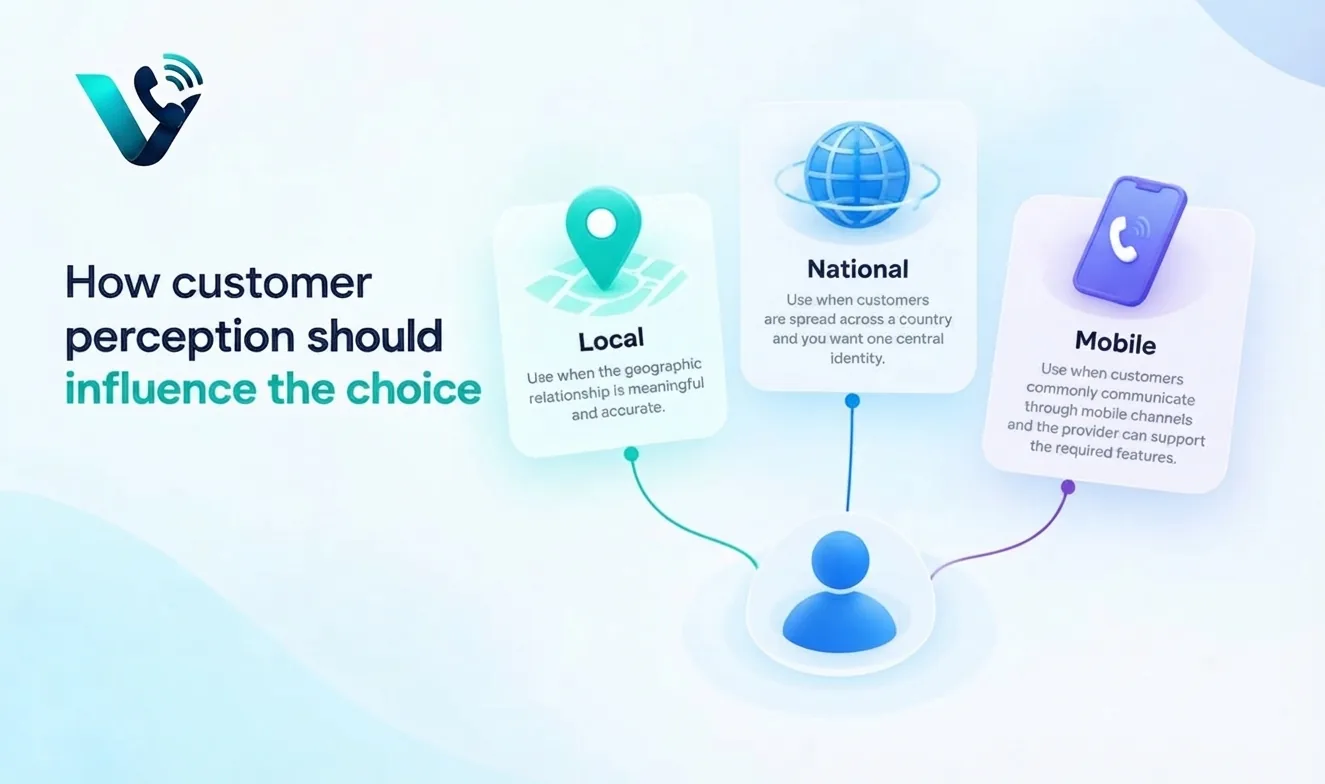
Feature differences that matter
Check inbound and outbound voice, SMS, outbound caller ID, concurrent calls, number porting, recording, emergency calling, CNAM or business-name display where applicable, SIP compatibility and fraud controls. Two numbers in the same country can support very different features because they belong to different carriers or regulatory categories.
Also consider call cost. Local and national numbers can have different caller tariffs, and mobile termination can be priced differently. Toll-free shifts cost toward the business. Model both customer experience and operating cost.
A simple buying framework
Start with the job to be done. If the requirement is “customers in Manchester should call a familiar regional support line,” start with a local number. If it is “customers anywhere in the country need one service desk,” evaluate national or toll-free. If it is “customers call and text the same number,” investigate mobile-capable ranges and verify messaging.
Then screen for regulation and documentation, test number availability, review pricing and validate the route before launch. If one number cannot meet every requirement, use multiple numbers tied to the same cloud phone system.
What global teams should do differently
Global teams should maintain a number inventory with owner, country, type, purpose, provider, renewal cost, KYC expiry, routing destination and compliance notes. This prevents orphaned numbers and helps teams understand why each number exists.
Standardise the cloud layer while allowing number types to vary by country. A support team can still use one queue even if one market enters through a toll-free number, another through a local number and another through a national number.
Examples by business model
A local home-services company may benefit from a geographic number because service territory matters. A national SaaS provider may prefer a non-geographic support number because customers are distributed across the country. A delivery marketplace may value a mobile-capable number if operational conversations happen by text as well as voice.
An international B2B company may use all three: Geographic numbers in strategic cities, one national support number, and mobile-capable numbers for selected workflows. The cloud system can route them to the same team while keeping reporting separate.
Procurement questions to ask before committing
When evaluating local vs national vs mobile virtual numbers, ask the provider to answer the commercial and technical questions in writing. Confirm the exact number type, current inventory, monthly rental, inbound and outbound call rates, included channels, overage pricing, minimum term, cancellation process and whether the number can be ported later. Then ask which capabilities are tied to the exact number rather than to the platform in general. This distinction matters because a dashboard may support SMS, recording or outbound caller ID even when a particular country range does not.
Compliance questions deserve the same treatment. Ask which carrier or licensed operator supplies the number, what KYC or business documents are required, whether a local address or entity is needed, and whether any intended-use restriction applies. Local numbers signal a geographic area; national numbers create a country-wide business identity; mobile numbers may support mobile-style calling or messaging depending on the market. A provider that can explain these dependencies clearly is usually easier to work with than one that promises universal instant activation without qualifying the number type or market.
Test the complete customer journey before launch
A successful local vs national vs mobile virtual numbers deployment should be tested from the customer side, not only from the admin portal. Place calls from the networks your customers are likely to use, listen for post-dial delay, confirm two-way audio, press IVR keys, transfer between agents, leave voicemail and trigger after-hours routing. If the workflow includes outbound calling, verify that the intended caller ID is presented correctly and that callbacks return to a monitored destination. If SMS is important, test sending and receiving with the real number instead of assuming support from a feature list.
Also test failure conditions. Temporarily make the primary queue unavailable and confirm that overflow or failover works. Check what happens when all agents are busy, when a call arrives outside business hours and when the destination system is offline. The label “virtual” describes how the number is delivered, not a universal feature set. These tests are inexpensive compared with discovering a broken route after the number has been printed on a campaign, customer portal or product packaging.
Try this on your own numbers
Local numbers in 118 countries, AI call notes and one shared inbox. Live the same day, no contract.
Measure the first 30 days and adjust
After launch, treat local vs national vs mobile virtual numbers as an operating channel with measurable outcomes. Track total calls, unique callers, answer rate, missed calls, average speed to answer, abandoned calls, call duration, transfer rate and the business result that matters for the use case. For sales that might be qualified meetings or revenue; for support it may be first-contact resolution, reopen rate or customer satisfaction. Segment performance by number so the team can see whether the chosen market or number type is actually useful.
Review cost at the same time. Include rental, usage, forwarding, recording, contact-centre licences and any carrier surcharges, then compare that total with the value created. If the number receives little traffic, consider whether it still serves a brand or compliance purpose. If demand is high, add channels or more specialised routing before adding more public numbers. Good comparison / virtual numbers strategy usually comes from improving a small number of well-managed customer entry points rather than accumulating numbers with no clear owner.
Bottom line
There is no universal winner in local vs national vs mobile virtual numbers. Local is strongest for genuine geographic relevance, national for a broad country-wide identity, and mobile for mobile-channel workflows where supported. Decide from the customer journey outward, then verify the provider, range and compliance details before buying.
Frequently asked questions
- What is a local virtual phone number?
- It is a geographic phone number delivered through a cloud or virtual phone system rather than being tied to one traditional line.
- What is a national virtual number?
- It is a country-wide or non-geographic business number that is not primarily identified with one city or local area.
- Are mobile virtual numbers good for SMS?
- They can be, but messaging support depends on the exact range, provider and destination service. Test before relying on it.
- Which number type is best for customer support?
- Local, national or toll-free can all work. Choose based on customer location, call cost, service volume and the brand experience you want.
- Can one company use multiple number types?
- Yes. Many businesses use local numbers for sales, national or toll-free for support, and mobile-capable numbers for messaging.
- Does a virtual number always support outbound caller ID?
- No. Outbound presentation must be supported and authorised for the exact number and provider route.