How Many Business Phone Numbers Does a Global Sales Team Need?
By Jamila Parker · · 8 min read

A practical framework for deciding how many phone numbers a global sales team needs by country, campaign, team, compliance, routing and reporting requirements.
Key takeaways
- There is no fixed number-per-rep rule. Start with markets, customer journeys and ownership rather than headcount.
- A useful baseline is one stable inbound identity per priority market or function, then add dedicated numbers only when routing, attribution or compliance needs justify them.
- Too many numbers create cost, reputation and governance problems; too few can make routing and reporting messy.
- Maintain a central number inventory with purpose, owner, provider, market, KYC and routing destination.
Quick answer: There is no universal number-per-rep formula
A global sales team needs enough business phone numbers to create clear customer entry points, support compliant outbound calling and measure performance without creating an unmanageable inventory. That number is driven by markets, teams and workflows not simply by the number of salespeople.
A ten-person team selling into one country may need only a main inbound line plus a small pool of outbound numbers. A three-person team selling into six countries may need more numbers because each market has different caller expectations, numbering rules and routing requirements.
Start with markets, not employees
List every country where the team actively sells, then classify each as core, growth or experimental. Core markets usually justify a stable customer-facing number. Growth markets may justify a number when there is sustained pipeline or inbound demand. Experimental markets can often begin with an existing regional line until data proves that a separate local identity is useful.
This prevents the common mistake of buying dozens of numbers because a provider makes provisioning easy. Inventory should follow a commercial reason.
Decide what each number is supposed to do
Numbers generally serve one of four jobs: Inbound sales, outbound prospecting, campaign attribution or account ownership. A main inbound sales number should be stable and well published. Outbound numbers should be controlled, monitored for reputation and linked to compliant calling policy. Campaign numbers can provide attribution, but they should not proliferate without a retirement plan.
Account-specific direct numbers can be valuable for enterprise customers, yet the company should retain a fallback route if the account owner changes roles or leaves.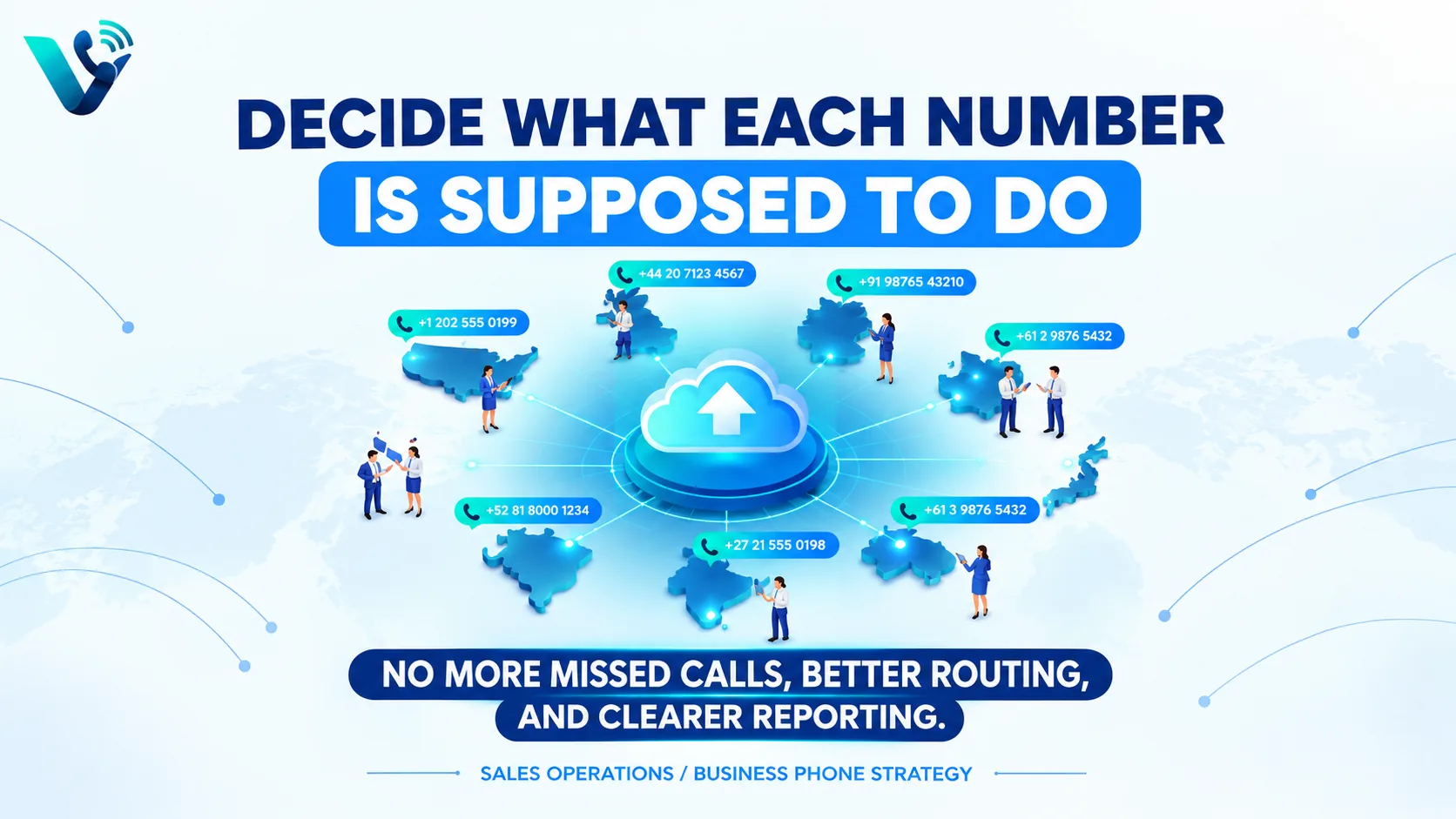
A practical sizing model
Use a layered model. First, allocate one primary inbound number for each priority country or major region where customers need a local entry point. Second, add functional numbers only where sales and support must be separated. Third, add outbound numbers when carrier policy, call volume or team segmentation requires them. Fourth, add temporary campaign numbers only when attribution value exceeds operational overhead.
This model often produces fewer numbers than a “one number per rep per country” approach while still giving customers clear access and managers useful reporting.
Why too many numbers become a problem
Every number creates lifecycle work: KYC, Billing, Configuration, Caller-ID reputation, Monitoring, Renewals, Ownership and Eventual decommissioning. Numbers that are forgotten can keep generating fees or, worse, remain published after the team stops monitoring them.
Large uncontrolled pools can also fragment answer rates and reputation data. Instead of learning whether one stable business identity is trusted, the company constantly rotates through unfamiliar numbers. Rotation should never be used as a tactic to evade spam controls or recipient preferences.
Why too few numbers also hurts
If one global number handles every market, customers may face international calling cost, unfamiliar formatting or inappropriate language menus. Reporting can also become muddy because market source must be inferred from CRM records rather than the dialled number.
A small amount of segmentation can improve routing. Separate country entry points can still terminate on the same sales queue, while the platform passes the dialled number as metadata so the agent sees market context.
When campaigns deserve dedicated numbers
A dedicated campaign number is useful when phone calls are an important conversion event and attribution would otherwise be lost. Examples include event booths, print campaigns, partner programmes and offline advertising. For digital campaigns, dynamic number insertion can sometimes provide more precise attribution, but it should be implemented carefully so canonical business details remain consistent for local SEO and customer recognition.
Retire campaign numbers deliberately. Keep a redirect or recorded message during the transition period so leads are not lost when a campaign ends.
Governance: Build a number inventory
Maintain a simple register containing the phone number, country, type, provider, purchase date, monthly cost, business owner, technical route, purpose, KYC documents, renewal status and where the number is published. Add a review date and decommissioning owner.
This register is especially important when sales teams change CRM systems or providers. It prevents business-critical numbers from being stranded in an old account.
A simple quarterly number review
Every quarter, review each number against five questions: Is it still published? Does it receive meaningful traffic? Is its owner still correct? Is the routing still tested? Does the cost or compliance burden still make sense? Numbers that fail these checks should be fixed, consolidated or retired.
When retiring a number, remove it from websites, directory profiles, email templates, CRM sequences and ads. Keep a temporary redirect or announcement where feasible, then document the final cancellation date and provider confirmation.
Procurement questions to ask before committing
When evaluating how many business phone numbers does a global sales team need, ask the provider to answer the commercial and technical questions in writing. Confirm the exact number type, current inventory, monthly rental, inbound and outbound call rates, included channels, overage pricing, minimum term, cancellation process and whether the number can be ported later. Then ask which capabilities are tied to the exact number rather than to the platform in general. This distinction matters because a dashboard may support SMS, recording or outbound caller ID even when a particular country range does not.
Compliance questions deserve the same treatment. Ask which carrier or licensed operator supplies the number, what KYC or business documents are required, whether a local address or entity is needed, and whether any intended-use restriction applies. There is no fixed number-per-rep rule. Start with markets, customer journeys and ownership rather than headcount. A provider that can explain these dependencies clearly is usually easier to work with than one that promises universal instant activation without qualifying the number type or market.
Test the complete customer journey before launch
A successful how many business phone numbers does a global sales team need deployment should be tested from the customer side, not only from the admin portal. Place calls from the networks your customers are likely to use, listen for post-dial delay, confirm two-way audio, press IVR keys, transfer between agents, leave voicemail and trigger after-hours routing. If the workflow includes outbound calling, verify that the intended caller ID is presented correctly and that callbacks return to a monitored destination. If SMS is important, test sending and receiving with the real number instead of assuming support from a feature list.
Also test failure conditions. Temporarily make the primary queue unavailable and confirm that overflow or failover works. Check what happens when all agents are busy, when a call arrives outside business hours and when the destination system is offline. A useful baseline is one stable inbound identity per priority market or function, then add dedicated numbers only when routing, attribution or compliance needs justify them. These tests are inexpensive compared with discovering a broken route after the number has been printed on a campaign, customer portal or product packaging.
Measure the first 30 days and adjust
After launch, treat how many business phone numbers does a global sales team need as an operating channel with measurable outcomes. Track total calls, unique callers, answer rate, missed calls, average speed to answer, abandoned calls, call duration, transfer rate and the business result that matters for the use case. For sales that might be qualified meetings or revenue; for support it may be first-contact resolution, reopen rate or customer satisfaction. Segment performance by number so the team can see whether the chosen market or number type is actually useful.
Review cost at the same time. Include rental, usage, forwarding, recording, contact-centre licences and any carrier surcharges, then compare that total with the value created. If the number receives little traffic, consider whether it still serves a brand or compliance purpose. If demand is high, add channels or more specialised routing before adding more public numbers. Good sales operations / business phone strategy strategy usually comes from improving a small number of well-managed customer entry points rather than accumulating numbers with no clear owner.
Try this on your own numbers
Local numbers in 118 countries, AI call notes and one shared inbox. Live the same day, no contract.
Final operational check before scaling
Before scaling how many business phone numbers does a global sales team need, run one final review with sales, support, IT and whoever owns telecom compliance. Confirm who owns the number, where calls route, which hours are covered, what happens during an outage, how recordings or customer data are handled, and how the number will be retired if the market strategy changes. A short cross-functional review catches problems that are easy to miss when procurement, routing and customer experience are handled by separate teams.
Bottom line
The right number of phone numbers is the smallest set that gives customers appropriate local access, keeps routing clear, supports legitimate outbound workflows and preserves useful attribution. Start with stable market-level identities, add numbers only for a specific operational reason, and manage the inventory like any other business asset.
Frequently asked questions
- Should every salesperson have a separate business number?
- Not necessarily. Direct numbers can help account ownership, but shared inbound and controlled outbound pools may be easier to manage for many teams.
- Should a global sales team have one number per country?
- Priority markets often benefit from a dedicated entry point, but low-volume or experimental markets may not justify one immediately.
- How many outbound numbers should a sales team use?
- Use the number of authorised, well-managed identities needed for volume and segmentation. Avoid unnecessary rotation or any attempt to bypass reputation controls.
- Are campaign phone numbers useful?
- Yes when phone-call attribution matters. They should have a clear owner, reporting purpose and retirement plan.
- What information belongs in a phone-number inventory?
- Track number, country, type, provider, cost, owner, purpose, routing, KYC, publication locations and review date.
- When should a business retire a phone number?
- Retire numbers that no longer serve an active market, team or campaign after removing published references and providing an appropriate transition path.