Building an SDR calling day, hour by hour
By Jamila Parker · · 8 min read

A productive SDR calling day protects high-value call windows, batches admin work and leaves room for research, follow-up and coaching. Here is an hour-by-hour model you can adapt.
Key takeaways
- A strong SDR calling day protects two or three focused calling windows instead of scattering calls between meetings and Slack messages.
- Prepare the list before the call block so the rep spends prime calling time speaking, not researching or cleaning data.
- Use buyer local time when choosing call windows; the rep’s office clock is not the only clock that matters.
- Batch CRM updates and low-value admin work around calling windows, while still logging outcomes quickly enough for follow-up automation.
- Judge the daily routine by conversations, meetings, follow-up completion and pipeline quality, not by dial count alone.
An SDR calling day works best when every hour has a job. The goal is not to create a rigid timetable that makes reps feel like machines. The goal is to protect the work that creates conversations from the constant friction of inboxes, research, meetings, CRM cleanup and internal messages. For teams that depend on outbound calling, a repeatable daily schedule also makes performance easier to diagnose: If call blocks are protected but connect rates are weak, investigate data and timing; if connects are healthy but meetings are low, investigate conversations and targeting.
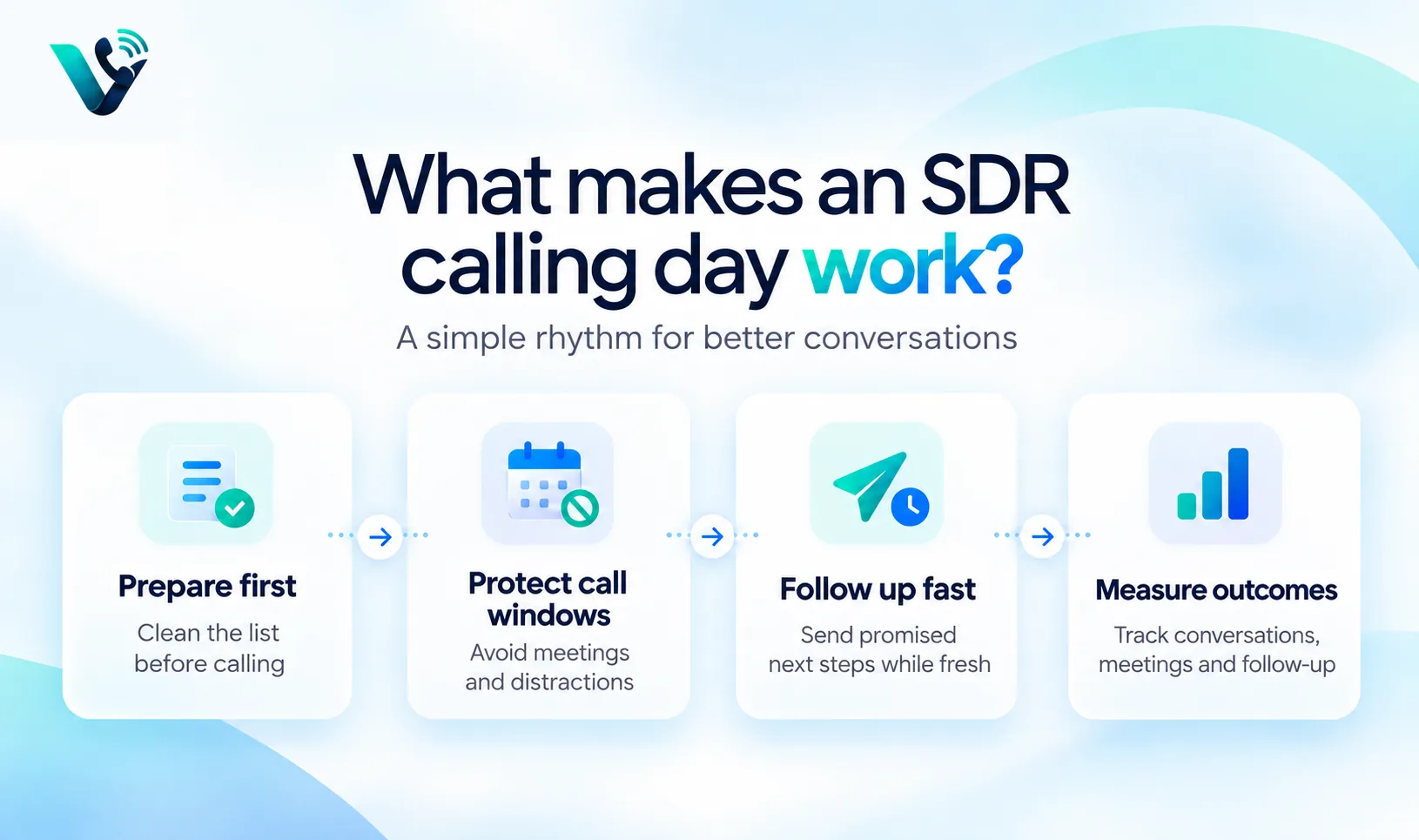
The principle: Build the day around buyer availability
HubSpot’s 2025 cold-calling survey found late morning, roughly 10 a.m. to noon, was the most commonly reported productive window among respondents, and Tuesday was the most frequently selected day. Those findings are useful starting points, not universal rules. Your SDR daily schedule should use prospect local time, industry routines and your own answer-rate data. A London rep calling New York should not copy a UK 10 a.m. block if it lands before the US buyer has started work.
The other principle is batching. Research and dialling use different kinds of attention. So do coaching, email writing and CRM hygiene. Every time a rep switches from a live calling rhythm to a spreadsheet or Slack thread, momentum drops. Build the day so preparation happens before the block, calls happen in a protected window, and follow-up happens immediately enough to preserve context.
An hour-by-hour SDR calling schedule
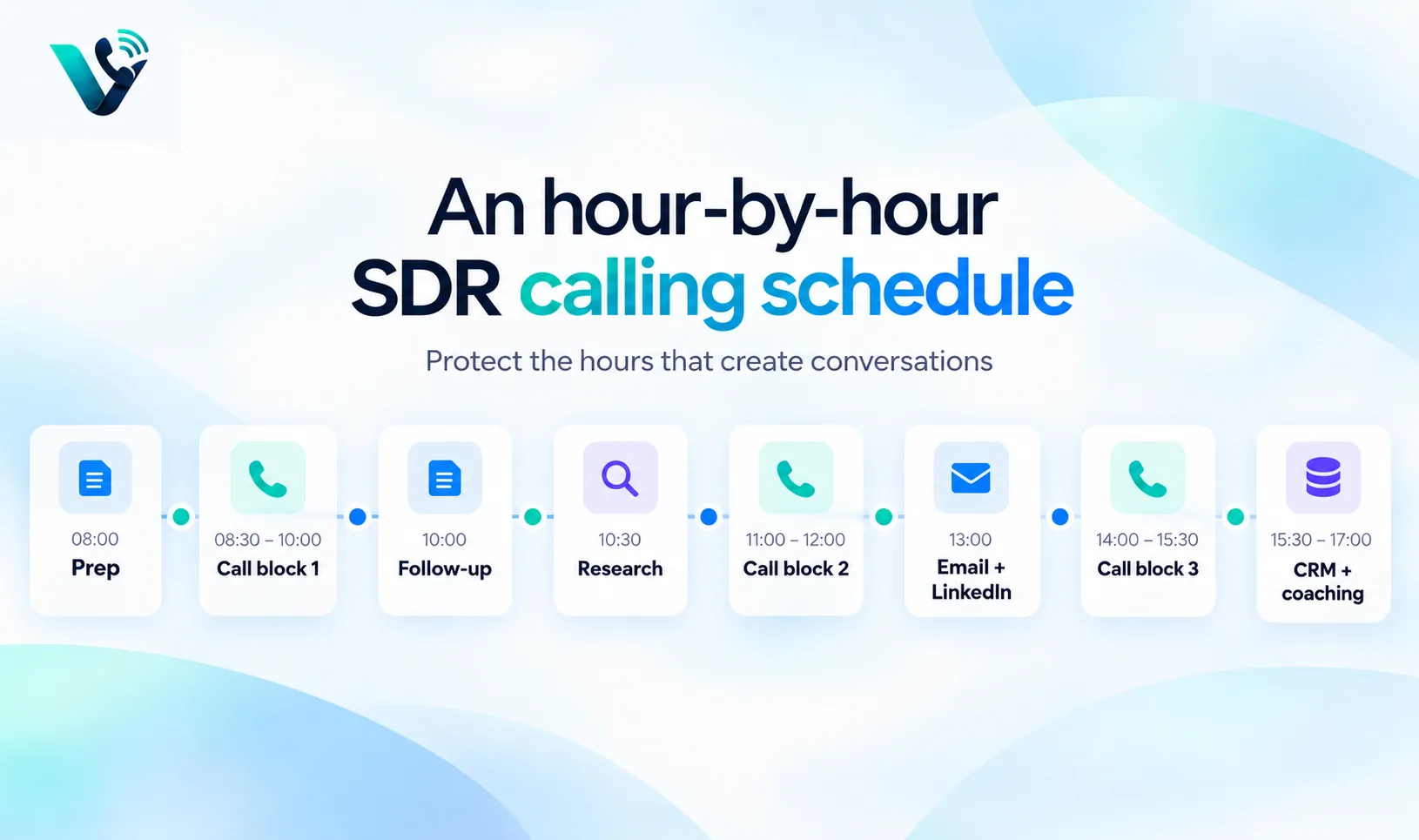
Time |
Primary block |
Purpose |
|
08:00-08:30 |
Priority review and list prep |
Handle replies, inspect intent signals, confirm call list and local times |
|
08:30-10:00 |
Call block 1 |
Reach early-window prospects; focus on priority accounts and callbacks |
|
10:00-10:30 |
Follow-up sprint |
Send promised emails, calendar links and short personalised notes |
|
10:30-11:00 |
Research refresh |
Build the next list segment; verify contacts and trigger events |
|
11:00-12:00 |
Call block 2 |
Use a late-morning window for the territory that is currently active |
|
12:00-13:00 |
Lunch and reset |
Protect a real break; Avoid turning lunch into CRM backlog |
|
13:00-14:00 |
Email, social and inbound replies |
Run complementary channels and respond to warm activity |
|
14:00-15:30 |
Call block 3 or meetings |
Second territory window, scheduled callbacks or booked discovery |
|
15:30-16:00 |
CRM and pipeline hygiene |
Close dispositions, update notes, create tasks and fix data gaps |
|
16:00-16:30 |
Coaching or team review |
Call review, objection practice or metric review |
|
16:30-17:00 |
Tomorrow prep |
Build first list, protect next-day blocks and review open commitments |
08:00-08:30: Prepare the day before the phone starts
The first thirty minutes should remove friction from the first calling block. Review overnight replies, meeting cancellations, inbound leads and any account signals that change priority. Confirm that numbers are valid, the contacts fit the campaign and the prospect local time is appropriate. If a rep begins the call block by searching LinkedIn for every company, the schedule is already broken.
Create a short priority layer rather than treating the whole sequence as equal. Callbacks requested by prospects, inbound hand-raisers, event attendees, high-fit accounts and time-sensitive triggers usually deserve attention before untouched cold records. The rest of the list can follow the normal cadence. This improves the quality of the SDR calling day without requiring the rep to research every account deeply.
08:30-10:00: Call block 1
The first call block should be distraction-light. Close unnecessary tabs, pause internal notifications where company policy allows it and keep the CRM record visible. The rep should be able to move from one eligible prospect to the next with minimal setup time. A power dialler can reduce manual number entry and logging, but it should not remove judgement about who belongs in the block.
Use this block for prospects whose local morning is active or for scheduled callbacks that already have intent. Track connects and meaningful conversations separately from raw dials. If a rep makes fifty calls and reaches two wrong people, that is a list-quality signal. If the rep reaches ten intended buyers but creates no next step, that is a conversation or targeting signal.
10:00-10:30: Follow up while context is fresh
Do not postpone every promised follow-up until the end of the day. If a buyer asked for a case study, pricing summary or calendar link, send it while the conversation is still fresh. Use templates for the structure, but personalise the line that proves the message belongs to the call. Log a clear call disposition so the CRM knows whether the contact is a callback, nurture, meeting booked, no fit or another outcome.
10:30-11:00: Research the next block
This is a controlled research window, not an invitation to spend thirty minutes on one account. Verify the next segment, scan company news or role context, and identify one relevant reason to call. HubSpot’s survey found many cold callers use company websites, social profiles and CRM history for research. That supports a practical model: Lightweight research at scale, deeper research only for accounts where the expected value justifies it.
11:00-12:00: Call block 2
Late morning can be a strong test window for many office-based B2B segments, but your own data should decide whether it stays. Compare intended-person connect rate, meaningful conversation rate and meetings per conversation by hour. If 11 a.m. produces more answers but 9 a.m. produces better meetings, decide which outcome matters for the campaign instead of optimising for pickup alone.
13:00-14:00: Run the channels that support the phone
Cold calling works inside a broader prospecting system. Use early afternoon for email responses, LinkedIn touches, short voice follow-ups where appropriate, and handling prospects who engaged with earlier outreach. HubSpot’s 2025 report shows cold calling is commonly paired with email and social outreach. The important operational rule is that channels should support the same account strategy rather than create disconnected activity quotas.
14:00-15:30: Call block 3, callbacks or discovery
The afternoon block can serve a different territory or a different intent level. An SDR in Europe may begin calling the US as North American business hours open. A US team may use the same time for West Coast prospects. Scheduled callbacks should take priority over cold dials because the buyer has already agreed to the interaction. If the SDR also runs discovery meetings, protect those meetings rather than forcing them between random outbound attempts.
15:30-16:00: Close the data loop
CRM hygiene should be short, accurate and useful. Finish dispositions, create future tasks, merge duplicates and correct invalid numbers discovered during the day. Do not turn the CRM block into narrative writing. Notes should preserve context for the next action: Problem mentioned, relevant stakeholder, timing, objection and promised follow-up. If the phone platform can log activity and summaries automatically, use that automation to reduce repetitive admin while keeping the rep responsible for the commercial meaning.
16:00-16:30: Coaching belongs inside the week
Coaching is easier to sustain when it has a predictable place in the operating rhythm. A manager can review one call, practise one objection or examine the funnel from dials to conversations to meetings. Keep the session specific enough that the rep can apply the change during the next calling block. Avoid using this time only for leaderboard reporting; performance review and skill coaching are different activities.
16:30-17:00: Make tomorrow easier
The final half hour should reduce tomorrow’s startup cost. Build the first call list, mark priority callbacks, check timezone changes and protect the next day’s calendar. Reps who end the day with an empty first block often spend the most valuable morning minutes deciding what to do. A prepared queue lets the SDR begin with action instead of administration.
How to adapt the SDR calling day
How Votelly fits into the daily workflow
Votelly’s sales-team and power-dialler pages describe one-click or automated dialling, local caller ID, call logging and CRM-connected workflows, while its analytics page focuses on live performance visibility. Those pages are the natural product links from an SDR daily schedule. The article should stay educational: The daily operating model comes first, and the phone platform removes friction around dialling, logging, local presence and measurement where the current Votelly feature set supports it.
Try this on your own numbers
Local numbers in 118 countries, AI call notes and one shared inbox. Live the same day, no contract.
Metrics for the SDR daily schedule
- Intended-person connect rate by call block and buyer local time.
- Meaningful conversations per hour, not only raw dials per hour.
- Meetings booked and meetings held per meaningful conversation.
- Callback completion and follow-up completion within the promised time.
- Invalid-number rate and wrong-person rate as indicators of list quality.
- Admin time per day, especially time spent on tasks that can be simplified or automated.
A good SDR calling day is a repeatable system, not a punishment calendar. Protect the windows where buyers are reachable, prepare enough context before the block, follow up while the conversation is fresh and leave space for coaching and recovery. When the schedule is measured by conversations and qualified outcomes instead of pure call volume, reps can improve efficiency without turning every hour into a race against a dial counter.
Frequently asked questions
- What does a typical SDR daily schedule look like?
- A practical SDR day usually mixes two or three protected call blocks with list preparation, follow-up, email and social outreach, CRM admin, coaching and next-day planning.
- How long should an SDR call block be?
- Many teams can work effectively with 60 to 90 minute focused blocks, but the best length depends on call intensity, territory and rep energy. Measure output and fatigue rather than forcing one universal duration.
- What is the best time for SDR cold calling?
- HubSpot’s 2025 survey found late morning was the most commonly reported productive period among respondents, but teams should test buyer local time and their own connect and meeting data.
- Should SDRs research every prospect before calling?
- Use lightweight research for scalable prospecting and deeper preparation for higher-value accounts. The objective is enough relevance to make the call useful without consuming the calling window.
- Which metrics should an SDR track daily?
- Track intended-person connects, meaningful conversations, meetings booked, meetings held, follow-up completion, list-quality errors and outcomes by calling window.
- How can Votelly support an SDR calling day?
- Votelly’s website describes power dialling, local caller ID, CRM-connected activity and call analytics for sales teams. Check the current sales-team, power-dialler and analytics pages for exact capabilities.